TowelDaily · Textile Engineering
How fiber, yarn, terry construction, color, and laundering combine—and why no single blend is chemically resistant to every salon product.
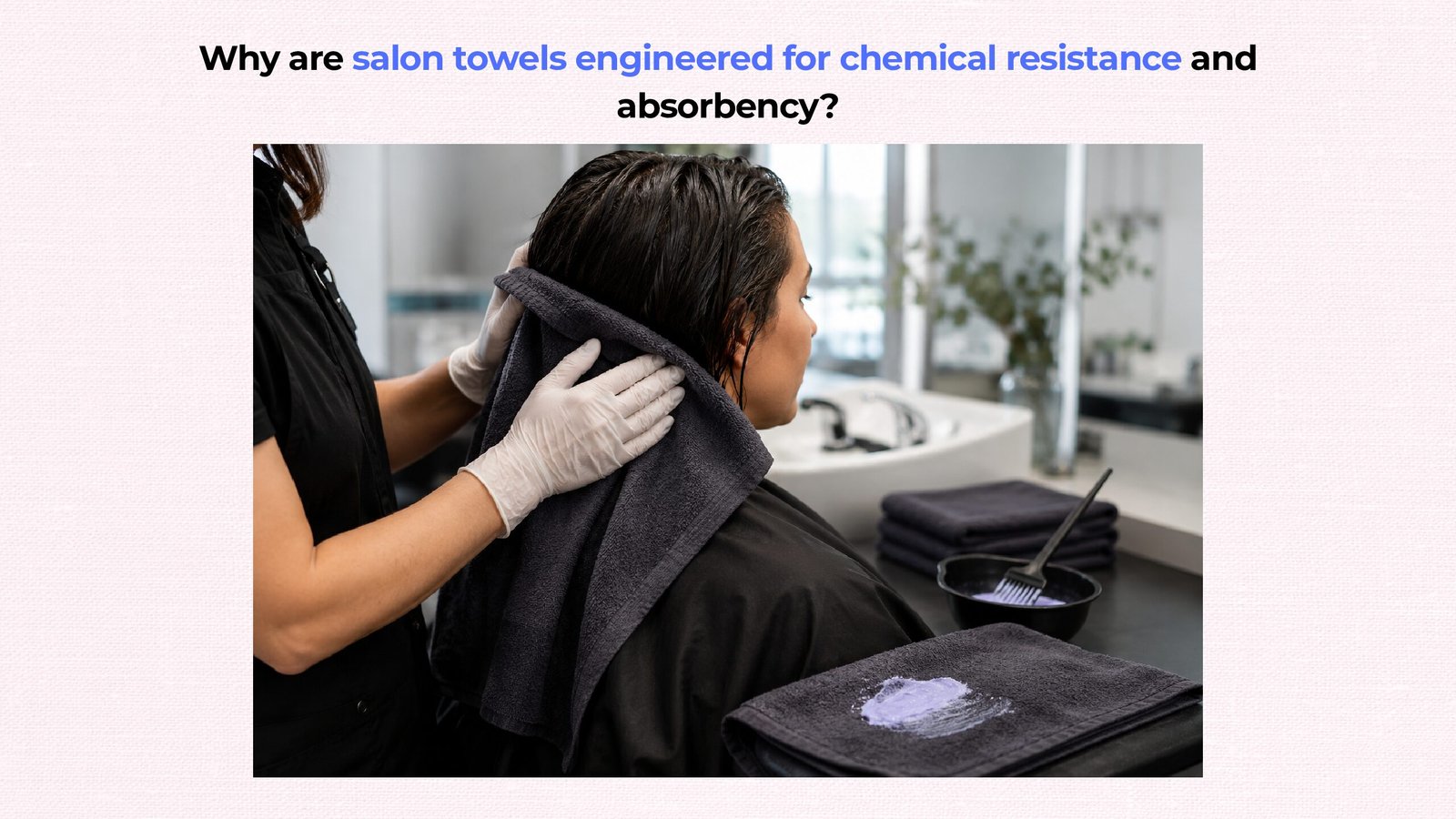
A salon towel may contact water, shampoo, conditioner, hair color, developer, lightener residue, styling products, skin, and repeated laundry chemistry. Each exposure differs in concentration, pH, temperature, contact time, and rinse history. “Chemical resistant” therefore needs a named chemical and a defined test condition.
The purchasing task is to choose a towel that performs during service and remains fit after the required laundering process. This article separates fiber claims from finished-product evidence, explains how to test absorbency and colorfastness, compares towel constructions, and provides a validation checklist for bulk orders.
What Defines an Engineered Salon Towel?
An engineered salon towel is a finished textile with measurable targets for water pickup, lint, color change, dimensional stability, structural damage, drying, and compatibility with the salon’s required wash process. A professional label alone does not establish those outcomes.
Chemical compatibility means that the towel retains defined properties after exposure to a specified chemical under stated conditions. It is narrower than “chemical proof.” A towel that tolerates one developer residue may still lose color or strength under chlorine bleach, strong alkali, or prolonged damp storage.
Absorbency also needs a test method. ASTM D4772-26 measures the ability of terry fabric to absorb and retain water from a surface. The method supports terry comparisons, but it does not measure colorfastness, chemical resistance, lint, or drying time.
Water pickup depends on more than fiber percentage, making the factors that control salon-towel absorbency important when comparing finished constructions.
Once the required outcomes are explicit, fiber and yarn choices can be evaluated without treating one construction as the universal salon standard.
How Do Fiber and Yarn Choices Affect Salon Towels?
Fiber and yarn choices affect salon towels by changing wetting, hand, lint, drying, strength, shrinkage, and chemical response. Cotton, cotton-rich blends, polyester-containing yarns, and microfiber constructions create different trade-offs; the fiber-content percentage does not reveal where each fiber sits in the towel.
Cotton cellulose contains hydroxyl groups that support water interaction when hydrophobic finishes and residues do not block the surface. Polyester contributes lower moisture regain and can alter drying or strength, but polyester is not chemically immune. Research on PET fabric shows that sufficiently strong alkali, temperature, and time can hydrolyze its ester bonds and reduce weight or strength.
Core-spun yarn places one material in the center and wraps another around it. A 2018 towel study compared seven core-spun yarns with five conventional yarns and found faster drying from polyester-core samples under its conditions. The core yarns were used in the weft—not established as every sample’s absorbent pile—so the study supports a possible design option, not a default salon-towel architecture.
A supplier should disclose total fiber content, yarn placement, pile composition, ground composition, dye method, finish, and care limits. Without that construction map, “cotton rich” or “polyester core” cannot predict service performance.
Since stronger constructions can sacrifice softness, drape, or absorption, how salon-towel construction influences durability should be evaluated alongside service performance.
Yarn architecture establishes material potential, while terry geometry determines how the finished surface contacts and transports water.
How Does Terry Construction Control Salon-Towel Absorbency?
Terry construction controls salon-towel absorbency through pile wetting, pile height, loop density, yarn twist, pore geometry, and the ground weave. GSM reports mass per area, but it does not identify how much mass belongs to the water-contacting pile.
Because the pile creates the main water-contacting surface, how loop density affects salon-towel absorbency helps explain why greater fabric compactness does not always improve water pickup.
Pile warp forms loops above the base, while ground warp and weft anchor the towel. More material can increase water-holding potential, yet a more compact structure can slow initial penetration or stiffen the hand. One variable cannot represent the entire system.
A 2025 woven-terry study tested four 75 × 75 cm constructions and found that greater weft density increased tensile strength while reducing absorbency, softness, smoothness, and drape. The study does not define a salon-towel GSM target, but it demonstrates the counterpart relationship between structural strength and comfort performance.
AATCC TM79-2025 applies to yarns, fabrics, and garments of any fiber content or construction. ASTM D4772-26 is more task-specific for terry surface-water pickup. Neither standard supports an automatic under-five-second target for every salon towel.
Water testing establishes service performance; a separate exposure protocol is needed before any chemical-resistance claim can be accepted.
How Should Salon-Towel Chemical Resistance Be Tested?
Salon-towel chemical resistance should be tested by defining the actual product, concentration, contact time, temperature, rinse, laundering sequence, and acceptable property loss. A broad “peroxide resistant” or “bleach safe” statement is incomplete without those conditions.
Since compatibility changes with the chemical, concentration, temperature, and contact time, what determines salon-towel chemical resistance must be assessed under the salon’s actual exposure conditions.

Salon products differ substantially, and worker safety begins with the label and Safety Data Sheet. OSHA instructs salons to use product labels and SDSs to identify hazardous chemicals and safe practices. Towels should not be used as substitutes for required spill-control materials or personal protective equipment.
Exposure severity changes the textile result. A 2012 cotton-bleaching study reported better bursting-strength retention at lower temperature than under its high-temperature peroxide process. Conversely, PET research shows alkaline hydrolysis at sufficiently strong concentration and temperature. These studies involve controlled textile-processing conditions—not ordinary salon residue—but they disprove claims of unconditional cotton weakness or polyester immunity.
| Exposure family | What to disclose | What to measure afterward |
|---|---|---|
| Developer or oxidative color residue | Exact product, peroxide strength, dilution, contact time, rinse | Color change, strength, absorption, odor, and staining |
| Lightener or alkaline color residue | Exact formulation or SDS, pH where known, contact, temperature | Mass loss, surface damage, hand, strength, and wetting |
| Laundry bleach | Active ingredient, concentration, cycle, textile-care limits | Colorfastness, tensile or tear retention, and absorption |
| Detergent and alkali | Dose, water hardness, temperature, time, rinse endpoint | Residue, hand, pH where required, and water pickup |
| Disinfectant contact | Whether the product label permits textile use and required contact time | Compatibility plus compliance with the disinfectant label |
Chemical compatibility protects function, while dye and colorfastness testing protects the salon’s visual presentation.
How Do Dye Systems Affect Salon-Towel Color Retention?
Dye systems affect salon-towel color retention through fiber type, colorant chemistry, dye location, fixation, after-treatment, and the exact service and laundry exposure. “Solution dyed” can describe how a synthetic component was colored, but it does not certify the whole towel against peroxide, persulfate, chlorine, or repeated washing.
Solution dyeing introduces color into a manufactured-fiber polymer or spinning solution before filament formation. A blended towel can still contain cotton components colored by another process, so the finished product may show different color responses across pile, ground, border, and sewing thread.
AATCC TM61 uses a 45-minute accelerated test to approximate the color change from five typical hand or home launderings under selected conditions. That method is useful for controlled comparison, but it does not automatically reproduce an industrial laundry or every salon chemical.
Chlorine claims need their own evidence. AATCC TM188 evaluates colorfastness through five home-laundering cycles with sodium hypochlorite and notes that results can help establish care instructions. A salon using a different bleach, concentration, washer, or regulation must test that actual route.
Color retention is therefore a finished-towel decision, not a reason to accept an unspecified “bleach-proof” label.
When Should Salons Choose Cotton, Blends, or Microfiber Towels?
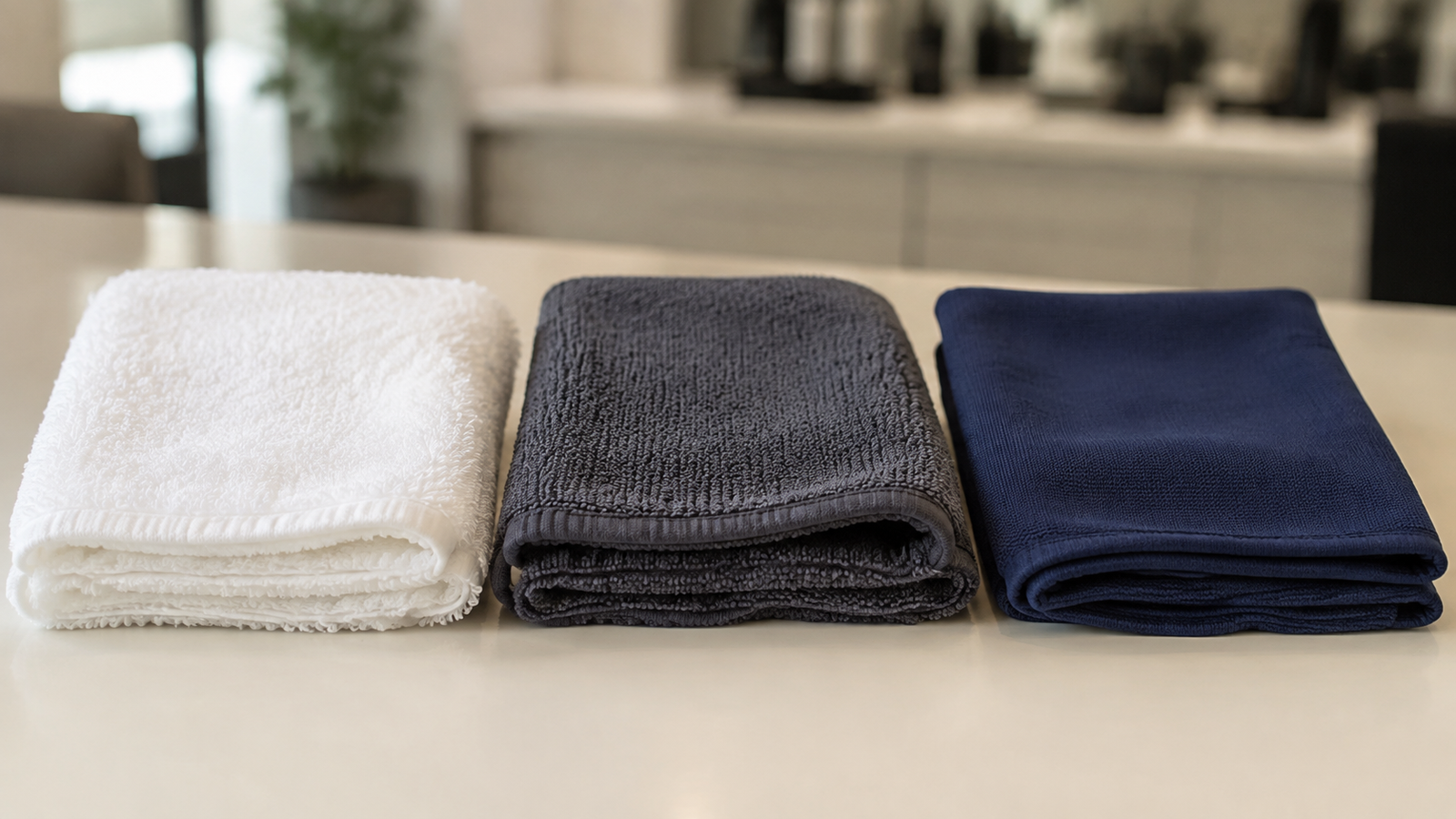
Salons should choose cotton, blends, or microfiber only after matching the towel to its task, chemical contact, desired hand, lint tolerance, drying route, and legal laundering process. No material wins every criterion.
A terry surface suits water pickup from hair and skin when the pile wets readily. A cotton-rich blend may change drying, strength, or shrinkage. A microfiber construction may offer a compact profile, but performance depends on filament split, blend, fabric structure, finish, and soil release rather than the microfiber label alone.
| Salon-towel option | Reason to consider it | Required verification |
|---|---|---|
| Cotton terry | Familiar hand and readily testable terry water pickup | Lint, shrinkage, color, drying, strength, and bleach compatibility |
| Cotton-rich blend | Potential balance of surface hand and structural or drying properties | Fiber placement, finished absorption, damage, and post-wash hand |
| Core-spun construction | Potential yarn reinforcement or drying change | Core location, pile composition, quick-dry result, and chemical exposure trial |
| Polyester/polyamide microfiber | Compact construction and different wiping behavior | Hair drag, wetting, soil release, lint, heat limits, and disinfectant compatibility |
Material selection resolves the service task, but laundering determines whether a compliant towel can be safely reused for the next client.
How Should Salon Towels Be Laundered Safely?
Salon towels should be laundered according to the salon’s jurisdiction, contamination category, textile-care limits, appliance instructions, and chemical labels. A universal 60–70°C wash, mandatory extra rinse, medium-heat dry, or six-to-eight-week stripping schedule cannot be applied safely everywhere.
Regulations demonstrate the variation. Ohio’s rule effective January 1, 2026 requires machine washing with detergent used according to its directions and drying before use. California permits commercial laundering or a noncommercial process with water at least 160°F for at least 25 minutes. Other jurisdictions specify different bleach, storage, or handling requirements.
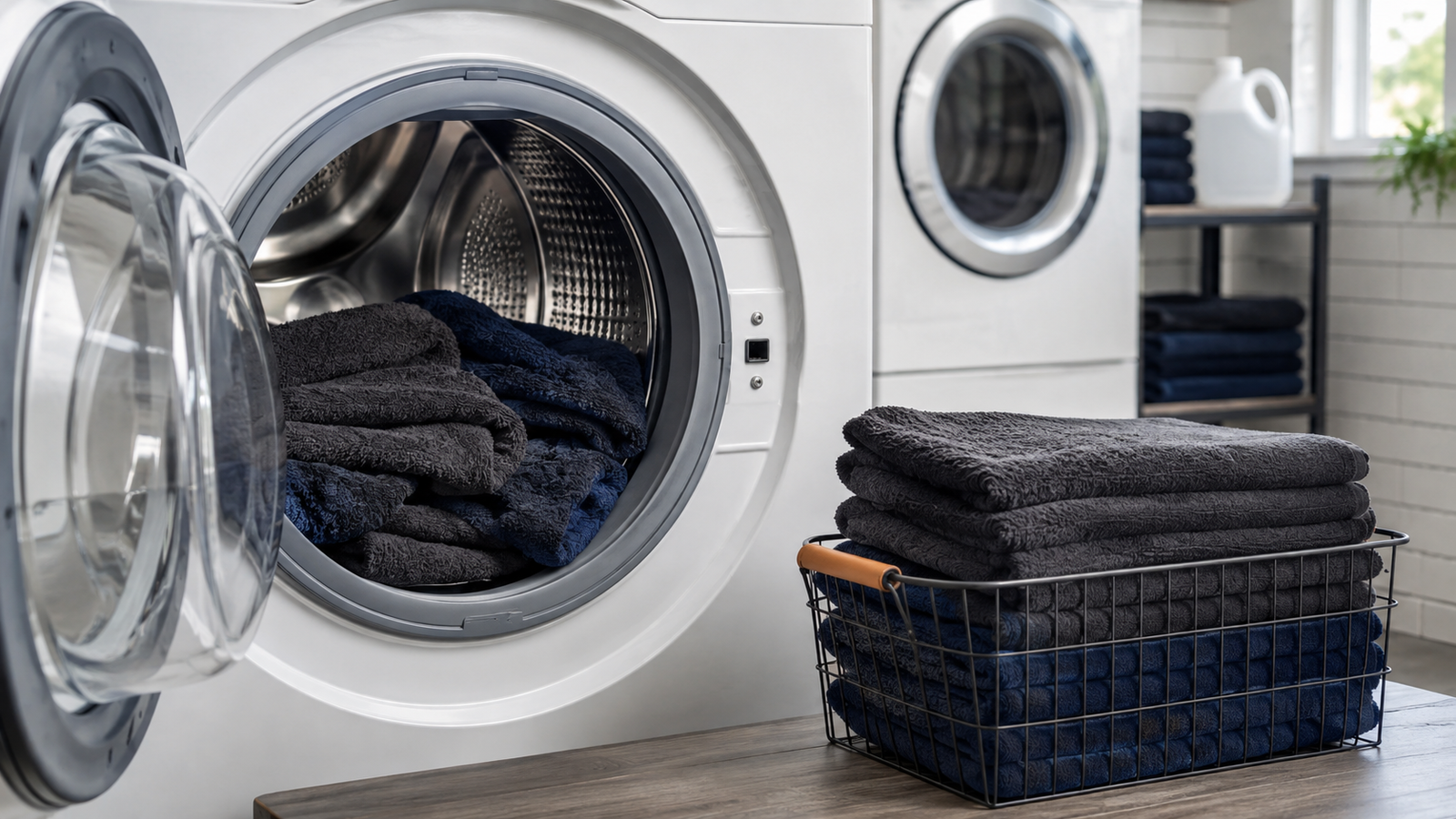
If the required hygiene process conflicts with a towel’s care limits, the solution is a compatible towel or qualified laundry process—not a weaker, improvised cycle. Items exposed to blood, body fluids, or a regulated hazard may require separate handling under local rules.
- ☐ Use each salon towel for only one client before laundering where local rules require single use.
- ☐ Place used salon towels in the required closed, covered, labeled, or ventilated receptacle.
- ☐ Identify the rule that applies to ordinary soil, chemical residue, and blood or body-fluid exposure.
- ☐ Follow detergent, bleach, disinfectant, washer, dryer, and textile instructions without combining incompatible chemicals.
- ☐ Dry salon towels completely when required and store clean items in the specified protected location.
- ☐ Inspect salon towels for odor, stains, color loss, pulled loops, distortion, and structural damage before reuse.
- ☐ Remove any salon towel that cannot meet both hygiene requirements and finished-product performance limits.
A controlled laundry route provides the real conditions for a pre-purchase wash trial.
How Can Salons Validate Towel Claims Before Buying in Bulk?
Salons can validate towel claims by testing representative samples through the intended service and laundry sequence, then comparing baseline and post-trial results against written thresholds. Supplier specifications should define the test conditions behind every numeric claim.
Start with the task: shampoo drying, color service, facial treatment, manicure, cleanup, or another controlled use. Record fiber content, dimensions, dry mass, GSM, pile and ground construction, color, finish, care label, and claimed chemical limits. A mixed-use towel should be approved against its most demanding permitted task.
Establish baseline absorption, color, dimensions, mass, hand, lint, and structural condition. Run a disclosed number of service exposures and required laundry cycles, then repeat the same measurements. A cycle count is meaningful only when the exposure and pass/fail thresholds travel with it.
Once absorbency is treated as a measurable property, how salon-towel absorbency should be tested becomes the next question before accepting supplier wet-out claims.
- ☐ Define the salon service, expected chemical contact, and applicable hygiene rule.
- ☐ Obtain the complete finished-towel construction and care specification.
- ☐ Measure initial water pickup with a method suited to the towel construction.
- ☐ Record initial color, dimensions, mass, hand, lint, and visible defects.
- ☐ Apply the disclosed chemical-contact and laundering protocol to representative samples.
- ☐ Repeat every baseline measurement under the same conditioning and test method.
- ☐ Approve the salon towel only when every required outcome meets its written limit.
This process converts “salon grade,” “bleach resistant,” and “quick dry” from marketing language into traceable purchasing evidence.
Which Salon-Towel Questions Need Short Answers?
Salon-towel questions need answers that distinguish universal mechanisms from product- and jurisdiction-specific settings. No universal fiber blend, GSM, wet-out time, wash temperature, bleach formula, stripping interval, or cycle life applies to every salon towel.
Why are salon towels different from ordinary bath towels?
Salon towels differ because they must balance five outcomes: surface-water removal, low lint, repeated laundering, color retention, and the salon’s required hygiene process. ASTM D4772-26 measures terry surface-water absorption, but not chemical resistance. A credible specification therefore combines multiple verified results instead of treating one fiber blend as proof.
Do salon towels contain synthetic fibers?
Salon towels may contain synthetic fibers, but no universal polyester percentage exists. A 2018 experiment compared seven core-spun with five conventional yarns and found quicker drying from polyester-core weft yarns under its conditions. Because the core yarn was used in the weft, the result does not establish a salon-towel pile.
Can salon towels be used at home?
Salon towels can be used at home when their size, hand, absorbency, and care instructions fit the task. AATCC lists nine separate moisture-management methods, confirming that absorbency, wicking, and drying are different properties. A professional label does not automatically make a towel softer, faster-drying, or more absorbent.
How should salon towels be washed?
Salon towels should be washed according to local rules and product instructions. Ohio’s 2026 rule requires machine washing with detergent as directed and drying before use; California specifies 160°F for at least 25 minutes in noncommercial laundering. That difference disproves a universal 60–70°C salon-towel recipe.
What Is the Bottom Line on Salon-Towel Chemical Resistance and Absorbency?
Salon-towel performance comes from a verified system. Fiber and yarn influence water interaction, drying, strength, and hand; terry construction controls the contact surface; dye and finish influence appearance; and the required laundry process determines whether the towel can be safely reused.
The strongest purchasing claim is not “40% polyester,” “under five seconds,” or “200 cycles.” It is a traceable result produced by a named method before and after the salon’s disclosed chemical and laundering protocol, with clear limits for absorption, color, dimensions, lint, hand, and damage.
After representative samples complete the intended service and laundry trial, what determines the usable lifespan of salon towels becomes more meaningful than an unsupported universal cycle count.
At TowelDaily, evidence-based salon-towel choices begin by defining the real task, testing the finished product, and keeping every performance claim tied to the conditions that produced it.