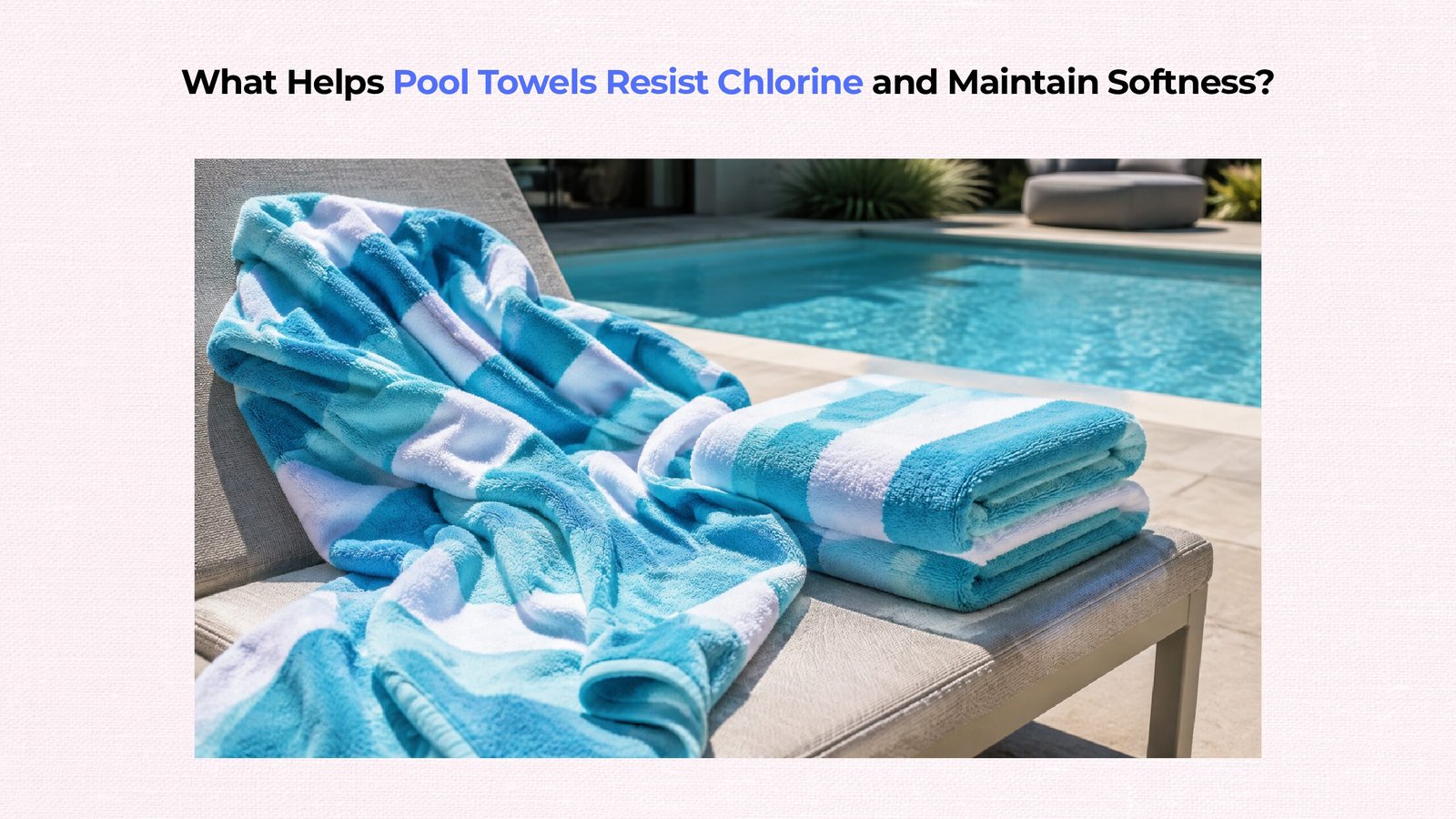
What Helps Pool Towels Resist Chlorine and Maintain Softness?
The towel-science guide to choosing, treating, and caring for swim towels that stay plush season after season.
Pool towels resist chlorine and retain softness longest when they combine a chlorine-tested fiber-and-dye system with moderate fabric mass, prompt fresh-water rinsing, accurate detergent dosing, complete rinsing, and care-label drying. Because no textile is automatically chlorine-proof, what determines a pool towel’s resistance to repeated chlorine exposure is the combination of fiber composition, dye system, finishes, exposure conditions, and finished-product testing.
The most useful buying evidence combines two different questions: does the color tolerate chlorinated water, and does the towel still absorb quickly? ISO 105-E03 and AATCC TM162 address chlorinated-water colorfastness, while AATCC TM79 addresses textile absorbency. A “chlorine-resistant” label without a named method does not answer both questions.
This guide separates verified mechanisms from marketing claims, compares cotton, cotton-polyester, and microfiber by use condition, and provides a wash-and-dry checklist for preserving softness without sacrificing absorbency.
How Does Chlorine Exposure Reduce Pool Towel Softness and Color?
What Happens to Cotton Cellulose and Pool Towel Dyes?
Active chlorine can change pool towel color and, with sufficient repeated exposure, oxidize cellulosic fibers. Cotton is principally cellulose, whose adjacent chains are held partly by hydrogen bonding between hydroxyl groups, as described in Cotton Incorporated’s Cotton Morphology and Chemistry guide. Chain scission means the cleavage of a long polymer chain into shorter segments; hypochlorite oxidation can alter the molecular-mass distribution of cotton cellulose, as Nabiev and Nikonovich reported in 1999.
Chlorinated-water testing measures a controlled exposure rather than promising unlimited durability. ISO 105-E03 specifies 20 mg/L active chlorine for accessories such as towels and beach robes, then assesses color change. AATCC TM162 likewise evaluates the resistance of colored textile yarns and fabrics to chlorinated pool water.
Pool towel performance can decline through three separate pathways:
- Color change: an unsuitable dye-and-fiber combination fades or shifts after chlorinated-water exposure, even when the towel remains structurally usable.
- Fiber damage: sufficiently strong or repeated oxidation shortens cellulose chains and weakens exposed cotton fibers; the rate depends on concentration, exposure time, temperature, pH, dyeing, and finishing.
- Removable stiffness: sunscreen, body oil, detergent, hardness minerals, and incomplete rinsing dry between terry loops and make the pile feel harsher without proving that the fibers have fractured.
The practical distinction is reversible residue versus irreversible fiber damage. Understanding how different pool towel materials degrade over time helps separate surface buildup from permanent changes to fibers, yarns, and fabric structure. Residue often improves after correct washing and additional rinsing; broken or severely oxidized fibers do not rebuild in a home washer.
20 mg/L
ISO 105-E03 active-chlorine condition intended for towels and similar accessories
≥1 ppm
CDC minimum free chlorine for pools without cyanuric acid; actual facilities and rules vary
2 tests
chlorinated-water colorfastness plus absorbency are needed for a useful performance claim
Once the damage pathways are separated, the next task is choosing a fiber system that matches pool frequency, drying time, and desired plushness.
Which Pool Towel Materials Best Balance Chlorine Resistance and Softness?
How Should Cotton, Cotton-Polyester, and Microfiber Pool Towels Be Compared?
Frequent swimmers usually gain faster drying and lower retained-water mass from polyester-rich microfiber, while users who prioritize plushness and water-holding capacity usually prefer cotton terry or a cotton-polyester terry blend. Fiber content narrows the choice, but it does not prove colorfastness, softness retention, or service life. Chlorine durability must also be weighed against the factors that determine pool towel softness, including pile construction, finishing, laundering history, residue, and mechanical wear.
Read the fiber percentages instead of relying on names such as “microfiber” or “premium cotton.” The U.S. Federal Trade Commission’s textile labeling guidance requires generic fiber names and percentages by weight for covered textile products. Then ask whether the finished colorway was evaluated with ISO 105-E03 or AATCC TM162; the ISO towel condition uses 20 mg/L active chlorine.
| Pool towel construction | Useful strength | Main trade-off | Best-fit condition | Evidence to request |
|---|---|---|---|---|
| 100% Cotton (Terry) | Plush hand and high water-holding capacity | Cellulose remains exposed to oxidation; dense pile retains more chlorinated water | Comfort-first use with prompt rinsing and full drying | ISO 105-E03 or AATCC TM162 colorfastness; AATCC TM79 absorbency |
| Cotton-Polyester Terry | Balances cotton pile feel with a dimensionally stable synthetic component | Results vary with blend ratio, pile fiber, ground yarn, dye, and finish | Repeated family or facility use when terry feel still matters | Exact blend percentages plus finished-product chlorine and absorbency tests |
| Polyester-Rich Microfiber | Low bulk, short drying time, and easy packing | Less plush than terry; polyamide content and finishes alter performance | Frequent swimming, travel, and rapid turnaround | Fiber percentages, AATCC TM199/TM200 drying data, and chlorine colorfastness |
| Finished or “Chlorine-Resistant” Towel | Potentially improved color or surface performance | A hydrophobic or softening finish can slow wetting and reduce towel absorbency | Only when the supplier identifies the method and tested property | Test report for the finished towel, not a claim about the raw fiber alone |
Decision rule: choose polyester-rich microfiber for speed and low retained water; choose cotton-polyester terry for a middle ground; choose cotton terry for maximum plushness when you are willing to rinse and dry it promptly. In every case, treat a named test method as stronger evidence than an unqualified “pool-safe” label. After selecting the fiber system, compare how fabric mass and pile construction control the water reservoir.
How Does Pool Towel Construction Affect Chlorine Retention and Softness?
Which GSM, Pile, and Weave Features Matter for Pool Towels?
Pool towel construction changes how much chlorinated water the fabric carries, how quickly that water leaves, and how the pile feels after laundering. Construction does not change cotton into a chlorine-proof fiber, but it changes the duration and amount of wet exposure between swims.
GSM means grams per square metre. ISO 3801 defines methods for determining fabric mass per unit area. A towel listed at 500 GSM contains about 500 grams of fabric per square metre; an 80 × 160 cm towel covers 1.28 m² and therefore has an estimated fabric mass of about 640 g, before normal manufacturing variation. GSM measures mass, not chlorine resistance or quality.
Loop height and pile density determine the water reservoir. Tall, crowded loops create more capillary space and a plush hand, but they also carry more water and usually need more drying time. A shorter or less dense pile sacrifices some plushness for faster turnaround.
A flat weave or terry-and-flat hybrid reduces bulk. This construction suits travel and frequent pool sessions because less fabric mass must dry. Because retained pool water creates an evaporation load, the factors that control pool towel drying time are especially relevant when comparing plush cotton terry with microfiber or another lower-bulk construction. AATCC lists separate methods for absorbency (TM79) and drying time or rate (TM199 and TM200), confirming that water uptake and water release are different performance attributes.
If plushness is the priority → choose denser cotton-rich terry → plan for prompt rinsing, open hanging, and longer drying time.
Construction determines the exposure pattern, while finishing determines how readily water reaches the fiber surface. That finish must be evaluated for both protection and absorbency.
Do Protective Finishes Make Pool Towels Chlorine-Resistant?
Why Must Pool Towel Finishes Be Tested for Both Protection and Absorbency?
A finish improves a pool towel only when it preserves the required color or hand without reducing water uptake below an acceptable level. “Silicone,” “cationic,” “resin,” and “chlorine-resistant” describe chemistries or claims; they do not provide a measured service-life multiplier.
- Color-protection finish: request the finished colorway’s ISO 105-E03 or AATCC TM162 result, because fiber identity alone does not predict dye performance.
- Softening finish: verify what determines pool towel absorbency before accepting a softness claim. Igarashi and Nakamura’s 2021 Journal of Oleo Science study describes the trade-off between cotton-towel softness and water absorption when hydrophobic softener molecules cover the surface.
- Water-repellent finish: recognize the functional conflict. A finish that delays wetting may reduce direct chemical contact, but a towel must wet and absorb to dry skin.
- Durability claim: ask how many exposure and laundering cycles were tested and which failure measure was used—color change, tensile strength, softness, absorbency, or drying rate.
Finish performance changes with use. A 2024 study by Potočić Matković and colleagues exposed polyamide/polyester swimwear fabrics to chlorinated outdoor pool water for 200 and 300 hours and found time-dependent changes in strength and moisture management. The materials were swimwear, not towels, so the data do not establish a towel lifespan; they demonstrate why a one-time finish claim cannot replace finished-product testing.
The safe buying rule is simple: require one chlorine-exposure result and one water-performance result. Without both, a protective finish may solve the wrong problem. Once product evidence is established, the care routine becomes the main controllable exposure variable.
How Should Pool Towels Be Rinsed, Washed, and Dried?
Which Pool Towel Care Sequence Removes Residue Without Damaging Absorbency?
Rinse pool towels promptly in fresh water, wash them according to the sewn care label with the correct detergent dose, rinse completely, and dry them fully before storage. Prompt rinsing reduces contact time; it does not justify an unsupported claim that a fixed percentage of chlorine has been removed.
ISO 3758:2023 organizes textile care around washing, bleaching, drying, and ironing symbols. Those instructions take priority over a universal temperature rule because pool towels differ in fiber blend, dye, finish, border, and decoration. Use cold or warm water only when the label permits it; choose enough heat and detergent to clean the soil load without exceeding the product’s instructions.
- ☐ Fresh-water rinse: Rinse the pool towel as soon as practical after the final use of the day, then press or spin out water without aggressive twisting.
- ☐ Care-label wash: Wash at the labeled temperature with a detergent suitable for the fiber and machine; measure the dose for load size, soil level, and local water hardness.
- ☐ Complete rinse: Add one water-only rinse when visible suds, a slick feel, fragrance buildup, or known detergent overdosing suggests residue remains.
- ☐ No automatic bleach: Review when bleach can be used safely on pool towels against the sewn care label, fiber content, dyes, finishes, and the bleach product’s instructions. AATCC LP5 exists specifically because bleach compatibility must be tested rather than assumed.
- ☐ Absorbency-first softening: Skip routine conventional fabric softener when rapid water uptake matters. The 2021 Igarashi–Nakamura towel study found that increasing softener concentration reduced wiping efficacy.
- ☐ Full drying: Open the towel completely and line-dry or tumble-dry at a permitted setting. Remove it when dry rather than baking the pile through an unnecessarily long, high-heat cycle.
- ☐ Dry storage: Store the pool towel only after the pile, hems, and decorative borders are fully dry.
If this sequence restores the hand, residue caused most of the stiffness. When removable buildup is responsible, restoring pool towel softness through correct washing and rinsing may improve the fabric hand without aggressive treatments. If roughness remains after correct washing and rinsing, inspect the loops for irreversible wear or chemical damage.
How Can You Diagnose a Pool Towel That Has Become Stiff or Less Absorbent?
Which Symptom Identifies Residue, Drying Effects, or Permanent Pool Towel Damage?
Diagnose pool towel stiffness by testing water uptake, checking whether the hand changes with drying method, and inspecting the pile for color loss or broken loops. Determining why pool towels become stiff after repeated use requires separating detergent buildup, hardness minerals, drying conditions, softener deposits, and structural damage rather than assuming every rough towel is “chlorine damaged.”
Igarashi and Nakamura’s 2021 cotton-towel experiment illustrates the softness–absorbency trade-off: a 0.075% on-weight-of-fabric softener condition received the lowest wiping-efficacy score on the study’s five-level scale. That laboratory concentration is not a household dose; the useful insight is that a softer hand can coexist with poorer wiping performance.
| Observed symptom | Most likely explanation | Controlled check | Corrective action |
|---|---|---|---|
| Water beads or absorbs slowly | Softener, oily sunscreen, or a hydrophobic finish obstructs rapid wetting | Compare uptake before and after one correctly dosed wash with an extra water-only rinse | Stop routine softener; wash by the care label; repeat only if residue remains |
| Towel absorbs well but feels stiff after line drying | Fiber-to-fiber bonding and compressed pile affect dry hand | Compare a small permitted low-tumble finish with the line-dried hand | Shake the towel before hanging or use a short permitted tumble to separate loops |
| Chalky, slick, or heavily fragranced pile | Detergent, hardness mineral, or product residue remains in the structure | Run one water-only rinse and check whether the hand changes | Correct detergent dose and avoid overloading so rinse water reaches the pile |
| Faded color but normal water uptake | The dye system lacks adequate chlorinated-water colorfastness | Compare protected hems with exposed pile and review any ISO 105-E03/AATCC TM162 claim | Prevent further exposure; laundering cannot restore oxidized dye |
| Thinning pile, persistent roughness, lint, or broken loops | Mechanical wear, chemical damage, or both have altered the fiber structure | Inspect high-friction zones and compare them with low-use borders | Retire or repurpose the towel when comfort or function is no longer acceptable |
| Musty odor returns after washing | The towel remains damp too long or the load does not rinse and dry completely | Dry the towel fully in an open position and monitor the next use cycle | Improve airflow, avoid sealed wet storage, and clean the washer if residue persists |
Rule → reason → result: change one care variable at a time → the symptom reveals its likely cause → you avoid using harsher chemicals on damage that chemistry cannot reverse. These diagnoses resolve the recurring selection and care questions summarized next.
Which Pool Towel Chlorine and Softness Questions Need Direct Answers?
How Should Common Pool Towel Decisions Be Resolved?
Resolve pool towel decisions by matching use frequency to material and drying time, then verify chlorinated-water colorfastness separately from absorbency. The following answers summarize the article’s selection, care, and troubleshooting rules without creating unsupported “chlorine-proof” guarantees.
What type of towel is best for pool use?
For frequent pool use, compare polyester-rich microfiber with cotton-polyester terry. Microfiber usually dries faster, while cotton-rich terry usually feels plusher and holds more water. Choose a towel whose supplier reports chlorinated-water colorfastness and absorbency testing for the finished product.
Can I restore softness to a chlorine-stiffened towel?
Sometimes. If residue causes the stiffness, wash according to the care label with a correctly measured detergent and add an extra water-only rinse. If the pile remains rough after residue is removed, chemical or mechanical fiber damage is probably permanent.
Should I use fabric softener on pool towels?
Avoid routine fabric softener when absorbency is the priority. Conventional softeners can make cotton feel smoother while slowing water uptake. Never mix vinegar or another acid with chlorine bleach or a hypochlorite product, because the reaction can release chlorine gas.
Do microfiber towels really resist chlorine better?
A polyester-rich microfiber towel is a practical frequent-pool option because it carries less water and dries faster than plush cotton terry. However, microfiber is not automatically chlorine-proof; fiber blend, dye, finish, construction, and exposure all affect performance.
These direct answers depend on the scope of each cited method. The evidence notes below show which claims are towel-specific and which require cautious inference from fiber chemistry or swimwear aging.
Which Standards and Studies Support This Pool Towel Guidance?
How Should Pool Towel Evidence and Its Limitations Be Interpreted?
The strongest pool towel claims identify the tested property, method, exposure condition, and material. ISO 105-E03 uses 20 mg/L active chlorine for towels and related accessories, but it assesses color change—not softness, absorbency, drying time, or guaranteed years of service.
- ISO 105-E03:2010, confirmed in 2026: chlorinated-water colorfastness, including the 20 mg/L condition intended for towels and beach robes.
- AATCC test-method directory: TM162 for chlorinated-pool colorfastness, TM79 for absorbency, and TM199/TM200 for drying performance.
- Cotton Incorporated, Cotton Morphology and Chemistry: cellulose structure and hydrogen bonding between cotton chains.
- Nabiev and Nikonovich, 1999: sodium-hypochlorite oxidation changes the molecular-mass distribution of cotton cellulose.
- Igarashi and Nakamura, 2021: cotton-towel softening and water-absorbency trade-offs under controlled treatment conditions.
- Potočić Matković and colleagues, 2024: time-dependent strength and moisture-management changes in chlorinated-water-aged swimwear materials; these results illustrate polymer aging but do not directly predict towel lifespan.
- ISO 3758:2023: consumer textile care symbols for washing, bleaching, drying, and ironing.
- Poison Control: acid mixed with hypochlorite can form chlorine gas; vinegar must never be combined with chlorine bleach or pool chemicals.
- CDC Healthy Swimming, 2024: pools without cyanuric acid should maintain at least 1 ppm free chlorine and pH 7.0–7.8 for public-health performance, not as a towel-preservation target.
Evidence from swimwear, raw fibers, or laboratory chemistry must be labeled as indirect when applied to towels. Finished-product test data remain the most relevant evidence for a specific pool towel. The final checklist converts that evidence hierarchy into a repeatable buying and care decision.
What Is the Best Overall Strategy for Keeping Pool Towels Soft?
Which Final Pool Towel Selection and Care Checks Matter Most?
The best strategy combines verified product selection with reduced wet-contact time and residue-controlled laundering. Choose fiber content and construction for the actual use frequency, require named chlorine and water-performance tests where possible, rinse promptly, follow the care label, measure detergent, rinse completely, and dry fully.
- ☐ The fiber percentages match the required balance of plushness, drying time, and packing weight.
- ☐ Any chlorine-resistance claim names ISO 105-E03, AATCC TM162, or an equivalent controlled method.
- ☐ Absorbency or drying performance is verified separately from colorfastness.
- ☐ The towel is rinsed in fresh water promptly after pool use.
- ☐ Washing temperature, bleach use, and drying follow the sewn care label.
- ☐ Detergent is measured, conventional softener is avoided when absorbency matters, and residue receives an extra water-only rinse.
- ☐ The towel is fully dry before it enters a hamper, bag, cabinet, or rotation stack.
TowelDaily’s evidence-based approach favors named test methods and condition-specific decisions over “chlorine-proof” marketing. With that standard, you can choose a pool towel whose softness, absorbency, and drying behavior fit the way you actually swim.