Towel Science
A TowelDaily technical deep dive
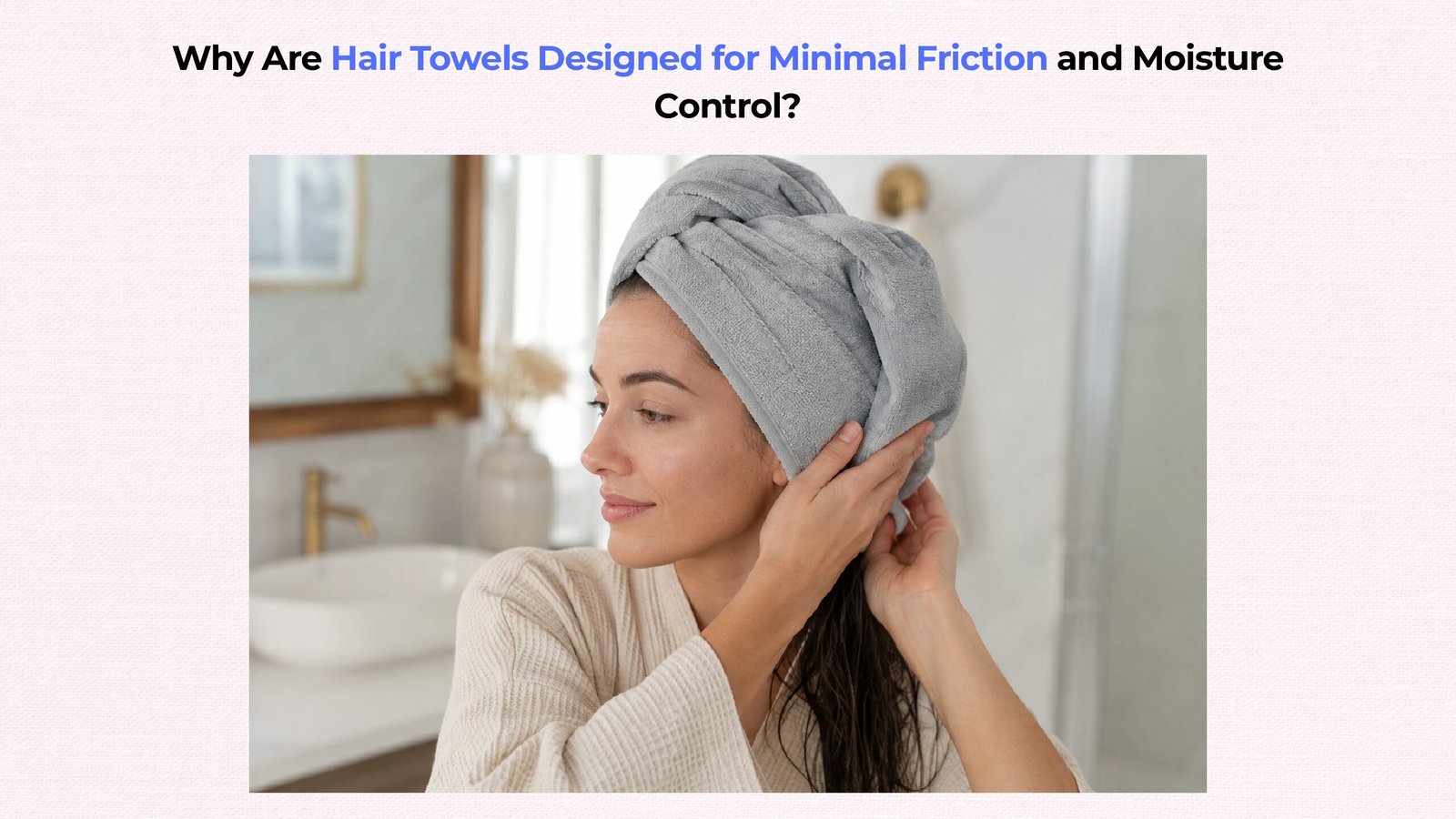
Hair towels are designed to remove surface water while limiting rubbing, tangling, and wrap tension. Their useful advantage comes from the complete system—surface texture, fabric construction, size, closure, water uptake, and technique—not from the words “microfiber,” “cotton,” or “hair towel” alone.
The practical goal is controlled drying: blot or wrap long enough to stop dripping, then remove the towel without aggressive rubbing or tight twisting. This guide explains why that approach matters, how moisture moves through different hair-towel constructions, what to compare, how to test performance, and how to fix declining absorbency.
during blotting, wrapping, and removal
through wetting, spreading, and storage
from a secure, comfortable wrap
1. Why Does Hair-Towel Technique Matter for Wet Hair?
Hair-towel technique matters because water changes a hair fiber’s dimensions and mechanical behavior, while rubbing adds sliding contact between neighboring strands and the fabric. A hair towel should therefore remove free water with as little repeated movement and tension as the task allows.
Hair consists of an outer cuticle surrounding the cortex. Its wet response varies with condition, treatment history, curl pattern, and the direction and size of the applied force. Laboratory work by Mizuno and colleagues found friction behavior differed between native and damaged hair, which means cuticle condition affects the interaction rather than every strand responding identically. See the 2013 hair-friction study.
The clearest consumer instruction is technique-based. The American Academy of Dermatology recommends wrapping hair in a towel or T-shirt to absorb water and warns that rough rubbing can cause damage. Once free water has been removed from the hair, how to use a hair towel properly becomes important for limiting rubbing, repeated movement, and uncomfortable wrap tension. Its guidance also notes that wet brushing affects tightly curled or textured hair differently from most other hair types, so a single “wet hair is weak” rule is too broad. Review the AAD’s healthy-hair advice and adapt the hair-towel wrap to the person’s hair and scalp comfort. That technique requirement leads to the next question: which towel properties control drag?
2. How Do Hair Towels Control Friction Without Material Guarantees?
Hair towels control friction by reducing the amount of sliding, snagging, compression, and tension applied during drying. A smooth-feeling microfiber may support that goal, but a rough seam, saturated fabric, tight closure, or vigorous rubbing can erase the expected advantage.
Friction is resistance to motion between contacting surfaces. At the hair-fabric interface, it is influenced by both sides of that contact: hair condition and wetness on one side, then towel texture, finishes, residues, pressure, and motion on the other. That is why a dry hand-feel test cannot establish how a hair towel will behave on wet hair.
Use these finished-product checks instead of assuming a fiber name determines drag:
- Wet-surface feel: dampen the towel and check whether it becomes grabby, stiff, or uneven.
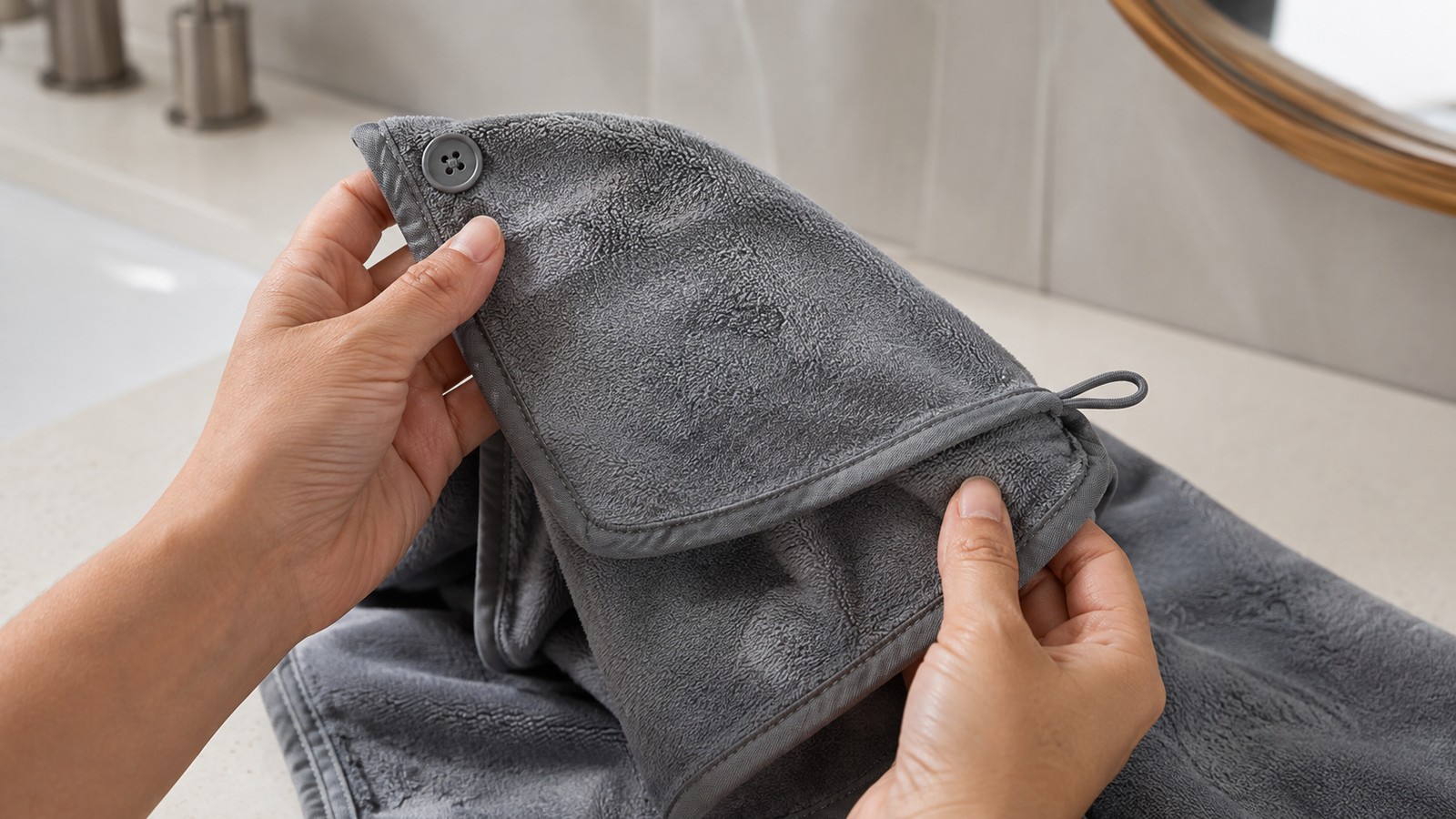
- Surface relief: inspect loops, pile, mesh, embroidery, and hook-and-loop parts that could contact hair.
- Edge quality: prefer flat, covered seams and a tag position that stays away from the hairline.
- Wrap load: confirm that the wet towel does not become so heavy that it pulls at the roots or neck.
- Technique fit: choose a size and closure that stay secure without repeated retwisting.
For curls, coils, fragile ends, extensions, or a sensitive scalp, start with short blotting intervals and low hair-towel tension. If curl grouping matters, support the hair rather than sweeping the fabric across it. Stop or adjust when the wrap pulls, feels rough, or disturbs the result you are trying to preserve. Once drag is controlled, moisture transfer becomes the next design task.
3. How Does a Hair Towel Perform Each Moisture-Control Job?
A hair towel must first wet, then draw or spread water through its structure, store enough liquid for the task, and finally release that moisture during drying. These are related but distinct behaviors, so one “absorbent” claim cannot describe the complete moisture-control process.
Wetting describes how readily water spreads into the surface. Absorbency describes how much liquid a specimen takes up under stated conditions. Wicking describes movement through capillary spaces, while drying rate describes later evaporation. Fiber chemistry, yarn shape, density, thickness, finishes, laundering residue, and the amount of airflow can affect different stages in different ways.
Split microfiber is one possible hair-towel construction. Its fine segments and spaces can create many capillary pathways, but cotton jersey, cotton waffle, blends, and other knit or woven constructions can also manage water. The American Association of Textile Chemists and Colorists explicitly applies its AATCC TM79-2025 absorbency method to yarns, fabrics, and garments of any fiber content or construction. Finished performance therefore has to be checked rather than inferred from the label. Fast initial wetting does not guarantee enough storage for a complete wrap, making how hair-towel water capacity affects drying performance important when comparing finished constructions.
4. How Should You Compare Hair Towels With Ordinary Towels?
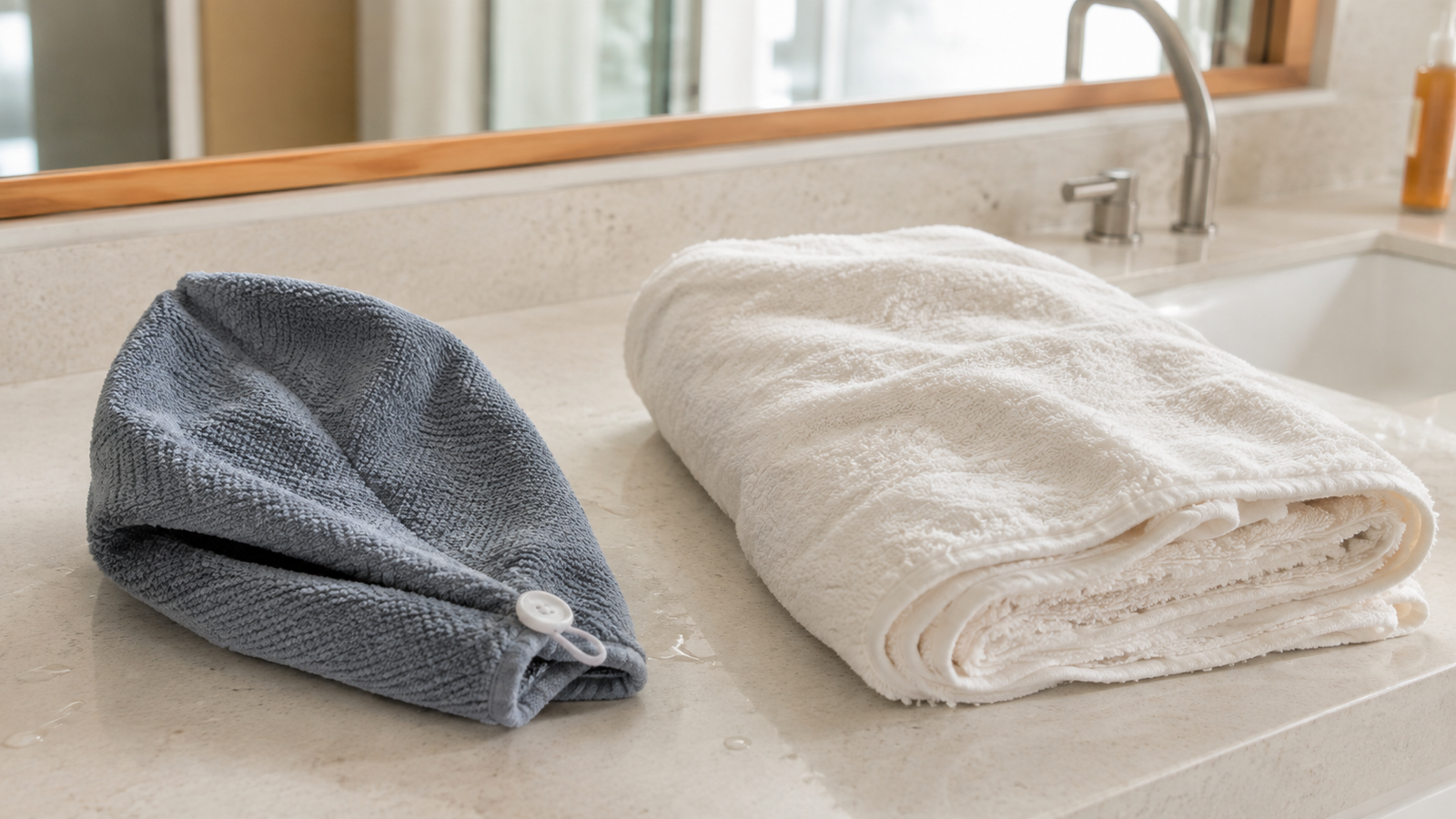
Compare a hair towel with an ordinary towel by how each finished product performs while damp, not by assigning automatic properties to cotton or microfiber. A purpose-shaped hair towel may be easier to secure with less bulk, but either towel can perform well or poorly depending on construction, condition, fit, and technique.
| Decision factor | Useful hair-towel target | What an ordinary towel may offer | How to verify |
|---|---|---|---|
| Wet contact depends on the finished surface. | A useful hair towel provides soft, even contact without snagging edges. | An ordinary towel’s wet contact varies with pile, weave, finishing, and wear. | Dampen each towel and inspect its face, seams, tags, and closure. |
| Water uptake combines wetting and capacity. | A useful hair towel wets readily and holds the expected shower load. | An ordinary towel may hold more or less water depending on its size and construction. | Weigh each towel before and after the same timed blotting task. |
| Wrap fit controls security and tension. | A useful hair towel provides enough area and a closure that stays secure at low tension. | An ordinary rectangular towel may work but can add bulk or require retucking. | Wear each towel briefly and check the hairline, roots, ears, and neck. |
| Wet mass affects comfort. | A useful hair towel remains comfortable after taking up water. | A larger ordinary towel may carry unnecessary wet mass. | Compare each towel’s total wet weight instead of dry GSM alone. |
| Between-use drying depends on conditions. | A useful hair towel becomes fully dry within the available interval. | An ordinary towel’s drying time varies with water load, thickness, airflow, and humidity. | Time equal wet loads while both towels hang in the same location. |
| Laundry fit determines repeatability. | A useful hair towel maintains its shape, wetting, seams, and closure after washing. | An ordinary towel may require a different cycle or drying temperature. | Follow both care labels and repeat the same performance checks. |
This comparison separates design intent from proof. “Hair towel” describes a use case; it does not certify a friction coefficient, absorption capacity, wicking rate, or drying time. GSM means grams per square metre, a fabric-mass measure that cannot establish softness or water performance by itself. When portability and limited drying space become part of the task, how hair towels perform during travel should be considered alongside wet weight, packability, fit, and between-use drying. Choose the product that completes the person’s actual drying task with the least rubbing and uncomfortable load, then verify the choice with controlled checks.
5. How Should You Choose Hair Towels by Finished Performance?
Choose a hair towel by testing the finished item in the sequence it must perform: accept water, move and hold water, remain comfortable when wet, dry between uses, and retain those properties after laundering. Standard methods provide controlled comparisons, while a small home trial confirms whether the dimensions and wrap suit the user. Travelers considering a compact synthetic construction should also examine whether microfiber hair towels are suitable for travel use rather than assuming the microfiber label guarantees low bulk or fast drying.
How Should You Test Hair-Towel Wetting and Absorbency?
Hair-towel wetting and absorbency should be tested before fiber labels are compared. AATCC TM79-2025 covers three specimen levels—yarns, fabrics, and garments—and allows any fiber content or construction, showing that absorbency is a measured outcome rather than a microfiber guarantee. See AATCC TM79-2025.
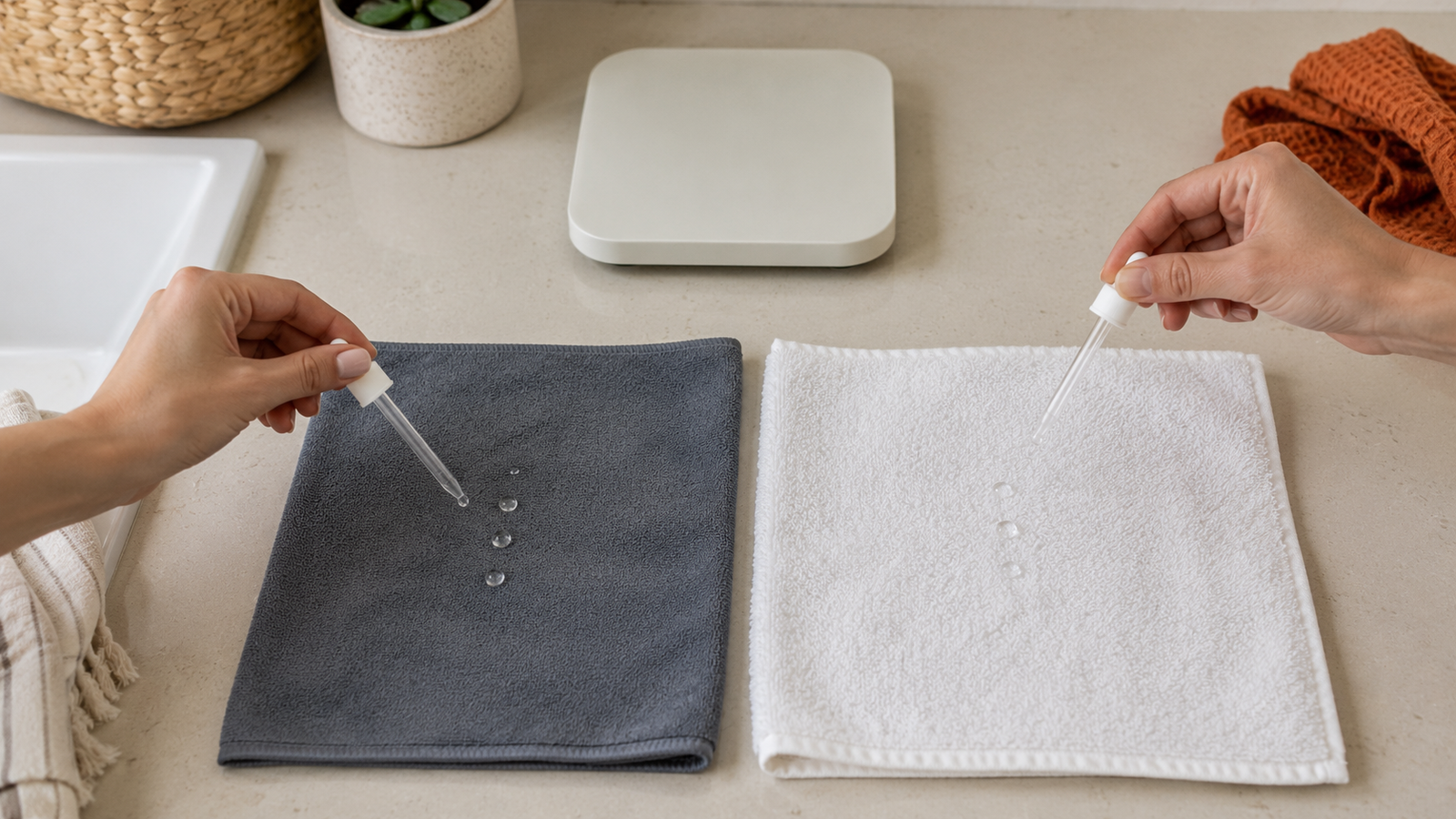
For a controlled home screen, condition two clean towels in the same room, apply the same water volume to equal areas, and record wetting time and mass gained. This is not a standards result, but it is more informative than squeezing two different-size towels by hand.
How Should You Compare Hair-Towel Wicking Over Time?
Hair-towel wicking should be compared at early and sustained intervals rather than reduced to one vague speed claim. AATCC TM213-2022 measures wicking at 120 seconds and 600 seconds, so a fabric that spreads water quickly at first can be distinguished from one that continues moving it later. See AATCC TM213-2022.
The unique buying insight is that fast initial wetting and useful total capacity are not interchangeable. A hair towel may spread a small dose rapidly yet saturate during a full wrap, or hold a large dose but wet slowly enough to tempt extra rubbing.
How Should You Evaluate Hair-Towel Drying and Laundry Stability?
Hair-towel drying time and post-wash stability should be evaluated as separate properties. AATCC TM135-2025 includes four washing temperatures, three agitation cycles, and four drying procedures; that range shows why a single wash result cannot support every care condition. See AATCC TM135-2025.
For drying-rate comparisons, control the starting water load, exposed area, temperature, humidity, and airflow. After the towel has absorbed its expected water load, what determines how quickly a hair towel dries becomes the next practical question for preventing prolonged dampness between uses. The practical insight is to retest fit, wetting, water uptake, odor, seams, and closure after repeated care because dimensional stability alone does not prove that moisture performance stayed unchanged.
- ☐ The hair towel contacts damp hair without rough edges, exposed fasteners, or snagging seams.
- ☐ The hair towel covers the user’s hair length and density without a tight fold or excessive twist.
- ☐ The hair-towel closure stays secure at a comfortable tension.
- ☐ The hair towel wets readily and holds the expected water load without becoming uncomfortably heavy.
- ☐ The hair towel dries completely within the available interval between uses.
- ☐ The hair-towel care label matches the household’s normal washing and drying options.
6. How Should You Use Hair Towels With Low Tension?
Hair towels should create steady contact without scrubbing or a tight, heavy twist. Blotting means pressing and releasing the fabric without sliding it repeatedly. The output should be hair that is no longer dripping and a wrap that feels secure but does not pull at the hairline, scalp, neck, or extensions.
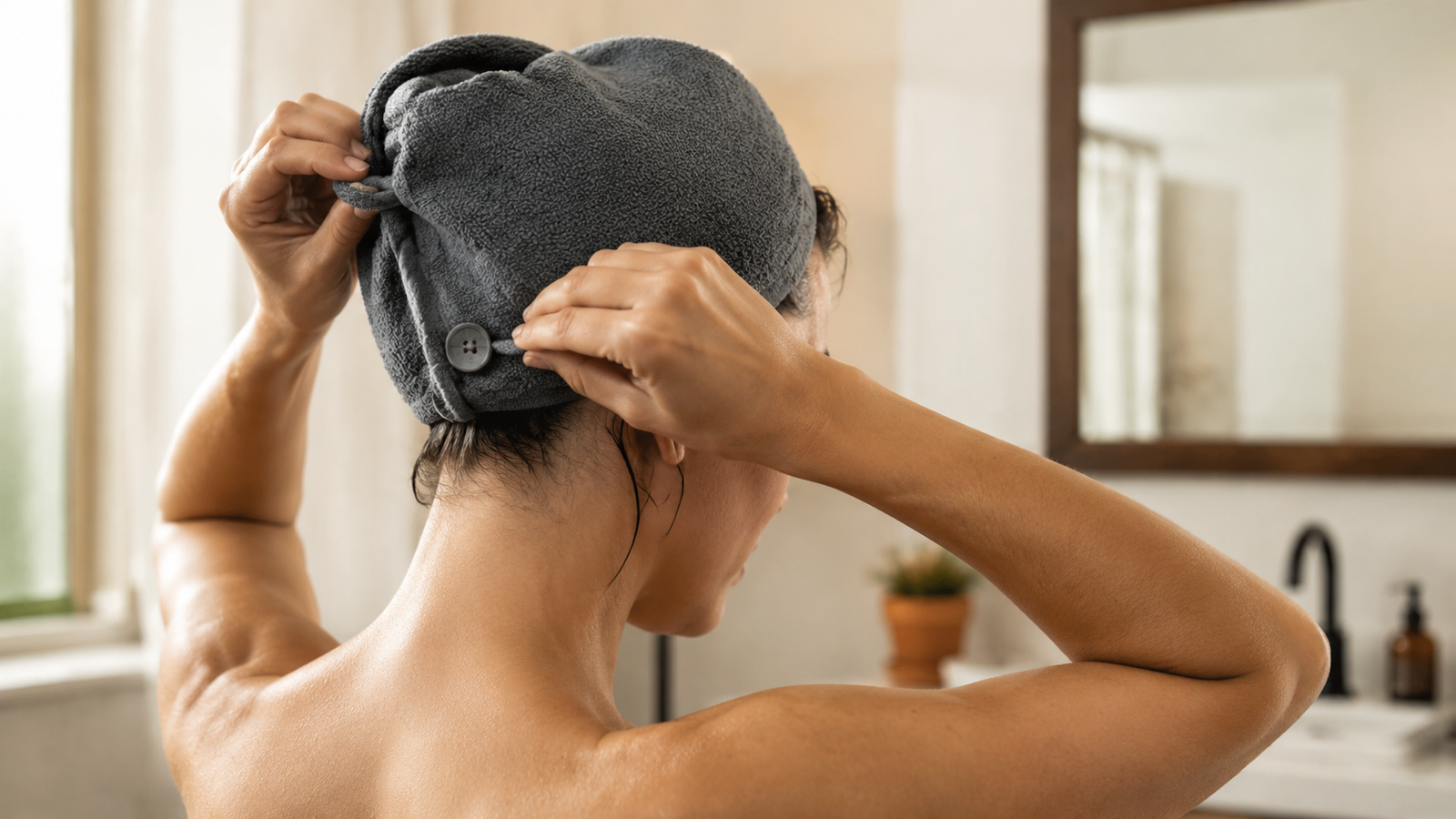
- Remove free water first: use your hands to squeeze sections gently; do not wring the hair.
- Blot high-load areas: press the hair towel against the lengths or ends instead of moving it rapidly back and forth.
- Place the hair comfortably: keep curls or long lengths supported rather than sharply folded or stretched.
- Secure the wrap lightly: use only enough twist or closure tension to prevent slipping.
- Check after a short interval: remove or reposition the hair towel when it is saturated, heavy, or pulling.
- Finish for the intended style: leave the hair at the dampness level needed for air-drying, styling products, or controlled blow-drying.
Do not assume longer hair-towel wrapping always improves the result. Once the contact area has approached its useful water capacity, more time may add wet weight without proportionate water removal. A secure wrap should stop dripping without pulling at the roots, scalp, or neck, so following the correct instructions for wrapping and using a hair towel helps keep contact controlled. People with scalp pain, fragile hair, medical adhesives, or extensions should follow their clinician’s or stylist’s individualized instructions. If the method stops working as expected, diagnose the symptom before replacing the towel.
7. How Can You Fix Hair-Towel Wetting, Odor, Fit, and Drying Problems?
Hair-towel problems should be fixed by matching each symptom to a likely cause before the product is replaced. A diagnostic symptom is the observable problem—such as delayed wetting or persistent odor—rather than an assumed cause. Residue, incomplete rinsing, trapped moisture, excess water load, distorted seams, and an unsuitable wrap size need different corrections.
| Symptom | Check first | Corrective action | Replacement signal |
|---|---|---|---|
| The hair towel beads water or wets slowly. | Product residue, oily soil, or incomplete rinsing may delay wetting. | Wash and rinse the hair towel according to its care label; omit optional additives during the comparison. | Replacement becomes reasonable when wetting remains poor after correct cleaning and full drying. |
| The hair towel smells after storage. | Damp storage or folding without airflow may retain moisture. | Rewash the hair towel as directed and dry it completely before storage. | Persistent odor, visible growth, or damage after appropriate care supports replacement. |
| The hair-towel wrap pulls or slips. | Size, wet mass, hair placement, or closure position may cause poor fit. | Reduce twisting, reposition the hair, or choose a better-fitting hair-towel shape. | Replacement is appropriate when the closure or seams no longer hold safely. |
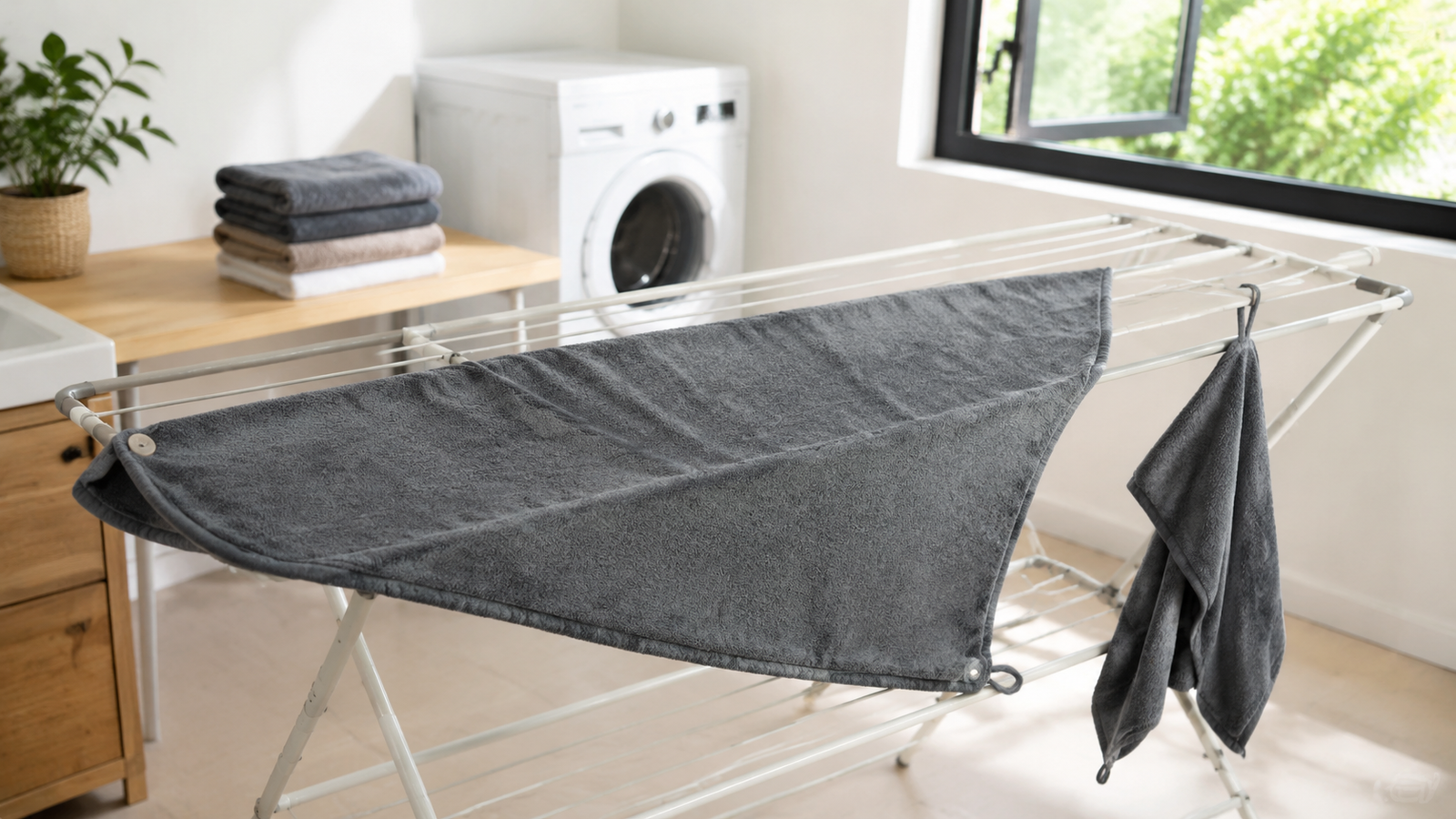
| The hair towel stays wet too long. | Starting water load, folded area, airflow, or humidity may extend drying. | Open the hair towel fully, improve safe airflow, and use the care-label drying method. | Replacement is practical when the hair towel cannot dry between uses under normal conditions. |
Follow the hair towel’s sewn care label for detergent, bleach, washing temperature, and drying method. Fabric softeners and dryer sheets can change textile wetting in some systems, so remove them from a troubleshooting trial if the label permits; do not claim that they physically “close” every capillary channel. Ordinary dryer temperatures also should not be described as melting polyester—excess heat is better treated as a care-label compatibility and durability issue. These limits resolve the most common questions before the final decision is summarized.
8. What Should You Know About Hair Towels?
These hair-towel answers separate useful technique from material-name promises. They also identify the conditions that can change friction, moisture pickup, drying time, and laundry compatibility.
Why use a hair towel instead of rubbing with a bath towel?
Rubbing creates repeated sliding contact, so technique can matter as much as the towel label. A well-fitted hair towel lets you blot or wrap with less movement and lower tension. The American Academy of Dermatology recommends wrapping hair to absorb water because rough rubbing can cause damage.
Are microfiber hair towels always the best choice?
No. Microfiber is one useful construction, but the label does not guarantee low drag, fast wetting, good water capacity, or comfortable seams. Compare the finished hair towel while damp, check its fit and closure tension, and confirm that its care instructions suit your laundry routine.
Do hair towels dry hair faster?
Sometimes. A hair towel can shorten the dripping stage when it wets readily, holds enough water, and maintains contact without tight twisting. Results vary with hair length, density, starting water load, towel area, technique, room conditions, and whether the towel is already saturated.
Can fabric softener be used on a hair towel?
Follow the sewn care label. Some softening products can leave deposits that change wetting or water uptake, but compatibility varies by textile and product. If performance declines, wash and rinse the hair towel as directed, skip optional additives during the comparison, and retest before replacing it.
Together, these hair-towel answers support one final decision rule: match the finished product and drying method to the user’s hair, comfort, water load, and care routine.
9. How Should You Choose a Hair Towel?
The best hair towel is the one that stops dripping with low sliding movement, comfortable wrap tension, enough water capacity, and reliable between-use drying. Microfiber, cotton, blends, flat knits, waffles, and low-pile constructions can each succeed or fail depending on the finished surface, size, closure, laundering history, and the user’s technique.