Laundry & Travel Towel Science
A task-first guide to measuring packability, water performance, drying and care in the finished towel.
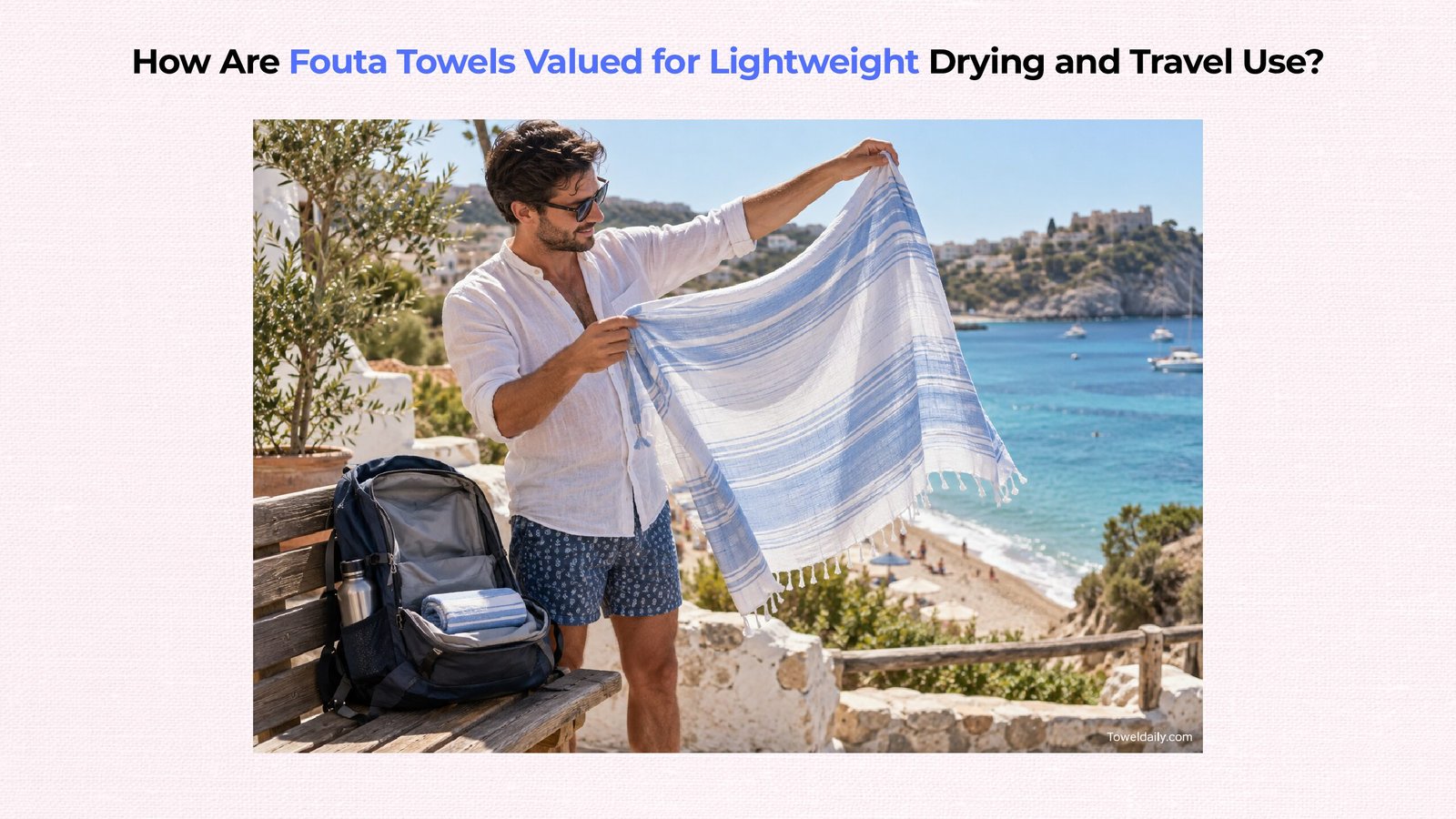
Fouta towels can be valuable for travel when the finished product weighs and packs less than the alternatives, removes the expected water load, and dries within the available time and environment. The name, fiber label, flat appearance, or advertised GSM cannot guarantee those outcomes by itself.
A fouta that works for a beach day may be too small, too transparent, or too low in capacity for repeated shower use. Another may provide excellent coverage but weigh nearly as much as a light terry towel. Define the trip, measure the actual specimen, and compare water performance after representative laundering before relying on category claims.
Measure dry
Mass and packed volume
Test wet
Pickup and capacity
Time drying
Controlled conditions
Trial care
Fit after laundering
What is a fouta towel?
A fouta is a flat-woven textile associated with Tunisian bathing and hammam use and now sold for drying, beach, home, and travel tasks. Products commonly have stripes or other woven decoration and fringed ends, but the label does not impose one size, fiber, mass, weave density, or performance threshold.
Sellers also use pestemal or peshtemal for related Turkish flat-woven bathing textiles. The terms can overlap in modern retail, yet they are cultural and merchandising descriptions rather than interchangeable technical specifications. Some pieces are cotton, while others use linen, regenerated cellulose, synthetic fibers, or blends.
The fouta name cannot define travel performance because finished dimensions, mass, thickness, yarn, weave, finish, fringe, and laundering history can vary independently. A decorative throw and a working drying towel may look similar while behaving differently when wet.
Read the product label and specification, then measure the item that will travel. Treat claims such as “lightweight,” “quick-drying,” “sand-free,” or “highly absorbent” as propositions to verify under a declared test rather than properties supplied automatically by the name.
Why can a fouta towel be useful for travel?
A fouta can suit travel when a relatively low-profile construction reduces dry mass and packed bulk while still providing adequate coverage, water pickup, capacity, comfort, and durability. Its potential advantage is a better task-to-load ratio, not a guaranteed number of saved grams or litres.
Once the intended trip has been defined, how fouta-towel portability supports travel use becomes more meaningful than relying on an unsupported lightweight claim.
| Travel need | Potential fouta advantage | Verify before relying on it |
|---|---|---|
| Low baggage mass | Thin constructions may use less material | Conditioned dry mass of the finished towel |
| Small pack volume | Low pile can fold or roll compactly | Repeatable packed dimensions at a defined compression |
| Between-use drying | Less retained water may shorten drying | Starting water, airflow, humidity, temperature and hanging geometry |
| Multi-use coverage | Large thin cloth can serve as wrap or light layer | Dimensions, opacity, drape, comfort and task safety |
Trade-offs remain. A thinner towel may hold less water, feel less cushioned, become transparent when wet, or require more surface rotation. Fringe can add character but may tangle or abrade. Compare those costs with the actual baggage, bathroom, beach, and laundry conditions of the trip.
How should fouta-towel weight and packability be measured?
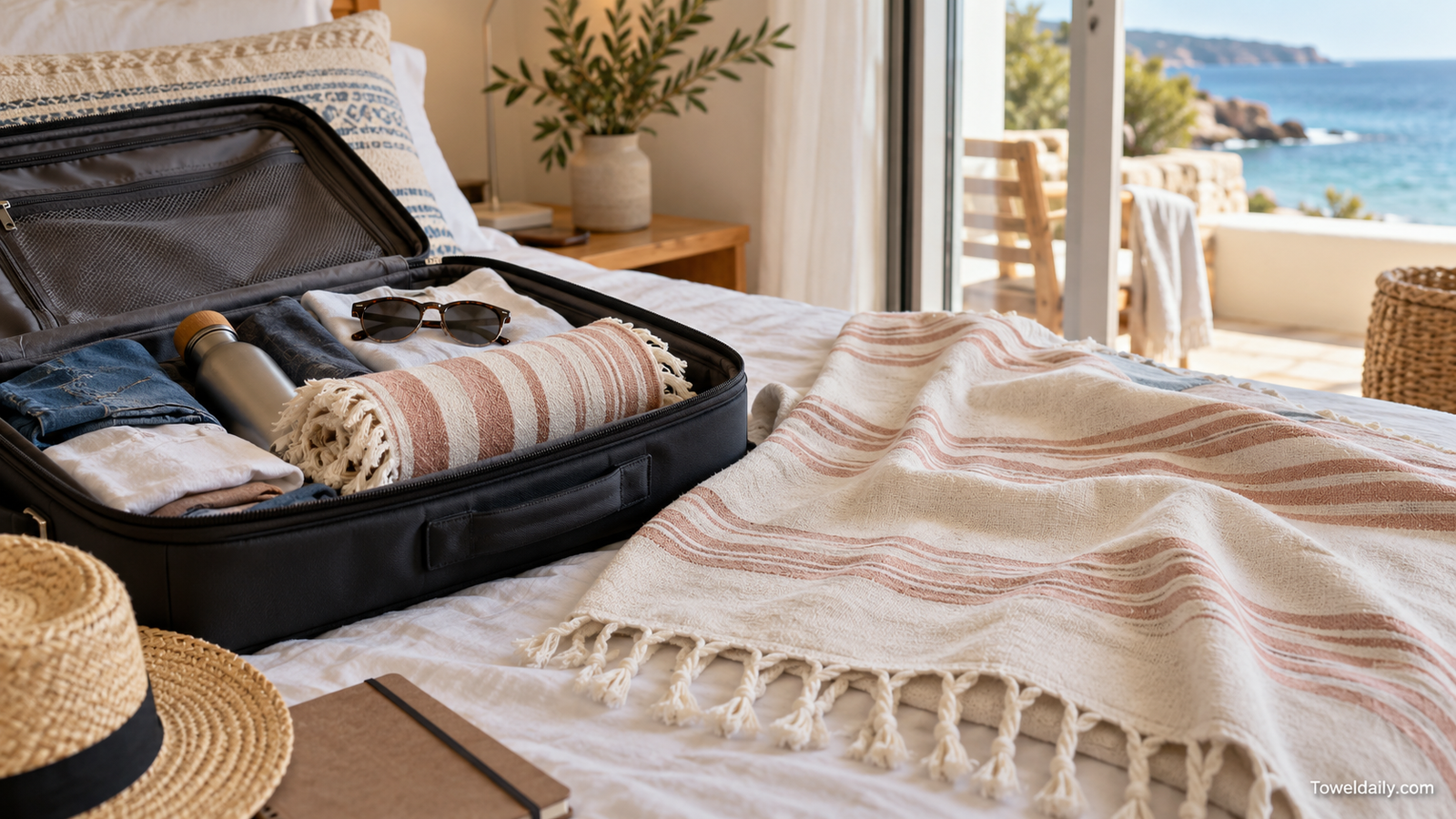
Measure a fouta after consistent conditioning: record finished length and width, dry mass, thickness under a defined pressure, and packed dimensions using the same fold, roll, restraint, and compression each time. Compare alternatives only when the procedures and units match.
Since GSM does not reveal total baggage load or packed dimensions, how fouta-towel size and weight affect compactness should be evaluated using the finished towel and a consistent packing method.
ASTM D3776/D3776M covers fabric mass per unit area for most fabrics, while ASTM D1777 covers textile thickness and specifies controlled measurement. These methods provide useful scientific counterparts for GSM and thickness, but neither declares the ideal travel towel. See ASTM D3776/D3776M and ASTM D1777-26.
What does GSM reveal—and what does it omit?
GSM reveals dry fabric mass per square metre; it omits the towel’s total area, total mass, packed shape, fiber placement, finish, absorption, drying, and comfort. The same GSM can produce different travel loads when dimensions or borders differ.
- ☐ Condition: bring every dry sample to the same declared state before weighing.
- ☐ Measure: record finished dimensions, mass, thickness and usable area.
- ☐ Pack: apply one fold or roll pattern with consistent compression.
- ☐ Repeat: test several specimens and report the range, not only the smallest result.
How does construction affect fouta-towel performance?
Construction affects a fouta through interacting variables: fiber composition, yarn size and twist, weave pattern and density, areal mass, thickness, finishing, hems, fringe, and dimensions. No single variable guarantees rapid wetting, high capacity, quick drying, low lint, or durability.
Construction labels become useful when considered alongside the materials and fiber compositions used in fouta towels because yarn, weave, finish, fringe, and dimensions interact.
| Variable | Possible effect | Limitation | Practical check |
|---|---|---|---|
| Cotton-rich yarn | Can support water interaction | Finishes and yarn structure can delay wetting | Test after representative laundering |
| Linen or regenerated-cellulose blend | Can change hand, drape and moisture behavior | Blend percentage does not reveal fiber placement | Compare wet feel, pickup and dimensional change |
| Synthetic component | Can alter mass, strength and drying | Polymer name does not establish finished performance | Verify wetting, residue response and comfort |
| Dense flat weave | Can improve stability and reduce bulk | May reduce flexibility or water entry | Measure drape, wetting, pickup and seam behavior |
| Fringe and decoration | Adds styling and identification | Can tangle, distort, bleed or reduce usable area | Inspect before and after laundering |
Cotton cellulose contains hydroxyl groups that interact with water, but chemistry alone does not define a towel’s surface pickup or drying time. Water must reach the fibers through the finished surface, and the amount retained after use depends on contact, pore structure, total material, dimensions, and technique.
How should fouta-towel absorbency and drying be tested?
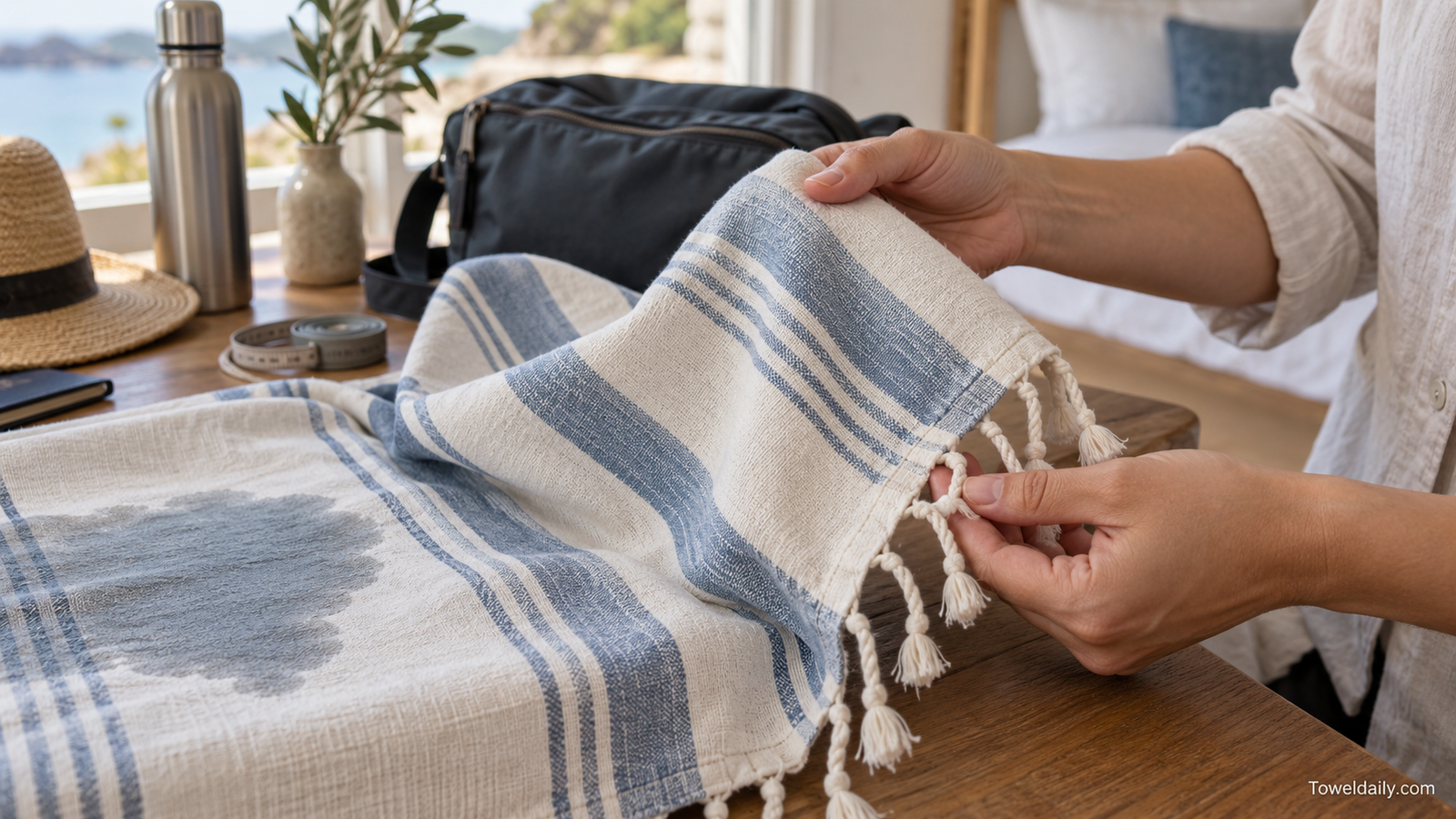
Test wetting, surface pickup, retained capacity, wicking, and drying separately under controlled conditions. Report specimen state, dimensions, mass, laundering history, applied water, contact procedure, hanging geometry, temperature, humidity, airflow, timing, endpoint, and variation.
After measuring dry mass and usable area, what determines fouta-towel absorbency is the next question when deciding whether one towel can manage the expected shower or beach water load.
AATCC’s moisture-management program lists distinct methods for absorbency, liquid movement, drying time, and drying rate, including TM79, TM195, TM197, TM198, TM199, TM200, TM201, TM204, and TM213. The method separation shows why “absorbent” and “quick-drying” are not interchangeable claims. See the AATCC moisture-method group.
Why can a lower-capacity towel appear to dry faster?
A lower-capacity towel can appear to dry faster because it may begin the test with less retained water. That can be useful in travel, but it does not prove a faster evaporation rate. Starting load and dry endpoint must be reported with elapsed time.
Run two comparisons when possible: apply the same water mass to equal usable areas to compare release under a common load, then test each towel at its measured capacity to evaluate a fully loaded scenario. AATCC TM200 explicitly addresses drying rate at absorbent capacity under airflow, while TM199 and TM201 use different conditions.
ASTM D4772 evaluates rapid surface water absorption and retention for terry fabrics, but its scope excludes several non-terry constructions where runoff or pass-through can invalidate results. It should not be imposed blindly on every fouta. See ASTM D4772-26.
How should a fouta compare with terry and synthetic travel towels?
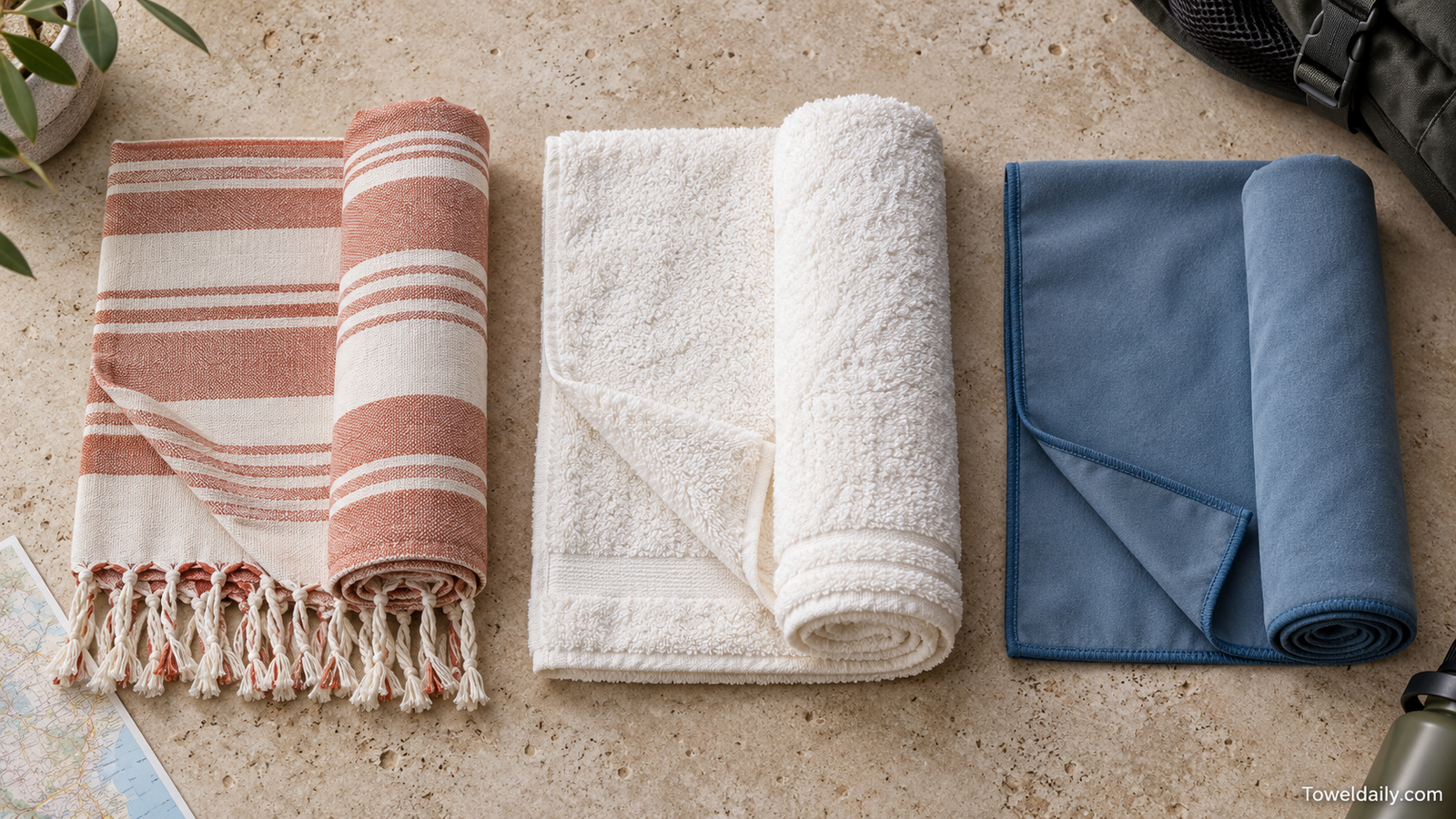
Compare fouta, terry, and synthetic travel towels by the same finished-product criteria rather than declaring one universal winner. The best option is the lightest and most compact candidate that still passes the user’s coverage, water, comfort, drying, durability, and care requirements.
Travelers choosing between flat-woven and loop-pile constructions should examine how fouta towels compare with terry-weave towels under identical coverage, absorption, comfort, packing, and drying conditions.
| Decision | Flat-woven fouta | Terry towel | Synthetic travel towel |
|---|---|---|---|
| Dry mass and volume | Often low profile; measure finished item | Pile can add bulk; light terry also exists | Can be compact; construction varies widely |
| Surface pickup | Depends on weave, finish and contact | Pile may increase contact area | Depends on polymer, split, knit and finish |
| Capacity | May be limited by lower material volume | May retain more through pile and mass | Must be measured; label is insufficient |
| Drying | Potential benefit from lower starting water and thickness | Can take longer when more water is retained | Varies with water load and structure |
| Comfort and coverage | Broad, drapable sheet is possible | Often cushioned but bulkier | Texture and dimensions vary |
| Debris release | Flat face may offer fewer pile spaces | Pile may retain particles | Surface texture controls result |
| Care | Fringe, dye and shrinkage need checking | Pile lint and bulk need checking | Heat, residue and edge instructions need checking |
Keep dimensions comparable when the task requires equal coverage. Comparing a large fouta with a smaller terry towel can distort mass, capacity, and packing conclusions. Conversely, equal dimensions do not create equal usable surface when borders, fringe, coatings, or attachments consume part of the towel.
How should a travel fouta be selected?
Select a travel fouta by defining the itinerary and then validating the finished towel’s dimensions, dry and wet handling, packed volume, water performance, drying, opacity, construction quality, and care compatibility. Fiber and GSM should support that decision, not replace it.
Because low weight does not guarantee resistance to abrasion or fringe damage, what determines fouta-towel durability should be assessed after representative use and laundering cycles.
- ☐ Define the task: shower, beach, gym, wrap, hostel, camping, or several controlled uses.
- ☐ Measure coverage: record finished dimensions, fringe exclusion and usable contact area.
- ☐ Record load: weigh the conditioned towel and measure it under the planned packing method.
- ☐ Test water performance: separate initial wetting, pickup, capacity and drying.
- ☐ Check wet privacy: assess opacity, cling, drape and comfort after representative wetting.
- ☐ Inspect construction: look for loose yarns, weak hems, uneven fringe, dye transfer and distortion.
- ☐ Match care: confirm that the label suits the machines, products and drying access available during travel.
How should a pre-purchase fouta trial be designed?
A pre-purchase trial should compare representative samples through the planned use and laundry sequence while changing one variable at a time. Record the baseline, observed range, failure criteria, and post-laundry result before approving additional units.
Include new and laundered states because removable finish, relaxation, shrinkage, and residue can change wetting, size, hand, and packed shape. AATCC TM135 measures dimensional change after standardized home laundering, but the selected laundering option must reflect the intended comparison. See AATCC TM135.
How should a fouta towel be used and packed during travel?
Use a fouta by exposing clean sections to the skin, applying controlled contact rather than unnecessary rubbing, and opening the textile fully after use. Pack it only when dry, or isolate a damp towel temporarily and remove it for drying as soon as practical.
Before returning a used fouta to luggage, the mildew risks of packing a travel towel while damp explain why the center, hems, and fringe should be checked for retained moisture.
- Before use: confirm the towel is clean, dry, and assigned to one person or one compatible task.
- During drying: rotate through clean surface zones before one area becomes saturated and starts smearing water.
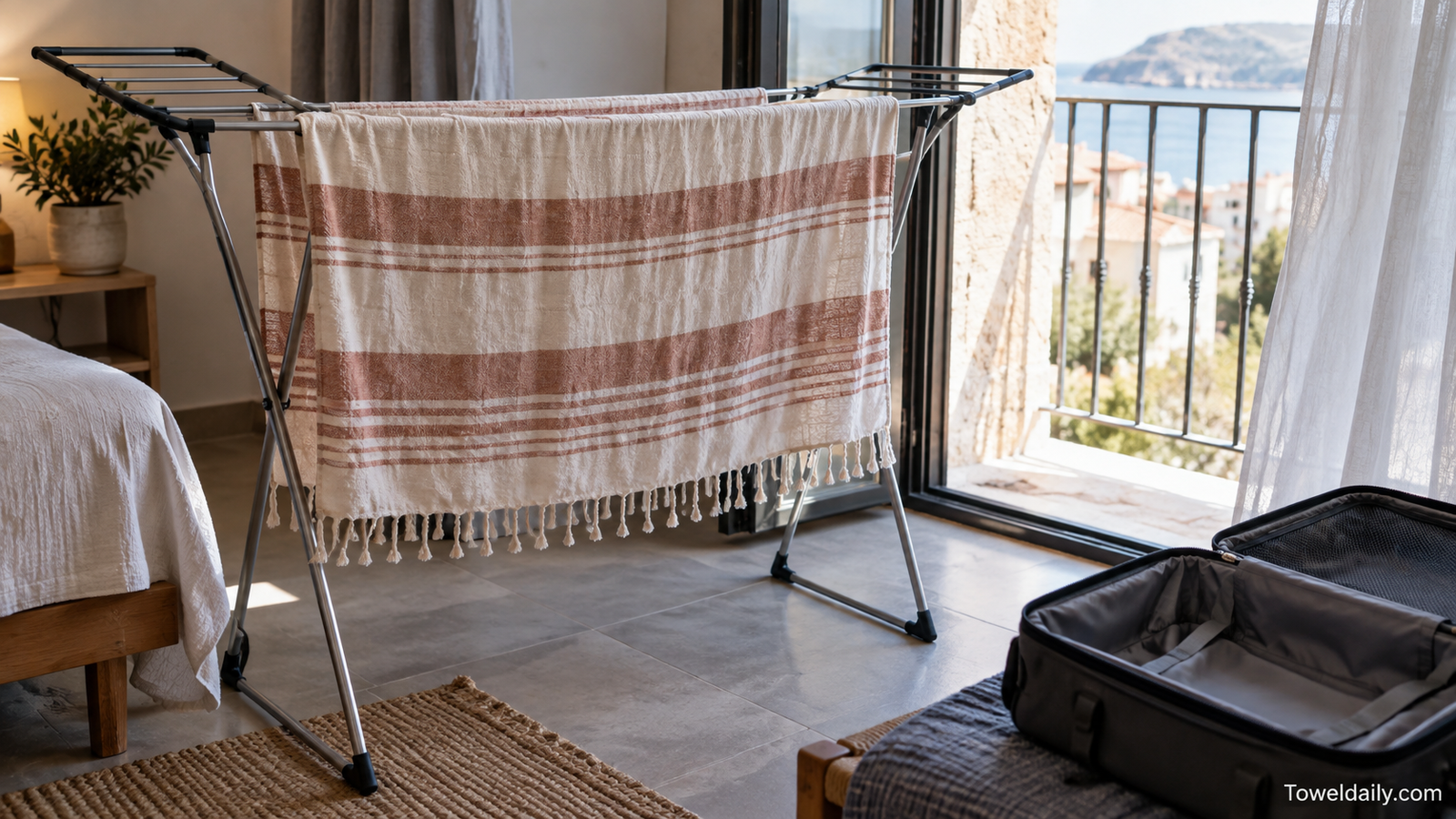
- After use: unfold the full area and hang it without thick overlaps where airflow can reach both faces.
- Before packing: check the centre, hems, and fringe for remaining dampness rather than judging only the exposed edge.
- In transit: keep a temporarily damp towel separate from clean clothing and avoid prolonged sealed storage.
Do not share a personal fouta when skin-contact hygiene matters. CDC advises against sharing towels and washcloths in its MRSA-prevention guidance. That does not mean every shared towel causes infection, but it supports clear assignment in hostels, gyms, and communal bathrooms. See CDC MRSA prevention.
A fouta can also serve as a beach layer, wrap, light blanket, or changing screen if its dimensions, opacity, thermal comfort, and surroundings permit. These uses are practical possibilities, not certified protective functions. Keep the textile clear of flames, heaters, machinery, and other hazards.
How should a fouta towel be washed and dried?
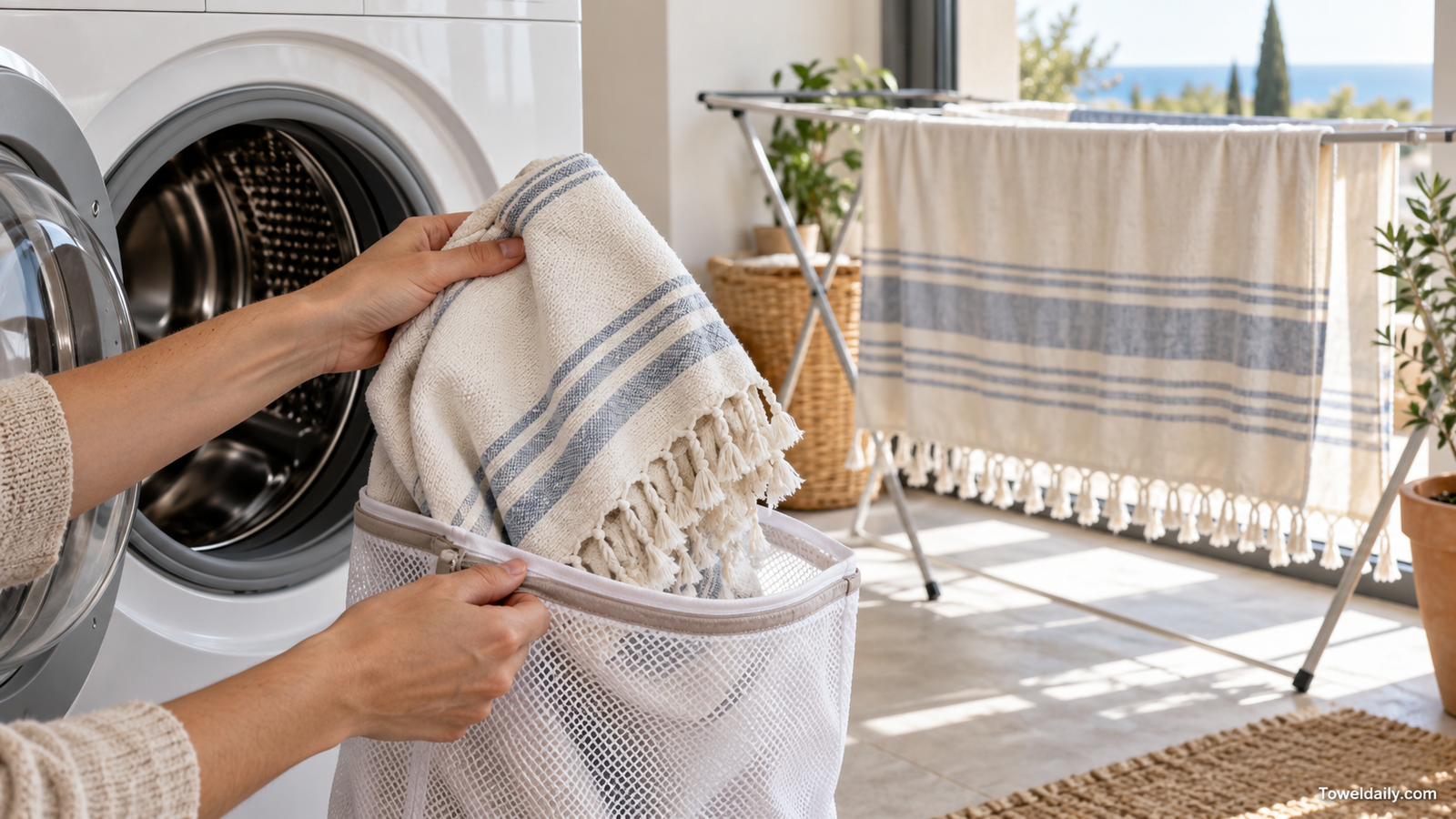
Wash and dry a fouta according to its care label, the washer instructions, and the laundry-product directions, using a process suitable for the actual soil. Dose accurately, rinse as specified, protect fringe when directed, and dry the towel completely before storage or packing.
Once the travel trial is complete, the correct washing instructions for fouta towels help protect their dyes, dimensions, edges, fringe, and water performance.
Do not impose one universal 30–40°C wash, mild-detergent dose, bleach ban, or low-heat dryer setting on every fiber, dye, fringe, and finish. The correct process depends on the product. Inspect for color transfer, shrinkage, edge distortion, lint, residue, and changed water performance during the trial.
Conventional fabric softeners can improve hand while reducing water absorbency under tested conditions, but no single loss percentage applies to all foutas. A 2021 material-science study describes this established trade-off and evaluates a modified hydrophilic softener. See the 2021 softener study.
What should be done when a new fouta wets slowly?
When a new fouta wets slowly, verify the test, follow the care label for its initial wash, condition it consistently, and retest before rejecting it. Removable finishing or laundry residue may be involved, but slow wetting does not prove one cause.
Compare an otherwise identical, correctly washed specimen and change only one care variable. Avoid improvised stripping recipes or fixed vinegar quantities unless the textile, appliance, and product instructions permit them. Never combine an acid with chlorine bleach because that mixture can release toxic chlorine gas, as explained in CDC chemical guidance.
How can common fouta-towel problems be fixed?
Fix fouta problems by classifying the symptom as wetting, capacity, drying, odor, fit, opacity, construction, or laundering failure and then testing the most likely variables one at a time. A category assumption cannot identify the cause.
| Symptom | Check first | Controlled response |
|---|---|---|
| Water beads on the surface | Conditioning, finish, residue and test method | Wash as directed and repeat the same wetting test |
| Towel saturates too soon | Usable area, mass, capacity and user water load | Rotate dry zones, issue a second towel, or choose greater capacity |
| Towel stays damp | Starting water, overlaps, airflow, humidity and storage delay | Open fully, improve exposure and measure drying again |
| Persistent odor | Delayed washing, retained soil, residue and incomplete drying | Remove from use and correct the permitted wash-and-dry process |
| Fringe tangles or frays | Construction, abrasion and washer handling | Follow label protection; reject persistent structural failure |
| Dimensions change | Before-and-after measurement and laundering option | Adjust the process if permitted or select a stable product |
| Wet towel lacks privacy | Opacity, cling, color and lighting | Use it only for drying or choose a more suitable wrap |
What do travelers ask about fouta towels?
Travelers most often need direct answers about shower capacity, drying, terminology, beach use, and machine washing. Each answer depends on the finished towel and declared conditions rather than the fouta label alone.
Is a fouta towel absorbent enough after a shower?
It can be when its usable area, pickup and capacity match the user’s water load. The fouta name alone does not prove this. Test a conditioned sample after representative laundering, using the same contact procedure and water load expected during shower drying.
Does every fouta towel dry faster than every terry towel?
No. A low-mass, thin fouta may dry sooner, but fiber, construction, starting water, dimensions, airflow, humidity and hanging geometry all matter. Compare finished towels with the same protocol and report both initial water load and the chosen dry endpoint.
Are fouta and peshtemal the same towel?
The names refer to related North African and Turkish bathing-textile traditions and are often used interchangeably by sellers. They are not a single performance standard. Verify each product’s dimensions, mass, fiber content, weave, fringe, colorfastness and care instructions.
Can a fouta be used as a beach towel?
Yes, if it provides enough coverage, water removal, opacity and comfort for the user. Flat construction may make debris easier to release, but sand behavior is not guaranteed. Test the finished towel with representative dry and damp sand before travel.
Can a fouta towel be machine washed?
Only when its care label permits machine washing. Follow the textile, washer and laundry-product instructions, protect fringes as directed and dry completely before packing. Record shrinkage, distortion, color transfer, lint and performance changes during the planned laundry trial.
When is a fouta towel valuable for lightweight drying and travel?
A fouta is valuable when its measured dry mass and packed volume reduce travel load without sacrificing the coverage, water pickup, capacity, comfort, drying time, durability, opacity, and care compatibility the trip requires. Its best use is therefore product- and itinerary-specific.
Ignore universal promises based on one retail size, GSM band, fiber name, roll diameter, or drying curve. Condition and measure the finished towel, compare identical tasks and environments, perform representative use and laundering trials, and choose the candidate that passes the declared criteria with the least practical baggage burden.