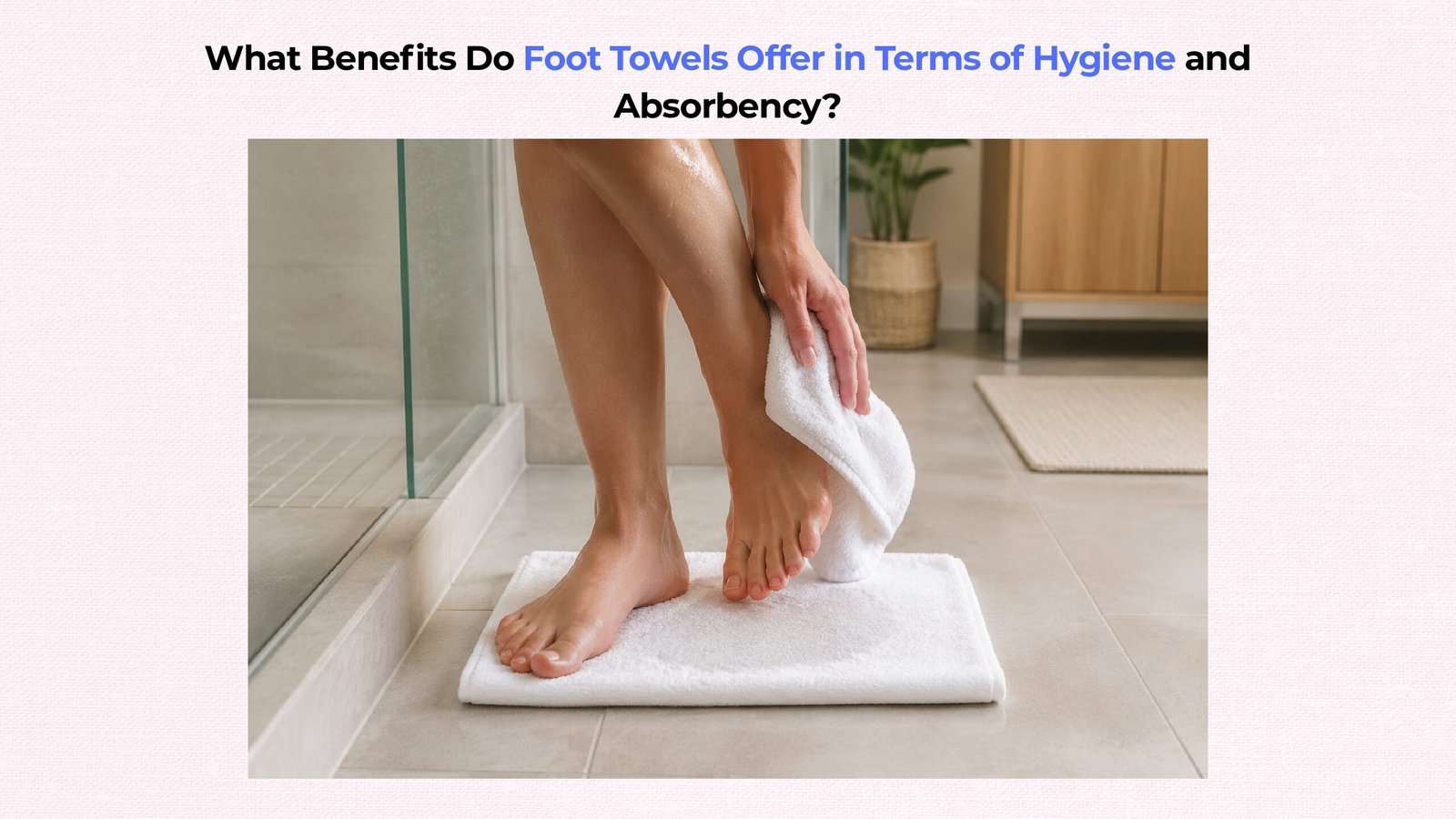
Towel Types & Foot Care
A clean, personal foot towel offers two practical benefits: it helps remove water from the soles and spaces between the toes, and it makes towel sharing or reuse on other body areas less likely. Those benefits depend on the finished towel, complete drying between uses, appropriate laundering, and careful technique. A foot towel is not sterile, and it cannot by itself prevent or treat athlete’s foot.
The decision is therefore not “Which fiber is naturally hygienic?” It is “Which towel can wet out, pick up the required water, dry in the available room, tolerate its care process, and remain personal to one user?” This article separates those measurable textile tasks from medical claims so readers can choose and use a foot towel without false precision.
What Hygiene Benefit Does a Dedicated Foot Towel Actually Provide?
A dedicated foot towel provides separation, not sterilization. Assigning it to one person and one body area reduces opportunities to share a damp textile or move it from affected feet to unaffected skin. The benefit is strongest when the towel is clean, fully dried after use, and not shared with other household members. Assigning one towel to the feet also raises the wider question of how separating body-contact textiles by body area supports hygiene without treating separation as sterilization.
The CDC’s foot-hygiene guidance advises washing feet daily and drying them completely. The American Academy of Dermatology also advises households not to share towels, linens, or shoes with a person who has athlete’s foot. These recommendations support clean, personal use; they do not prove that a special towel construction prevents infection.
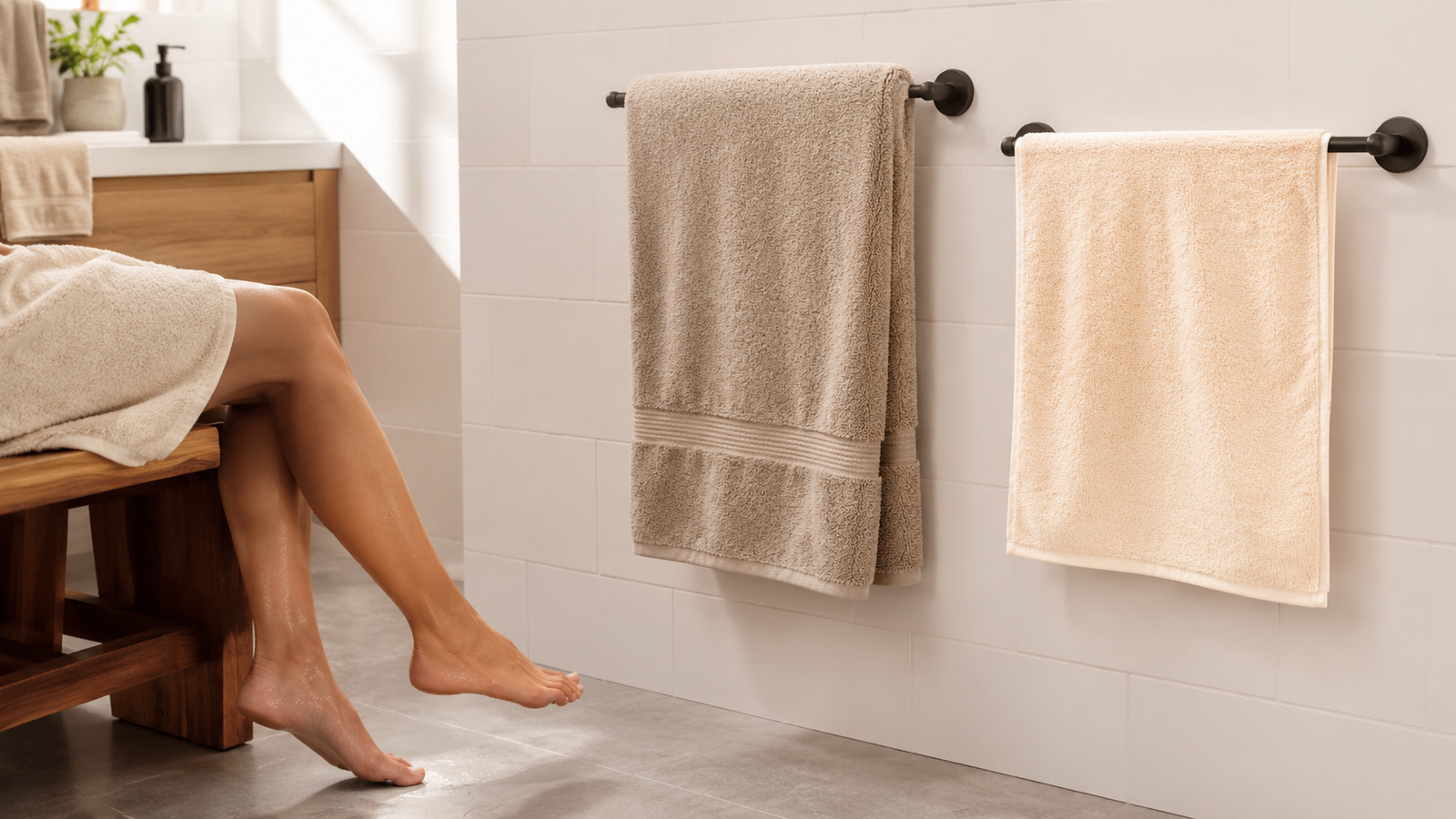
How Does Foot-Towel Separation Change the Transfer Path?
Foot-towel separation removes some transfer opportunities, but only correct handling completes the barrier. When several people share a bathroom, how sharing personal washcloths can affect bacterial transfer and infection risk helps explain why a feet-only towel should remain assigned to one user. The practical path has three control points:
- Contact: Water, skin cells, product residue, and any organisms present can move from feet to the towel during drying.
- Storage: A towel that remains bunched or damp has a different between-use condition from one spread on a clean rail with airflow.
- Next use: Personal, feet-only use avoids sharing and avoids wiping the same textile over unaffected body areas.
The original draft’s universal colony count and “blocked pathway” were not supported by a study that matched this use case. A towel can still become contaminated, and a dedicated towel can still be mishandled. Separation lowers opportunity; washing, full drying, no sharing, and treatment of any infection remain separate controls.
How Does Foot-Towel Absorbency Support Complete Drying?
Foot-towel absorbency supports complete drying when the surface wets readily, removes water at light contact, and stores the amount picked up from both feet without becoming saturated. Loop geometry, yarn structure, fiber chemistry, finishing, previous laundering, detergent residue, fabric mass, and the applied pressure can all change the result.
Wetting, surface water absorption, wicking, capacity, and drying rate are related but different properties. Once personal use has been established, how to select a foot towel for absorbency becomes the next question because these properties measure different parts of performance. A towel may wet quickly yet hold little water, or hold a large load yet take too long to dry in a humid bathroom. GSM reports dry mass per square metre; it does not independently prove any of those outcomes.
Which Tests Answer Different Foot-Towel Moisture Questions?
No single test gives a complete “absorbency score.” The AATCC moisture-management program lists nine separate methods covering absorbency, liquid transport, vertical or horizontal wicking, drying time, drying rate, and water-vapor transmission. The unique insight is that results from one method should not be relabeled as another property.
- Initial wetting: Use a defined wetting method, such as AATCC TM79, rather than timing an uncontrolled household splash.
- Surface pickup: Use a terry-specific surface-water method, such as ASTM D4772, when the question is how rapidly fabric removes liquid from a surface.
- Retained capacity: Weigh a conditioned dry sample and the same sample after a controlled water load and drainage procedure; report the procedure with the result.
- Between-use drying: Apply the same water load, extraction method, hanging arrangement, temperature, humidity, and airflow before comparing elapsed drying time.
How Should Foot Towels Be Compared Before Purchase?
Compare foot towels by the tasks they must perform in the intended bathroom, not by category averages. Before rejecting an unused product for slow wetting, consider why a new foot towel may not absorb water effectively until removable manufacturing finishes have been washed out. Use equally sized, prewashed samples; apply the same water load and contact method; then record wetting, pickup, saturation, drying time, texture, seam comfort, and dimensional change.

What Does ASTM D4772-26 Measure?
ASTM D4772-26 is the 2026 standard for surface water absorption of terry fabrics. It evaluates the ability to absorb and retain liquid rapidly from a surface; it is not applicable to non-terry constructions and does not establish a universal GSM, towel size, whole-towel capacity, drying time, or infection-prevention threshold.
| Property | Question It Answers | Home Comparison | Failure Sign |
|---|---|---|---|
| Wetting | Does water enter the surface promptly? | Apply equal drops to clean, conditioned samples without pressing. | Persistent beading or delayed penetration. |
| Surface pickup | Does light contact remove water? | Use equal water, area, pressure, and contact time. | Repeated wiping is needed. |
| Capacity | Can it finish both feet without saturation? | Weigh dry and after a defined load and drainage step. | Water pushes back to the surface. |
| Drying | Will it dry before the next intended use? | Hang samples identically in the real bathroom. | Core or hems remain damp. |
| Wash stability | Does performance survive the care routine? | Repeat checks after several label-compliant washes. | Stiffness, odor, distortion, lint, or slower wetting. |
- ☐ The towel is large enough to dry both feet without touching the floor.
- ☐ Its edges and labels do not scratch toes or tender skin.
- ☐ It wets and picks up water after the finishes from manufacturing have been washed out.
- ☐ It can hang open and dry within the actual time available.
- ☐ Its care label permits the household’s realistic wash and drying process.
Which Foot-Towel Properties Matter More Than a Material Label?
Finished construction and verified performance matter more than fiber name alone. Fiber names become more useful when considered alongside how absorbent materials perform in finished foot towels rather than being treated as guarantees of water pickup or hygiene. Fiber content can narrow expectations, but yarn geometry, pile or flat weave, finishing, fabric mass, edge construction, dimensions, laundering, airflow, and water load interact to determine comfort, pickup, dry time, and service life.
| Label | What It Identifies | What It Does Not Prove | What to Verify |
|---|---|---|---|
| Cotton | Cellulosic fiber content. | Automatic softness, capacity, fast wetting, or hot-wash durability. | Finished wetting, pile integrity, drying time, and care label. |
| Microfiber | Very fine manufactured fibers; composition can vary. | Automatic low friction, high capacity, fast drying, or hygiene. | Blend, texture when damp, water load, edge comfort, and dry time. |
| Rayon made from bamboo | Regenerated cellulose whose plant source may be bamboo. | Retention of bamboo’s natural antimicrobial properties. | Accurate label, substantiated treatment claims, wash stability, and performance. |
| Linen | Flax fiber content. | Automatic softness, rapid surface pickup, antimicrobial action, or climate suitability. | Weave, stiffness, seams, pickup, wrinkling, and dry time. |
The U.S. Federal Trade Commission specifically warns that most textiles promoted as bamboo are rayon made from bamboo and that the processed rayon should not be assumed to retain the plant’s natural antibacterial properties. A supplier’s antimicrobial claim therefore requires product-specific substantiation and does not replace normal laundering.
How Should a Foot Towel Be Used Safely and Effectively?
Use a foot towel by supporting yourself securely, pressing or patting clean skin, and drying every surface—including between the toes—without forceful rubbing. Keep the handheld towel off the floor, do not share it, and place it fully open on a clean rail immediately afterward.
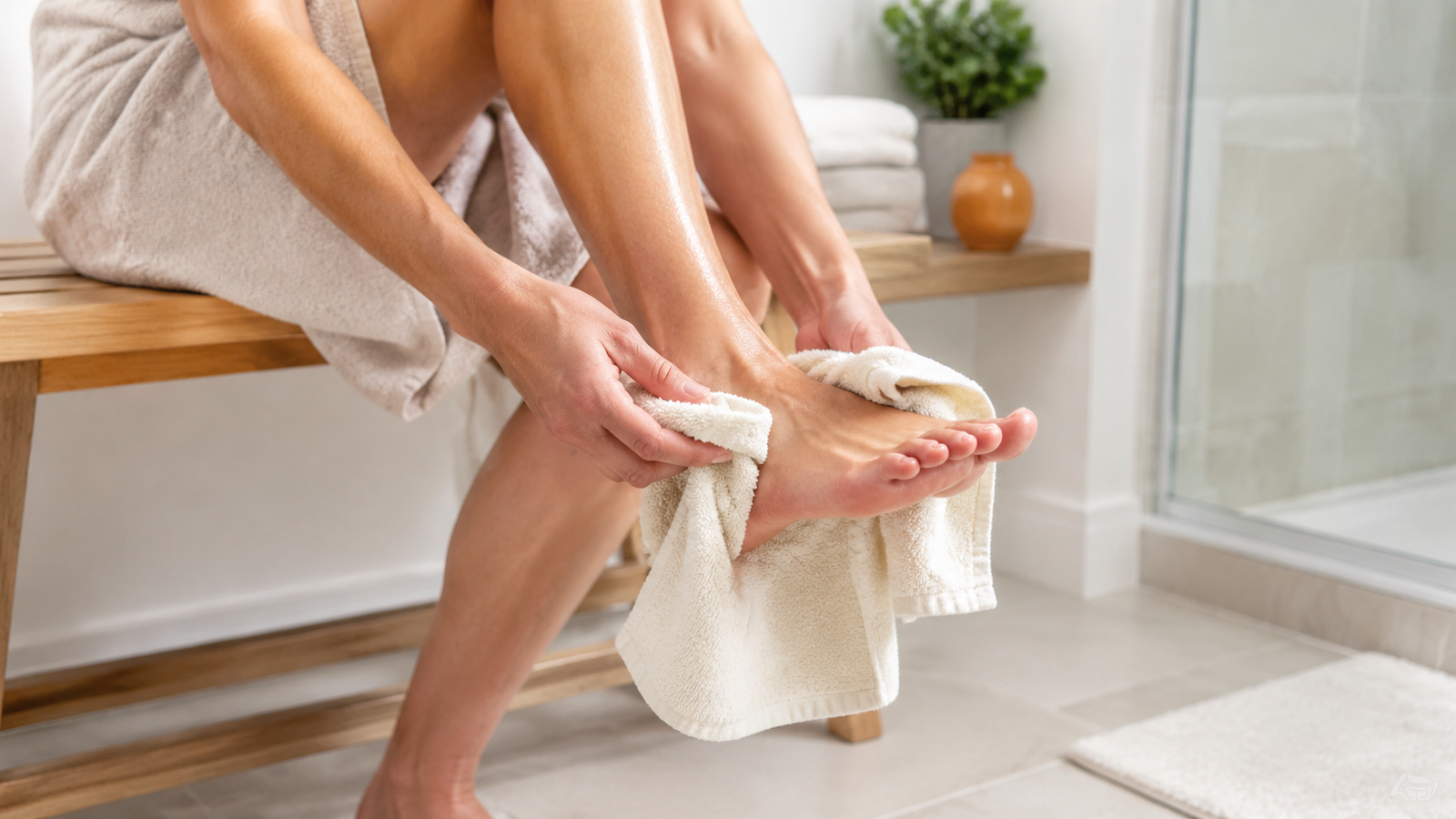
- Prepare: Choose a clean, dry towel and a stable seated or standing position. A handheld foot towel is not a slip-resistant bath mat.
- Remove free water: Pat the tops, soles, heels, and sides rather than scrubbing.
- Dry between toes: Use a clean section of fabric and light contact in each space.
- Inspect: Check for persistent moisture, redness, cracking, blisters, scaling, pain, or drainage rather than assuming the towel solved the cause.
- Separate: Do not reuse the damp towel on the face or body, and do not allow another person to use it.
- Open-dry: Hang it in a single layer with airflow; do not leave it crumpled, folded wet, or on the bathroom floor.
How Should Foot Towels Be Washed and Dried?
Wash a foot towel with an appropriate detergent on a care-label-permitted cycle, then dry it completely by the permitted method. After use, complete drying and appropriate laundering make foot-towel care and hygiene requirements important for controlling damp storage, odor, residue, and avoidable sharing. Increase laundering when the towel is soiled, odorous, unable to dry between uses, or used on infected skin; no single temperature, chemical, interval, or dryer setting suits every towel and household.
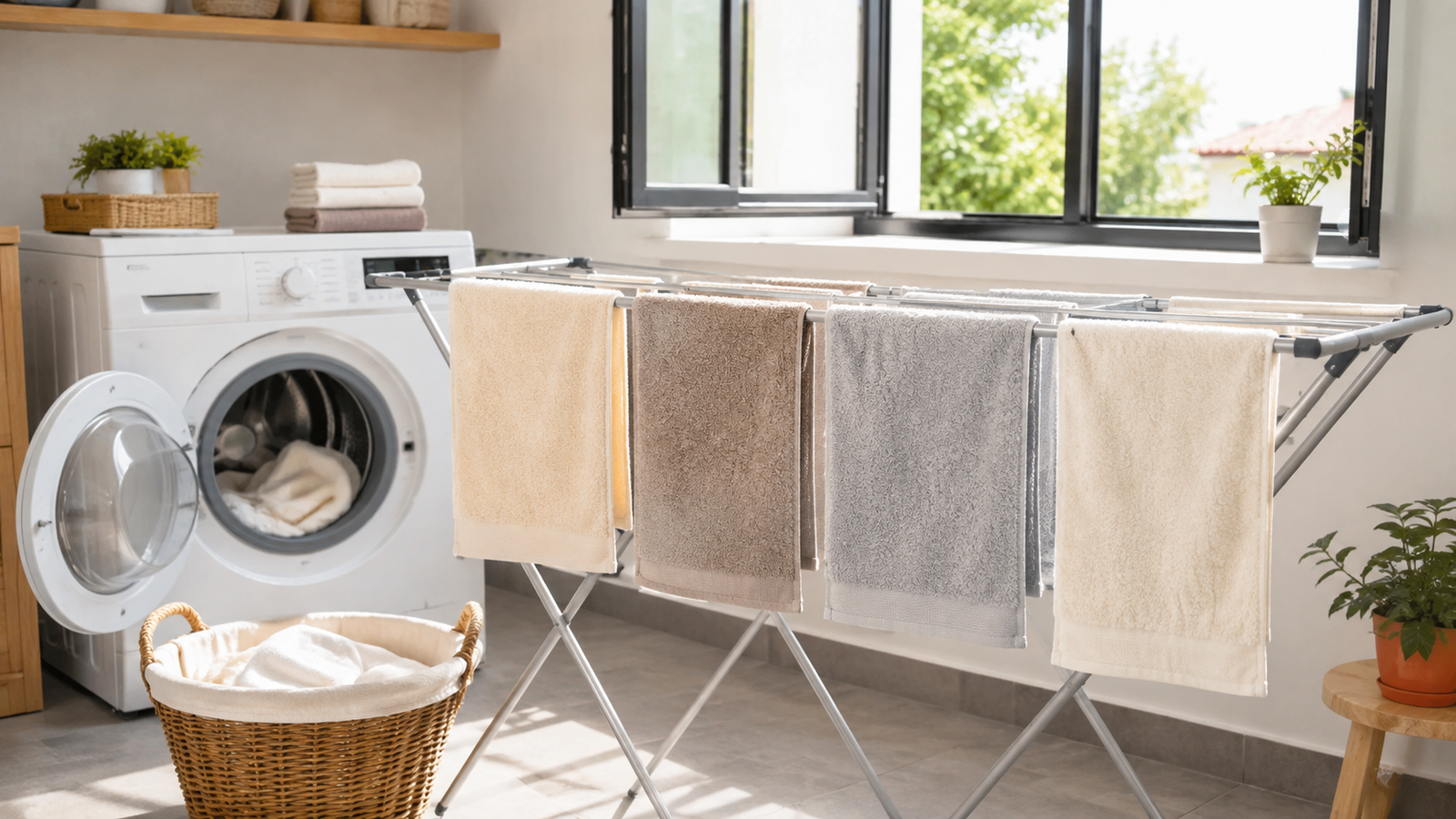
When Does 60°C Laundering Evidence Apply?
A 2022 controlled study found that laundering experimentally contaminated linens at 60°C removed dermatophyte conidia under its tested machine, program, textile, and organism conditions. That supports a high-temperature option when infection control is needed and the label allows it; it does not prove that every towel requires 60°C or that temperature alone covers every hazard.
Follow the towel label, washer instructions, detergent directions, and any advice from a clinician or public-health authority. The FTC’s care-label guidance explains that safe washing, drying, and bleaching conditions are product-specific. Do not improvise chemical mixtures, exceed label limits, or assume “white” means chlorine-bleach safe.
- ☐ Wash before first performance comparison so removable finishing does not distort the result.
- ☐ Keep a towel used on infected skin personal and out of another person’s load when health guidance calls for separation.
- ☐ Use the labeled detergent dose for the load, water conditions, and machine.
- ☐ Use bleach or another laundry additive only when both textile and product instructions permit it.
- ☐ Dry the towel completely and keep clean items away from the floor and used laundry.
- ☐ Retire a towel that remains odorous, damaged, abrasive, or unable to dry after the process has been corrected.
What Problems Show That Foot-Towel Use or Care Needs Adjustment?
Adjust the towel, technique, or care process when water beads, drying requires repeated rubbing, the towel stays damp, odor returns, edges feel harsh, or skin symptoms persist. Diagnose one condition at a time so the result identifies a likely cause instead of hiding it behind extra detergent, heat, or fragrance.
| Observed Problem | Check First | Action | Expected Result |
|---|---|---|---|
| Water beads on the surface | New-towel finish, residue, or an unsuitable face. | Wash as labeled; retest the same face without adding an unneeded coating product. | Faster wetting, or evidence to reject the towel. |
| Towel stays damp | Water load, folded hanging, humidity, and airflow. | Hang open; improve airflow; rotate clean towels or choose a construction that dries sooner. | A fully dry towel before the next use. |
| Odor returns after washing | Overloading, dose, washer condition, and incomplete drying. | Correct the process according to product and machine instructions; replace if odor persists. | No persistent odor after complete drying. |
| Skin feels rubbed or sore | Pressure, seams, stiffness, and existing skin damage. | Stop rubbing; pat with a smoother clean towel and inspect the skin. | Lower mechanical irritation; clinical review if symptoms continue. |
| Towel touches the floor | Size, technique, and storage position. | Use it by hand from a stable position; use a separate washable bath mat for standing. | Clear separation between skin-drying and floor-contact textiles. |
When Should Foot Care Move Beyond Towel Advice?
Towel advice is not enough when itching, scaling, cracking, odor, redness, swelling, pain, drainage, numbness, color change, a blister, or a nonhealing area is present. If itching, scaling, cracking, redness, or another persistent symptom appears, the health risks and limits associated with foot-towel use help clarify when textile adjustments are insufficient and professional guidance is needed. These signs can have multiple causes, so stop treating the towel as the diagnosis and seek appropriate medical or pharmacy guidance.
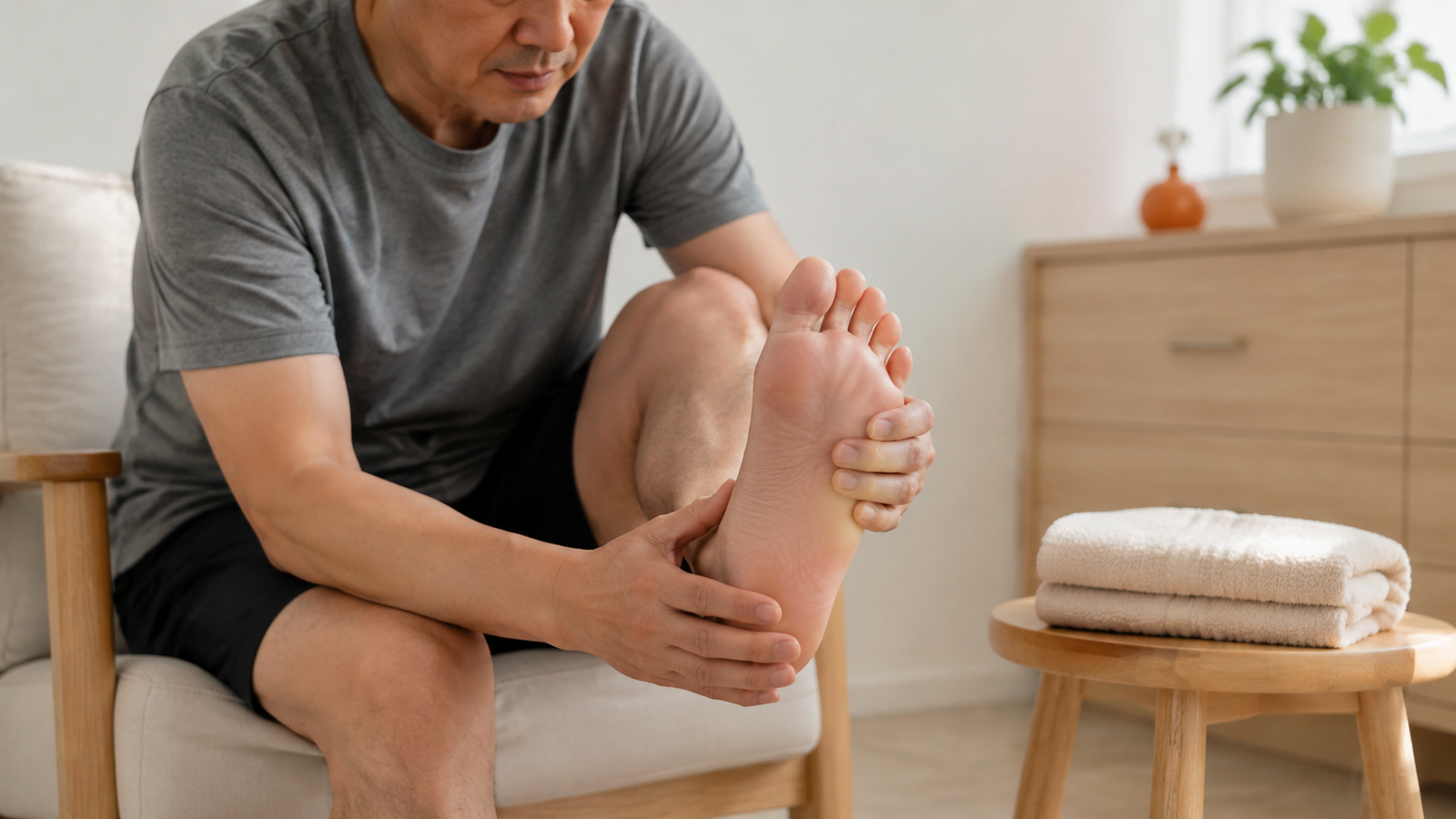
People with diabetes, reduced sensation, poor circulation, immune suppression, or a history of foot ulcers need particular caution. The CDC’s diabetes foot-care guidance advises daily inspection, warm—not hot—water, complete drying, and prompt attention to changes. A soft towel does not make vigorous rubbing or self-treatment of a wound safe.
What Do Readers Ask About Foot-Towel Hygiene and Absorbency?
Readers most often need decisions about washing frequency, towel separation, material claims, athlete’s foot, and performance testing. The answers below keep those decisions conditional on actual use, care instructions, and health status instead of presenting universal thresholds.
How often should I wash a foot towel?
Wash it whenever it becomes visibly soiled, smells, stays damp, has touched infected skin, or cannot dry fully before reuse. There is no universal two- or three-day rule. Use a clean personal towel, follow its care label, and increase laundering during an active infection.
Can I use the same towel for my feet and body?
A clean towel used once by one person is not automatically unsafe, but a separate foot towel makes use more consistent and is especially sensible during athlete’s foot. Do not share it, and use a separate clean towel for unaffected body areas when an infection is present.
Are microfiber foot towels more hygienic than cotton?
Not from the fiber label alone. Hygiene depends on the finished towel’s wetting, water pickup, drying time, cleanability, and how it is used and stored. Compare products under the same conditions and do not treat cotton, microfiber, linen, or rayon as an automatic hygiene guarantee.
Can a foot towel prevent or cure athlete’s foot?
No. Keeping feet clean and completely dry and avoiding shared towels can support prevention and control, but a towel cannot diagnose, prevent, or cure every infection. Persistent itching, scaling, cracking, pain, spreading redness, or recurrent symptoms require appropriate clinical or pharmacy advice.
How should foot-towel absorbency be compared?
Compare identical-sized samples after the same laundering and conditioning. Record wetting time, surface water pickup, retained water relative to dry mass, and time to dry after a controlled water load. One result cannot substitute for the others, so avoid judging performance from GSM alone.
What Is the Practical Conclusion About Foot-Towel Benefits?
A foot towel is useful when it creates a repeatable personal-use boundary and removes water from the entire foot with light contact. Its value comes from finished performance plus clean handling—not from a universal GSM, fiber hierarchy, antimicrobial label, fixed washing interval, or promise to prevent infection.
Choose by controlled comparison, use the towel by hand rather than as a floor mat, dry between the toes, hang the towel open, and launder according to the care label and the health context. If symptoms or high-risk conditions are present, move from textile troubleshooting to appropriate clinical care.