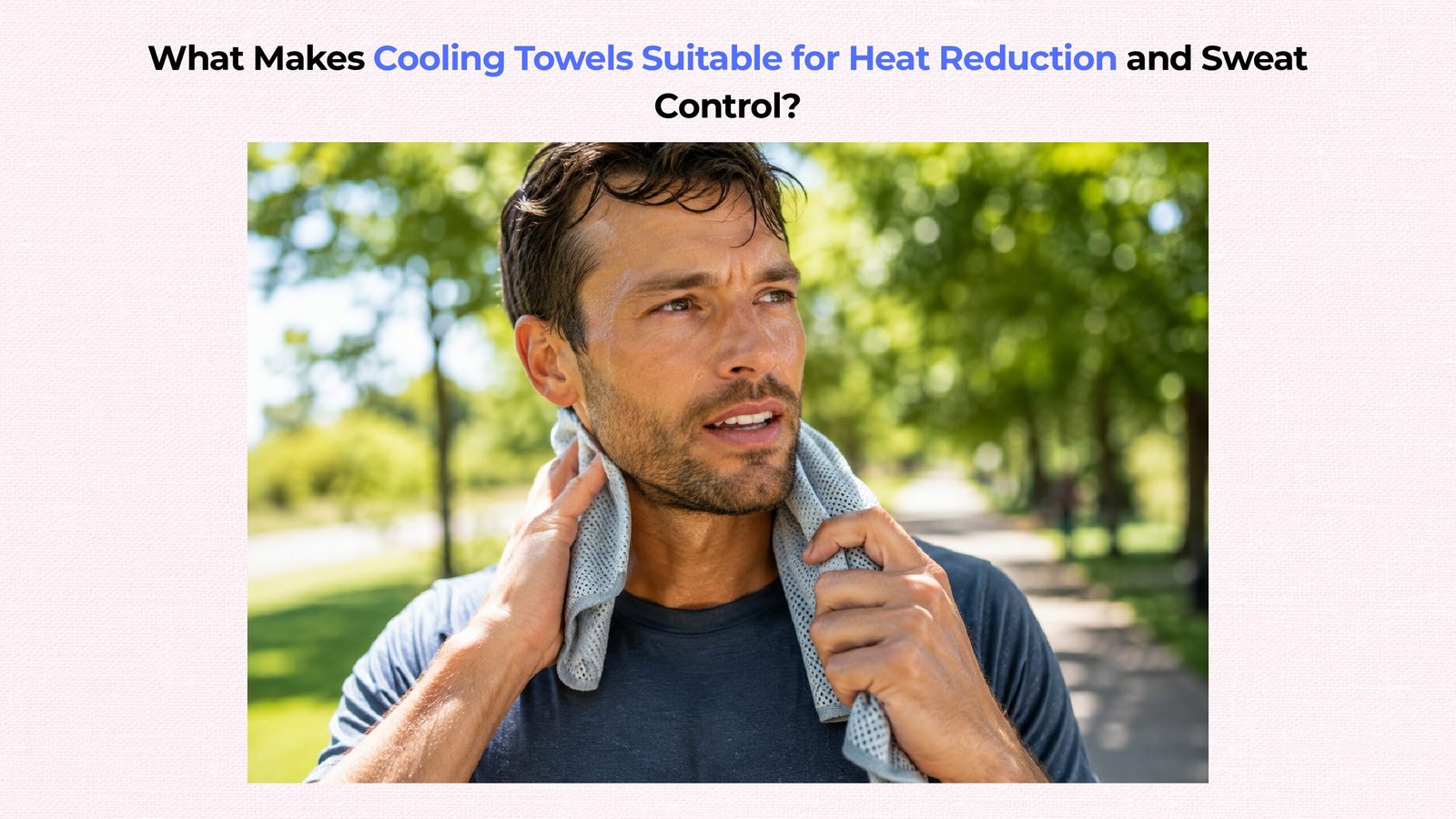
Cooling towels provide local skin cooling when water in the textile starts cooler than the skin or evaporates into the surrounding air. Their usefulness depends on water availability, skin contact, fabric construction, airflow, relative humidity, and the product’s care instructions—not on the words “cooling towel” alone.
This guide explains how cooling towels manage heat and liquid sweat, how to compare materials and performance claims, how to activate and care for a towel, and when a cooling towel is not enough for heat safety. The central distinction is simple: feeling cooler at the skin does not prove that core body temperature is controlled.
How Do Cooling Towels Reduce Local Skin Heat?
Cooling towels reduce local skin heat through two mechanisms: contact with water that is cooler than the skin and heat transfer during evaporation. The first effect begins immediately; the second continues only while liquid water can leave the fabric as vapor.
What Cooling-Towel Evaporation Mechanism Removes Heat?
Cooling-towel evaporation removes heat because liquid water absorbs energy during its phase change into vapor. Latent heat of vaporization means the energy required for that phase change without a temperature increase; near 25°C, water requires about 2.44 MJ per kilogram, based on thermochemical data compiled by the NIST Chemistry WebBook.
That large energy requirement explains why evaporating a small mass of water can cool a wet textile surface. It does not create a fixed temperature drop: air temperature, relative humidity, air speed, exposed wet area, water temperature, and skin contact all change the result.
Once water transport is understood, how cooling towels respond to body heat becomes the next question because contact cooling and evaporation can change independently.
Cooling-towel design therefore starts with water transport, because evaporation cannot continue if water stays in isolated pools or the fabric dries completely.
How Do Cooling Towels Manage Sweat Without Stopping Perspiration?
Cooling towels manage some surface sweat by absorbing, spreading, or moving liquid within the textile; they do not switch off the body’s sweating response. Once the towel becomes saturated, the liquid has nowhere to move until drainage or evaporation restores capacity.
How Do Cooling-Towel Wetting, Wicking, and Absorbency Differ?
Cooling-towel wetting describes how readily liquid enters the surface, wicking describes capillary movement through or along the textile, and absorbency describes how much liquid the material takes up. These are related attributes, but no single value proves overall cooling or sweat-control performance.
The American Association of Textile Chemists and Colorists lists nine separate methods in its moisture-management proficiency program, including tests for absorbency, liquid moisture management, vertical and horizontal wicking, drying rate, and water-vapor transmission. Capillary action is liquid movement through narrow spaces caused by adhesive and cohesive forces.
The practical insight is that high water capacity and fast moisture spreading solve different tasks. A suitable cooling towel balances enough retained water for continued use with enough exposed wet area and airflow for evaporation.
Which Cooling-Towel Materials Fit Different Uses?
Cooling-towel materials fit different uses only when their finished construction supports the required contact, water handling, drape, drying, and care. Fiber names alone cannot rank cooling performance because knit geometry, thickness, finishes, dimensions, and test conditions also influence the result.
That makes how cooling-towel materials and construction influence performance more useful than judging a product by fiber name alone.
How Should You Compare PVA, Microfiber, Mesh, and PCM Cooling Towels?
Cooling-towel materials should be compared by mechanism and verified finished-product behavior. AATCC TM195 explicitly covers three fabric classes—knitted, woven, and nonwoven textiles—and states that results depend on the fabric’s geometry, internal structure, fibers, yarns, and wicking characteristics.
Polyvinyl alcohol (PVA) is a water-compatible synthetic polymer used in some porous sheet constructions. Phase-change material (PCM) stores or releases heat while changing physical phase; a PCM insert therefore uses a different mechanism from a water-activated evaporative towel.
| Cooling-towel construction | Primary mechanism to verify | Useful selection check | Important limitation |
|---|---|---|---|
| Porous PVA sheet | The finished sheet retains and exposes water for evaporation. | Check wet flexibility, dry-storage instructions, odor care, and permitted wringing. | Some PVA products stiffen when dry, so the label must govern rehydration and storage. |
| Polyester or polyamide microfiber | The yarn and fabric structure spread liquid across an air-exposed area. | Compare wetting time, lateral spread, damp mass, drying time, and wash durability. | “Microfiber” identifies fine filaments, not a guaranteed wicking rate or cooling result. |
| Lightweight knit or mesh blend | The open construction supports air access while the fibers retain limited water. | Check drape, skin contact, edge comfort, stretch recovery, and re-wetting frequency. | Lower wet mass often means less stored water, but construction prevents a universal ranking. |
| Cotton or cotton blend | The cellulose component absorbs water while the fabric structure controls spreading and drying. | Compare thickness, wet weight, drying time, lint, and wash response. | High absorbency does not automatically produce fast evaporation or sustained skin cooling. |
| PCM insert or composite | The phase-change medium absorbs heat near its stated transition temperature. | Verify transition temperature, recharge method, duration protocol, total weight, and coverage area. | A PCM insert does not automatically absorb sweat or provide evaporative cooling. |
Material comparison leads to a more reliable buying rule: reject category-wide superlatives and look for test conditions that match the towel’s actual size, construction, water load, and intended environment.
Which Cooling-Towel Performance Claims Can You Verify?
Verifiable cooling-towel claims identify the test method, specimen size, starting water temperature, wringing method, air temperature, relative humidity, air speed, contact condition, comparison fabric, and measurement interval. A temperature drop or duration without those conditions is not a portable benchmark.
How Should Cooling-Towel Wetting, Drying, and Temperature Be Tested?
Cooling-towel testing should separate moisture uptake, moisture movement, drying, surface temperature, comfort, and core-temperature outcomes. The AATCC program uses nine different moisture methods; this separation shows why one absorbency result cannot establish every part of performance.
Gravimetric measurement means calculating a change from mass. Water uptake by dry weight is calculated as ((wet mass − dry mass) ÷ dry mass) × 100, but the wringing pressure and elapsed time must remain consistent for comparisons to mean anything.
- ☐ Record one cooling towel’s dimensions, dry mass, fiber label, and construction before wetting.
- ☐ Use the same water temperature, water volume, soaking time, wringing method, room conditions, and airflow for every specimen.
- ☐ Measure wet mass to calculate water uptake instead of accepting an unsupported “times its weight” claim.
- ☐ Log surface temperature with the same instrument and distance at fixed intervals; do not compare readings from different devices.
- ☐ Track the return toward dry mass to compare drying behavior under the same environment.
- ☐ Treat comfort and skin-temperature observations as local outcomes, not proof of reduced core temperature or heat-illness prevention.
Controlled measurement replaces the original universal claims of a 10–15°F drop, 30–60-minute duration, and two-to-four-times water uptake; those figures require product-specific evidence before publication.
After measuring the initial temperature change, examine what controls cooling-towel cooling duration because water load, airflow, and humidity determine how long the effect can continue.
How Should You Activate and Use a Cooling Towel?
A cooling towel should be activated according to its sewn label or package instructions because water-activated textiles and PCM products require different handling. Activation means putting the product’s cooling mechanism into its working state. The safe default for a water-activated towel is to wet it, remove unwanted dripping, maintain comfortable skin contact, and re-wet it when it warms or dries.
After identifying the mechanism, follow the correct way to activate a cooling towel so wetting, wringing, and re-wetting support the intended process.
Which Cooling-Towel Steps Preserve Contact and Evaporation?
Cooling-towel contact and evaporation are preserved by a five-step, label-led process. OSHA includes cold wet towels among several active first-aid cooling techniques, but its guidance also prioritizes a cooler area, removal of outer layers, fans, and rapid escalation when heat illness is suspected.
- Identify the mechanism. Confirm that the product is water-activated rather than a PCM insert that needs chilling, freezing, or another recharge process.
- Wet with clean water. Follow the label’s water-temperature and soaking directions; cold water adds an initial contact-cooling effect, while evaporation sustains local cooling afterward.
- Remove excess water as directed. Press or wring only if the care label permits it, stopping when the towel is wet without unwanted dripping.
- Apply without restriction. Keep the towel in comfortable contact without tightening it around the neck or allowing it to obstruct breathing, circulation, movement, or vision.
- Re-wet by condition. Re-wet the towel when it becomes warm or dry; no defensible universal 30–60-minute interval applies across products and environments.
Correct activation prepares the towel; the surrounding environment then determines how much evaporation remains available.
When Do Humidity and Airflow Limit Cooling-Towel Performance?
High relative humidity and low air movement usually limit evaporative cooling because water vapor leaves the towel more slowly. Direct contact with cooler water may still lower local skin temperature briefly, but a damp feeling or improved comfort does not establish control of internal body heat.
For damp environments, how humidity changes cooling-towel performance is the next practical question before relying on a duration or temperature claim.
Why Can a Cooling Towel Feel Cool Without Lowering Core Temperature?
A cooling towel can feel cool without lowering core temperature because local skin sensation and whole-body heat storage are different outcomes. Core temperature describes deep-body temperature, whereas skin temperature describes a surface or regional measurement.
In a 2016 randomized trial of 35 physically active men, Sefton and colleagues found that a commercial cooling towel used during 20 minutes of recovery in a hot, humid chamber did not lower rectal core temperature; temperature continued to rise in the towel, mist-fan, and passive groups. The finding directly rejects the assumption that a cool sensation proves physiological heat removal.
Evidence also changes with the protocol. A 2015 pilot study of eight men at 35°C and 70% relative humidity found that a wet neck towel plus fanning temporarily reduced neck skin temperature but did not prevent the measured cognitive decline. By contrast, a 2019 study of 12 trained football players reported a 0.28°C smaller rise in rectal temperature during a combined ice-towel, chilled-water, and extra-break protocol; that design cannot isolate the towel’s effect.
The unique decision rule is to match claims to the exact intervention: water-activated towel, ice towel, neck cooler, fan, drink, rest period, and body coverage are not interchangeable treatments.
How Should You Wash and Store a Cooling Towel?
A cooling towel should be washed and stored according to its care label, using enough rinsing to remove sweat, body oil, soil, and detergent. Dry or damp storage rules differ by construction, especially for porous PVA sheets, so a universal “air-dry only” instruction is unsafe for product care.
Because residue can alter wetting and odor, how to wash a cooling towel without degrading its performance should be checked against the product label before choosing detergent or additives.
Which Cooling-Towel Care Steps Protect Wetting and Odor Control?
Cooling-towel wetting and odor control are protected by complete cleaning, thorough rinsing, and label-compliant drying or storage. In a 2021 textile study, Igarashi and Nakamura measured the absorption time of a 0.04 mL water droplet and showed that softener chemistry and added hydrophilic particles—water-attracting particles—changed the wetting result; “softener always ruins absorbency” is therefore too broad.
- ☐ Wash the cooling towel after sweaty or dirty use at the label’s permitted temperature and cycle.
- ☐ Use the detergent dose required for the soil level and water conditions; rinse until no slippery or sudsy residue remains.
- ☐ Add fabric softener, bleach, disinfectant, vinegar, or another treatment only when the towel label and product directions permit it.
- ☐ Dry or store the cooling towel exactly as directed; some constructions require complete drying, while some PVA products specify storage practices that prevent damaging stiffness.
- ☐ Retire a cooling towel that retains objectionable odor after proper washing, sheds material, develops permanent tackiness, or causes skin irritation.
Care preserves the textile’s function, but even a clean, well-performing towel remains a supplemental comfort tool rather than a complete heat-control plan.
Once the towel is clean, how to store a cooling towel between uses determines whether trapped moisture, stiffness, or odor becomes the next problem.
When Is a Cooling Towel Not Enough for Heat Safety?
A cooling towel is not enough when heat exposure requires hazard reduction, rest, shade or air conditioning, fluids, acclimatization, supervision, or medical care. Acclimatization is the gradual physiological adaptation to repeated heat exposure. OSHA’s heat-control guidance states that the best prevention reduces the heat hazard itself or changes how work is performed; personal cooling equipment supplements those controls.
In higher-risk conditions, the limits of cooling-towel performance in extreme heat help separate local comfort from adequate heat-safety control.
Which Heat-Illness Signs Show a Cooling Towel Is Not Enough?
A cooling towel is not enough when heat-illness symptoms appear: provide prompt first aid, and call 911 immediately for confusion, slurred speech, or unconsciousness. OSHA’s heat-illness guidance says to cool the person immediately and never leave an affected worker alone because the condition can worsen rapidly.
- ☐ Move a symptomatic person to shade, air conditioning, or another cooler area immediately.
- ☐ Stop exertion, remove unnecessary outer clothing, and begin active cooling while help is arranged.
- ☐ Use cold water, ice, fans, or cold wet towels as appropriate first-aid tools; do not rely on one small cooling towel alone.
- ☐ Call 911 immediately for confusion, slurred speech, unconsciousness, or any concern for heat stroke.
- ☐ Stay with the affected person and continue cooling until emergency help arrives.
Heat safety therefore sets the boundary for every product claim: local comfort must never delay hazard control or emergency response.
Which Cooling-Towel Questions Need Short Answers?
Cooling-towel questions need answers that separate local sensation, textile moisture behavior, environmental limits, and core-temperature safety. The following four answers summarize the article’s mechanism, material, humidity, and perspiration findings without adding new claims.
What Should Users Know About Cooling-Towel Cooling, Humidity, and Sweat?
Cooling-towel users should apply the same four evidence boundaries to the answers below: AATCC methods characterize textile behavior, OSHA guidance addresses heat safety, human trials test specific protocols, and product labels govern activation and care. None makes every product equivalent.
Why does a cooling towel feel cold after wetting?
A cooling towel feels cold because water on and inside the textile absorbs thermal energy as it evaporates. Wetting also creates an initial conductive cooling effect when the water is cooler than the skin. Airflow supports evaporation; snapping is optional and does not open permanent fabric channels.
Do all cooling towels work by evaporation?
Most water-activated cooling towels depend mainly on evaporation and initial contact with cooler water. Products containing a phase-change insert use melting or solidification as an additional mechanism. Product construction matters, so buyers should verify the care label and manufacturer instructions instead of relying on the category name alone.
Do cooling towels work in high humidity?
Cooling towels usually evaporate more slowly in high humidity because the surrounding air has less capacity to accept additional water vapor. A towel may still feel cool through contact with cooler water, but comfort does not prove that it lowers core body temperature or prevents heat illness.
Do cooling towels stop sweating?
Cooling towels do not stop the body’s sweating response. A suitable fabric absorbs or spreads some liquid and keeps water available for evaporation, but performance changes as the textile saturates, dries, becomes coated with residue, or sits in humid, still air.
What Is the Bottom Line on Cooling-Towel Performance?
Cooling-towel performance comes from water temperature, evaporation, contact, moisture movement, and finished construction working under specific environmental conditions. The towel can improve local comfort and manage some liquid sweat, but it does not guarantee a fixed temperature reduction, duration, one-way transport path, or lower core body temperature.
Which Cooling Towel Should You Choose?
Choose a cooling towel whose labeled mechanism, dimensions, care requirements, wet weight, and verified test conditions match the intended activity and climate. Use it as one part of heat management, then prioritize shade, rest, fluids, acclimatization, and medical action when conditions demand them.
TowelDaily’s evidence-based approach treats every cooling claim as a testable interaction between textile, water, air, skin, and use conditions. That approach gives you a clearer choice—and a safer boundary—than any unsupported “best cooling towel” promise.