TowelDaily Science & Textile Engineering
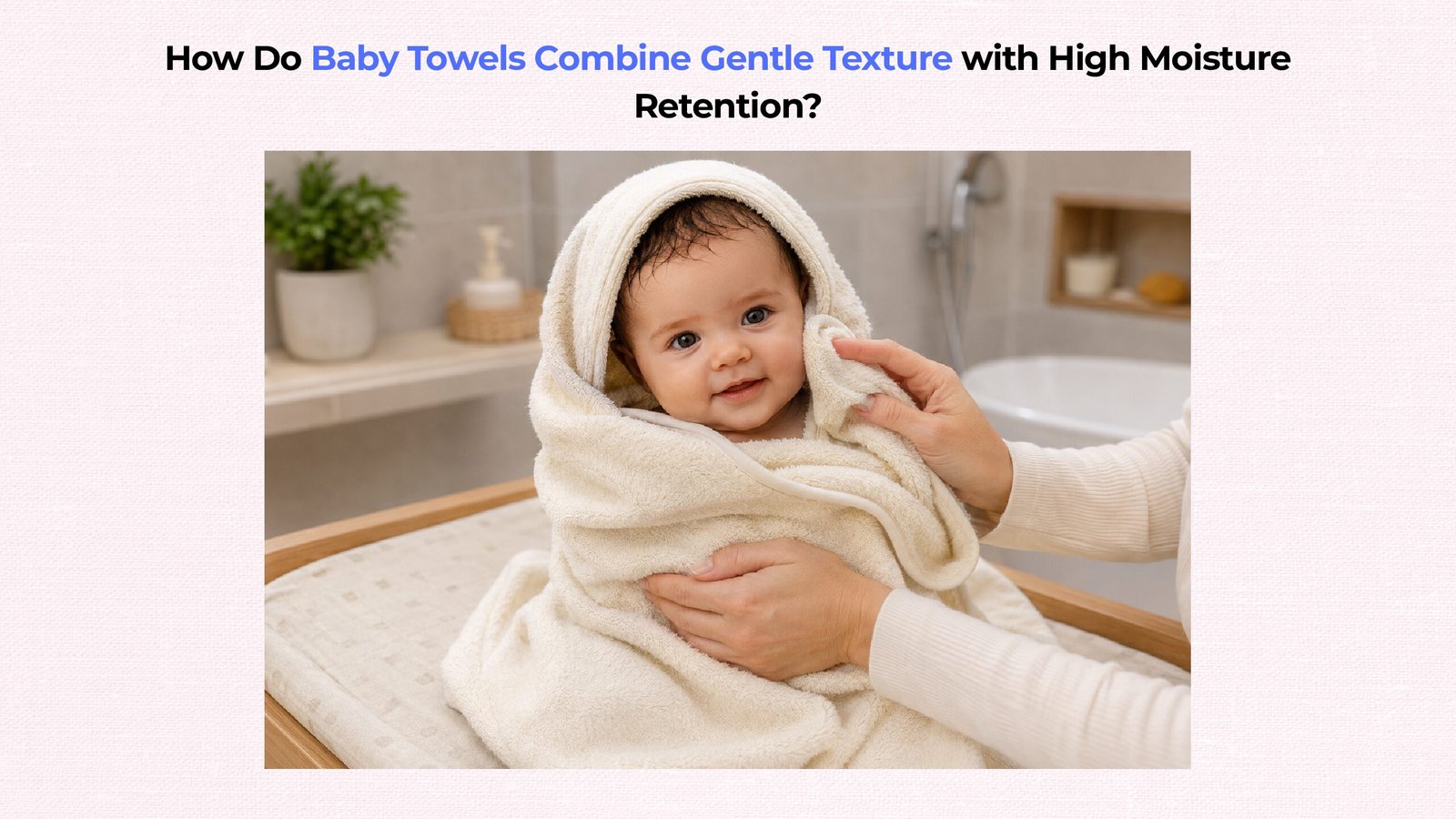
A baby towel combines gentle contact with effective moisture removal when its finished surface stays pliable while wet, its construction picks up bath water with light blotting, and its size and edges remain easy to control. No fiber name, GSM band, loop profile, or marketing claim proves that combination on its own.
That distinction matters because parents experience the complete product, not an isolated fiber. Yarn twist, pile geometry, ground fabric, seams, laundering, water load, pressure, and drying method interact. This guide turns those variables into selection, testing, use, care, and troubleshooting decisions without inventing one universal baby-towel specification.
Surface, seams, and hems
Measured after prewashing
Coverage without excess bulk
Before clean storage
How Can a Baby Towel Be Gentle and Absorbent at the Same Time?
A baby towel can satisfy both tasks when the contact surface bends under light pressure and the textile wets and retains enough water for the intended bath. Gentleness and absorbency are related through construction and use, but they are not opposite ends of one universal scale.
Fabric hand is the combined tactile impression of properties such as pliability, surface roughness, thickness, and resilience. Wetting is how readily liquid spreads into the textile; surface pickup is how much water the towel removes from another surface; capacity is how much water it holds under a defined procedure. These properties require separate observations.
The surface must also be evaluated wet. A towel may feel plush on a shelf yet become stiff, slick, linty, or heavy after washing and saturation. Conversely, a low-profile towel may provide controlled blotting and shorter between-use drying. The correct comparison uses finished, prewashed samples under the same conditions.
Which Baby-Towel Constructions Can Balance Contact and Water Storage?
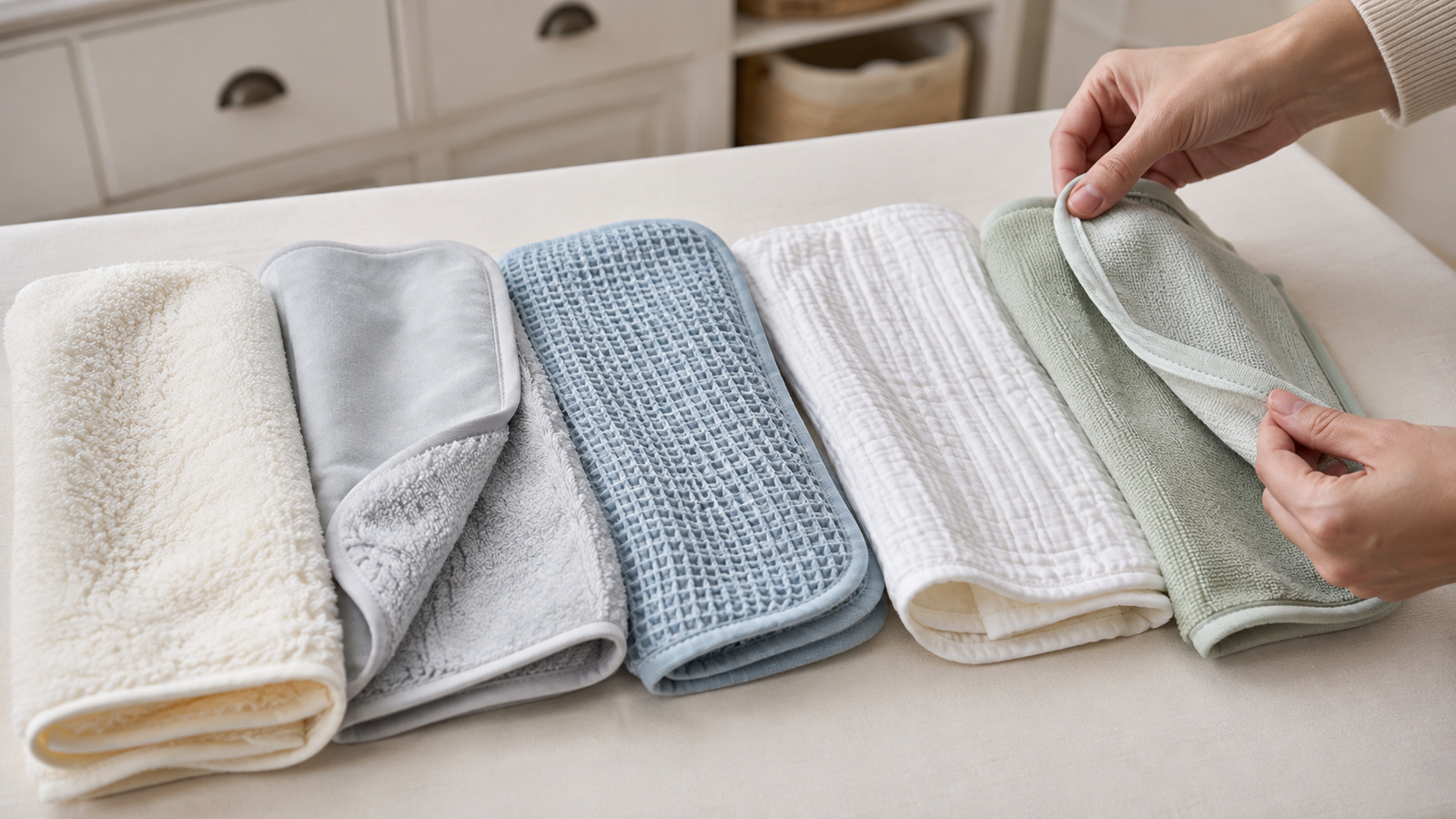
Terry, velour-faced terry, waffle, muslin, and knitted pile can each work, but they distribute contact area, water storage, bulk, and drying demand differently. A velour face with a terry reverse is one possible two-surface construction, not the standard architecture for every baby towel.
Uncut terry supplies exposed pile loops and additional yarn mass. Shearing those loops creates a velour face but also changes the contact surface and can change water pickup. Waffle relief creates raised contact points and open channels with lower pile bulk. Muslin relies on layered plain-weave fabric rather than terry loops. None of these names discloses yarn quality, finish, seam construction, or behavior after laundering.
How Should Baby-Towel Gentleness Be Assessed?
Assess gentleness by controlling how samples are conditioned and handled, then inspect the entire finished towel in both dry and damp states. AATCC EP5-2025 standardizes presentation for subjective fabric-hand evaluation, while ASTM D1388-23 measures bending length and flexural rigidity. Neither method is a medical test of infant-skin compatibility.
For a practical household trial, prewash candidate towels as instructed, dampen equal areas with the same water volume, and compare pliability, snagging, loose lint, seam ridges, label edges, and hood stiffness. The unique failure point is often not the field of fabric but a bound edge that becomes firmer when wet or distorted after laundering.
Since a towel can feel different after wetting and repeated laundering, what determines baby-towel softness and comfort should be assessed across the surface, seams, hems, and hood edges.
How Should Baby-Towel Absorbency and Drying Be Tested?
Baby-towel performance should be tested as a sequence: initial wetting, surface pickup, usable capacity, wet handling, and drying under defined conditions. Calling all five outcomes “absorbency” hides the reason one towel succeeds and another fails.
Which Textile Methods Answer Each Moisture Question?
ASTM D4772-26 addresses rapid surface-water absorption and retention by terry fabric. ISO 20158:2018 separates water-absorption time from capacity across several absorbent fabric structures, while AATCC TM79-2025 is a general textile-absorbency method. Results from different procedures are not interchangeable.
Drying adds another condition set: starting water mass, specimen size, air temperature, humidity, airflow, orientation, and end point. AATCC lists separate moisture methods for drying time and drying rate because a towel tested nearly dry is not equivalent to one tested at absorbent capacity. Supplier data should therefore identify the method and conditions, not just say “quick-dry.”
Once gentleness has been assessed, how baby-towel absorbency relates to drying performance becomes the next question because greater water storage can also increase wet bulk and drying demand.
How Can Parents Run a Controlled Baby-Towel Comparison?
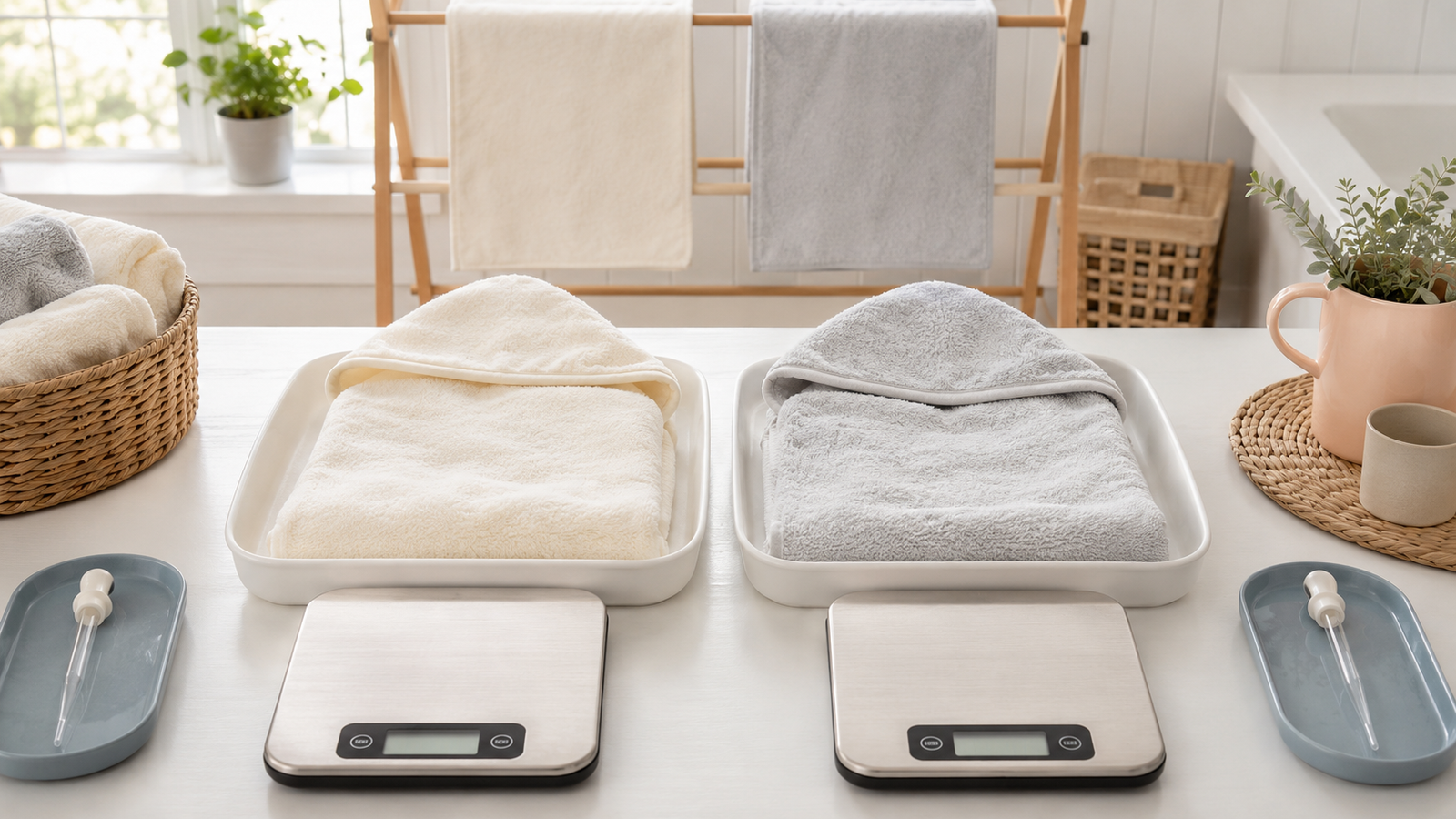
Parents can screen candidates by prewashing them as labeled and comparing equal areas with the same measured water load, contact time, folding pattern, and drying location. Run three repetitions per towel; repeatability is more informative than one dramatic demonstration.
Record dry mass, mass after pickup, visible water left on the test surface, damp hand, and time to reach the same dry end point. Water gained equals wet mass minus dry mass. Dividing water gained by dry mass gives a capacity ratio for that procedure only; it is not a universal rating or substitute for a standardized laboratory method.
| Claim | What to control | What to record | Main limitation |
|---|---|---|---|
| Wets quickly | Prewash, drop size, surface, time | Time to spreading or entry | Does not measure total capacity |
| Picks up water | Water load, contact, pressure | Mass gain and water remaining | Technique affects the result |
| Holds enough | Sample size and saturation procedure | Water gained per dry mass | More capacity can mean more wet bulk |
| Dries quickly | Starting water, airflow, humidity, hanging | Time to the same dry end point | Room conditions change the result |
| Feels gentle | Conditioning, wetness, handling order | Surface, seams, lint, pliability | Subjective hand is not a skin-safety test |
How Do Fiber and Construction Labels Affect Baby-Towel Selection?
Fiber and construction labels narrow the comparison, but they do not predict the hand, absorbency, drying time, lint, or dimensional stability of a finished baby towel. Use them to identify what to test, then decide from the laundered product.
Cotton can be made into low- or high-pile terry, velour, waffle, or muslin. Regenerated cellulose can be blended with cotton or used in pile yarns. Polyester and polyamide can appear in microfiber constructions or supporting yarns. Each category spans different yarn counts, finishes, pile densities, and fabric masses, so categorical “best” rankings are unreliable.
Fiber labels become more useful when considered alongside how baby-towel materials interact with delicate skin rather than being treated as guarantees of softness or irritation prevention.
The U.S. Federal Trade Commission distinguishes actual bamboo fiber from rayon or viscose made using bamboo as the plant source. A “bamboo” marketing label therefore should not be read as proof of natural fiber, antimicrobial activity, softness, absorbency, or environmental superiority.
| Label or format | Potential design reason | Verify after laundering |
|---|---|---|
| Cotton terry | Pile surface and yarn mass | Pickup, wet bulk, lint, complete drying |
| Velour face / terry reverse | Two different contact geometries | Which side picks up water; edge stiffness |
| Waffle | Relief without long pile | Damp texture, coverage, capacity |
| Layered muslin | Light, flexible plain-weave layers | Pickup per pass, seam distortion, coverage |
| Rayon/viscose made from bamboo | Regenerated-cellulose component | Exact blend, wet strength, drying, care limits |
How Should GSM, Size, and Hood Design Be Chosen for a Baby Towel?
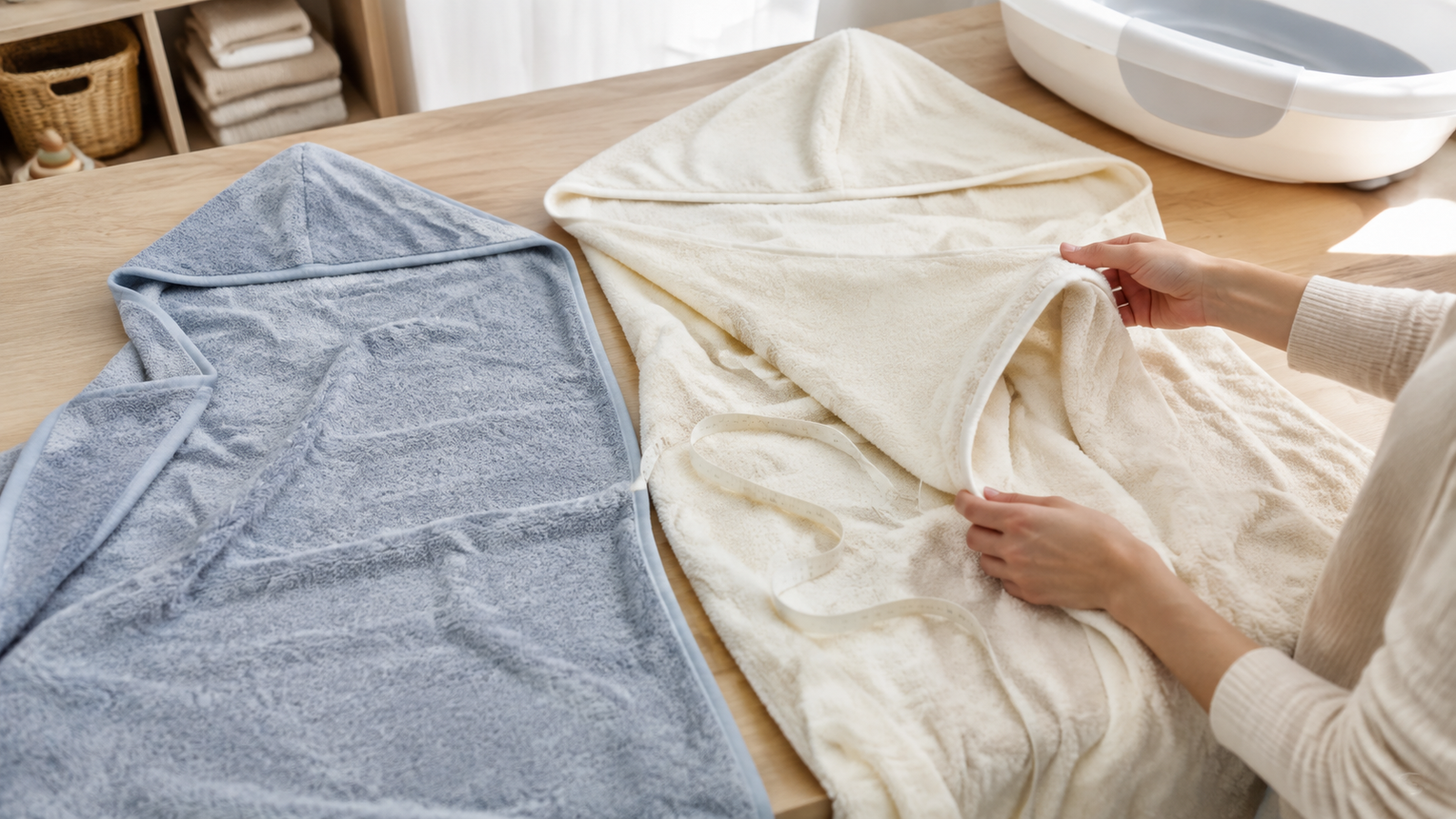
Choose GSM, dimensions, and hood design as interacting handling variables. The towel should provide enough dry area for the intended bath while remaining easy for the caregiver to position, fold, lift, launder, and dry completely.
GSM is dry fabric mass in grams divided by area in square meters. It does not disclose size: two towels can share one GSM yet have different total mass. Nor does GSM reveal fiber placement, loop geometry, finish, surface pickup, water capacity, or drying time. Reject the unsupported idea that one 350–450 GSM band suits every baby, climate, and laundry setup.
Since GSM does not reveal total towel mass or ease of handling, how baby-towel size and thickness affect practical use should be considered before choosing a product.
A hood can help position a corner and cover the head after lifting, but it is not a safety device. Inspect hood depth, binding stiffness, decorative attachments, and loose threads. Keep the towel away from the face and airway, supervise continuously, and do not use a bath towel as sleepwear, bedding, or an unattended wrap.
When a hood is included, the benefits and safety considerations of hooded baby towels help parents evaluate positioning, binding stiffness, attachments, and airway clearance.
☐ The laundered surface and every bound edge remain pliable when damp.
☐ The towel removes the trial water load without repeated rubbing.
☐ Its wet mass, size, and hood remain easy to control with one caregiver.
☐ No loose trim, hard label edge, snagged loop, or distorted seam is present.
☐ The care instructions fit the household washer, dryer, and drying space.
How Should a Baby Towel Be Used After a Bath?
Use a baby towel by preparing it before the bath, supporting the baby continuously, covering promptly for warmth, and blotting rather than scrubbing. The towel is part of the handling sequence; absorbency never replaces direct supervision.
Place the open towel within reach on a stable, dry surface before water contact begins. The U.S. Consumer Product Safety Commission says young children should never be left alone near bath water and should stay within an adult’s arm’s reach in the bathtub. Do not step away to retrieve a towel.
After lifting the baby securely, cover the head and body without covering the nose or mouth. Expose one area at a time and press a clean, dry section lightly against the skin. Rotate to a drier area when the contact zone becomes saturated. Pay attention to skin folds, then move the used towel to a ventilated drying or laundry location.
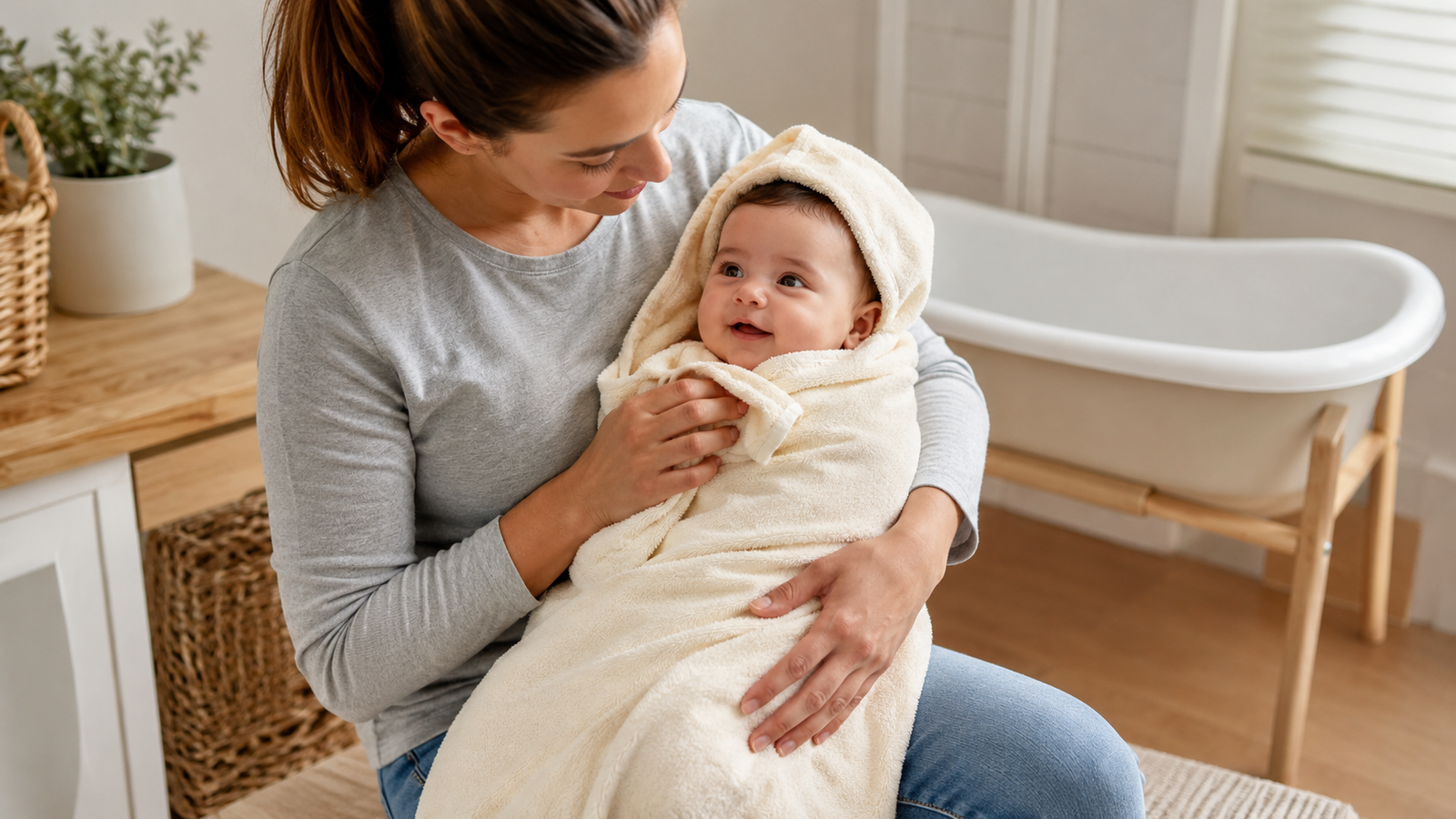
HealthyChildren.org from the American Academy of Pediatrics advises keeping a baby warm during bathing and using a dry towel for coverage. That guidance supports prompt preparation and coverage; it does not establish a required towel fiber, pile height, or GSM.
What Changes When a Baby Has Eczema or Sensitive Skin?
When a baby has eczema, broken skin, a rash, or persistent irritation, prioritize the child’s care plan and minimize rubbing; do not assume a textile label will prevent a flare. A clean, soft towel and gentle technique are supporting choices, not treatment.
The American Academy of Dermatology recommends warm rather than hot water, a five-to-ten-minute bath, and gently patting a child’s skin partially dry. The towel should therefore remove excess surface water without aggressive wiping or repeated dragging.
Change one variable at a time when investigating irritation: towel, detergent, softener, fragrance, bath product, temperature, or technique. Stop using a towel that causes visible redness, snagging, or discomfort. Seek pediatric or dermatology guidance for worsening, infected-looking, weeping, painful, or persistent symptoms rather than repeatedly changing textile treatments.
How Should Baby Towels Be Washed and Dried?
Wash and dry baby towels according to the sewn-in or supplied care instructions, the appliance manuals, and the laundry-product directions. There is no defensible universal rule to use half-dose detergent, cap washing at 40°C, or add vinegar every six to eight weeks.
After each use, how to wash baby towels correctly determines whether soil, residue, lint, and fabric stiffness are managed without damaging the construction.
Before first use, follow the product’s washing instruction to remove loose lint and permitted manufacturing residues. Dose detergent for the washer type, load size, soil, and water conditions. Overloading can obstruct washing, rinsing, and drying; under-dosing or over-dosing can each leave performance problems, depending on the soil and formula.
Because both excessive and insufficient dosing can create performance problems, how to choose and use detergent safely for baby towels should be checked against the textile, appliance, and laundry-product instructions.
Fabric softener requires a trade-off decision. A 2021 cotton-fabric study describes improved softness alongside reduced water absorbency with existing softeners. That finding does not justify “never” for every formula and textile, but it supports comparing the same towel with and without a permitted softener when pickup declines.
Do not improvise with vinegar, bleach, disinfectant, or fragrance boosters. These chemicals have separate labels, incompatibilities, and appliance restrictions. Use only what every relevant instruction permits, never combine laundry chemicals, and keep all products out of children’s reach. If a clinician gives infection-control instructions for a medical condition, follow that plan.
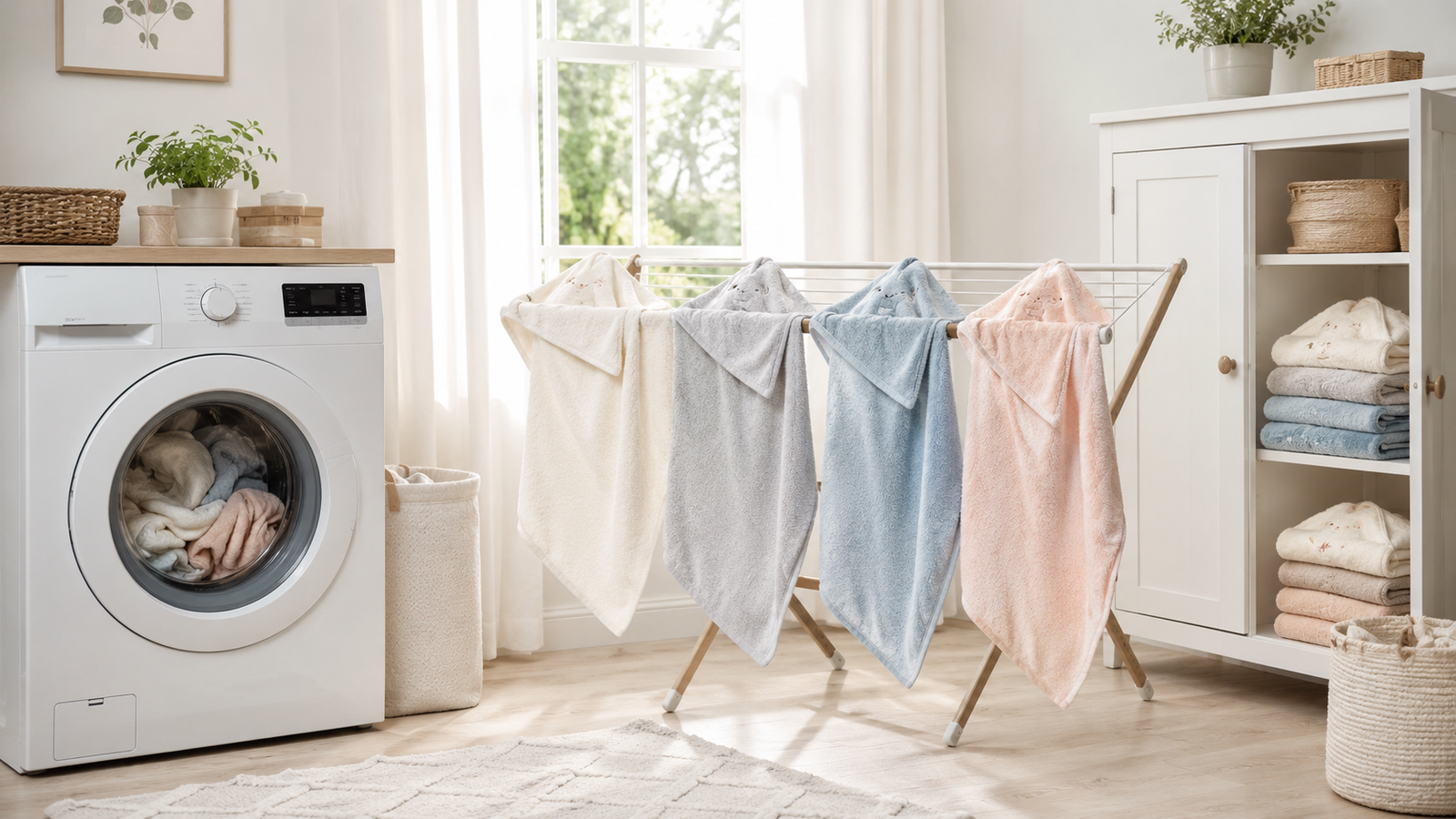
Dry the towel completely before clean storage. “Line dry” and “tumble dry” are not interchangeable, and dryer temperature must follow the label. When comparing products over time, note shrinkage and seam distortion; AATCC TM135-2025 exists specifically to measure dimensional change after home-laundering procedures.
Once washing is complete, how baby towels should be dried before storage becomes essential for controlling prolonged dampness, odor, shrinkage, and seam distortion.
☐ Read the towel, washer, dryer, and laundry-product instructions.
☐ Separate heavily soiled items as household and clinical guidance requires.
☐ Use the directed product dose and a load size that permits circulation.
☐ Add no unapproved treatment and never mix laundry chemicals.
☐ Confirm complete drying before folding or storing the towel.
How Can Common Baby-Towel Problems Be Diagnosed?
Diagnose a baby-towel problem by changing one factor and repeating the same comparison. Slow wetting, poor pickup, stiffness, odor, lint, and long drying have different possible causes, so one stripping treatment cannot responsibly solve them all.
| Symptom | Check first | Controlled next step | Retire or escalate when |
|---|---|---|---|
| Slow initial wetting | Newness, finish, softener, test method | Care-label wash; repeat equal-load test | Pickup remains inadequate for the bath |
| Stiff or scratchy | Overdrying, residue, mineral load, seams | Verify dose, rinse, and drying setting | Edges abrade, snag, or irritate skin |
| Persistent odor | Delayed washing, damp storage, load size | Launder as labeled; dry completely | Odor persists or visible growth appears |
| Excess lint | Early washes, torn loops, labels, abrasion | Inspect after the permitted wash and dry | Shedding is heavy or damage progresses |
| Redness or discomfort | Technique, products, seams, skin condition | Stop use; compare one variable at a time | Symptoms persist, worsen, or look infected |
What Do Parents Ask About Baby Towels?
Parents most often need to separate finished-towel performance from fiber, GSM, softener, skin, and care claims. These concise answers preserve those boundaries.
What makes a baby towel feel gentle?
Finished construction matters more than a single fiber label. Check the damp surface, seams, hems, and any hood edge, then pat rather than rub. A towel that stays pliable after repeated care-label laundering and removes water without repeated passes is the stronger candidate.
Does a higher GSM make a baby towel more absorbent?
Not by itself. GSM reports dry mass per square meter, while wetting speed, surface pickup, capacity, and drying time are separate properties. Compare equal-size, prewashed samples under the same water load and technique instead of relying on an unsupported universal GSM range.
Can fabric softener be used on baby towels?
Check the towel, washer, and softener instructions first. Softener can improve dry hand but may reduce water absorbency on cotton, so a no-softener comparison is useful when pickup declines. Avoid assuming softener either sterilizes the towel or causes bacterial growth by itself.
Which baby-towel material is best for sensitive skin?
No fiber name guarantees compatibility with sensitive skin. Compare the finished towel after laundering: damp-surface feel, seam stiffness, lint, fragrance or residue, and the child’s response all matter. For eczema or persistent irritation, follow the child’s clinician or dermatologist rather than a textile label.
How should baby towels be washed and dried?
Follow the care label plus the washer, dryer, and detergent directions. Use the instructed dose and permitted temperatures, rinse adequately, and dry completely before storage. Do not add vinegar, bleach, softener, or another treatment unless every relevant product and appliance instruction permits it.
What Is the Best Way to Choose a Gentle, Absorbent Baby Towel?
The best approach is to select a controllable size, inspect the complete construction, prewash it as labeled, and compare damp hand, water pickup, wet bulk, and complete drying under repeatable conditions. Use gentle blotting, keep the baby supervised and warm, and let the child’s skin response override marketing claims.
Fiber content, weave, pile, and GSM remain useful descriptors, but none is a finished-performance guarantee. A baby towel succeeds when its laundered surface and edges stay comfortable, its available area removes the expected bath water without rubbing, and the household can wash and dry it correctly every time.