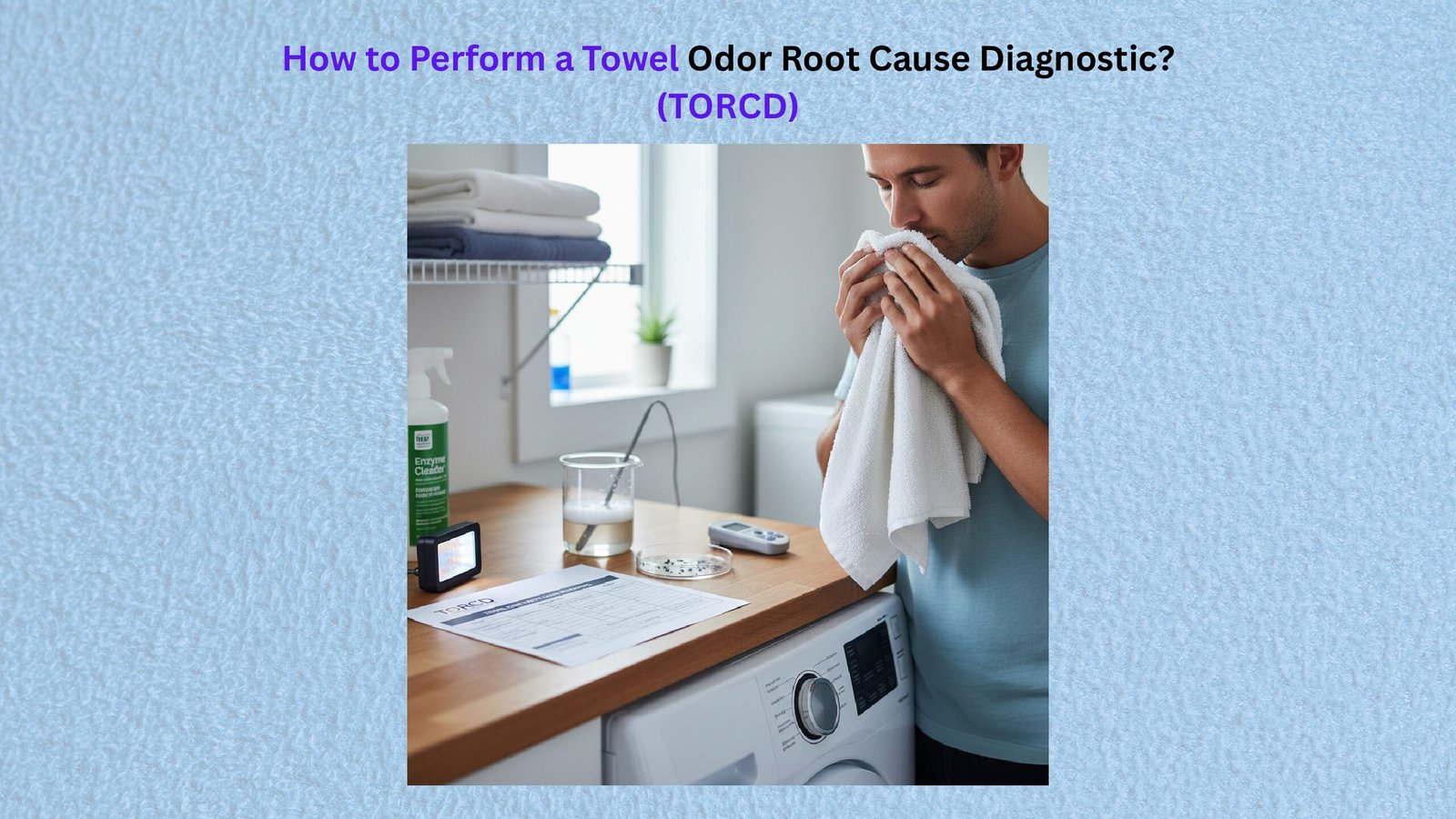
How to Perform a Towel Odor Root Cause Diagnostic? (TORCD)
A Towel Odor Root Cause Diagnostic is a systematic process of variable isolation designed to distinguish between microbial colonization (Moraxella osloensis) and chemical surfactant buildup, enabling the permanent elimination of “sour” laundry smells.
This article will provide a scientific framework to test water temperature, detergent volume, and drying speed to identify the specific driver of malodor in household textiles. By identifying whether the failure point is thermal, chemical, or environmental, we can move beyond symptomatic masking toward a permanent cure.
Why a Strategic Towel Odor Root Cause Diagnostic is Essential for Microbial Control
A strategic Towel Odor Root Cause Diagnostic is essential for microbial control because “sour” odors are not merely unpleasant; they are the metabolic byproduct of thriving bacterial colonies protected by chemical biofilms. These structures act as armor, rendering standard “cold water” or “quick wash” cycles ineffective.
Quantifying the Microbial and Chemical Drivers in a Towel Odor Root Cause Diagnostic
Quantifying the microbial and chemical drivers in a Towel Odor Root Cause Diagnostic reveals the specific biological mechanism behind the smell. Seminal research by Kubota et al. (Kao Corporation) identified Moraxella osloensis as the primary culprit in textile malodor.
The “sour” odor is caused by 4-methyl-3-hexenoic acid (4M3H), a volatile compound produced by Moraxella bacteria. This bacterium is highly resistant to desiccation (drying) and requires temperatures $\ge 60^{\circ}C$ ($140^{\circ}F$) to denature its proteins effectively.
Unique Insight: The Detergent Paradox
Excess detergent volume creates a surfactant-rich biofilm inside the washer and on the fiber; this sticky layer traps skin cells, creating a nutrient-dense breeding ground for bacteria while shielding them from hot water. More soap often makes the smell worse.
What Defines the Research Protocol for a Towel Odor Root Cause Diagnostic?
The research protocol for a Towel Odor Root Cause Diagnostic defines the exact conditions required to replicate and isolate the malodor. Consistency in these variables is the only way to ensure the data accurately reflects the towel’s condition.
Establishing the Problem Statement and Objective for the Towel Odor Root Cause Diagnostic
Establishing the problem statement for the Towel Odor Root Cause Diagnostic requires identifying the “Reactivation Trigger.” Using concepts from ASTM E18 (Standard Guide for Sensory Evaluation), we categorize the odor profile.
The human olfactory threshold for 4M3H is extremely low (parts per billion). The objective is to determine if the odor appears immediately upon re-wetting (indicating dormant bacteria reactivation) or builds up over time (indicating slow drying).
The Differentiation Rule: If the towel smells sour while dry, it’s a storage/mildew issue. If it smells sour only when damp, it is a Moraxella/Biofilm issue, which dictates the diagnostic path.
How to Isolate and Manipulate Variables within the Towel Odor Root Cause Diagnostic
Isolating and manipulating variables within the Towel Odor Root Cause Diagnostic involves testing one factor at a time to find the failure point. This ensures that a single change (e.g., higher heat) can be definitively linked to an outcome.
How Do You Manipulate Independent Variables for the Towel Odor Root Cause Diagnostic?
Manipulating independent variables for the Towel Odor Root Cause Diagnostic focuses on the three pillars of laundry hygiene: Chemistry, Thermal Energy, and Time.
- Variable A (Temperature): Test Low ($30^{\circ}C$) vs. High ($60^{\circ}C$). Bacterial populations can double every 20 minutes in optimal conditions; heat must be sufficient to kill, not just annoy.
- Variable B (Drying Velocity): Test High-Heat vs. Air Dry. Dampness exceeding 4 hours allows surviving populations to regrow to olfactory detection levels before the towel is dry.
Unique Insight: Detergent Starvation
Run a cycle with Zero Detergent. If suds appear in the window, you have confirmed “Detergent Build-up” as the root cause (the towel is washing itself with old soap).
How Do You Control Confounding Inputs to Ensure Integrity?
Controlling confounding inputs ensures that the Towel Odor Root Cause Diagnostic measures the towel’s condition, not the machine’s environment. According to Callahan et al., domestic washing machines can harbor >10^6 CFU/cm² of biofilm in rubber door seals.
Machine Cleanliness
Run a “Clean Washer” cycle with 1 cup of bleach before testing to zero out the machine’s microbial load.
Material Consistency
Use 100% cotton towels. Synthetic blends harbor different microbiomes (e.g., Micrococcus) due to hydrophobicity.
How to Log Data and Calculate Results for the Towel Odor Root Cause Diagnostic?
Logging data and calculating results for the Towel Odor Root Cause Diagnostic transforms smell—a subjective sense—into a hard data point.
Executing the 5-Cycle Data Log for the Towel Odor Root Cause Diagnostic
Executing the 5-Cycle Data Log for the Towel Odor Root Cause Diagnostic requires disciplined sensory evaluation based on ISO 13299 methodology.
Interactive TORCD Score Log
Score each cycle 1 (Fresh) to 10 (Severe). Wet the towel, sit for 2 hours, then evaluate.
Using the Comparison Matrix to Finalize Insight
Using the Comparison Matrix to finalize the Towel Odor Root Cause Diagnostic insight highlights the correlation between variables and odor reduction. This uses Six Sigma Root Cause Analysis principles to find the “Good Cycle” commonality.
| Variable Condition | Frequency in “Good” (Score 1-3) | Frequency in “Bad” (Score 7-10) | Root Cause Implication |
|---|---|---|---|
| Hot Water ($>60^{\circ}C$) Used | 5/5 | 0/5 | Thermal Failure |
| Reduced/No Detergent | 4/5 | 1/5 | Chemical Biofilm |
| High Humidity Drying | 0/5 | 5/5 | Drying Velocity |
The unique insight is identifying Biofilm vs. Bacteria: If “No Detergent” cycles smell better than “Full Detergent” cycles, the root cause is Chemical Biofilm Trapping, not lack of soap.
Frequently Asked Questions
Why do my towels only smell “sour” once they get damp?
Can I use vinegar instead of baking soda for the diagnostic?
How often should I perform a Towel Odor Root Cause Diagnostic?
Does fabric softener interfere with the diagnostic protocol?
Conclusion: Executing the Final Solution via the TORCD Hypothesis
The final solution involves executing a validated hypothesis to permanently resolve the findings of the Towel Odor Root Cause Diagnostic.
Run a cycle with No Detergent + 1 Cup Baking Soda at $60^{\circ}C$. Baking soda pH ($\approx 8.3$) neutralizes acidic 4M3H odor.
Reduce volume by 50% from manufacturer recommendation to prevent new biofilm formation.
Ensure Odor Score remains $\leq 2$ after multiple uses.
Summary Conclusion
The Towel Odor Root Cause Diagnostic eliminates “sour” smells by isolating Moraxella osloensis and Biofilm Buildup, proving that higher temperatures ($>60^{\circ}C$) and lower detergent volumes are often the scientific solution. Trust the chemistry of the diagnostic over the marketing of “more scent beads.”