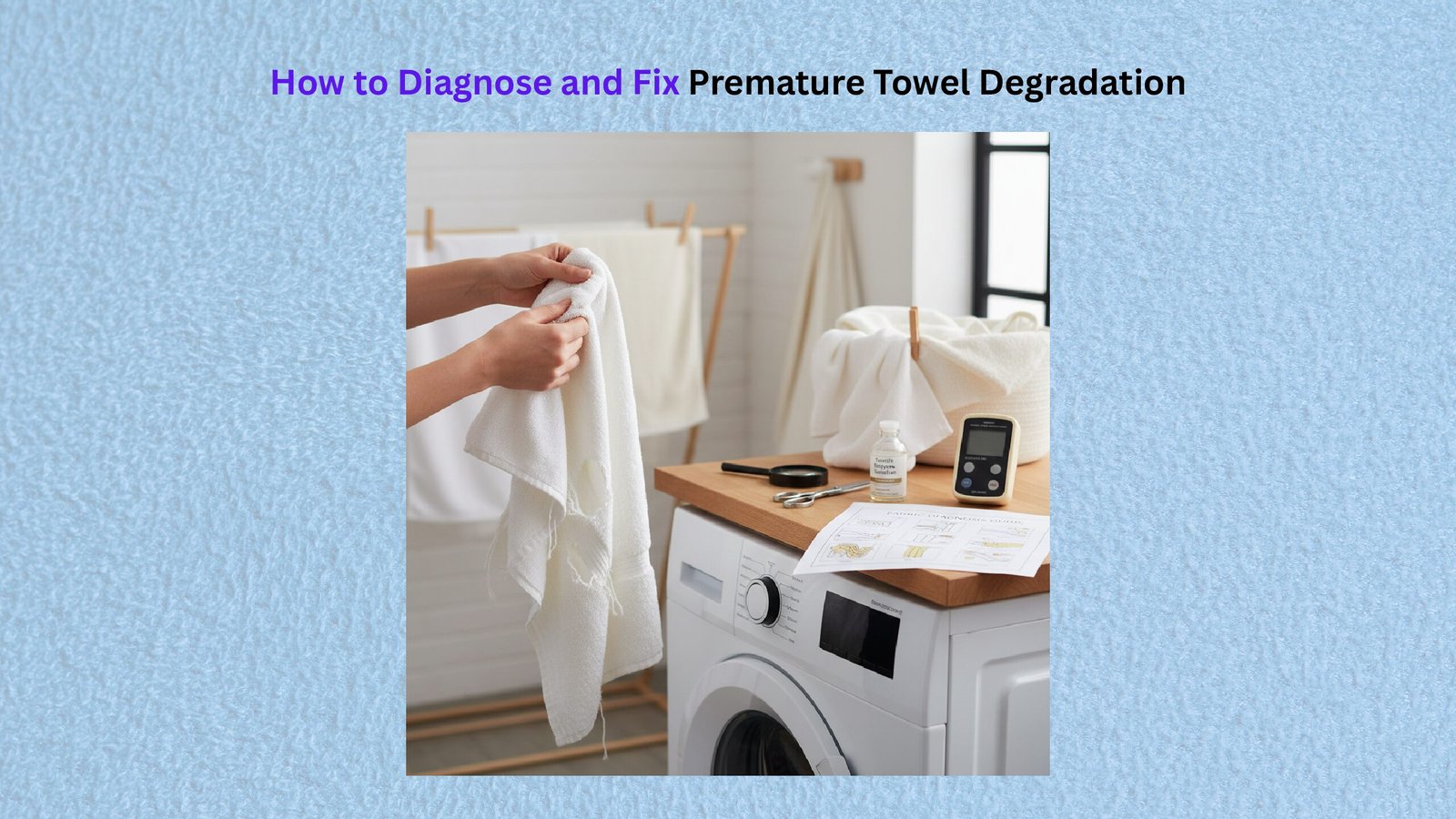
How to Diagnose and Fix Premature Towel Degradation
(A 5-Step Protocol)
Premature Towel Degradation—the rapid fraying, thinning, or loss of absorbency in your towels—is a common, costly problem, but it is solvable. You have likely invested significant capital into premium textiles, only to find them suffering from structural or functional failure far earlier than their expected lifespan.
Rather than accepting this as normal wear, you need to identify the root cause. This 5-step, scientifically-sound diagnostic protocol will help you identify exactly what is causing the premature towel degradation.
Why is Diagnosing Premature Towel Degradation a Smarter Approach?
Diagnosing Premature Towel Degradation is a smarter, data-driven approach because it moves beyond guesswork to identify the specific, unidentified stressor causing the failure. When you simply replace a towel without diagnosing the failure, you are treating the symptom, not the disease.
How Diagnosing Premature Towel Degradation Finds the True Culprit
This diagnostic protocol finds the true culprit by treating Premature Towel Degradation not as “age,” but as the predictable outcome of a specific, measurable stressor. By isolating variables, this protocol helps you find the “smoking gun.”
What is the Science Behind Premature Towel Degradation?
The science behind Premature Towel Degradation involves understanding the five primary “stressors”—thermal, mechanical, and chemical—that attack and break down textile fibers.
What Are the 5 “Stressors” That Cause Premature Towel Degradation?
- Thermal Stress (Dryer Heat): High heat causes low-temperature pyrolysis in cotton, making fibers brittle. For Microfiber, heat above ~227°C melts fibers.
- Mechanical Stress (Agitation): Heavy-duty cycles cause fiber-to-fiber abrasion, leading to pilling.
- Mechanical Stress (Snagging): Washing towels with zippers or hooks is the #1 cause of fraying, especially for Zero-Twist towels.
- Chemical Stress (Bleach): Chlorine Bleach chemically dissolves Cellulose fibers.
- Chemical Stress (Fabric Softener): Waxy Quats clog micro-gaps, destroying absorbency.
How to Set Up Your Diagnostic for Premature Towel Degradation (Phase 0-1)
Setting up your diagnostic for Premature Towel Degradation (Phases 0-1) involves identifying your towel’s material vulnerabilities before you start logging data.
How to Use the Material Matrix to Predict Degradation
| Stressor | 100% Cotton | Bamboo/Modal | Microfiber |
|---|---|---|---|
| High Dryer Heat | HIGH Vulnerability (Brittleness) | HIGH Vulnerability (Embrittlement) | CATASTROPHIC (Melting) |
| Chlorine Bleach | HIGH Vulnerability (Dissolves) | HIGH Vulnerability (Dissolves) | LOW Vulnerability (Stable) |
| Snagging | Moderate (High for Zero-Twist) | Moderate | LOW Vulnerability |
| Fabric Softener | HIGH (Functional Failure) | HIGH (Functional Failure) | HIGH (Functional Failure) |
How to Execute and Log Your Diagnostic (Phase 3-4)
Executing your diagnostic involves collecting objective data over 4-6 wash cycles to identify the root cause. You must measure two key metrics:
- Water Drop Test (Absorbency): Time for a drop to absorb. Good: <5s. Fail: >30s.
- Visual Degradation Score (VDS): Count new snags (0-5) and pilling (1-5).
Stress Test Data Logger
Log a Wash Cycle
Likely Root Cause
—
Log data to see the diagnosis.
Damage Correlation Analysis
Protocol Disclaimer & Limitations
For Diagnostic Use Only.
This protocol is designed to identify common household laundry issues. Severe fabric degradation may be permanent and unfixable. Always check your towel manufacturer’s care label before applying high heat or chemical treatments.What is the Key Takeaway?
The key takeaway is that Premature Towel Degradation is a solvable engineering problem, and this diagnostic protocol is the tool to find the data-driven solution. By systematically tracking your laundry practices against your towel’s performance, you can get a definitive, quantitative answer to why your towels are failing.
Diagnostic Complete
You have successfully moved from guessing and marketing claims to empirical, data-driven proof.