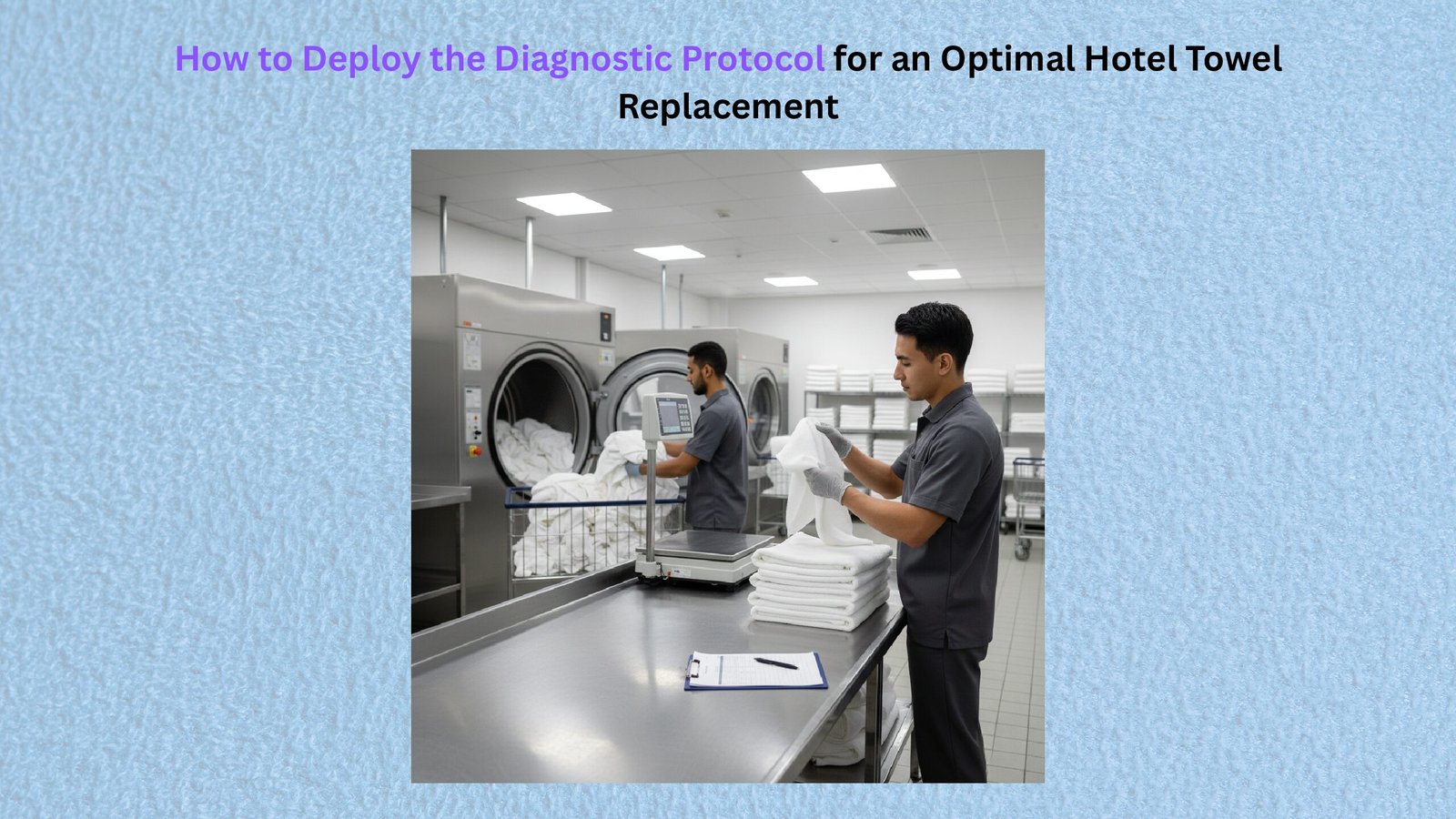
How to Deploy the Diagnostic Protocol for an Optimal Hotel Towel Replacement (Hotel Towel Replacement)
The Hotel Towel Replacement (HTR) protocol utilizes quantitative diagnostic tests—measuring absorbency speed, tensile strength, and whiteness index—to identify the exact “Economic Pivot Point” where asset maintenance costs exceed replacement value. This article will provide a technical framework for auditing textile fatigue and triggering data-backed procurement orders to protect Guest Satisfaction Scores (GSS).
Why a Data-Driven Hotel Towel Replacement is Critical for Asset Protection
A data-driven Hotel Towel Replacement strategy is critical because relying on visual inspection often results in retaining “zombie inventory” that drives up utility costs and drives down guest satisfaction.
How Do You Identify the Economic Pivot Point in Hotel Towel Replacement?
Identifying the economic pivot point in Hotel Towel Replacement involves calculating the intersection of declining performance and rising energy consumption. According to the Textile Rental Services Association (TRSA) linen life expectancy guidelines, industrial textiles operate within a finite performance window before fiber attrition renders them inefficient.
While a high-quality hotel towel typically survives 100–150 wash cycles, fiber thinning beyond this point reduces water retention capacity, often necessitating 10–15% longer dryer cycles to achieve the same tactile dryness, effectively increasing utility costs per unit.
Unique Insight: The “Zombie Asset”
A towel that looks white but feels scratchy and repels water is a “Zombie Asset.” These units consume labor (folding/stacking) and energy (washing/drying) but generate negative value (guest complaints), making immediate replacement the only economically viable option.
What Variables Define the Diagnostic Phase of the Hotel Towel Replacement?
How Do You Isolate Independent Structural Variables in Hotel Towel Replacement?
Isolating independent structural variables in Hotel Towel Replacement requires measuring specific physical degradation markers like the CIE Whiteness Index and dimensional warp.
Unique Insight: Degree of Polymerization (DP)
DP is the measurement of the length of the cellulose chains in cotton. Oxidative damage (bleach) cuts these chains; when DP drops below a critical threshold (often <1500), the fiber loses tensile strength.
How to Conduct Quantitative Data Logging for the Hotel Towel Replacement?
How Do You Measure Physical Performance Thresholds in Hotel Towel Replacement?
AATCC 79: Absorbency Speed Diagnostic
Analyzing the Lifecycle Decision Matrix within the Hotel Towel Replacement
| Data Metric | Status | Primary Cause | Required Intervention |
|---|---|---|---|
| Absorbency > 15s | CRITICAL | Fiber Vitrification | Immediate Replacement. |
| Whiteness < 80 | FAILED | Permanent Graying | Relegate to Pool or Rags. |
| Tensile Strength: Low | RISK | Chemical Thinning | Retire within 30 days. |
| Dimensional Warp > 5% | AESTHETIC | Heat Contraction | Rotate to Lower Tier. |
Final Procurement Checklist
- ☐ Diagnostic: Is Absorbency Speed >15s on 5 random samples?
- ☐ Control: Did the Acid-Rinse fail to restore softness?
- ☐ Visual: Is CIE Whiteness Index <80 compared to a control sample?
- ☐ Procurement: Has the replacement PO been issued for Long-Staple Cotton?
Present this replacement plan not as an expense, but as a strategic asset upgrade.