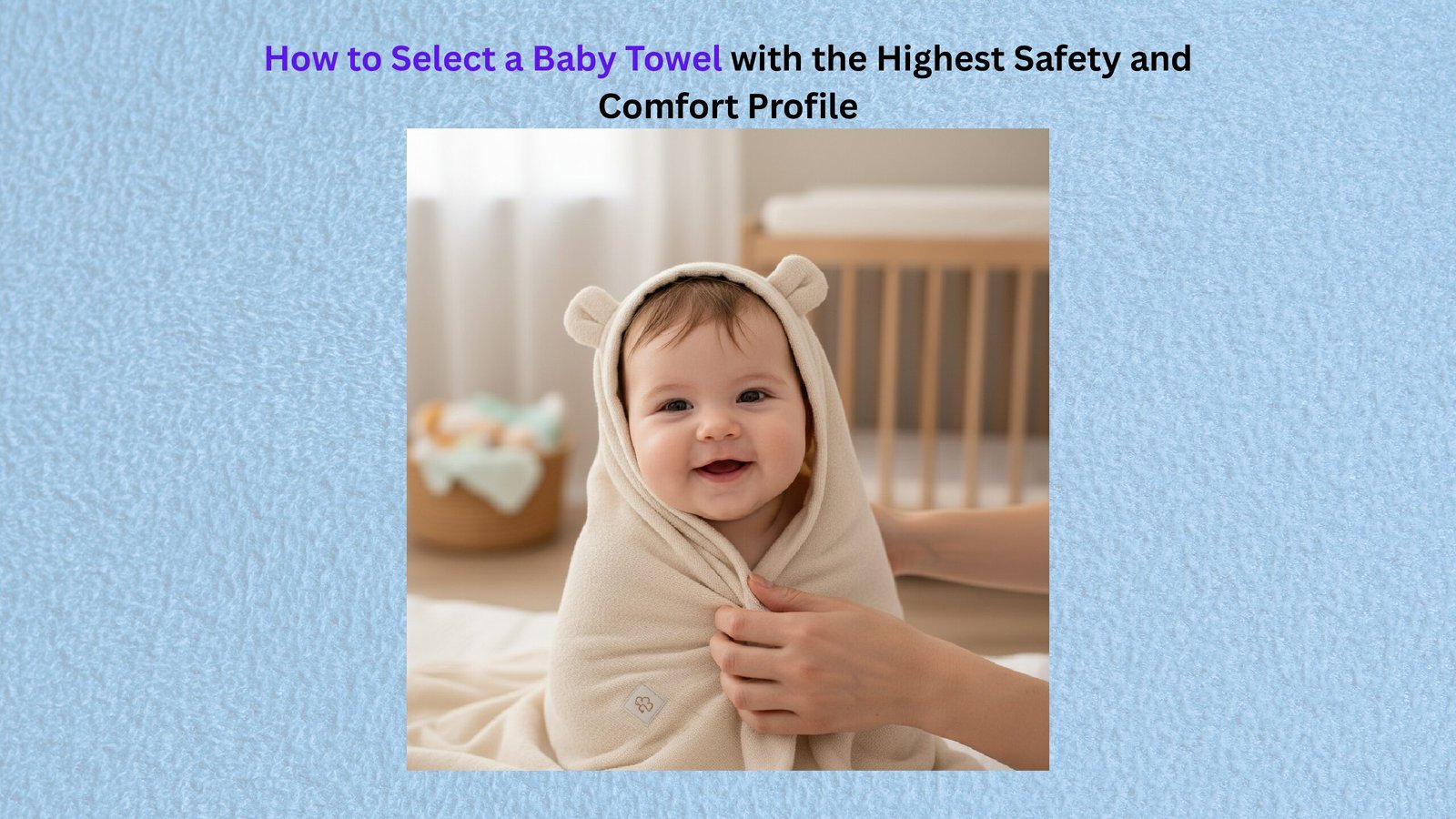
How to Select a Baby Towel with the Highest Safety and Comfort Profile
(A Data-Driven Guide)
Selecting safe and high-comfort baby towels is a critical decision about your baby’s epidermal health and physical safety, not just comfort.
The wrong material, finished with uncertified chemicals, irritates a baby’s highly permeable skin. Poor construction, like a loose weave, poses acute physical safety risks like Hair-Thread Tourniquet Syndrome (HTTS).
This guide replaces guesswork with a structured, data-driven framework. We will use The Baby Towel Safety Matrix (BTSM) to evaluate and select the best safe and high-comfort baby towels with empirical confidence.
This article will deconstruct the 6 critical pillars of baby towel safety and provide a quantitative scoring matrix to objectively identify the best safe and high-comfort baby towels.
Why is Choosing Safe and High-Comfort Baby Towels a Critical Decision?
Choosing safe and high-comfort baby towels is a critical decision because an infant’s skin is not a smaller version of an adult’s; it is a structurally and functionally distinct organ that is uniquely vulnerable.
How Does Infant Skin Physiology Increase Chemical Risk?
An infant’s skin physiology dramatically increases chemical risk because its primary protective layer, the stratum corneum, is 30% thinner than an adult’s. This structural deficit is significant; the entire epidermis is 20% thinner.
This thinner barrier, combined with a higher rate of Transepidermal Water Loss (TEWL), results in highly permeable skin where external substances are absorbed more readily. This is not a minor issue. At least one in ten infants is affected, as demonstrated by the 10.4% prevalence of atopic dermatitis (eczema) in US children aged 0-5. This data proves that for millions of infants, the skin barrier is already clinically compromised. A towel must be chemically pure.
How Do Chemical Certifications Protect Safe and High-Comfort Baby Towels?
Chemical certifications are the only way to verify safe and high-comfort baby towels, with Oeko-Tex Standard 100, Product Class I being the non-negotiable benchmark for infant safety. These certifications test for specific chemical threats, including Formaldehyde (a carcinogen), Azo Dyes (which can release carcinogenic amines), Phthalates (endocrine disruptors), PFAS (“forever chemicals”), and heavy metals like lead (a neurotoxin). Third-party verification is the only way to ensure a towel is free of these substances.
It is essential to distinguish between the two primary standards. The Global Organic Textile Standard (GOTS) is a process standard; it ensures the fibers are grown organically and the manufacturing is eco-friendly. Oeko-Tex Standard 100 is a product safety standard; it tests the final product for over 100 harmful substances. Product Class I is the strictest Oeko-Tex category, designed specifically for babies up to 36 months, mandating far more stringent limits than adult-use products.
| Substance | Product Class I (Baby) Limit | Product Class II (Adult) Limit | Clinical Significance |
|---|---|---|---|
| Formaldehyde | n.d. (non-detectable) | 75 mg/kg | A zero-tolerance policy for this carcinogen on baby products. |
| Lead (Pb) | 0.2 mg/kg | 1.0 mg/kg | A 5-times more stringent limit to protect against neurotoxins. |
| Arsenic (As) | 0.2 mg/kg | 1.0 mg/kg | A 5-times more stringent limit for this toxic heavy metal. |
How Do Safe and High-Comfort Baby Towels Prevent Physical Safety Risks?
Safe and high-comfort baby towels prevent acute physical safety risks by using high-integrity weaves that do not shed the loose threads that cause Hair-Thread Tourniquet Syndrome (HTTS).
Hair-Thread Tourniquet Syndrome (HTTS) is a pediatric surgical emergency. The mechanism is frighteningly simple: a single thread or hair wraps around an appendage (like a finger, toe, or genitals), constricting blood flow. This constriction causes focal edema, which tightens the tourniquet further, leading to ischemia and, if not treated, necrosis (tissue death).
This risk is most common in infants aged 2-6 months. One US study analyzing cases found 44% occurred on the penis and 40% on the toes. This is an entirely preventable risk. A “fluffy,” high-pile towel is a high-risk design. The superior, safer choice is a dense, low-pile terry or a tight waffle weave that resists shedding loose threads.
What is the Science Behind Safe and High-Comfort Baby Towels?
The science behind safe and high-comfort baby towels is a system of six distinct evaluation criteria, or “pillars,” which form the basis of our Safety Matrix.
What Are the 6 Critical Pillars of Safe and High-Comfort Baby Towels?
- Material Purity & Certification: Is the fabric certified Oeko-Tex Standard 100, Product Class I or GOTS? This is Pillar 1.
- Weave & Construction Integrity: Is the weave low-pile and tight to prevent loose threads and HTTS?
- Hood Design & Safety: Does the hood design prevent 85% heat loss from the head without posing an airway obstruction risk?
- Absorbency Efficiency: How quickly does it remove water? High absorbency (like bamboo rayon) means less friction on permeable skin.
- Softness & Gentleness Score: What is the initial feel and post-wash texture?
- Durability & Wash-Resistance: How well does it hold up to frequent, hot-water sanitizing washes?
How Does Absorbency Define Safe and High-Comfort Baby Towels?
Absorbency is a key pillar for safe and high-comfort baby towels because it directly minimizes the friction required to get the baby dry, reducing skin irritation. A high-absorbency material, such as bamboo rayon, pulls water from the skin faster and more completely.
This action minimizes the friction and rubbing required to get the baby dry, which reduces skin irritation. The optimal absorbency range is 400-600 GSM (Grams per Square Meter). A 600-900 GSM towel, while marketed as “luxury,” is a potential risk for babies; its very slow dry time makes it a breeding ground for mildew and bacteria. Bamboo rayon is a superior choice, as tests show it absorbs faster than cotton, achieving the clinical goal of minimizing skin contact and friction.
How to Score Your Options for Safe and High-Comfort Baby Towels
You can score your options for safe and high-comfort baby towels by using this data-driven “Quantitative Scoring Rubric” and the Safety Matrix.
The “Baby Towel Safety Matrix” Calculator
Use this interactive tool to score two towels head-to-head based on the 6 pillars. The calculator will apply the safety weights and declare a winner, complete with a visual analysis graph.
1. Material Purity (Weight: x3)
2. Weave Integrity (Weight: x2)
3. Hood Safety (Weight: x2)
4. Absorbency Efficiency (Weight: x1)
5. Softness & Gentleness (Weight: x1)
6. Durability (Weight: x1)
How to Analyze Your Data
To analyze your data for safe and high-comfort baby towels, you must calculate the weighted total score for each option.
- For each towel, multiply its score for each criterion by the “Weighting” factor. (e.g., a Purity score of 5 is 5 x 3 = 15).
- Add up the weighted scores to get the final “TOTAL SCORE” for each towel.
The towel with the highest total score is the objectively superior choice. This weighted system intentionally prioritizes the safety-critical pillars (Purity, Weave, Hood) over comfort.
What is the Final Action Plan for Your Safe and High-Comfort Baby Towels?
The final action plan (Phase 5) for your new safe and high-comfort baby towels involves a mandatory “First-Use Safety Protocol” to prepare them for your baby.
What is the “First-Use Safety Protocol” for Your Safe and High-Comfort Baby Towels?
This “First-Use Safety Protocol” is a final safety checklist you must complete before your new safe and high-comfort baby towels ever touch your baby’s skin. This is a required chemical neutralization and physical safety inspection.
Protocol Disclaimer & Limitations
For Educational & Diagnostic Use Only. Not a Substitute for Medical Advice.
This guide and the Safety Matrix are diagnostic tools intended for educational and personal comparative analysis. The information provided is based on publicly available data regarding material science, chemical certifications, and pediatric safety risks. Scores derived from the Matrix are for personal reference and do not constitute a formal product endorsement, certification, or medical advice. Always consult with a pediatrician or dermatologist regarding your child’s specific health needs (e.g., severe atopic dermatitis). Your final product choice is your own responsibility.What is the Key Takeaway on Safe and High-Comfort Baby Towels?
The key takeaway is that this diagnostic matrix is a powerful tool that replaces guesswork, allowing you to confidently select safe and high-comfort baby towels.
Protocol Complete: You Can Now Select With Confidence
By replacing guesswork with this data-driven framework, you can confidently select safe and high-comfort baby towels that are: 1) Chemically Safe (Certified Oeko-Tex Product Class I), 2) Physically Safe (a low-pile weave to prevent HTTS), and 3) Thermally Safe (a functional hood that prevents heat loss).