How Does Washing Increase Softness in Turkish Cotton Towels?
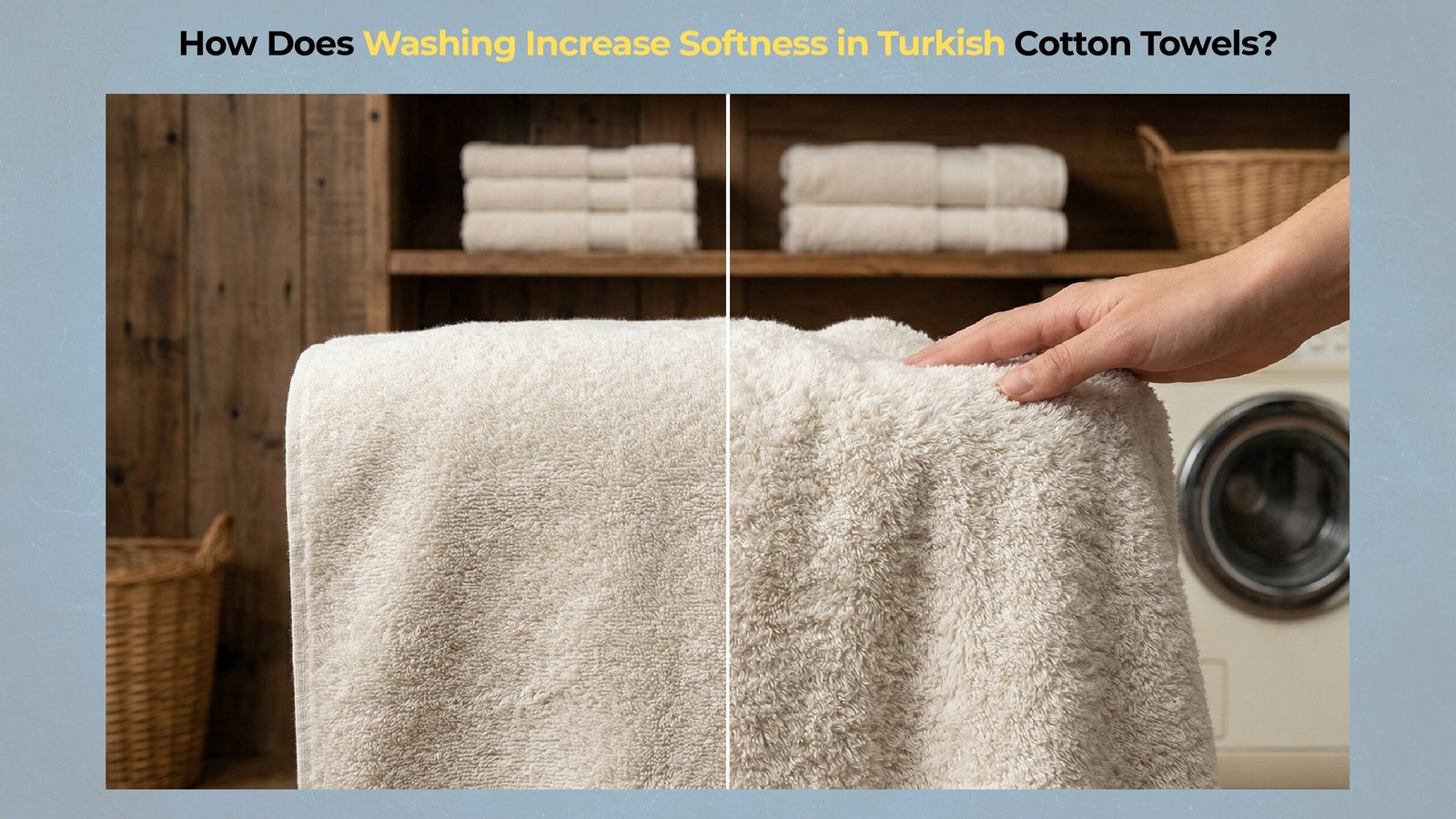
Yes, Turkish cotton towel softness increases as towels become softer, fluffier, and more absorbent with each wash and use because the long-staple fibers relax over time rather than breaking down once initial manufacturing treatments are washed away.
These manufacturing treatments, typically composed of starch-based sizes and paraffinic waxes, initially coat the high-quality Gossypium hirsutum fibers to protect them from the high-speed mechanical stress of the loom. Unwashed Aegean fibers exhibit “water-pushing” behavior until these manufacturing tensions are released through hydrothermal energy.
These manufacturing tensions, once dissolved, allow for the “Volumetric Bloom” unique to the Nazilli 84 and related regional cultivars. This guide audits the cellulose physics, hydrogen bond relaxation, and surfactant chemistry of Aegean cotton to verify Turkish cotton towel softness and provide technical steps for accelerating the breaking-in period.
Why Does Laundering Increase Turkish Cotton Towel Softness?
Turkish cotton towel softness increases progressively through early laundry cycles because moisture exposure facilitates the physical expansion of long-staple fibers once weaving tensions are removed. Turkish cotton towel softness increases as industrial coatings are removed during early wash cycles, allowing fibers to expand and relax. To understand what causes the initial resistance to softness, it is useful to explore why Turkish cotton towels feel stiff when new.
This physical expansion acts as a mechanical finishing step, effectively “unlocking” the internal volume of each terry loop. The removal of stiffening resins typically allows the loops to reach their engineered loft. This engineered loft is a structural consequence of the activation window, where the fiber transition from a flat, ribbon-like state to a cylindrical, absorbent geometry occurs.
How Does the Blooming Trigger Facilitate Turkish Cotton Towel Softness?
Turkish cotton towel softness is triggered by a mechanical “Bloom” where saturated fibers physically expand and untwist after the initial factory compression is released. According to research in the Journal of The Textile Institute, this fiber relaxation is a fundamental property of high-quality long-staple cotton when subjected to repetitive hydration.
The volumetric bloom effect occurs as fibers expand and increase internal air volume after repeated hydration cycles. Since this behavior is rooted in fiber morphology, you may want to explore what the fiber structure of Turkish cotton towels looks like at the microscopic level.
Laboratory observations suggest that Aegean LS cotton can increase fabric thickness after initial washes as spinning tensions relax. This increased thickness disrupts mechanical spinning tension and facilitates the bloom of Turkish cotton towel softness.
What Is the Ideal Activation Window for Turkish Cotton Towel Softness?
Peak Turkish cotton towel softness typically reaches its peak functional equilibrium after the initial breaking-in period, once the laundering cycle successfully strips the paraffinic sizing used during weaving. Cotton Incorporated scouring guidelines emphasize that this paraffinic sizing must be fully emulsified to reveal the natural tactile properties of the cellulose.
Statistical data from absorbency tests shows that wicking speed can significantly improve absorption time within the first several laundry cycles. These initial cycles serve as a molecular recalibration, allowing the textile to support moisture equilibrium.
How Do Molecular Physics Influence Turkish Cotton Towel Softness During Activation?
Molecular fiber resets and the removal of industrial lubricants influence Turkish cotton towel softness, leveraging the natural relaxation of the cellulose polymer chains. These cellulose polymer chains are the primary drivers of tactile response, governing how the fiber reacts to both liquid saturation and thermal drying. These manufacturing treatments create a temporary hydrophobic barrier that prevents proper fiber activation. Since this barrier directly affects performance, a logical next step is to review how chemical residues impact Turkish cotton towel performance and tactile feel.
How Does Stripping Industrial Lubricants Activate Turkish Cotton Towel Softness?
Natural Turkish cotton towel softness remains masked until thermal energy dissolves the “Loom Shield”—a combination of starches and waxes that typically prevents yarn breakage during weaving. The Textile Research Journal identifies this loom shield as a temporary hydrophobic barrier necessary for manufacturing but detrimental to user comfort.
Sizing accounts for a measurable percentage of the fabric mass in unwashed linens, creating a hydrophobic barrier. This hydrophobic barrier often masks the high-quality fibers with a synthetic “slickness” that is mistaken for softness but lacks the plushness of clean cotton. Sizing agent dissolution exposes the hydrophilic cellulose core and initiates Turkish cotton towel softness.
Why Does Hydrogen Bond Relaxation Increase Turkish Cotton Towel Softness?
Turkish cotton towel softness increases during saturation because water molecules temporarily disrupt the internal hydrogen bonds of the cellulose, allowing fibers to reset into a more flexible state as they dry. Hydrogen Bond Relaxation is defined as the process where moisture intake allows cellulose polymer chains to slide and realign into a more pliable matrix. Hydrogen bond relaxation allows cellulose chains to become more flexible during moisture exposure, improving softness. Because this process depends on fiber length and alignment, it is useful to review what staple length Turkish cotton towels typically have and why it enhances softness.
This moisture intake is critical; a specific moisture regain threshold is required to maintain molecular flexibility. This moisture regain threshold prevents “hornification”—a permanent stiffening of the fiber caused by excessive dehydration at high temperatures.
How Do You Use This Mechanism Matrix to Analyze Turkish Cotton Towel Softness?
Evaluating the intersection of thermal energy and mechanical agitation predicts the progression of Turkish cotton towel softness. This mechanical agitation, provided by the tumbling action of a modern dryer, prevents the loops from adhering to one another during the evaporation phase.
| Trigger | Physical Action | Result for Turkish Cotton Towel Softness |
|---|---|---|
| Thermal Energy | Dissolution of sizing agents | Removes starches and waxes that cause “slick” rigidity |
| Water Saturation | Cellulose fiber swelling | Increases filament flexibility and loop volume |
| Mechanical Agitation | Loop separation | Breaks fiber-to-fiber adhesion to increase loft |
Why Do Aegean Fibers Provide Superior Turkish Cotton Towel Softness?
Botanical morphology and high fiber uniformity influence Turkish cotton towel softness, utilizing a specific staple length that minimizes surface friction against the skin. This specific staple length, native to the Nazilli and Aegean plains, provides the structural integrity needed for high-absorbency constructions.
How Do Long-Staple Fibers Improve Turkish Cotton Towel Softness?
Turkish cotton towel softness results from a staple length typically between 30–35 mm, which creates smoother yarns with fewer interruption points prone to pilling. Join-Point Density refers to the frequency of overlapping fiber ends within a yarn segment.
These overlapping fiber ends are the primary sites for tactile roughness. The Nazilli 84 cultivar benchmark for regional fiber uniformity demonstrates that this fiber uniformity minimizes the need for excessive twist, optimizing skin comfort. Long-staple fiber alignment reduces Join-Point density and optimizes the skin-comfort of Turkish cotton towel softness.
Does Low-Twist Construction Facilitate Turkish Cotton Towel Softness?
Turkish cotton towel softness reaches its maximum potential through low-twist ring-spinning, where the high tenacity of Aegean fibers allows for a porous yarn architecture. Per ISO 2060 (Twist determination) standards, this porous yarn architecture provides the air-pockets necessary for the “fluff” sensation. Low-twist yarn construction supports softness by increasing porosity and reducing fiber compaction. Since this originates at the yarn level, you may want to explore how Turkish cotton towel yarn construction affects softness and durability.
High-strength Aegean fibers typically utilize lower twist constructions than Upland cotton varieties. These lower twist constructions allow individual fibers to bloom outward rather than being tightly bound, yielding significant air-volume gains.
How Do Different Finishes Affect Turkish Cotton Towel Softness?
Selection of the ideal inventory results from comparing the tactile evolution of Turkish cotton towel softness against the initial state of raw and pre-treated linens. These pre-treated linens, often called “garment-washed,” have already undergone initial activation.
| Finish State | Initial Texture | Texture After 5 Washes | Activation Effort |
|---|---|---|---|
| Raw / Sized | Stiff / Slick | Velvety / Plush | High (Thermal Wash Needed) |
| Garment-Washed | Soft / Pliable | Very Soft / Full Loft | Low (Standard Wash) |
| Stone-Washed | Maximum Softness | Stable / Plush | Near-Zero |
Which Laundry Protocols Preserve Turkish Cotton Towel Softness?
Preservation of wicking channels and mechanical loft results from maintenance protocols that protect Turkish cotton towel softness by excluding hydrophobic residues and limiting thermal stress. These maintenance protocols serve as an operational strategy for extending the service life of premium linens. Maintaining softness requires proper laundering protocols that preserve fiber openness and prevent buildup. Since maintenance determines long-term performance, it is essential to understand what care instructions should be followed to maintain towel softness and usability.
Why Does the Absence of Softeners Protect Turkish Cotton Towel Softness?
Functional Turkish cotton towel softness can be significantly reduced if the textile is treated with liquid fabric softeners, as cationic surfactants coat the long-staple fibers in a hydrophobic silicone layer. AATCC 79 absorbency testing proves that these cationic surfactants dramatically decrease the rate at which water can enter the cellulose core. Softness can decline when residues or softeners recoat the fibers and block moisture pathways. To better understand this long-term performance issue, you can explore how cotton towel durability is affected by washing and repeated use.
Softeners can create a waxy barrier that traps odors and reduces the wicking ability of the terry loops. This waxy barrier creates a “greasy” feel that is distinct from the airy, natural softness of pure cotton.
Does the Thermal Activation Wash Restore Turkish Cotton Towel Softness?
Turkish cotton towel softness baseline levels are established by an initial wash where higher temperatures (around 60°C) improve removal efficiency of factory lubricants. These higher temperatures are necessary to break the molecular bonds of the loom shield.
Detergent should be avoided in this first cycle to ensure the sizing is completely flushed from the drum. This first cycle prevents persistent residue layers from being “baked” into the fiber during the drying stage. High thermal energy emulsifies factory waxes and neutralizes Turkish cotton towel softness rigidity.
How Does the “Damp-Pull” Rule Preserve Turkish Cotton Towel Softness?
Protection of Turkish cotton towel softness typically results from maintaining mechanical drying temperatures on “Medium” or “Low” and removing the textile while it remains slightly damp. ISO 3758 care labeling guidelines suggest that these mechanical drying temperatures are optimal for preventing fiber brittleness.
This damp-pull rule allows the final relaxation of the fibers to occur at room temperature, preventing the loops from sticking together due to static or over-drying.
How Can You Fix Stiffness to Restore Turkish Cotton Towel Softness?
Restoring compromised Turkish cotton towel softness results from executing chemical resets to strip away oleophilic lipids and mineral calcification. These oleophilic lipids—natural body oils—can accumulate over time, creating a dense, non-absorbent surface.
How Does Mineral Stripping Restore the Flexibility of Turkish Cotton Towel Softness?
Recovery of Turkish cotton towel softness results from a warm vinegar rinse that dissolves the alkaline mineral films responsible for fiber “crunch.” Calcium Acetate Formation is the chemical reaction between acetic acid and limescale that breaks down hard-water deposits.
This chemical reaction effectively “unlocks” the stiff fibers. Acetic acid rinses dissolve mineral calcification and restore the flexibility of Turkish cotton towel softness.
Why Does Removing Detergent Residue Restore Peak Turkish Cotton Towel Softness?
Turkish cotton towel softness typically improves if a separate wash with sodium bicarbonate (baking soda) strips the waxy soap films that prevent fiber expansion. Under ISO 9001 quality management guidelines, these waxy soap films are recognized as the primary cause of tactile degradation in residential laundry.
How Do You Use This Turkish Cotton Towel Softness Audit Checklist?
Systematic technical audits verify Turkish cotton towel softness by ensuring current protocols align with objective structural benchmarks. These objective structural benchmarks, including the AATCC 79 drop test, provide measurable proof of fiber health.
Quality Audit Checklist for Turkish Cotton Towel Softness
- ☐ Wicking Check: Does a water droplet absorb quickly (within seconds)?
- ☐ Visual Audit: Do the loops show a visible “Bloom” (raised, open loops) post-wash?
- ☐ Chemistry Audit: Is the laundry routine 100% free of liquid cationic softeners?
- ☐ Tactile Test: Does the dry textile feel “velvety” or “plush” rather than “slick” or “waxy”?
- ☐ Activation Check: Has the towel completed initial washes to ensure sizing removal?
Frequently Asked Questions About Turkish Cotton Towel Softness
How many washes are required to reach peak Turkish cotton towel softness?
Peak functional equilibrium typically occurs after 3 to 5 laundry cycles. This timeline ensures that industrial lubricants are fully emulsified and the internal hydrogen bonds of the cellulose have successfully relaxed to allow for the maximum volumetric bloom.
Why are new Turkish cotton towels stiff upon arrival?
The initial rigidity is caused by the “Loom Shield”—a manufacturing necessity where starches and waxes are applied to long-staple fibers to reduce mechanical friction during weaving. This layer acts as a temporary hydrophobic barrier that must be removed through a high-temperature activation wash to unlock the true tactile profile of the cotton.
Can household additives like vinegar improve Turkish cotton towel softness?
Yes, white vinegar (acetic acid) is a highly effective chemical reset for dissolving alkaline mineral films caused by hard water. Regular mineral stripping prevents fiber “crunch” and restores the molecular flexibility of the cellulose chains without the need for detrimental cationic softeners.
Does heat damage Turkish cotton towel softness over time?
Excessive thermal stress can cause “hornification,” where the cellulose fibers become permanently brittle and lose their ability to swell with moisture. Utilizing “Low” or “Medium” heat and removing towels while slightly damp (the Damp-Pull rule) is critical for preserving the high-tenacity integrity of Aegean LS cotton.
Final Summary: Does the Performance Profile of Turkish Cotton Towel Softness Fit Your Needs?
Operationalizing a Turkish cotton towel softness strategy requires a shift from “Instant Gratification” expectations to a technical commitment that honors the unique physics of Aegean cotton. The trade-off between standard carded cotton and high-tenacity Aegean LS fibers is found in the “bloom” timeline; while standard cotton may feel soft initially due to chemical coatings, it lacks the structural durability and progressive softening profile of Turkish linens. Peak softness is a consequence of proper sizing removal and the relaxation of internal hydrogen bonds during initial laundry cycles.
Ultimately, a superior bathroom experience is defined by the precise Turkish cotton towel softness management that turns a high-performance fiber into a lasting asset that helps maintain freshness through technical care.
Technical Disclaimer
The information provided in this guide is for educational and informational purposes only. While every effort has been made to ensure the technical accuracy of the textile science and maintenance procedures described, individual results may vary based on local water chemistry, specific appliance settings, and variations in textile manufacturing lots. Toweldaily.com does not assume liability for damages resulting from improper laundry techniques, mechanical over-stressing of fibers, or the misuse of household chemicals. Always refer to the manufacturer’s care label before performing a chemical reset.