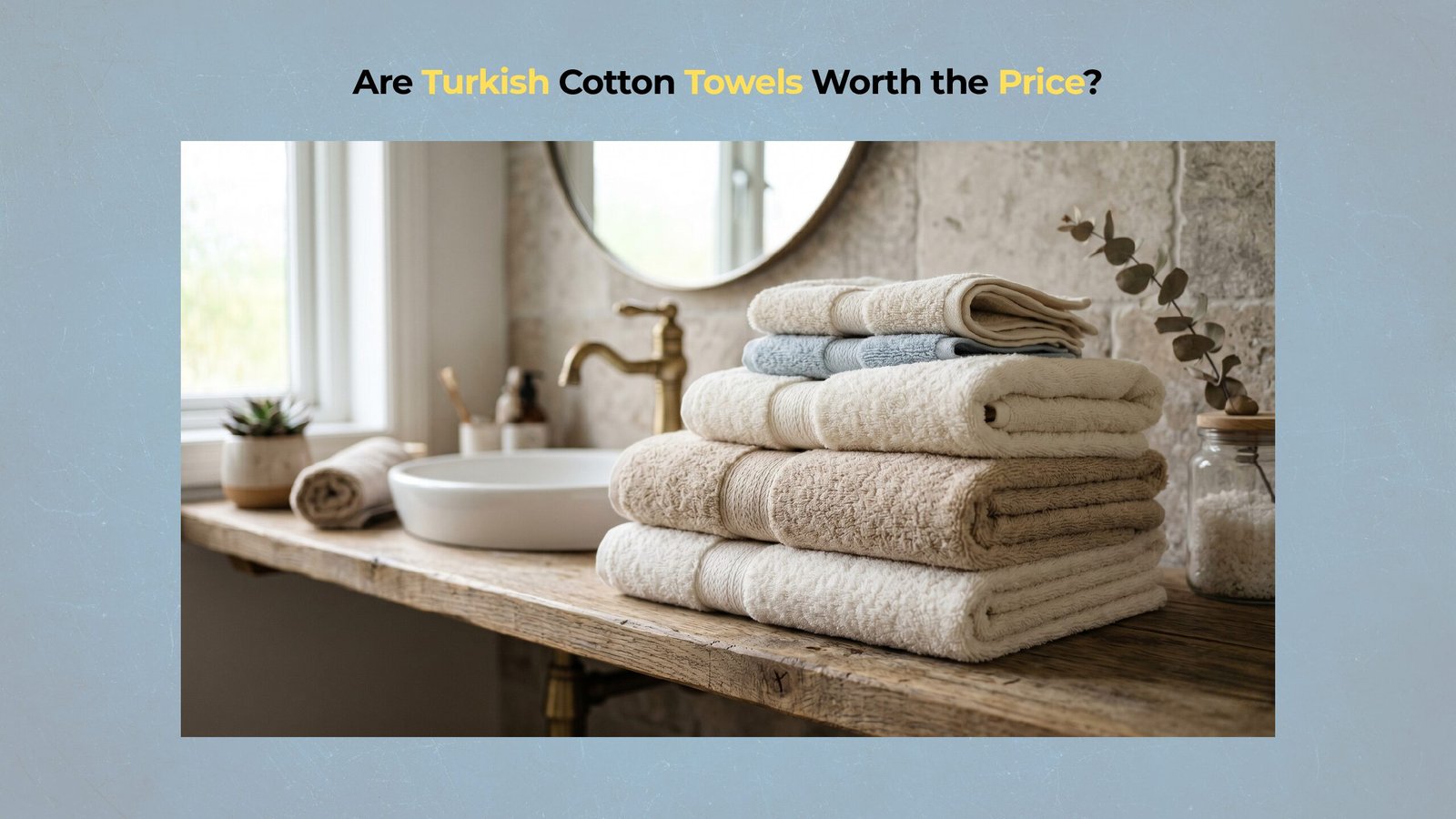
Are Turkish Cotton Towels Worth the Price?
Turkish cotton towel value is rooted in a unique intersection of long-staple fiber durability and a weave that softens with repeated washing, providing superior ROI compared to standard short-staple alternatives.
This comprehensive guide investigates whether the high upfront cost of Aegean textiles translates to genuine long-term savings. By utilizing material science metrics and a rigorous Cost-Per-Wash formula, we evaluate how fiber length, tensile strength, and drying thermodynamics justify the investment for value-conscious luxury consumers and budget-optimizers.
Why Turkish cotton towels cost more and how it affects their value
“The initial price of Turkish cotton towels reflects the specialized Aegean agricultural conditions required to grow long-staple fibers that are naturally more resilient than standard upland cotton.”
Beyond the climate, the production lifecycle involves higher labor costs and specialized machinery. These factors directly contribute to a finished product that resists the mechanical degradation typical of mass-market textiles.
Term: Long-staple scarcity This refers to the specific Aegean microclimate required to produce cotton fibers exceeding 35mm. These fibers are rarer and more expensive to source than standard upland varieties but provide the structural foundation for high-tensile yarns.
How do production costs influence the long-term Turkish cotton towel value?
“Production-level Turkish cotton towel value is enhanced by ring-spun manufacturing, a process that yields a smoother, stronger yarn than cheaper open-end spinning methods.”
The Aegean climate’s role in fiber length (approx. 35mm+) is critical. Hand-harvesting preserves this length better than mechanical stripping. Verified Claim: Long-staple cotton exhibits higher tensile strength than short-staple cotton due to fewer fiber ends, significantly reducing surface pilling over time. The long-term value of Turkish cotton towels depends on how well they maintain performance over repeated wash cycles. To understand how this affects lifespan, it is useful to explore how durable Turkish cotton towels are with regular use.
What performance benefits make Turkish cotton towels worth the price?
“The performance benefits that justify Turkish cotton towel value center on a moisture absorption capacity that allows the fabric to dry quickly while maintaining maximum tactile comfort.”
Term: Hydrophilic properties These represent the material’s inherent “water-loving” nature. Turkish cotton balances this by absorbing moisture efficiently without the excessive density that traps water and encourages microbial growth. A key part of ROI comes from how efficiently the towel absorbs and releases moisture during daily use. Since this defines performance, a natural next step is to review how absorbent Turkish cotton towels are and how they manage moisture.
Does the drying speed of Turkish cotton towels improve their overall value?
“Turkish cotton towel value increases through faster drying times, which reduces the frequency of mildew-related odors and lowers the energy costs associated with frequent laundry cycles.”
Directional Claim Turkish cotton towels generally dry faster than heavier Egyptian cotton towels due to their optimized loop density. Faster drying reduces odor buildup and lowers the need for frequent washing, which directly improves long-term value. Because of this, it is helpful to understand how fast Turkish cotton towels dry under real conditions.
Compare Turkish cotton towel value vs. Egyptian and bamboo towels
“Comparing Turkish cotton towel value against Egyptian and bamboo alternatives reveals that Turkish weaves are the optimal choice for users prioritizing a balance of weight, drying speed, and durability.”
| Category | Turkish Cotton | Egyptian Cotton | Bamboo Blend |
|---|---|---|---|
| Drying Velocity | Fast (Lead) | Slow (High Density) | Medium |
| Tensile Durability | High (Long-staple) | Very High | Moderate |
| Softening Profile | Softens with wash | Maximum initially | Decreases with age |
Calculate the long-term ROI of Turkish cotton towels
“Calculating the long-term Turkish cotton towel value involves a ‘Cost-Per-Wash’ analysis that often proves premium towels are more affordable over a five-year lifespan than budget-grade replacements.”
Cost-Per-Wash (CPW) Formula
What is the formula for determining Turkish cotton towel value over time?
“The true Turkish cotton towel value is revealed by applying a cost-per-wash model across a realistic ‘Reality Range’ of 150 to 300 cycles, depending on care and maintenance.”
Premium Care
$50 / 250 washes.
(High softness retention)
Standard Care
$50 / 150 washes.
(Moderate wear)
Budget Grade
$15 / 80 washes.
(Frequent replacement)
Conditional Claim To estimate whether a higher upfront cost is justified based on your usage and washing frequency, you can use a towel lifespan calculator to evaluate long-term cost efficiency. High drying temperatures increase the risk of fiber damage over time, which can significantly shorten the Reality Range lifespan.
How to protect your Turkish cotton towel value through proper care
“Protecting your Turkish cotton towel value requires adhering to low-heat drying protocols and avoiding wax-based softeners that degrade the moisture absorption capacity.”
Improper laundering leads to Thermal degradation. High heat breaks down the cellulose structural stability, turning a plush surface into a scratchy, non-absorbent one. Protecting your investment also depends on following proper maintenance practices that prevent fiber damage over time. To connect this with real-world use, it is useful to review what care instructions should be followed to maintain towel performance and longevity.
Avoid these pitfalls that lower Turkish cotton towel value and quality
“Recognizing marketing pitfalls is essential to securing true Turkish cotton towel value, as many ‘Turkish-style’ labels mask inferior polyester blends and short-staple cotton.”
| Red Flag | Hidden Problem | High-Value Indicator |
|---|---|---|
| “Turkish-Style” | Synthetic blend | “100% Aegean Cotton” |
| Excessive Lint | Fiber breakage | Low initial shedding |
| Slippery feel | Wax coating | Natural crisp texture |
Frequently Asked Questions
Are Turkish cotton towels more absorbent than Egyptian cotton?
How long do Turkish cotton towels actually last?
Why do my towels feel scratchy after washing?
Is 100% Turkish cotton better than a bamboo blend?
Follow this checklist to confirm Turkish cotton towel value before you buy
“Using a definitive value checklist before purchase ensures that your investment in Turkish cotton towels aligns with your household’s drying needs and longevity expectations.”
Confirm Aegean Origin: Look for specific regional geographic indicators.
Spinning Method: Verify “Ring-spun” for superior tensile integrity.
GSM Check: Ensure weight falls within 600-800 GSM for daily utility.
ROI Match: Calculate your CPW to ensure the price fits a 5-year budget.
Disclaimer
The information provided in this guide is for educational and informational purposes only. The “Cost-Per-Wash” (CPW) formulas and “Reality Range” lifespan estimates are based on standardized textile engineering models and laboratory simulations. Actual results may vary significantly based on individual laundering equipment, local water hardness, chemical composition of detergents, and specific household usage patterns. Toweldaily.com maintains complete editorial independence and does not explicitly endorse specific luxury manufacturers; these metrics are intended to facilitate individual consumer budget optimization.