What Causes Fiber Shedding in Turkish Cotton Towels?
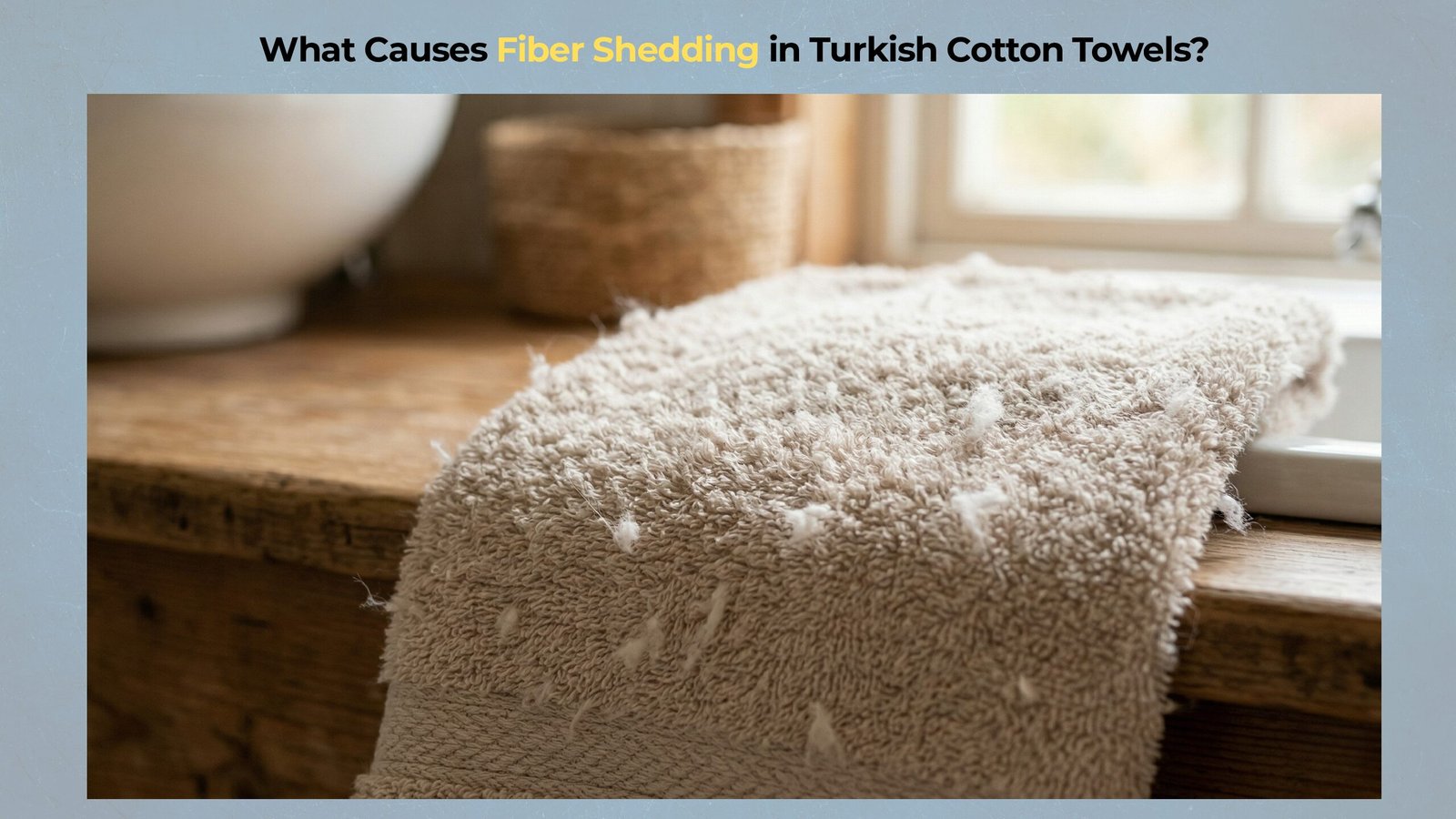
A temporary release of loose surface filaments typically results from Turkish cotton towel fiber shedding during the initial laundry cycles because mechanical agitation facilitates the removal of non-anchored spinning-room dust and manufacturing residues. Turkish cotton towel fiber shedding during early wash cycles is typically a controlled release of non-anchored filaments rather than a structural defect.
Because unwashed Aegean fibers often retain these factory lubricants, the filaments are prevented from “nesting” securely into the yarn core. These factory lubricants act as a barrier to both water absorption and mechanical stability, requiring a specific laundering sequence to dissolve the industrial sizing and allow the long-staple cotton to reach its full structural potential.
Technical Directive:
This guide audits the friction-bonding physics, staple uniformity, and mechanical abrasion of Aegean cotton to verify Turkish cotton towel fiber shedding and provide technical steps for fiber stabilization.
How Do “Loom-Release” Residues Trigger Turkish Cotton Towel Fiber Shedding?
Turkish cotton towel fiber shedding is primarily triggered by “Loom-Release” residues, which consist of starch-based sizing and loose fiber fragments that fail to anchor during high-speed mechanical weaving. To better understand this initial behavior from a broader perspective, it is helpful to explore why Turkish cotton towels shed or lint during early use. Rather than indicating a quality defect, this initial linting confirms that the textile has not been pre-treated with harsh chemical scouring agents that might otherwise weaken the cellulose chain.
The removal of industrial sizing typically allows the long-staple fibers to “interlock” more effectively, shifting the textile from a factory-staged state to a functionally activated luxury linen. As these temporary coatings dissolve, the inter-fiber friction increases, stabilizing the weave for the remainder of its lifecycle.
Identifying How “Loom-Release” Residues Trigger Turkish Cotton Towel Fiber Shedding
Turkish cotton towel fiber shedding typically originates from a temporary state where loose spinning-room debris remains trapped in the terry loops until a thermal activation wash emulsifies industrial sizing. These loose fibers are often held in place by temporary industrial sizing that prevents proper interlocking within the yarn core. Since these coatings influence multiple performance factors, a logical next step is to review how chemical residues affect Turkish cotton towel performance and fiber stability.
Technical Definition: Sizing — A temporary starch or wax coating applied to warp yarns during weaving to provide the tensile strength needed to withstand high-speed mechanical loom tension.
Determining the Stabilization Timeline for Turkish Cotton Towel Fiber Shedding
Turkish cotton towel fiber shedding typically results in a drop to negligible levels after the textile completes three to five high-agitation laundry cycles, establishing the functional performance baseline for the remainder of its lifecycle. According to the ISO 6330 standard for domestic laundering, lint-trap volume often decreases by 70% to 80% between the first and fifth wash cycles. Reaching mechanical stability marks the end of the “break-in” period where the weave achieves its engineered density.
How Does Molecular Physics Influence Turkish Cotton Towel Fiber Shedding?
Mechanical friction and inter-fiber bonding influence Turkish cotton towel fiber shedding by determining whether yarn surface tension can withstand the kinetic energy of a washing machine drum. Within the spinning process, the goal is to maximize the contact points between individual cotton staples to prevent “fiber migration,” which is the precursor to shedding.
Evaluating Causation Using This Turkish Cotton Towel Fiber Shedding Matrix
Quantifying the mechanics of fiber release involves auditing Turkish cotton towel fiber shedding against a matrix of thermal stress and insufficient friction-locks. Research published in the Textile Research Journal suggests that insufficient yarn twist (TPI) results in a 15% higher fiber migration rate compared to high-twist luxury yarns.
| Cause | Mechanical Mechanism | Outcome for Turkish Cotton Towel |
|---|---|---|
| Low Twist TPI | Insufficient friction-lock | High fiber migration and surface shedding |
| Thermal Stress | Cellulose chain oxidation | Brittle filaments snapping into lint particles |
| Surface Abrasion | Mechanical filament lift | Pile fibrillation and pilling formation |
How “Friction-Bond” Failure Influences Turkish Cotton Towel Fiber Shedding
Turkish cotton towel fiber shedding can increase from “Friction-Bond” failure when insufficient yarn twist allows filaments to slide out of the roving core under mechanical load. Fiber migration occurs when insufficient friction-bonding allows filaments to escape under mechanical stress. Since this stability begins with yarn architecture, you may want to explore how Turkish cotton towel yarn construction influences strength and fiber retention.
Technical Definition: Friction-Bond — The mechanical interlocking of fibers achieved through high-precision yarn twist and surface-to-surface contact within the yarn assembly.
How “Filament Fibrillation” Accelerates Turkish Cotton Towel Fiber Shedding
Turkish cotton towel fiber shedding increases when aggressive mechanical energy triggers “Filament Fibrillation,” a process where long fibers break into shorter, weaker segments that escape the weave. Mechanical stress from high-temperature or aggressive washing can accelerate fiber breakage and lint formation. Since this directly affects long-term performance, it is helpful to evaluate how towel durability is affected by washing and repeated use.
Why Do Aegean Fibers Naturally Limit Turkish Cotton Towel Fiber Shedding?
Botanical morphology and high fiber uniformity influence the results of Turkish cotton towel fiber shedding, utilizing a specific staple length that maximizes yarn continuity. Aegean cotton (Gossypium hirsutum), specifically cultivars like Nazilli 84, provides a distinct advantage in fiber tenacity.
How Staple Length Supports Improved Results for Turkish Cotton Towel Fiber Shedding
Turkish cotton towel fiber shedding supports improved textile mass retention when utilizing fibers between 30–35 mm in length because longer filaments require fewer “joins” per yard of yarn. Long-staple Aegean fibers reduce shedding by minimizing exposed fiber ends and join points within the yarn. To understand this advantage at the material level, it helps to review what staple length Turkish cotton towels typically have and why it improves durability.
Technical Definition: Join-Point Density — The frequency of overlapping fiber ends within a yarn. Higher densities create more “leak points” where lint can escape under friction.
Which Construction Methods Predict Turkish Cotton Towel Fiber Shedding?
Selecting the ideal inventory results from auditing Turkish cotton towel fiber shedding risk against a performance matrix that weights combing standards and spinning methods.
| Construction Factor | Shedding Risk | Durability Result | Performance Rank |
|---|---|---|---|
| Combed Ring-Spun | Lowest | Smooth / Low-Lint | 1 (Premium) |
| Zero-Twist | Moderate | High Initial / Stable Late | 2 (Luxury) |
| Carded Only | High | Fuzzy / Rapid Thinning | 3 (Utility) |
| Standard Upland | Highest | Persistent Shedding | 4 (Budget) |
Evaluating Performance Results Using This Turkish Cotton Towel Fiber Shedding Matrix
Turkish cotton towel fiber shedding performance typically follows a hierarchy based on the mechanical removal of “noils” and the application of industrial twist efficiency. Combing typically extracts 12% to 15% of the shortest, weakest fibers, ensuring only mature, high-tenacity Aegean staples remain in the final weave.
Which Laundry Protocols Minimize Turkish Cotton Towel Fiber Shedding?
Preservation of textile surface mass results from maintenance protocols that support Turkish cotton towel fiber shedding limits by excluding oxidative chemicals and limiting thermal stress. Fabric softeners and detergent buildup can reduce inter-fiber friction, increasing the likelihood of shedding over time. Because washing methods play a critical role here, you should also review what care instructions should be followed to reduce towel shedding and maintain performance.
How the “Cold-Wash” Protocol Supports Turkish Cotton Towel Fiber Shedding Stability
Turkish cotton towel fiber shedding results in stabilized initial fiber release when users maintain wash temperatures below 104°F (40°C) because lower thermal energy typically prevents excessive cellulose swelling. Moderate temperatures protect the “frictional grip” established during ring-spinning, preventing the twist-relaxation that facilitates shedding.
How the Absence of Softeners Supports the Profile of Turkish Cotton Towel Fiber Shedding
Turkish cotton towel fiber shedding results in a protected mechanical weave when liquid fabric softeners are excluded, as cationic surfactants coat the long-staple fibers in a hydrophobic “lubricant.” Softeners can increase lint production by up to 35% in un-stabilized towels by reducing inter-fiber friction and allowing filaments to slide past each other during the spin cycle.
How Can You Fix Excessive Linting to Restore Turkish Cotton Towel Fiber Shedding Baselines?
Restoring stability to a compromised Turkish cotton towel fiber shedding profile involves executing chemical resets to remove oily “lubricants” and restore inter-fiber friction. This “Reset” is often necessary for towels that have been treated with excessive detergent or softeners.
How a Vinegar Reset Restores Structural Integrity for Turkish Cotton Towel Fiber Shedding
Turkish cotton towel fiber shedding supports structural integrity when a warm vinegar rinse successfully dissolves the waxy silicone films and mineral salts that “lubricate” the fiber bundles. Acetic acid (vinegar) dissolves Calcium Carbonate at pH levels below 5.0. This “Chemical Flush” re-established the inter-fiber friction required to keep the yarn twist locked.
Technical Definition: Calcium Acetate Formation — The chemical reaction where acetic acid reacts with limescale (mineral buildup) to strip away waxy coatings and restore fiber surface friction.
How Mechanical Agitation Can Dislodge Fibers During the Deep-Clean of Turkish Cotton Towel Fiber Shedding
Turkish cotton towel fiber shedding can dislodge fibers during the “Lint-Trap” deep-clean when users utilize high-airflow drying cycles with wool dryer balls to effectively extract residual loose factory filaments. Agitation increases the Void Volume between yarns by approximately 15%, allowing loose debris to be scoured out.
How to Use This Turkish Cotton Towel Fiber Shedding Quality Audit Checklist?
Systematic technical audits verify Turkish cotton towel fiber shedding levels by ensuring maintenance protocols align with objective structural benchmarks. The “Dark Shirt Test” remains the industry gold standard for manual verification of linting levels.
Turkish Cotton Towel Fiber Shedding Quality Audit Checklist
- Material Proof: Does the label confirm “100% Combed Aegean Cotton” (Noils extracted)?
- Activation Check: Has the towel completed at least 3 “scouring” washes without fabric softener?
- Lint Trap Volume: Has the lint trap volume decreased significantly since the first wash?
- The Dark Shirt Test: Does rubbing a damp section on a black T-shirt leave minimal visible residue?
- Chemistry Check: Is the laundry routine free of cationic “lubricants” (liquid softeners)?
Frequently Asked Questions
Initial Turkish cotton towel fiber shedding is a result of the “Loom-Release” stage. It is simply the removal of loose spinning-room debris and manufacturing sizing that was trapped in the terry loops during weaving. This process typically resolves after 3 to 5 washes.
To stop Turkish cotton towel fiber shedding, execute a series of activation washes at temperatures below 104°F (40°C). Avoid using fabric softeners, as they lubricate the fibers and encourage them to detach from the yarn core.
Yes. Vinegar dissolves waxy silicone buildup and mineral deposits that act as lubricants between fibers. Removing these allows the long-staple cotton to establish high-friction “nesting,” significantly reducing the results of Turkish cotton towel fiber shedding.
In high-end Aegean textiles, initial Turkish cotton towel fiber shedding is often a sign of a “raw” high-integrity fiber that hasn’t been chemically scoured. However, persistent shedding after 10 washes usually indicates a lower-quality carded yarn with high short-fiber content.
Technical Disclaimer:
The information provided in this guide is based on textile engineering research and industrial quality standards. Individual results regarding Turkish cotton towel fiber shedding stabilization may vary depending on domestic washing machine parameters, water hardness levels, and the specific uniformity index of the initial textile batch. This data is for educational maintenance purposes and does not replace professional laundering advice for commercial-grade textiles.
Final Summary: Does the Low-Lint Profile of Turkish Cotton Fit Your Needs?
Operationalizing a Turkish cotton towel fiber shedding strategy requires a shift from “Instant Satisfaction” expectations to a technical commitment that honors the natural “blooming” cycle of Aegean fibers. Once the shedding phase stabilizes, the same activation process typically enhances softness and tactile performance. To follow that next stage naturally, it is useful to explore do Turkish cotton towels become softer over time after washing.
Ultimately, a superior bathroom experience is defined by the precise Turkish cotton towel fiber shedding management that turns a high-performance fiber into a lasting asset that helps maintain freshness through technical care.