Textile-Allergen Retention Guide
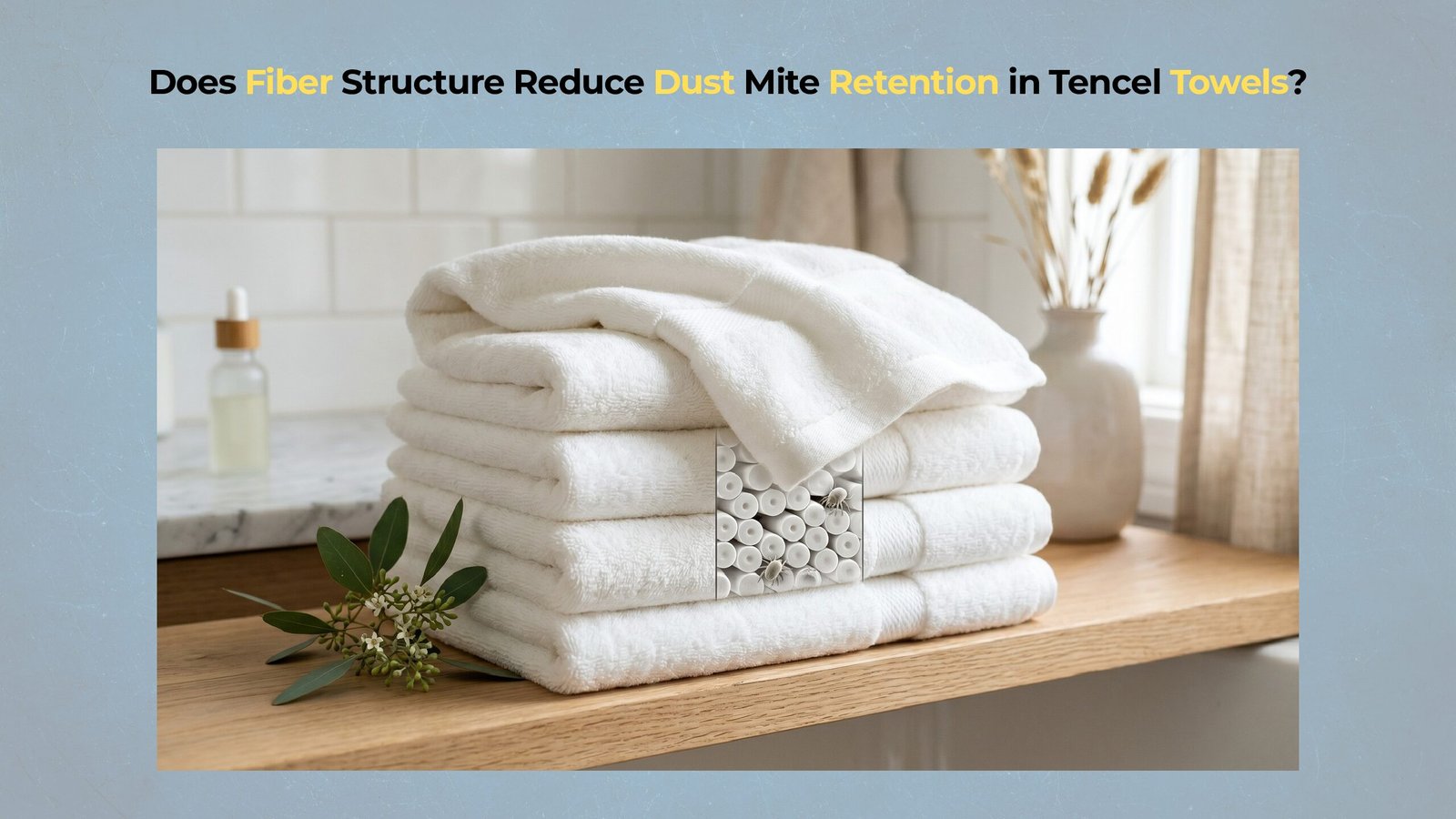
Does Fiber Structure Reduce Dust Mite Retention in Tencel Towels?
A practical, evidence-led guide to Tencel towel fiber structure, dust-mite-related allergen retention, bathroom humidity, towel construction, washing, drying, and storage.
Tencel towel fiber structure may reduce dust mite retention risk indirectly because smooth, moisture-managing fibers can support cleaner towel contact, better moisture handling, and full drying when towel construction, airflow, and humidity allow it, but Tencel towels are not dust-mite-proof.
Tencel towel fiber structure may influence retention through fiber smoothness, moisture behavior, towel pile density, weave structure, towel weight, fabric porosity, drying speed, and washability. Retention means particles, moisture, lint, skin flakes, or residue remaining in towel fibers, loops, or folds after use, storage, or washing.
TENCEL Lyocell and TENCEL Modal are Lenzing textile fibers associated with soft hand feel, smooth touch, and moisture management. Those properties can support a lower-retention towel routine, but fiber structure alone does not kill, repel, block, or neutralize dust mites.
Direct answer: Choose Tencel towels when you want smooth towel contact and moisture-managing construction, but judge the final dust mite retention risk by pile height, dampness, washing frequency, bathroom humidity, drying speed, and storage habits.
This article follows the practical path a concerned reader needs: why retention matters, what retention means, how Tencel towel fiber structure may influence it, when it helps, how Tencel compares with other fibers, how to choose lower-retention Tencel towels, how to wash and dry them, which assumptions weaken the routine, how to troubleshoot concerns, and how to make the final decision.

Why Does Dust Mite Retention in Tencel Towels Matter for Allergy-Conscious Users?
Dust mite retention in Tencel towels matters because towels collect skin flakes, moisture, lint, body oils, and household dust through repeated contact with skin and bathroom air.
A dust mite allergen is a protein-containing particle from mite waste, dust mite droppings, or body fragments that can settle into dust and fabrics. Towels are not the same reservoir as mattresses or carpets, but towel pile and storage folds can still hold dust load, dampness, and allergen particles.
Portnoy et al. in Annals of Allergy, Asthma & Immunology (2013) identifies 35% to 50% humidity, regular washing, and regular cleaning as part of effective dust mite exposure control. The Environmental Protection Agency gives a broader indoor relative humidity range of about 30% to 60% for controlling dust mites, mold, and other biological pollutants.
How Do Tencel Towels Retain Dust Mite Allergens?
Dust mite retention in Tencel towels increases when repeated use allows skin flakes, household dust, moisture, and allergen-carrying debris to remain inside towel pile or storage folds.
The unique insight is simple: towel dust mite retention is a condition-control problem, not a fiber-only problem. A smooth Tencel towel used in a humid bathroom, stored damp, or washed too rarely can still retain debris pockets.
After the towel problem is clear, the next step is defining what retention actually means.
| Retention factor | Why it matters in towels | How it connects to Tencel towels |
|---|---|---|
| Skin flakes | Skin debris can support dust mite presence where dust and humidity persist. | Frequent washing limits organic buildup in TENCEL towel fibers. |
| Moisture | Humidity supports mite-friendly conditions. | Full drying reduces damp conditions; TENCEL moisture management helps only when construction and airflow allow complete drying. |
| Fabric surface | Loops and lint can hold allergen particles and household dust. | Lenzing supports smooth-touch TENCEL fiber properties; lower cling remains a conditional mechanism. |
| Pile density | Dense loops can create debris pockets. | Low-to-medium pile can reduce debris-pocket risk when the towel dries fully. |
| Storage | Bunched towels stay damp longer. | Open hanging supports lower dust-mite-related allergen retention in Tencel towels. |
What Does Dust Mite Retention Mean in Tencel Towels?
Dust mite retention in Tencel towels means actual mites, mite waste particles, shed fragments, household dust, and skin-debris buildup remain trapped in towel fibers, loops, or storage folds.
Retention is the tendency of fabric structure to hold particles, moisture, or debris after use, storage, or washing. In towels, retention can happen in looped pile, weave intersections, detergent residue, lint buildup, fabric porosity, or folded damp storage.
Mayo Clinic uses 130°F / 54.4°C as a hot-water bedding benchmark for dust mite control, while Arlian et al. in the Journal of Allergy and Clinical Immunology (1999) found that mean daily relative humidity below 50% restricted dust mite population growth. Those figures explain the care context; they do not prove a Tencel towel-specific allergen-release result.
What Does Dust Mite Retention Mean in Tencel Towels?
Dust mite retention in Tencel towels must separate actual mites, mite waste, dust, and allergen particles because each form of retention affects towel hygiene differently.
The unique insight is that retention means particles, debris, moisture, and allergen-carrying material staying in fabric, not only live mites. This distinction keeps the article practical and prevents unsupported fear around ordinary towel use.
Once retention is defined, the next question is whether Tencel fiber structure changes the retention conditions.
| Term | Plain meaning | Towel relevance |
|---|---|---|
| Dust mites | Microscopic organisms associated with dust and humidity. | They are more likely where moisture and debris persist. |
| Mite waste | Allergen-containing particles from dust mites. | Particles can settle into fabrics and household dust. |
| Dust load | Household dust, lint, skin flakes, and debris. | Dust load builds up in towel pile when washing is infrequent. |
| Retention | How well particles stay trapped in fabric. | Pile, weave, washing, drying, and residue affect retention. |
| Reduction | Lowering buildup and exposure conditions. | Reduction requires fiber choice plus a care routine. |
How Can Tencel Towel Fiber Structure Influence Dust Mite Retention?
Tencel towel fiber structure may influence dust mite retention conditions through surface smoothness, moisture behavior, pile density, and washability, but towel-specific allergen retention still depends on construction, washing, drying, humidity, and storage. At the fiber level, Tencel nanofibril structure supports moisture uptake in ways that help explain why moisture behavior is discussed separately from dust-mite-proof claims.
No towel-specific allergen-retention testing is assumed. Smooth Tencel fibers may reduce rough surface cling, but no towel-specific dust or allergen particle-release test is assumed.
Particle cling is the tendency of dust, lint, skin flakes, or allergen-carrying particles to stay attached to a fabric surface. Lenzing describes TENCEL Lyocell fibers as soft and smooth to touch, and TENCEL fiber positioning supports moisture control and a natural dry feeling. That surface behavior connects naturally to how Tencel fiber luster and smoothness affect towel surface behavior, but it still supports a mechanism, not a dust-mite-proof claim.
How Does Tencel Fiber Structure Affect Retention?
Tencel towel fiber structure affects dust mite retention by shaping particle cling, dampness, pile debris, and wash-release performance when the towel is cleaned and dried correctly.
Arlian et al. in the Journal of Allergy and Clinical Immunology (1999) reported that daily low-RH regimens reduced mite populations by 98.8% to 99.4% compared with continuous 75% RH conditions. The unique insight is that smooth Tencel towel fibers can only support lower retention when drying and humidity conditions also suppress mite-friendly environments.
The mechanism matters only when the bathroom and towel routine allow the structure to work.
| Feature | Possible retention effect | Important limit |
|---|---|---|
| Smooth Tencel fiber surface | May support lower particle cling when low-lint pile and washing release debris. | Lenzing supports smooth-touch properties; no source proves dust-mite-proof towel performance. |
| Moisture management | May support moisture management and full drying when airflow and humidity allow it. | Bathroom humidity can override fiber-level moisture benefits. |
| Low-to-medium pile | Reduces debris-pocket risk compared with dense plush pile when the towel dries fully. | Sekerden 2012 supports pile-height effects on water retention, not direct allergen release. |
| Clean weave structure | Limits lint pockets when yarn structure stays stable through washing. | Jamshaid et al. 2025 supports construction effects on towel performance; care still controls buildup. |
| Washable towel design | Supports frequent particle removal. | Care label limits must still be followed. |
When May Tencel Towels Reduce Dust Mite Retention Risk?
Tencel towels may reduce dust mite retention risk when they dry fully between uses, are washed frequently, and hang in a bathroom with good airflow and controlled humidity.
Relative humidity is the percentage of moisture in the air compared with the maximum moisture the air can hold at that temperature. In a bathroom, high relative humidity can keep towels damp even when the fiber itself manages moisture well, which is why Tencel towel suitability for humid climates depends on drying conditions, airflow, and storage habits.
The American Lung Association recommends keeping indoor humidity below 50% to reduce dust mites. Portnoy et al. in Annals of Allergy, Asthma & Immunology (2013) identifies 35% to 50% humidity, regular washing, and regular cleaning as part of mite exposure control.

When Do Tencel Towels Dry Well Enough?
Dust mite retention in Tencel towels decreases most when bathroom airflow, humidity control, and full drying support the towel’s smooth, moisture-managing structure.
The unique insight is that Tencel towel fiber structure becomes useful only when airflow and drying prevent damp towel storage. A towel that stays damp for hours has a retention problem even when the fiber label looks ideal, so how fast Tencel towels dry between uses becomes part of the retention decision.
After the ideal use case is clear, the reader can compare Tencel towels against other towel fibers by retention criteria.
| Situation | Tencel towel fit | Why this matters |
|---|---|---|
| Towel dries fully after each use. | Strong fit when construction is washable. | Dry fabric is less supportive of mite-friendly conditions. |
| Bathroom is humid with poor airflow. | Weak fit unless care improves. | Moisture can outweigh fiber benefits. |
| Hand or face towel is washed often. | Good fit for allergy-conscious routines. | Frequent washing and smooth contact help control buildup. |
| Plush towel is reused many times. | Riskier fit if drying is slow. | Dense pile can hold debris and moisture. |
| Towel is stored in a closed cabinet after use. | Poor fit until storage changes. | Restricted airflow keeps moisture trapped. |
How Do Tencel Towels Compare With Other Towel Fibers for Dust Mite Retention?
Tencel towels compare well with other towel fibers for dust mite retention when the reader prioritizes smoothness, moisture handling, washability, and towel construction over marketing claims. When bamboo-labeled towels enter the comparison, how Tencel towels compare with bamboo towels helps readers separate fiber identity from broad “bamboo” marketing language.
Washability is the ability of a towel to tolerate frequent cleaning while releasing dust, skin debris, body oils, and residue. Washability often matters more than a fiber label because washing removes the dust load that towels collect through normal use.
Lenzing supports TENCEL softness and moisture-management positioning, while Portnoy et al. in Annals of Allergy, Asthma & Immunology (2013) points to 35% to 50% humidity plus routine cleaning. The material comparison should therefore focus on construction, drying, and wash release.

Which Towel Fibers Retain Less Debris?
Tencel towel fiber structure should be compared with cotton, bamboo, and microfiber through smoothness, drying speed, pile structure, and washability because those features shape dust mite retention.
The unique insight is that towel construction and drying behavior predict retention risk more reliably than fiber labels alone. Cotton can work well when washable and quick to dry. Bamboo-labeled towels need fiber-label checking. Microfiber particle retention depends on weave, split-fiber structure, cleaning behavior, and wash release.

Once the reader chooses Tencel intentionally, the next step is checking which Tencel towel construction reduces retention risk.
| Towel fiber | Potential advantage | Retention watchout |
|---|---|---|
| Tencel towels | Smooth feel and moisture management can support lower-retention conditions. | Dense pile or poor drying can still retain debris. |
| Cotton towels | Broad availability and frequent washing can support debris removal. | Heavy towels may stay damp longer in humid bathrooms. |
| Bamboo towels | Many products are marketed as soft. | Fiber type and blend can be unclear without label checking. |
| Microfiber towels | Many constructions dry quickly. | Split fibers and dense weaves are designed to trap fine particles in cleaning textiles; towel relevance depends on construction and wash release. |
How Should You Choose Tencel Towels That Reduce Dust Mite Retention Risk?
Tencel towels reduce dust mite retention risk best when buyers choose clear fiber content, low-to-medium pile, clean weave construction, manageable towel weight, fast drying, and strong washability. The same buying path also depends on why quick-dry performance matters when buying towels, especially when the bathroom has limited airflow.
Pile height is the height of towel loops or raised fibers that create plushness and absorbency. High pile can feel luxurious, but dense loops can trap lint, dust, skin flakes, and moisture if the towel does not dry fully. That is where Tencel moisture capacity and towel drying performance become more useful than judging softness alone.
Lenzing identifies TENCEL as its textile brand, including TENCEL Lyocell and TENCEL Modal fiber types. Arlian et al. in the Journal of Allergy and Clinical Immunology (1999) found that mean daily RH below 50% restricted mite population growth, so a buying decision should prioritize drying in the user’s real bathroom.

What Tencel Towel Features Reduce Retention?
Low-retention Tencel towels require clear fiber content, controlled pile height, clean weave, manageable weight, and drying speed because each feature changes dust mite retention risk.
The unique insight is that the best buying choice is not the plushest Tencel towel. The stronger choice is the towel construction that dries fully, releases debris during washing, and avoids long-term lint buildup.
A lower-retention towel construction still needs the right wash-dry routine to remove buildup.
| Buying check | Why it matters for retention | How to apply it |
|---|---|---|
| Tencel percentage | Fiber content confirms whether Tencel is a meaningful part of the towel. | Check for TENCEL Lyocell, TENCEL Modal, generic lyocell, or blend wording. |
| Pile height | Dense pile can hold more debris and moisture. | Choose low-to-medium pile when plush towels stay damp in your bathroom. |
| Weave clarity | Clean construction may reduce lint pockets. | Avoid shaggy, decorative, or unstable loop constructions for allergy-conscious use. |
| Drying speed | Lower damp time reduces mite-friendly conditions. | Match towel weight to bathroom airflow and humidity. |
| Washability | Frequent laundering removes dust and skin debris. | Choose towels with care instructions you can follow consistently. |
| Separate towel sizes | Face and hand towels can be washed more often. | Use smaller towels where frequent replacement and washing are easier. |
How Should You Wash and Dry Tencel Towels to Reduce Dust Mite and Allergen Retention?
Tencel towels reduce dust mite and allergen retention most effectively when regular washing removes skin flakes, body oils, dust, and particles, and full drying prevents damp storage.
Residue buildup is leftover detergent, minerals, body oils, or fabric additives that remain inside towel fibers after washing. Residue can make a towel feel stiff, hold odors, and increase particle cling.
Mayo Clinic recommends washing bedding weekly in water at least 130°F / 54.4°C, or using a dryer above 130°F for at least 15 minutes when hot washing is not possible. Use this as dust mite control context, not as permission to ignore a Tencel towel care label.
How Should You Wash and Dry Tencel Towels?
Dust-mite-related allergen retention in Tencel towels decreases when regular washing, correct detergent dosing, thorough rinsing, full drying, open hanging, and dry storage remove debris and moisture.
Portnoy et al. in Annals of Allergy, Asthma & Immunology (2013) supports a combined routine that includes humidity control, regular washing, and regular cleaning. The unique insight is that washing reduces retained allergens only when rinsing and full drying prevent residue and damp storage.
For broader towel residue and absorbency troubleshooting, Toweldaily’s guide on how to make towels absorbent again is a natural next step after the reader understands washing, rinsing, and drying control.

Care controls retention, but common assumptions can still weaken the routine.
| Care step | Action | Retention benefit |
|---|---|---|
| Frequent washing | Wash regularly to remove dust, body oils, and skin debris. | Reduces mite food sources and allergen particles. |
| Correct detergent dose | Use enough detergent to clean without residue overload. | Limits sticky buildup in fibers. |
| Thorough rinse | Clear detergent and loosened debris from towel loops. | Supports cleaner towel contact. |
| Full drying | Dry completely before folding, storing, or reusing. | Reduces mite-friendly damp conditions. |
| Open hanging | Hang towels where air can pass through them. | Prevents moisture from staying trapped. |
| Dry storage | Store towels only when completely dry. | Prevents damp folded fabric from retaining debris. |
What Mistakes Weaken Dust Mite Reduction in Tencel Towels?
Dust mite reduction in Tencel towels weakens when users treat Tencel fiber structure as a dust-mite barrier, ignore humidity, buy overly dense towels, store towels damp, or trust vague natural-fiber claims.
Dust-mite-proof is a barrier claim that should be reserved for products specifically designed and tested to block dust mite allergen movement. Ordinary towels, including Tencel towels, should not be described that way without product-specific proof.
Arlian et al. in the Journal of Allergy and Clinical Immunology (1999) reported 98.8% to 99.4% population reduction under daily low-RH regimens compared with continuous 75% RH. The American Lung Association also recommends indoor humidity below 50% to reduce dust mites.
What Tencel Towel Dust Mite Myths Need Correction?
Common dust mite retention assumptions about Tencel towel fiber structure must be corrected because smooth fibers cannot replace humidity control, frequent washing, full drying, and clean storage.
The unique insight is that no ordinary towel fiber structure replaces humidity control and full drying. A vague “natural,” “hypoallergenic,” or “anti-dust” label does not prove dust mite retention reduction, so Tencel towel hypoallergenic properties should be understood as a cautious comfort-and-care framework rather than a medical or dust-mite-proof promise.
If retention concerns already exist, the reader needs a step-by-step isolation process.
| Mistake | Why it fails | Better action |
|---|---|---|
| Saying Tencel blocks dust mites. | Fiber structure is not an allergen barrier. | Use washing, drying, and humidity control. |
| Ignoring humidity. | Dust mites are strongly affected by moisture conditions. | Improve airflow and monitor drying. |
| Buying very dense towels. | Dense pile can trap debris and moisture. | Match towel weight to drying conditions. |
| Storing damp towels. | Damp storage supports buildup. | Dry fully before storage. |
| Trusting vague claims. | Marketing language may not prove performance. | Check fiber content, pile, washability, and care requirements. |
How Do You Fix Dust Mite Retention Concerns in Tencel Towels?
Dust mite retention concerns in Tencel towels should be fixed by isolating whether the problem comes from towel structure, washing frequency, humidity, storage, dust load, or damaged fibers.
Dust load is the amount of dust, lint, skin flakes, and debris available to settle into towel fibers. Dust load rises when towels sit near dusty shelves, stay unwashed too long, collect lint, or dry in poorly ventilated spaces.
The American Lung Association’s below 50% humidity guidance, Mayo Clinic’s weekly washing and 130°F / 54.4°C bedding benchmark, and Portnoy et al. 2013 all point to the same practical conclusion: test drying time and humidity before replacing the towel fiber.
How Do Dampness, Storage, and Dust Load Drive Tencel Towel Retention?
Dust mite retention in Tencel towels can be isolated by checking drying time, pile density, lint buildup, musty odor, visible dust, bathroom humidity, washing frequency, and storage.
The unique insight is that troubleshooting must test the towel environment first. A towel that smells musty or feels dusty may need better rinsing, more complete drying, or lower bathroom humidity before the fiber itself is blamed.
After the reader isolates the cause, the final step is deciding whether Tencel fiber structure is enough or care changes matter more.

Tencel Towel Dust Mite Retention Troubleshooting Sequence
- Notice musty odor, dusty towel feel, visible lint, or repeated dampness.
- Check bathroom humidity and towel drying time.
- Check pile density, lint buildup, and towel age.
- Wash Tencel towels more frequently.
- Rinse thoroughly and dry fully.
- Store only when completely dry.
- Improve airflow, ventilation, or dehumidification.
- Replace dense, old, damaged, or residue-heavy towels if problems continue.
Does Tencel Towel Fiber Structure Reduce Dust Mite Retention Enough for Your Needs?
Tencel towel fiber structure reduces dust mite retention enough for some allergy-conscious users when the towel is smooth, washable, fully dried, stored dry, and used in a low-humidity bathroom.
Retention-control routine means the combined use of fiber choice, towel construction, washing, drying, humidity control, and dry storage to reduce particle buildup. Tencel fiber structure is not enough if the bathroom is humid, towels stay damp, or washing is infrequent.
TENCEL/Lenzing fiber properties, Arlian et al. 1999 below 50% RH evidence, Portnoy et al. 2013 35% to 50% humidity guidance, and Mayo Clinic’s 130°F / 54.4°C bedding benchmark all support a combined system rather than a single-fiber solution.

What Tencel Towel Retention Checklist Should You Use?
The final Tencel towel fiber structure and dust mite retention checklist helps readers decide whether fiber structure is enough or whether humidity control, washing, drying, and storage matter more.
The unique insight is that Tencel towel fiber structure is enough only when towel construction, washing, drying, humidity control, and storage work together. The final decision should prioritize low-to-medium pile, clear fiber labeling, easy washing, complete drying, and dry storage.
| Your situation | Decision | Best next step |
|---|---|---|
| Towels dry fully after each use. | Tencel towels can help. | Choose smooth, washable Tencel towels. |
| Bathroom is humid. | Fiber structure is not enough. | Improve airflow and drying first. |
| Towels smell musty. | Fix care before blaming fiber. | Wash more often and dry fully. |
| You need dust mite allergy control. | Tencel may support the routine. | Combine with humidity and laundry control. |
| You want a dust-mite-proof towel. | Do not rely on fiber alone. | Use proven dust mite reduction habits. |
Final Tencel Towel Dust Mite Retention Checklist
- ☐ Choose Tencel towels if you want smoother fibers, good moisture handling, and a towel that dries fully between uses.
- ☐ Confirm whether the towel is TENCEL Lyocell, TENCEL Modal, generic lyocell, or a blend.
- ☐ Choose low-to-medium pile if dense plush towels stay damp in your bathroom.
- ☐ Wash Tencel towels regularly to remove skin flakes, body oils, dust, and trapped particles.
- ☐ Rinse thoroughly to reduce detergent residue and particle cling.
- ☐ Dry towels fully before folding, storing, or reusing.
- ☐ Improve bathroom airflow if towels remain damp for hours.
- ☐ Store Tencel towels only when completely dry.
- ☐ Replace dense, old, damaged, or residue-heavy towels if problems continue.
- ☐ Treat Tencel towel fiber structure as one part of a dust mite reduction routine, not a dust-mite-proof barrier.
Tencel towel fiber structure may support lower dust mite retention when the towel is smooth, washable, fully dried, and used in a bathroom with good airflow and controlled humidity. Tencel towels are not dust-mite-proof, but you can control the towel environment through fiber choice, pile selection, washing, rinsing, full drying, airflow, humidity control, and dry storage.