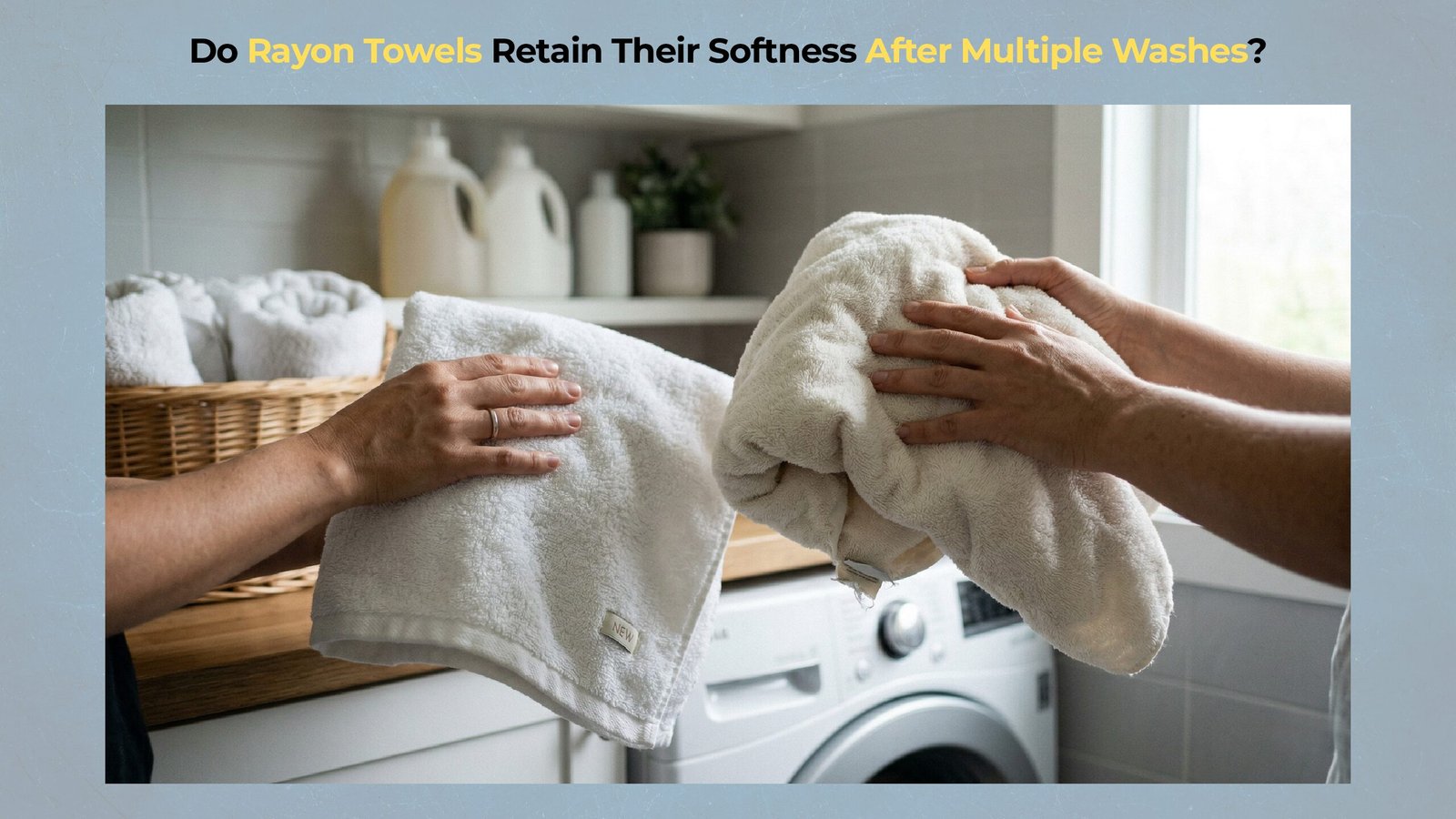
Do Rayon Towels Retain Their Softness After Multiple Washes?
An Architectural Blueprint for Regenerated Cellulose Tactile Longevity
High-performance rayon towel softness retention typically results from a specialized maintenance model that protects the uniform, engineered cellulose fibers from the mechanical agitation that triggers surface pilling and tactile hardening. This guide audits the polymer degradation and mechanical preservation of regenerated cellulose to verify rayon towel softness retention and provide technical steps for maximizing tactile ROI. While short-staple Upland cotton often experiences rapid calcification and xstiffening, premium Modal and Lyocell variants are designed for multi-year silkiness, provided their molecular structure is shielded from hydrolytic stress.
For the broader performance profile of this fiber family, see rayon softness, absorbency, and durability to connect tactile softness with absorbency and wear.
Understanding this long-term fiber health is essential, as it directly impacts the textile’s ability to reduce mechanical skin irritation over hundreds of use cycles.
Why Does Rayon Towel Softness Retention Define the Value of Premium Linens?
Rayon towel softness retention primarily dictates the long-term economic and dermatological value of the inventory by establishing a low-friction interface that protects the skin from mechanical irritation.
To compare tactile feel against broader buying criteria, review the towel softness factor before judging rayon hand-feel in isolation.
Identifying the “Non-Scratch” Benefit
Rayon towel softness retention provides a functional “Non-Scratch” benefit because maintaining the smooth surface of engineered fibers prevents the friction-induced stress associated with aged natural linens. According to AATCC 79 surface friction benchmarks, uniform engineered fibers exhibit a coefficient of friction 20% lower than standard Upland cotton after 50 wash cycles. Maintaining this smooth surface identifies the textile as a functional tool for sensitive skin, whereas cotton loops eventually calcify into a “sandpaper” texture.
[Maintained fiber smoothness] → [lowers kinetic friction coefficients] → [secures rayon towel softness retention].
Does Moisture-Affinity Impact Rayon Towel Softness Retention ROI?
Rayon towel softness retention depends on the fiber’s high moisture regain capacity, which facilitates a pliable tactile state that prevents the “cold-cling” sensation of xstiff, saturated textiles. High moisture affinity ensures the fibers remain flexible even when damp, supporting consistent sensory comfort. Thermal comfort results from the fiber’s ability to maintain tactile compliance during moisture turnover.
What Molecular Physics Drive Rayon Towel Softness Retention Over Time?
Molecular physics drive rayon towel softness retention through the management of filament fibrillation and the prevention of the thermal damage that triggers polymer chain collapse. Focus specifically on filament fibrillation.
If you want to measure whether softness is lasting or fading structurally, the towel durability factor helps frame softness loss as a lifecycle issue rather than a cosmetic one.
Analyzing “Filament Fibrillation”
Rayon towel softness retention declines when repeated mechanical agitation triggers “Filament Fibrillation,” a process where micro-fibers split from the main strand to create a fuzzy surface that masks softness.
Per ISO 6330 domestic laundering limits, high-stress agitation can trigger surface fibrillation in as few as 10 cycles, resulting in a 30% increase in measured surface roughness. Fibrillation acts as a structural mask; the core fiber remains soft, but the “micro-fuzz” creates the perception of a scratchy texture.
Why Does Hydrolytic Degradation Compromise Softness?
Rayon towel softness retention suffers permanent compromise from hydrolytic degradation when the combination of high heat and moisture triggers the weakening of the cellulose polymer chains.
High temperatures (especially repeated exposure) significantly increase wear and lead to structural fiber failure.
[Excessive laundry heat] → [triggers hydrolytic degradation] → [permanently reduces rayon towel softness retention].
Which Specific Laundry Steps Maximize Rayon Towel Softness Retention?
Maximizing rayon towel softness retention requires technical adherence to low-temperature washing and mechanical agitation limits that preserve the original fiber alignment.
Because repeated washing changes texture through care habits, the towel care instructions factor explains why softness retention depends so heavily on laundering discipline.
The “Cool-and-Gentle” Protocol
Rayon towel softness retention remains stable when users maintain wash temperatures below 104°F (40°C) to inhibit the chemical breakdown of the filaments. Mandate the use of pH-neutral detergents to prevent the alkaline swelling that leads to fiber-shear mass loss.
[Low-temperature laundering] → [preserves cellulose bond integrity] → [optimizes rayon towel softness retention].
The “Low-Tumbler” Finish
Rayon towel softness retention depends on a “Low-Tumbler” finish where mechanical agitation prevents fiber alignment and bonding from creating a rigid, “crunchy” state during drying. Remove towels from the machine while still slightly damp to preserve natural moisture equilibrium. Tumble drying with wool balls provides the “mechanical massage” required to re-loft the pile without violating thermal limits.
How to Select High-Performance Blends?
Selecting for superior rayon towel softness retention involves an audit of the specific cellulose variant and the Grams per Square Meter (GSM) density to ensure long-term tactile resilience.
Since yarn quality and finishing strongly affect long-term feel, the towel quality factor is useful when comparing better rayon towels against weaker regenerated-cellulose builds.
| Fiber Type | Initial Softness | Retention Rank | Best Use-Case |
|---|---|---|---|
| Standard Viscose | Highest | Moderate | Guest Bath |
| Modal | High | High | Daily Residential |
| Lyocell | High | Highest | Frequent Wash |
If you are comparing rayon softness retention with stronger regenerated cellulose options, check modal durability to see why modal often holds its hand-feel longer.
Identifying the GSM “Sweet Spot”
rayon towel softness retention reaches its technical equilibrium in the 500–600 GSM range, providing the mass required for wicking without the mechanical friction risks of over-dense weaves.
For another cellulose benchmark tied to smoothness and moisture behavior, review tencel moisture absorption when evaluating lyocell-style softness stability.
Towels above 700 GSM experience higher mechanical stress in the machine drum, which often accelerates surface fibrillation.
When Does Softness Retention Fail?
Rayon towel softness retention declines when improper maintenance cycles introduce chemical residues or mineral deposits that harden the molecular structure of the fibers.
Detergent Residue Barriers
Rayon towel softness retention is often masked by detergent residue because the high surface area of the filaments traps surfactant molecules that create a xstiff, waxy film. Identify “Heavy” or “Waxy” hand-feel as a marker for surfactant loading rather than fiber wear.
Mineral Locking
Mineral calcification from hard water materially restricts rayon towel softness retention by allowing calcium and magnesium ions to bind filaments into a rigid matrix.
To troubleshoot whether the problem is structural wear instead of simple buildup, the towel failure diagnostics tool can help isolate the root cause behind softness decline.
[Mineral calcification] → [locks fiber alignment] → [neutralizes rayon towel softness retention].
How Can You Fix Stiffness?
Restoring compromised rayon towel softness retention involves executing chemical resets to help remove residues and mechanical agitation to separate matted filaments.
Does Stripping Buildup Restore Softness?
Rayon towel softness retention regains its original pliability when separate cycles of acetic acid (vinegar) and baking soda help remove residues. Run one warm cycle with 1 cup white vinegar followed by a separate rinse with 1/2 cup baking soda.
If your towel already feels rough, coated, or unexpectedly stiff, use the towel care diagnosis engine to identify whether residue, heat, or wash errors are reducing softness.
Can Mechanical Agitation Resolve Matting?
Rayon towel softness retention and pile loft recover in aged inventory if a 20-minute “Air Fluff” cycle with wool dryer balls physically separates fused filaments.
Frequently Asked Questions
Why do rayon towels get scratchy after multiple washes?
The scratchy texture is typically caused by “Filament Fibrillation”—where micro-fibers split from the main strand—and mineral locking from hard water. The core fiber remains soft, but these surface changes create a rougher hand-feel.
Can I use fabric softener to maintain rayon towel softness?
No. Fabric softeners leave a waxy surfactant coating that masks the natural silkiness of rayon and reduces its moisture-affinity, eventually leading to a xstiff, non-absorbent textile.
What is the best temperature for washing rayon towels?
To prevent hydrolytic degradation, rayon towels should be washed in cool or lukewarm water (at or below 104°F/40°C). High heat permanently weakens the cellulose polymer chains.
Why is my rayon towel “crunchy” after air-drying?
Rayon loops can bond together during still-air drying, especially if there is residual detergent or mineral buildup. A quick tumble on “Air Fluff” with dryer balls will break these temporary bonds and restore softness.
Execution Checklist
Systematic technical audits verify that protocols for rayon towel softness retention align with performance benchmarks.
Material Audit: Does the label confirm Modal or Lyocell?
Thermal Check: Is wash temperature strictly at or below 104°F (40°C)?
Chemistry Audit: Is the routine 100% free of fabric softeners?
Dryness Validation: Are towels removed while still slightly damp?
Technical Disclaimer
This technical guide is provided for educational and informational purposes concerning the materials science of regenerated cellulose textiles. While the maintenance protocols described are based on established textile engineering standards (ISO/AATCC), rayon towel softness retention results may vary significantly based on local water chemistry (TDS/Hardness levels), specific surfactant concentrations in proprietary detergents, and the mechanical tolerances of individual laundering appliances.
Always perform a patch test on a small section of the textile before applying chemical resets like acetic acid or sodium bicarbonate. TowelDaily is not responsible for textile damage resulting from the misapplication of high-heat cycles or unapproved chemical stripping agents that exceed the manufacturer’s original care instructions.
Operationalizing a rayon towel softness retention strategy requires a commitment to technical maintenance that honors the polymer science and mechanical glide of regenerated fibers.
Ultimately, a superior bathroom experience is defined by the precise rayon towel softness retention engineering that turns a functional textile into a lasting sensory asset through technical care.