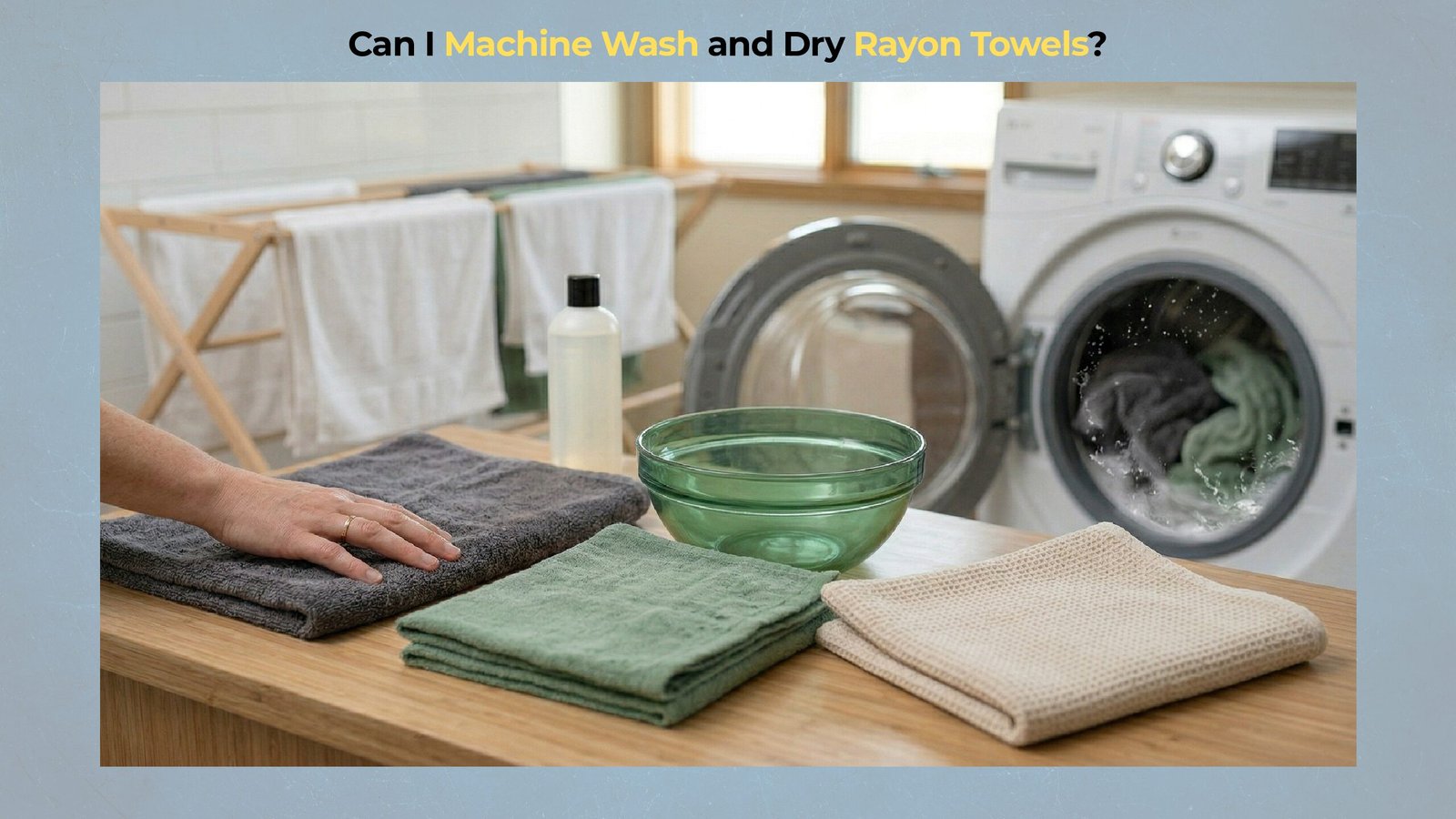
Can I Machine Wash and Dry Rayon Towels?
Yes, rayon towel machine washing and drying is permissible for most modern textiles, though the process requires delicate care to prevent the shrinkage and damage triggered by significant wet-fiber weakening; while many bamboo or modal variants are designed for laundering, they require treatment as delicate items.
Detailing how improper agitation and heat lead to permanent stiffening or collapse of the fabric structure is essential for long-term inventory management. When laundering protocols fail to account for the material’s inherent moisture sensitivity, the resulting structural failure becomes irreversible. Consequently, understanding how laundering protocols determine long-term textile lifespan is the first step in high-performance linen maintenance.
Why Does the Protocol for Rayon Towel Machine Washing and Drying Determine Textile Lifespan?
Rayon towel machine washing and drying primarily determines the functional service life of the textile by establishing the protective boundaries required to prevent the structural weakening of the cellulose fibers. To better understand how structural damage develops under stress, it is useful to review why rayon towels shed, snag, or tear easily during use, especially when wet fibers are exposed to mechanical friction. By controlling the mechanical environment, operators can maintain the fiber’s original wicking efficiency and tactile drape over hundreds of cycles. Longevity results from managing the wet-weakness variable through every phase of the wash.
Identifying the “Wet-Weakness” Variable in Rayon Towel Machine Washing and Drying
Rayon towel machine washing and drying requires gentle handling because regenerated cellulose fibers lose a significant portion of their tensile strength when saturated. Once you understand this wet-weakness variable, the next step is learning how to properly care for and maintain rayon towels to preserve fiber integrity across repeated wash cycles. Moisture penetrates the amorphous regions of the fiber, making the “Wash Phase” the period of highest risk for mechanical tearing or stretching as water molecules disrupt the internal hydrogen bonding network.
[Moisture saturation] -> [disrupts hydrogen bonds] -> [increases the mechanical risk of rayon towel machine washing and drying].
Evaluating the “ROI” of Disciplined Rayon Towel Machine Washing and Drying
A disciplined technical care protocol for rayon towel machine washing and drying significantly extends the usable lifespan of premium Modal or Lyocell inventory compared to standard laundering habits. Financial motivation for adhering to machine standards comes from reducing the frequency of inventory replacement; a single aggressive cycle can cause a 20% loss in molecular structural integrity. Safety is also dictated by selecting machine-compatible variants.
Can All Rayon Towels Be Safely Machine Washed and Dried?
Safety during rayon towel machine washing and drying depends on a high-authority decision gate that identifies the specific fiber generation and blend ratio of the textile. Users must analyze the label to determine if the cellulose has been chemically modified to withstand higher mechanical loads or if it requires artisanal-level care.
Contrasting Standard Viscose vs. High-Tenacity Variants for Rayon Towel Machine Washing and Drying
Selecting the correct fiber generation dictates the success of rayon towel machine washing and drying, where Modal and Lyocell are engineered for higher wet-strength resilience than standard viscose. For a deeper understanding of long-term performance differences, you should evaluate how durable rayon towels are with regular use across different fiber types. “Bamboo Viscose” is typically more fragile than “Tencel Lyocell,” requiring more aggressive mechanical safeguards during machine use. High wet-modulus variants identify the textile as “machine-safe,” as lower-tier rayon collapses and loses dimensional stability upon saturation.
Evaluating the “Blend Factor” for Safe Rayon Towel Machine Washing and Drying
Rayon towel machine washing and drying becomes safer when the textile is blended with at least 30% cotton or polyester, which provides a structural “frame” that supports the softer regenerated fibers. Hybrid weaves distribute mechanical stress more evenly than 100% rayon constructions, acting as a skeleton that prevents the cellulose from over-extending. These mechanical limits are governed by the underlying fiber physics.
What Fiber Physics Define the Limits of Rayon Towel Machine Washing and Drying?
Fiber physics define the limits of rayon towel machine washing and drying through the interaction of thermal energy and the mechanical stress applied to wet fibers. The interaction between temperature and agitation creates a risk profile that increases exponentially as the cycle progresses.
Does Excessive Heat Lead to Cumulative Fiber Weakening in Rayon Towel Machine Washing and Drying?
Rayon towel machine washing and drying results in fiber fatigue when prolonged exposure to high heat and moisture gradually weakens the cellulose polymer structure.
“Hot” water settings and high-heat drying are fundamentally incompatible with cellulose chain preservation as they accelerate the breakdown of the amorphous inter-crystalline regions.
Definition: Fiber Fatigue – The progressive structural damage that occurs when a material is subjected to repeated thermal and mechanical stress.
Evaluating the Impact of “Spin-Cycle Stress” on Rayon Towel Machine Washing and Drying
Rayon towel machine washing and drying results in structural distortion if high-RPM spin cycles place excessive stress on weakened wet fibers. Since shrinkage is closely tied to mechanical and thermal stress, it is important to understand how to wash rayon towels to prevent shrinkage and dimensional loss during machine cycles. Friction during agitation contributes to fiber fibrillation and surface pilling, where loops are pulled out of alignment.
[High spin speeds] -> [cause fiber distortion] -> [compromise the dimensions of rayon towel machine washing and drying].
Which Specific Settings Execute a Safe Rayon Towel Machine Washing and Drying Cycle?
Specific machine parameters execute a safe rayon towel machine washing and drying cycle by limiting mechanical agitation and maintaining temperatures below the fiber’s thermal fatigue threshold.
Table: Risk Matrix for Rayon Towel Machine Washing and Drying
| Setting | Risk Level | Primary Technical Impact |
|---|---|---|
| Hot Water (>60°C) | High | Prolonged fiber weakening |
| High-Speed Spin | High | Permanent loop distortion |
| Machine Overloading | Moderate | Friction-based fiber fibrillation |
| Dryer: High Heat | High | Thermal contraction and stiffness |
Selecting Optimal Parameters for Rayon Towel Machine Washing and Drying
Optimized performance for rayon towel machine washing and drying results from a combination of cold-water washing and “Delicate” mechanical cycles that preserve the original weave geometry.
Table: Parameter Selection for Rayon Towel Machine Washing and Drying
| Parameter | Recommended Setting | Technical Reason |
|---|---|---|
| Water Temp | < 104°F (40°C) | Prevents thermal fiber damage |
| Cycle Type | Delicate / Hand Wash | Minimizes mechanical agitation |
| Spin Speed | Low (Gentle) | Reduces mechanical fiber stress |
| Machine Load | Avoid Overloading | Prevents friction-based pilling |
Executing the “Mesh-Bag Shield” for Rayon Towel Machine Washing and Drying
Rayon towel machine washing and drying and loop integrity are secured through the use of large mesh laundry bags that provide a physical barrier against abrasive drum surfaces. Forbid washing rayon towels with hardware-heavy items like jeans; mesh isolation prevents snags that lead to unravelling and terminal fiber loss. Management of the dryer phase is the next critical step.
How Should You Manage the Dryer Phase of Rayon Towel Machine Washing and Drying?
Managing the dryer phase of rayon towel machine washing and drying requires a technical shift to low-heat protocols and mechanical agitation to prevent the rigid alignment of fiber bundles. Because drying directly affects softness and wicking efficiency, you may also want to explore how absorbent rayon towels are and how drying impacts their performance over time.
Implementing the “Low-Heat / Air-Fluff” Rule for Rayon Towel Machine Washing and Drying
Rayon towel machine washing and drying results in superior softness when users strictly utilize “Low Heat” or “Air Fluff” settings and remove the textile while it remains slightly damp. Utilize the “Damp-Pull” technique: remove towels before they reach 100% dryness to preserve the air-trap within the loops and prevent moisture-equilibrium exhaustion.
[Controlled drying heat] -> [prevents over-drying and stiffness] -> [facilitates the soft finish of rayon towel machine washing and drying].
Using Mechanical Agitation to Restore Loft in Rayon Towel Machine Washing and Drying
Rayon towel machine washing and drying utilizes mechanical agitation from wool dryer balls to physically separate matted fibers and re-loft the pile without the need for high heat. Recommend using 3–4 wool balls to provide the “mechanical massage” required to restore the towel’s original silk-like drape. Even with correct settings, users must identify risky scenarios.
When is Rayon Towel Machine Washing and Drying Risky?
Rayon towel machine washing and drying can fail when users attempt to process aged linens or textiles that have been compromised by cumulative mineral calcification.
Identifying “Aged” Textiles Unsuitable for Rayon Towel Machine Washing and Drying
Rayon towel machine washing and drying utility terminates upon the appearance of visible thinning or fraying, after which users should transition to hand-washing only. When a towel feels “paper-thin,” it indicates a terminal loss of molecular mass that cannot survive the mechanical rotation of a drum.
Recognizing the “Hard Water” Risk in Rayon Towel Machine Washing and Drying
Rayon towel machine washing and drying results decline in hard-water environments where mineral deposits bind to the regenerated fibers and create a rigid, “crunchy” texture after drying. Calcium and magnesium ions act as an “environmental glue” that locks fiber loops into a non-wicking state. Fixing stiffness via chemical resets is the only recovery path.
How Can You Fix Stiffness to Restore Rayon Towel Machine Washing and Drying?
Restoring compromised rayon towel machine washing and drying involves executing chemical resets to remove mineral residues and restore the fiber’s natural wicking pathways.
Stripping Mineral Buildup via a Vinegar Rinse for Rayon Towel Machine Washing and Drying
Rayon towel machine washing and drying baseline levels are often restored if a periodic white vinegar rinse dissolves the mineral “crust” that causes fiber rigidity. Run one warm cycle with 1 cup of white distilled vinegar and NO detergent to clear the loops of accumulated salts.
[Acetic acid rinses] -> [dissolve mineral calcification] -> [restore the flexibility of rayon towel machine washing and drying].
Frequently Asked Questions
No, fabric softener coats the regenerated cellulose fibers with a hydrophobic film, which reduces absorbency and can lead to cumulative fiber fatigue by preventing moisture-equilibrium management.
Chlorine bleach should be strictly avoided as it causes rapid oxidative degradation of the cellulose polymer chains, leading to terminal thinning and loss of tensile strength.
A rigid texture typically results from mineral calcification (hard water) or “over-drying,” which collapses the moisture-equilibrium within the terry loops and aligns fiber bundles too tightly.
While permissible if both are machine-safe, rayon towels are better protected when washed separately or in mesh bags to prevent cross-friction with heavier, hardware-heavy cotton weaves.
How to Verify Your Strategy with a Machine Care Checklist?
Systematic technical audits of your selection and care verify that current protocols for rayon towel machine washing and drying align with objective performance benchmarks.
Checklist: Rayon Towel Machine Washing and Drying Audit Checklist
- Material Audit: Does the label confirm a machine-compatible variant like Modal or Lyocell?
- Thermal Check: Is the wash temperature confirmed at or below 104°F (40°C)?
- Mechanical Check: Is the washing machine strictly set to “Delicate” or “Gentle”?
- Load Check: Has the load size been monitored to avoid overloading the machine?
- Dryer Audit: Is the machine strictly set to “Low Heat” or “Air Fluff”?
- Moisture Check: Are towels removed from the dryer while still slightly damp to the touch?
Technical Disclaimer
The technical protocols for rayon towel machine washing and drying presented in this guide are intended for general informational purposes based on standard textile engineering principles for regenerated cellulose fibers. While these maintenance SOPs are designed to maximize fiber preservation, results may vary based on specific textile blend ratios, local hard water chemistry, and specific appliance calibration. Users should always prioritize the manufacturer’s care label (ISO 3758) found on the individual textile inventory. TowelDaily is not liable for structural damage resulting from equipment failure or chemical interactions outside of the controlled parameters described herein.