Do Rayon Towels Dry Quickly After Use?
An Architectural Blueprint for Regenerated Cellulose Desiccation Strategy
High-performance rayon towel drying speed often presents a slower turnover rate than synthetic microfiber because the regenerated cellulose fibers possess a high moisture affinity that prioritizes internal sequestration over rapid atmospheric release. This desiccation behavior directly depends on moisture release physics, explaining why rayon differs significantly from fast-evaporating materials.
This prolonged moisture release window is the primary variable determining overall bathroom hygiene and the prevention of persistent odors.
Why Does Rayon Towel Drying Speed Impact Bathroom Hygiene and Odors?
Rayon towel drying speed primarily determines the duration of the biological window required for odor-causing bacterial growth and the subsequent formation of musty textile scents. When desiccation is delayed, the textile remains in a state of warm saturation that acts as a petri dish for microbial colonization.
Identifying the “Damp-Window” in Rayon Towel Drying Speed
A specific “Damp-Window” characterizes rayon towel drying speed, where the high moisture affinity of regenerated fibers can sustain an environment conducive to microbial proliferation if not managed with active airflow.
According to AATCC 100 (Antimicrobial Finishes) standards, prolonged dampness exceeding 4–6 hours significantly increases the risk of microbial colonization. This delay triggers the metabolic production of ammonia and sulfide byproducts, commonly recognized as “mildew smell.” Rapid moisture turnover serves as a functional safety feature that disrupts the metabolic cycles of surface pathogens.
Evaluating the Time-ROI of Rayon Towel Drying Speed
Rayon towel drying speed requires a significant time-ROI investment because the high-density fiber structure typically necessitates longer drying durations compared to the rapid moisture release of linen or nylon. While a lightweight linen towel may dry in 2 hours, a high-GSM rayon variant may require 8–12 hours to reach moisture equilibrium. To compare drying speed with a faster natural fiber, see linen absorbency, durability, and drying for a bast-fiber evaporation contrast.
How Does Fiber Chemistry Dictate Rayon Towel Drying Speed?
Molecular fiber chemistry dictates rayon towel drying speed through the interaction of hydrophilic hydroxyl groups and the internal swelling behavior that sequesters water within the filament core. Since fiber chemistry drives evaporation limits, the towel material factor helps explain how regenerated cellulose traps moisture compared to cotton or synthetics.
Analyzing the Impact of Internal Fiber Swelling on Rayon Towel Drying Speed
Rayon towel drying speed remains influenced by internal fiber swelling, where the regenerated cellulose polymer expands upon saturation to physically trap liquid molecules within its structure. To connect drying speed with how much water the fiber holds, the towel absorbency factor explains why high moisture regain slows desiccation.
Standard viscose has a “Moisture Regain” benchmark of 11%–13%. As fibers swell, their diameter increases, effectively “clogging” the interstitial gaps required for airflow. This creates a material barrier that restricts the kinetics of evaporation.
The High-Capillary Mechanism Influencing Rayon Towel Drying Speed
The high-capillary mechanism influencing rayon towel drying speed utilizes structural pores to provide high-speed pathways for moisture to migrate toward the textile surface during initial wicking. This explains the “Wick-but-Hold” paradox: the textile pulls water away from the skin near-instantaneously but refuses to release it from the core without thermal or mechanical intervention. Overcoming this paradox requires specific laundry acceleration steps.
Which Specific Laundry Steps Accelerate Rayon Towel Drying Speed?
Specific laundering protocols accelerate rayon towel drying speed by maximizing mechanical water extraction and optimizing the surface-to-air exposure ratio during the desiccation phase. If your towels remain damp too long, consult the towel care instructions factor to align laundering and drying protocols with fiber physics.
Executing a “High-Speed Spin” to Boost Rayon Towel Drying Speed
Rayon towel drying speed improves significantly when users utilize a high-speed spin cycle in the washing machine to remove excess moisture before the evaporation phase begins. By selecting the highest available RPM setting (1200+), centrifugal force displaces the core saturation that natural evaporation alone cannot reach.
Implementing the “Air-Flow Gap” Rule for Rayon Towel Drying Speed
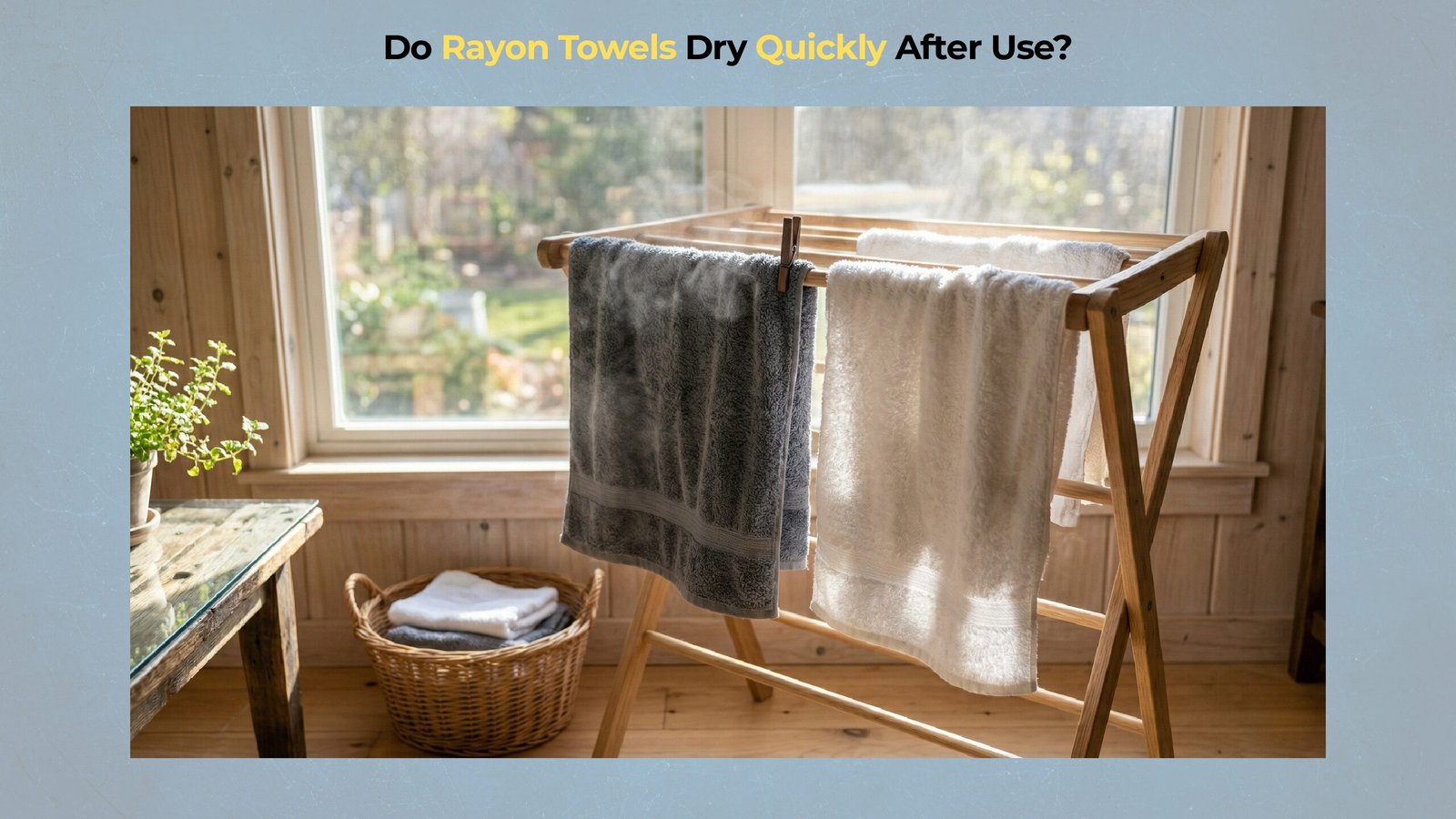
Adhering to the “Air-Flow Gap” rule ensures rayon towel drying speed remains consistent by preventing the moisture stagnation associated with double-folding damp textiles on hooks. Users must utilize wide towel bars for a “Full-Spread” hang. Bunching fabric prevents the vapor pressure equalization required for core drying, leading to “wet pockets” and bacterial risk.
How to Select Fiber Types and Environments to Optimize Rayon Towel Drying Speed?
Calibrating fiber selection and drying environments optimizes rayon towel drying speed by aligning the textile’s mass with the facility’s localized humidity and ventilation capabilities.
Drying Time Reality Matrix
| Environment | Est. Dry Time (Avg. GSM) | Impact on Performance |
|---|---|---|
| Outdoor Sun | 2–4 Hours | UV heat + Natural cross-ventilation |
| Indoor Airflow | 4–8 Hours | Mechanical convection aids wicking |
| Humid Bathroom | 8–12+ Hours | Saturated air stalls core evaporation |
Comparing Performance Across the Regenerated Cellulose Family
Performance deltas in rayon towel drying speed exist across the regenerated cellulose family, where Lyocell typically outpaces Viscose under controlled structural conditions due to its unique fibrillated surface. If you want a deeper comparison of how moisture behaves inside the fiber, review tencel moisture absorption to benchmark lyocell’s faster evaporation profile.
| Fiber Type | Dry Speed Rank | Evaporation Profile |
|---|---|---|
| Lyocell (Tencel) | 1 (Fastest) | Fibrillated surface facilitates air transit |
| Modal (Beechwood) | 2 | Higher wet-strength stabilizes predictably |
| Standard Viscose | 3 (Slowest) | Significant swelling requires maximum airflow |
Does GSM Optimization Impact Rayon Towel Drying Speed?
| Bathroom Profile | Recommended GSM | Selection Logic |
|---|---|---|
| Humid / Low Airflow | 300–450 GSM | Lightweight weave prevents mold risk |
| Arid / Ventilated | 500–650 GSM | Balances luxury with safe drying speed |
| AC / Dry Office | Any GSM | Material reaches equilibrium predictably |
When Does Rayon Towel Drying Speed Become a Liability?
Rayon towel drying speed can transition into a performance liability when environmental “Fail-States” or excessive textile density neutralize the fiber’s ability to release sequestered moisture. If slow drying leads to odor or persistent dampness, use the towel failure diagnostics tool to identify the root cause.
Recognizing the “Humidity Trap”
Rayon towel drying speed suffers a significant reduction in high-humidity environments (>70% RH) as the narrow moisture gradient significantly slows evaporation from the swollen cellulose core. In these conditions, the ambient air is already near capacity, leaving no vapor pressure differential to pull water out of the towel.
Does High GSM Density Restrict Rayon Towel Drying Speed?
Fabric weights exceeding 700 GSM materially restrict rayon towel drying speed because the excessive fiber mass traps water too deeply within the weave for effective indoor evaporation. As mass increases, the time required for moisture to migrate from the ground yarn to the surface expands qualitatively, often exceeding the safe “Hygiene Window.” Sluggish evaporation must be fixed through chemical and mechanical resets.
How Can You Fix Sluggish Rayon Towel Drying Speed Cause by Residue?
Restoring rayon towel drying speed in aged or “slimy” inventory involves executing chemical resets and mechanical agitation to reopen wicking channels blocked by mineral or detergent residues. For troubleshooting residue buildup that blocks evaporation, the towel care diagnosis engine can help restore proper drying performance.
Stripping Detergent Residue to Restore Speed
Rayon towel drying speed recovers its original velocity if a warm vinegar rinse successfully dissolves the waxy films and surfactant residues that physically plug the fiber pores.
The Low-Heat Tumble Fix
Rayon towel drying speed and surface-area evaporation improve through a low-heat tumble fix where mechanical agitation from wool dryer balls lifts matted pile to increase air penetration. Static air-drying often causes filaments to adhere to one another; using 3 wool dryer balls on a “Low” setting physically separates the fibers to maximize surface area.
How to Verify Your Strategy with a Rayon Towel Drying Speed Checklist?
A technical audit of your maintenance routine verifies rayon towel drying speed by ensuring current protocols align with objective performance benchmarks.
Checklist: Rayon Towel Drying Speed Audit Checklist
- Material Audit: Does the label confirm a high-transit variant like Lyocell or Modal?
- Mass Audit: Is the GSM matched to the bathroom’s ventilation level (Lower = Faster)?
- Mechanical Check: Is the washing machine spin cycle used to remove maximum water?
- Chemistry Audit: Is the laundry routine 100% free of waxy liquid fabric softeners?
- Moisture Test: Does the textile reach a dry-touch state within 8–12 hours under standard indoor ventilation (~50% RH)?
Frequently Asked Questions: Rayon Towel Drying Speed
Do rayon towels dry faster than cotton?
No. While rayon wicks surface moisture faster, its internal moisture regain (11–13%) is higher than cotton’s (~8%), leading to longer drying times in standard indoor conditions.
Why do my bamboo rayon towels stay damp for so long?
This is usually due to fiber swelling and high GSM. When saturated, the fibers expand and close the air gaps in the weave, trapping moisture in the core. Poor bathroom ventilation or “bunching” the towel on a hook exacerbates this significantly.
Can I put rayon towels in the dryer?
Yes, but use a low-heat setting. High heat can damage the regenerated cellulose fibers. A low-heat tumble with wool dryer balls is recommended to restore pile and improve evaporation velocity by separating the matted filaments.
How do I prevent my towels from smelling musty?
Maximize airflow immediately after use. Hang the towel fully spread on a wide bar rather than a hook. If odors persist, use the “Vinegar Reset” protocol described above to strip detergent residues that act as food for bacteria.
Technical Disclaimer: The information provided in this guide is for informational purposes only. Rayon towel drying speed is subject to individual environmental variables including ambient humidity, temperature, and specific laundry equipment specifications. Always refer to the manufacturer’s care label before implementing high-speed mechanical extraction or chemical reset protocols.