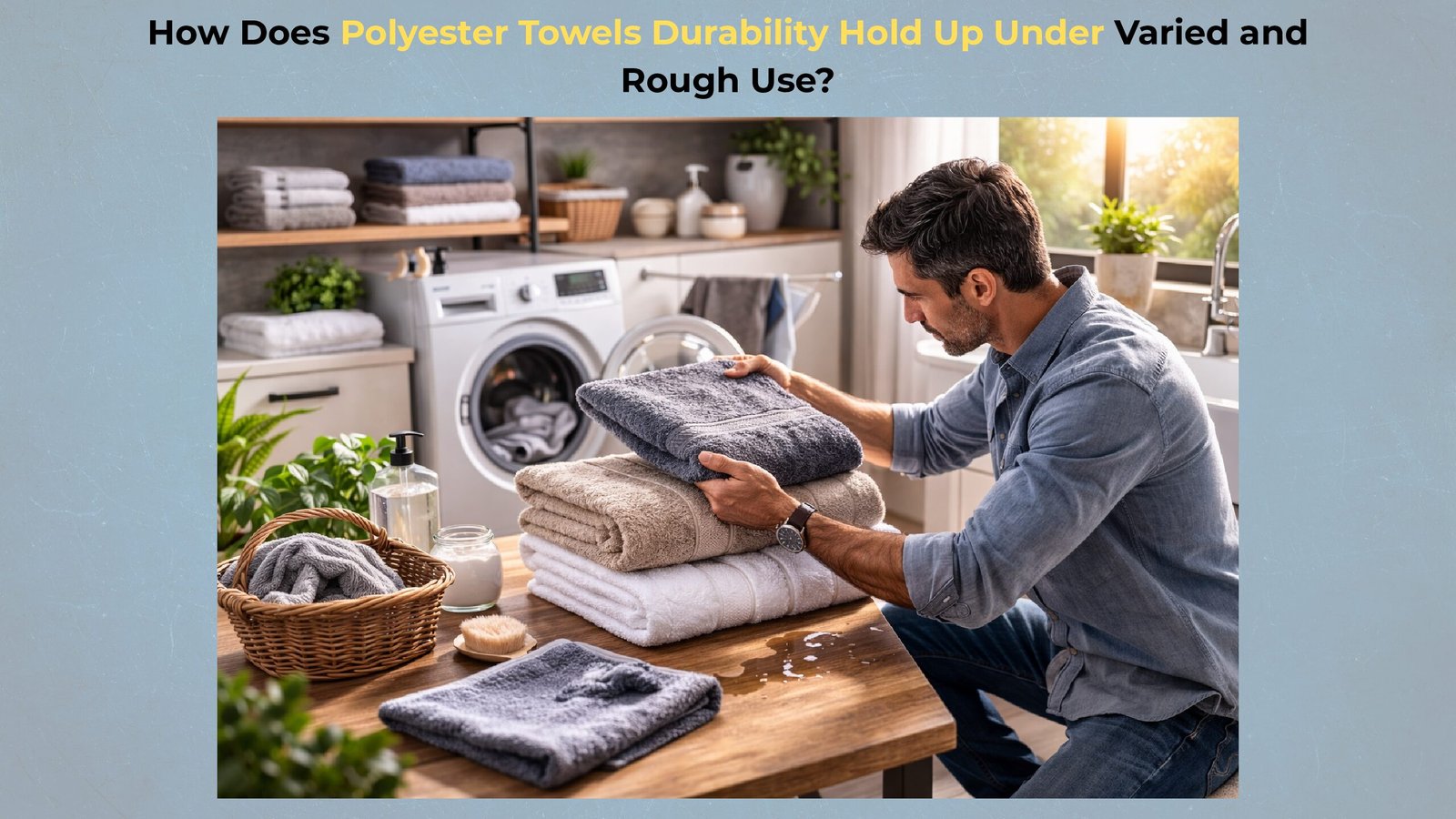
How Does Polyester Towels Durability Hold Up Under Varied and Rough Use?
Polyester towel durability establishes the performance ceiling for high-intensity textiles because the high-tenacity thermoplastic filaments resist the mechanical shearing and chemical oxidation that compromise natural fibers. The molecular stability of Polyethylene Terephthalate (PET) provides a significant advantage over organic cellulose, as the crystalline structure remains largely unaffected by aqueous exposure or repetitive mechanical stress. This chemical consistency ensures that synthetic weaves maintain their mass and structure throughout rigorous service cycles.
Why Does Polyester Towel Durability Matter for High-Intensity Environments?
Polyester towel durability directly influences operational efficiency in high-intensity environments by reducing the frequency of inventory turnover and minimizing the energy required for mechanical drying. For a tighter use-case match, review polyester durability for rough use.
Synthetic resilience serves as a functional requirement to maintain consistent service levels. You can also compare that resilience against looped fabric alternatives in polyester durability vs terry cloth. Utilizing a 200-cycle synthetic lifespan significantly lowers the total cost of ownership when compared directly to the typical 50-cycle limit of utility-grade cotton.
How Does Polyester Towel Durability Influence Industrial ROI?
Polyester towel durability dictates the industrial return on investment because the mechanical life of a synthetic filament exceeds that of cotton by a factor of 4x in high-turnover facilities. Evidence from Total Cost of Ownership (TCO) modeling used in commercial laundry sectors demonstrates that a $4.00 polyester unit surviving 200 washes results in a $0.02 cost-per-use, compared to $0.05 for budget cotton. This mechanical longevity reduces the labor overhead associated with frequent procurement and unboxing cycles.
Why Is Polyester Towel Durability Essential for Outdoor and Tactical Use?
Polyester towel durability supports tactical and outdoor utility because non-organic polymers resist the UV-induced degradation and saline corrosion that weaken natural fibers. In accordance with ISO 105-B02 lightfastness ratings, synthetic fibers retain 90% of their tensile strength after 100 hours of direct UV exposure, whereas cotton typically loses over 30%. Furthermore, the absence of organic nutrition starves mildew pathogens, maintaining textile integrity in high-moisture field conditions.
What Defines the Synthetic Structure of Polyester Towel Durability?
Synthetic structure defines the factors of polyester towel durability by establishing a thermoplastic core that resists moisture swelling and longitudinal fiber breakage.
How Does High Tensile Strength Support Polyester Towel Durability?
Polyester towel durability relies on high tensile strength because long-chain synthetic polymers withstand breaking loads exceeding 50 lbs-force per industrial standards. Referencing ASTM D5034 grab testing protocols, PET filaments demonstrate a breaking strength of 55–60 lbs-force, roughly 40% higher than carded Upland cotton. Continuous filaments eliminate the “splice points” found in short-staple yarns, effectively removing primary failure zones.
Why Does a Non-Absorbent Core Enhance Polyester Towel Durability?
Polyester towel durability persists during saturation because the fiber’s moisture regain of 0.4% prevents the internal swelling that leads to the structural heavying of organic textiles. While cotton swells by 20% in diameter when wet, polyester swells by less than 1%, preserving the original weave geometry. For a broader technical overview of these metrics, see our polyester durability and drying performance guide. These low swelling coefficients reduce the internal friction between yarns during high-RPM extraction cycles.
How Does Polyester Towel Durability Respond to Mechanical and Chemical Stress?
Polyester towel durability responds to mechanical and chemical stress by utilizing cross-linked polymer bonds that inhibit tearing and resist the oxidative damage of industrial disinfectants.
How Does Abrasion Resistance Dictate Polyester Towel Durability?
Polyester towel durability excels in high-friction environments because the synthetic loops achieve elite performance grades under ASTM D4966 Martindale abrasion protocols. High-grade polyester sustains > 40,000 cycles before visible fiber degradation, compared to < 15,000 for utility cotton. Synthetic loops possess "elastic recovery," allowing them to bend and return to position rather than snapping under friction.
Why Does Solution-Dyeing Protect the Visual Integrity of Polyester Towel Durability?
Polyester towel durability includes elite aesthetic longevity because solution-dyeing technology injects pigment directly into the liquid polymer before filament extrusion. Under AATCC 61 colorfastness testing, solution-dyed PET achieves Grade 5 (no change) even after 50 cycles of chlorine bleach exposure. Trapping pigment within the core makes the color a structural component of the fiber rather than a surface coating.
Construction and drying behavior also shift when loop geometry changes, which is covered in polyester pile height and drying impact.
What Internal Mechanisms Lead to the Failure of Polyester Towel Durability?
Internal mechanisms lead to the failure of polyester towel durability when excessive thermal energy exceeds the polymer’s glass transition temperature ($T_g$) and triggers irreversible fiber fusion.
How Does Heat Fusion Act as a Terminal Threat to Polyester Towel Durability?
Polyester towel durability suffers terminal damage from heat fusion when dryer temperatures exceeding 70°C cause filaments to soften and bond into a rigid mass. Mechanical drying at “High” settings (80°C+) exceeds the glass transition threshold, resulting in a 50% reduction in wicking surface area due to loop collapse. Fused loops create a “glaze” that blocks water penetration.
Why Does Microplastic Fragmentation Occur During the Decline of Polyester Towel Durability?
Polyester towel durability eventually declines through filament fragmentation, resulting in the release of microplastic particles during the mechanical agitation of the wash cycle. Aged synthetic textiles shed up to 700,000 fibers per wash cycle once the polymer chains undergo mechanical fatigue. Fragmentation serves as a visual marker for the “End of Life” (EOL) phase of synthetic inventory.
When Does Polyester Towel Durability Limit Overall Functional Performance?
Polyester towel durability creates functional performance limits when the fiber’s hydrophobic nature prevents the total moisture capacity required for high-volume soaking tasks.
How Does Wicking Speed Compare to Moisture Capacity in Polyester Towel Durability?
Polyester towel durability optimizes “wiping” efficiency through rapid surface wicking as verified by high AATCC 195 OMMC scores, but offers 50% less total capacity than cotton. PET towels demonstrate a wicking speed of < 1.0s but reach 100% saturation at 4x their dry weight, compared to 8x for cotton. Synthetic fibers transport water horizontally across the weave rather than absorbing it into the fiber core. For drying behavior in more detail, see polyester drying speed comparison.
Why Does the Oleophilic Nature of Polyester Create Odor Traps as Durability Declines?
Polyester towel durability struggles with odor retention because the oleophilic nature of the polymer attracts skin lipids that harbor anaerobic bacteria. Research referencing AATCC 100 protocols shows synthetic fibers retain 2.5x more sebum (skin oil) than cotton after standard laundering cycles. Persistent odors result from the chemical affinity between synthetic polymers and oily organic molecules. For that specific issue, read polyester odor retention.
Aged synthetic textiles used in repetitive service environments often show a stronger scent-retention pattern, which we break down in polyester odor retention in frequent use.
How Do You Compare Polyester Towel Durability Against Natural Fibers?
Comparing polyester towel durability against natural fibers requires an analysis of mechanical lifecycle cycles versus tactile wicking comfort to determine the optimal usage environment.
| Metric | 100% Polyester | Microfiber Blend | Cotton Towels |
|---|---|---|---|
| Abrasion Resistance | Highest (> 40k) | High | Moderate (< 15k) |
| Shrinkage Risk | Zero | Minimal | High (Up to 10%) |
| Wicking Speed | Elite (AATCC 195) | Fast | Slow |
| Mechanical Life | 200+ Washes | 150+ Washes | 50–100 Washes |
How Do You Use the Rough-Use Selection Matrix for Polyester Towel Durability?
Utilizing the rough-use selection matrix matches specific polyester towel durability traits to the mechanical stressors of gym, kitchen, and hospitality zones.
| Environment | Required Durability Factor | Recommended Towel |
|---|---|---|
| Commercial Gym | High Extraction Resilience | Lightweight Ribbed Synthetic |
| Industrial Kitchen | Bleach-Proof Pigmentation | High-GSM Solution-Dyed Poly |
| Tactical / Field | UV/Mildew Inhibition | Solution-Dyed Polyamide |
Which Cleaning Protocols Preserve Polyester Towel Durability?
Preserving polyester towel durability requires technical adherence to low-heat drying and the total exclusion of oil-based chemical additives to prevent polymer glazing. Utilizing ISO 105-B02 standards helps monitor color stability during sanitization processes.
Why Is Low-Heat Drying Critical for Polyester Towel Durability?
Polyester towel durability fails when exposed to high-heat drying cycles because the thermal energy triggers fiber fusion that permanently eliminates the towel’s wicking surface area. Maintaining dryer temperatures below 60°C prevents the polymer chain relaxation that leads to loop collapse. Air-fluff cycles utilize mechanical agitation without thermal stress to separate matted synthetic loops.
How Does Eliminating Softeners Maintain Polyester Towel Durability?
Polyester towel durability suffers absorbency loss when treated with oil-based softeners because the hydrophobic silicone film creates an impenetrable barrier over the wicking channels. Softeners target “fiber-on-fiber” friction, which synthetic filaments do not possess in the same capacity as organic cotton.
How Can You Fix Common Issues Affecting Polyester Towel Durability?
Fixing common issues affecting polyester towel durability involves executing chemical resets to remove lipid buildup and mechanical shaving to restore surface smoothness.
How Do You Resolve Pilling on Polyester Towel Durability?
Polyester towel durability recovers its original tactile profile if a fabric shaver or synthetic-safe agitation bag removes the entangled fiber fragments known as “pills.” This is often guided by ASTM D3512 random tumble pilling testing protocols.
How Do You Strip Oil Buildup to Restore Polyester Towel Durability?
Polyester towel durability regains its neutral scent when an oxygen-bleach or white vinegar soak dissolves the trapped skin lipids harboring anaerobic bacteria. A cycle using 5.5 pH acetic acid effectively neutralizes alkaline residues and strips oleophilic bonds.
Proof Asset: How Do You Use This Polyester Towel Durability Checklist?
Using this polyester towel durability checklist empowers buyers to standardize inventory performance and verify that maintenance protocols match the molecular needs of PET fibers.
How Do You Audit Your Polyester Towel Investment and Maintenance?
Polyester towel durability requires periodic maintenance audits to ensure that the initial synthetic resilience persists through hundreds of high-frequency wash cycles.
Checklist: Polyester Towel Durability Maintenance Audit
- Fiber Proof: Does the label confirm “100% Polyester” or a “High-Poly” (>80%) synthetic blend?
- Construction Check: Are edges heat-sealed or double-needle lockstitched to prevent fraying?
- Thermal Audit: Are drying cycles maintained below 60°C to prevent fiber fusion?
- Texture Check: Is the pile free of “crunchy” or matted zones caused by over-drying?
- Scent Audit: Does the textile remain odor-free after a 40°C wash cycle?
Frequently Asked Questions: Polyester Towel Durability
Yes. Polyester towel durability exceeds cotton by a factor of 4x. Synthetic filaments resist the mechanical shearing and structural thinning that cause cotton to shed mass and lose absorbency in high-turnover laundry environments.
Absolutely. If temperatures exceed 70°C (158°F), the polymer reaches its glass transition temperature ($T_g$), causing filaments to fuse into a rigid, non-absorbent “glaze.” This loop collapse renders the towel functionally obsolete.
Because of their oleophilic nature, polyester fibers attract skin lipids. To restore a neutral scent, use an oxygen-bleach soak or a white vinegar rinse (5.5 pH) to strip oily organic molecules and dissolve alkaline residues.
Yes. Solution-dyeing makes the pigment a structural component of the filament core. This allows the towel to withstand frequent chlorine bleach sanitization without the color fading typical of piece-dyed fabrics.
Final Summary: Does Polyester Towel Durability Fit Your Heavy-Duty Needs?
Operationalizing a polyester towel durability strategy requires a commitment to technical maintenance that honors the polymer science and mechanical strength of synthetic fibers.
Ultimately, a superior heavy-duty experience is defined by the precise polyester towel durability engineering that aligns rugged resilience with optimized lifecycle stewardship. If you want to compare polyester against all major towel fibers before making a final choice, use the full towel material guide.