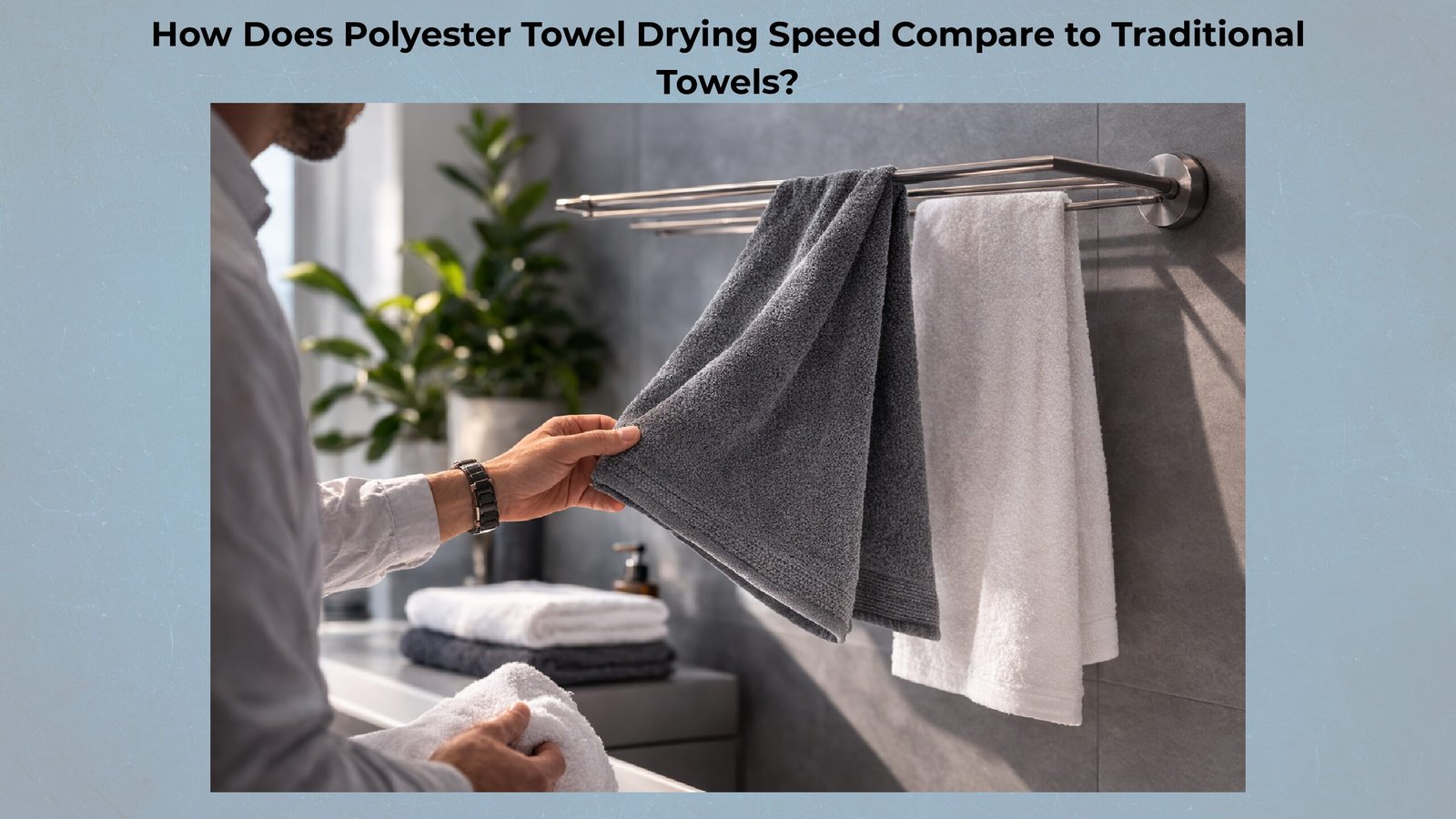
How Does Polyester Towel Drying Speed Compare to Traditional Towels?
Polyester towel drying speed exceeds that of traditional natural fibers by 40% to 60% because the hydrophobic filaments resist internal water saturation and maintain moisture on the textile surface for rapid evaporation.
Audits of the polymer physics and moisture transport mechanisms of synthetic weaves verify polyester towel drying speed under rigorous commercial and residential conditions. By utilizing AATCC 199 (Drying Time of Textiles), researchers verify that “Fast-Drying” is an engineering specification, derived from attributes like a moisture regain of < 0.4% for PET. Rapid moisture release drives hygiene and energy efficiency by minimizing atmospheric residence time.
Why Does Polyester Towel Drying Speed Impact Hygiene and Energy Efficiency?
Polyester towel drying speed directly influences operational hygiene and energy efficiency by reducing the duration of the biological window required for anaerobic bacterial colonization.
A rapid moisture turnover facilitates a sterile state and lowers the total cost of ownership (TCO) in high-volume facilities. For a more complete overview of performance trade-offs, review polyester durability and drying performance.
This desiccation velocity serves as a critical functional health requirement rather than a secondary aesthetic feature.
How Does Polyester Towel Drying Speed Prevent Musty Odors?
Polyester towel drying speed prevents musty odors because the rapid evaporation rate maintains the textile’s moisture content below the 15% threshold required for microbial proliferation.
Saturated polyester returns to a safe moisture equilibrium in < 90 minutes in standard conditions, while cotton requires > 6 hours. Polyester towel drying speed helps reduce odor risk, but synthetic fibers can still trap skin lipids over time. For that issue, see polyester odor retention.
Rapid desiccation materially restricts the probability of anaerobic bacterial colonization, preventing the metabolic production of ammonia and sulfide off-gassing.
What Is the Energy-Saving ROI of Polyester Towel Drying Speed?
Polyester towel drying speed dictates the energy-saving return on investment by reducing mechanical dryer runtime by up to 75% compared to traditional heavyweight cotton.
According to Total Cost of Ownership (TCO) data, standard commercial synthetic loads reach dryness in 10-15 minutes, whereas cotton loads often exceed 45-60 minutes. Mechanical longevity and reduced thermal exposure during shorter dry cycles extend the total amortization period of the textile asset. These gains result from the synthetic mechanisms and polymer science of the fiber.
What Defines the Synthetic Mechanics of Polyester Towel Drying Speed?
Synthetic mechanisms define the factors of polyester towel drying speed by establishing a thermoplastic filament core that refuses to absorb liquid water into its molecular matrix.
Polyester towel durability supports tactical and outdoor utility because non-organic polymers resist the UV-induced degradation and saline corrosion that weaken natural fibers. For harsher environments, see polyester durability under rough use.
How Does the Hydrophobic Core Drive Polyester Towel Drying Speed?
Polyester towel drying speed relies on a hydrophobic core where Polyethylene Terephthalate (PET) molecules repel liquid, forcing water into the interstitial gaps between fibers.
Polyester exhibits a moisture regain of < 0.4%, whereas natural cotton absorbs 8% to 10% of its dry weight into the fiber core. Because moisture remains on the filament exterior, the energy required for phase change (liquid to vapor) is significantly lower than for internally saturated fibers.
Why Does the Difference Between Wicking and Absorption Impact Polyester Towel Drying Speed?
Polyester towel drying speed optimizes moisture turnover by functioning as a wicking conduit rather than an absorbent reservoir, moving water horizontally across the weave surface.
By referencing AATCC 195 (Liquid Moisture Management), high-performance synthetics achieve an OMMC score exceeding 0.60, doubling the transport speed of utility cotton. Users perceive synthetic towels as “drier” even when damp because the water occupies the weave gaps rather than swelling the fiber itself.
Construction geometry also changes evaporation behavior, especially when loft and bulk increase. For that variable, read polyester pile height and drying impact.
Wicking efficiency remains conditional upon surrounding bathroom ventilation.
How Does Bathroom Ventilation Affect Polyester Towel Drying Speed?
Polyester towel drying speed depends on bathroom ventilation levels because the rate of evaporation is governed by the vapor pressure differential between the wet textile and the ambient air.
Do Evaporation Rates in Humid Environments Limit Polyester Towel Drying Speed?
Polyester towel drying speed remains superior in high-humidity environments compared to cotton because the synthetic weave facilitates higher passive airflow even when the vapor pressure gradient is narrow.
In 70% relative humidity, polyester outpaces cotton drying velocity by a factor of 3x due to the significant delta in moisture regain properties. Pairing synthetic towels with active cross-ventilation (exhaust fans) achieves near-instantaneous moisture turnover, making them the optimal choice for poorly ventilated coastal facilities.
This performance transitions to the direct comparison of performance metrics.
Evaporation Rate Comparison Matrix
Comparing polyester towel drying speed against natural fibers requires an analysis of air-dry durations and mechanical thermal requirements across distinct moisture profiles.
| Fiber Type | Air-Dry Time (Approx) | Dryer Time (Low Heat) | Moisture Profile |
|---|---|---|---|
| 100% Polyester | 45–90 Minutes | 10–15 Minutes | Surface Wicking |
| Microfiber Blend | 120–180 Minutes | 20 Minutes | High Surface Area |
| Traditional Cotton | 6–10 Hours | 45–60 Minutes | Internal Saturation |
| Linen | 3–4 Hours | 25 Minutes | Breathable Bast |
What Is the Softness-to-Speed Trade-off in Polyester Towel Drying Speed?
Polyester towel drying speed presents a performance trade-off where the high-velocity moisture release of 100% synthetics results in a slicker tactile profile compared to the plushness of absorbent cotton.
Blending 20% polyester into the ground weave maintains cotton softness while increasing dry-time efficiency by approximately 15% to 20% (based on blend efficiency standards). Pure polyester maximizes speed; poly-cotton blends provide a tactile compromise for residential users who prioritize hand-feel.
This selection links to the essential laundry protocols required to protect the fiber.
Which Laundry Steps Optimize Polyester Towel Drying Speed?
Optimizing polyester towel drying speed requires technical adherence to surfactant restrictions that prevent the deposition of hydrophobic waxy coatings on the wicking channels.
Why Must You Avoid Softeners to Preserve Polyester Towel Drying Speed?
Polyester towel drying speed suffers catastrophic failure if treated with liquid softeners because cationic surfactants form a waxy film that seals the wicking pathways.
AATCC 79 absorbency testing reveals that cationic softeners increase water-beading probability, extending wetting time from < 1.0s to > 5.0s, neutralizing the fast-dry benefit. Softeners target fiber friction, which synthetic filaments do not possess in the same capacity as organic cotton, making the chemical application redundant and harmful.
How Do High-Speed Spin Cycles Accelerate Polyester Towel Drying Speed?
Polyester towel drying speed reaches its maximum potential when utilizing high-RPM spin cycles to mechanically displace surface water before the evaporation phase.
High-speed extraction (350G) removes 80% more surface water from synthetics than from saturated cotton due to the lack of internal absorption. Mechanical water removal is significantly more efficient on synthetics, leaving only a trace film of moisture for the thermodynamic drying phase.
This leads to the protocols for fixing odors and restoring wicking performance.
How Can You Fix Odors and Restore Performance in Synthetic Towels?
Restoring polyester towel drying speed involves executing chemical resets to strip away oleophilic lipids and detergent salts that inhibit moisture transport.
How Does Stripping Buildup Restore Polyester Towel Drying Speed?
Polyester towel drying speed regains its original wicking velocity when an oxygen-bleach or baking soda “deep clean” emulsifies the trapped skin oils harboring bacteria.
In high-turnover settings, repeated exposure to sweat and body oils can intensify scent retention patterns. We cover that in polyester odor retention in frequent use.
Restoring the “thirsty” nature of the synthetic weave improves drying speed by an estimated 20% by reopening clogged interstitial capillary gaps. These restorative cycles neutralize the oleophilic bonds that trap skin sebum within the polymer matrix.
This introduces the performance verification checklist.
Polyester Towel Drying Speed Audit Checklist
Verifying optimal polyester towel drying speed requires periodic technical audits to ensure that maintenance protocols align with the molecular needs of the polymer filaments.
Audit criteria are anchored in AATCC 199 parameters, ensuring textiles reach moisture-equilibrium thresholds (< 5% residual moisture) within designated windows.
Material Audit: Does the label confirm “100% Polyester” or a “High-Poly” synthetic blend?
Ventilation Check: Is the drying zone supported by active cross-ventilation or high-CFM extraction?
Chemical Audit: Is the care routine 100% free of cationic fabric softeners and silicone additives?
Velocity Test: Does the textile reach a “bone dry” state within 2 hours of hanging per AATCC 199 parameters?
Texture Audit: Is the pile free of “waxy” or “slick” residues that signal detergent buildup?
Final Summary
Operationalizing a polyester towel drying speed strategy requires a shift from traditional cotton maintenance to a polymer-centric approach that prioritizes turnover velocity and hygienic safety.
If you want to compare polyester against other towel fabrics before choosing, use the full towel material guide.
Turnover velocity, energy ROI, and hygiene are the pillars of synthetic performance. Managing chemical glazing remains essential for long-term wicking efficacy. By auditing maintenance cycles and ventilation gradients, facilities optimize the unique hydrophobic properties of PET.
“Ultimately, a superior high-turnover experience is defined by the precise polyester towel drying speed engineering that aligns rugged efficiency with optimized textile physics.”