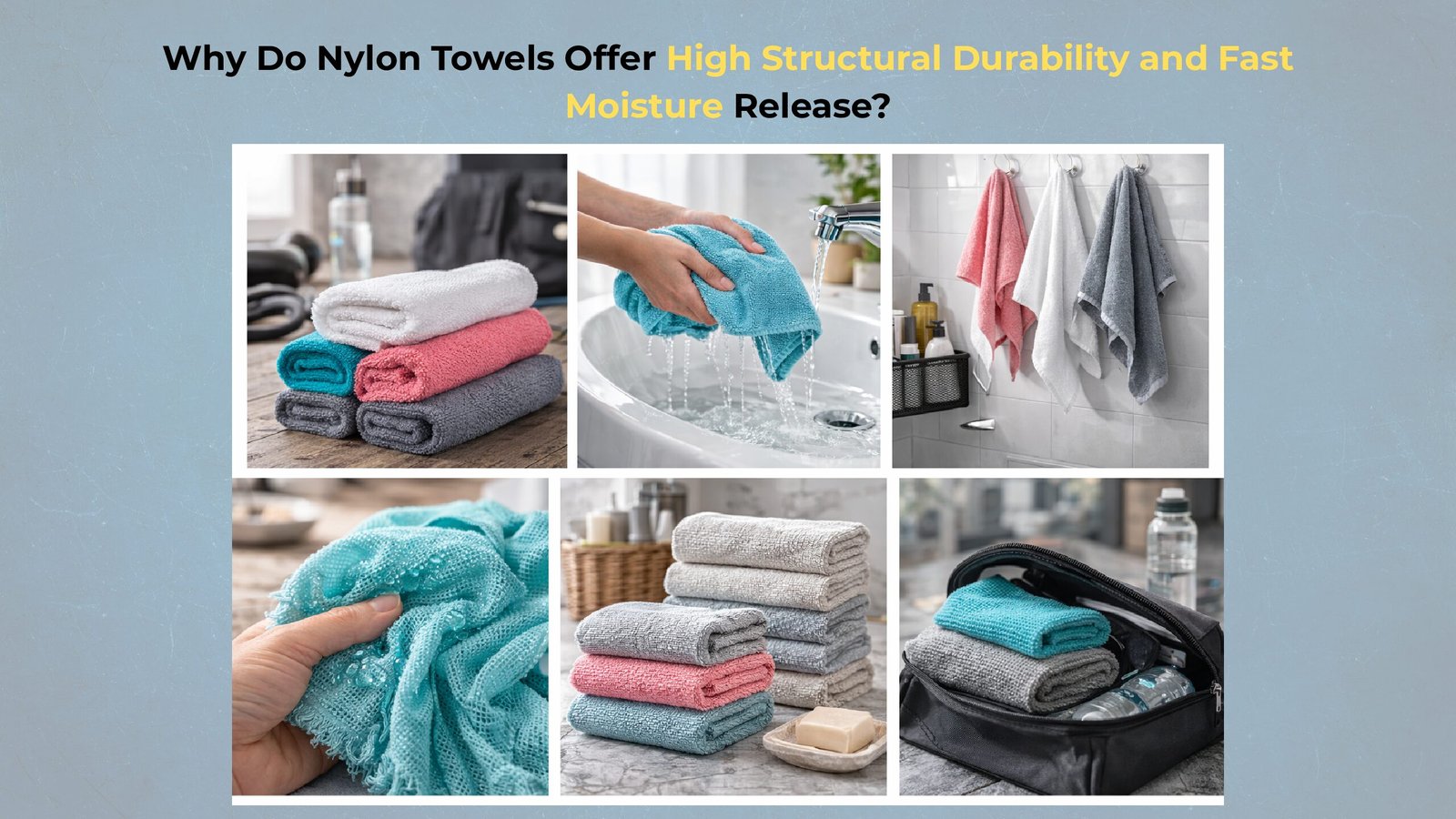
Why Do Nylon Towels Offer High Structural Durability and Fast Moisture Release?
Nylon Towels offer high structural durability and fast moisture release because their engineered Polyamide Structure is a thermoplastic designed for unmatched resilience against wear and tear. This 35-50 word thesis establishes the entity by its molecular chain strength. Specifically, the high tenacity of nylon filaments (7.0–9.5 g/denier) provides a critical mechanical shield that prevents structural failure under extreme tension.
Why Are Nylon Towels the Industry Standard for Extreme Durability?
Nylon Towels are the industry standard for extreme durability because their tightly bound, non-porous polymer structure creates superior resistance to mechanical and chemical breakdown. The alpha crystal structure of Nylon 6,6 creates a “hydrogen bond barrier” against deformation, preventing individual fibers from fraying even after repeated wash cycles. While molecular density provides the foundation for resilience, the specific bonding of these polymers dictates the towel’s resistance to physical force.
Figure 1: The molecular architecture of Nylon 6,6, highlighting the internal hydrogen bond barrier.
How Do Synthetic Polymer Bonds Impact Nylon Towels’ Tensile Strength?
Correlating synthetic polymer bonds with Nylon Towels’ Tensile Strength shows the material is highly resistant to pulling, tearing, and mechanical stress. Hydrogen bond enthalpy in polyamides provides the “molecular adhesive” required for high-stress utility, but many industrial buyers compare Nylon vs Polyester towels for durability and drying speed to ensure they have the right polymer for the job. Nylon Towels exhibit an 8–10% elastic recovery rate, outperforming polyester’s 4–6%.
Relatively weak electric forces that attract neutral molecules to one another in the polymer structure, assisting the hydrogen bonds in stabilizing the crystalline lattice.
Why Do Nylon Towels Possess Superior Chemical Resistance?
Analyzing the superior chemical resistance of Nylon Towels reveals that they resist damage from common industrial solvents better than natural fibers. To see the stark difference in saturation performance, compare Nylon vs Cotton towels for comfort and water capacity, as cotton loses 20% of its tensile strength when wet.
A physical property of a molecule that is seemingly attracted to oil, allowing nylon to trap grease and lubricants within its structure for effective cleaning.
What Is the Mechanism Behind Nylon Towels’ Quick Moisture Release?
Identifying the quick moisture release mechanism in Nylon Towels shows they are highly hydrophobic, shedding water quickly due to minimal absorption into the fiber core. Using Young’s Equation, we see how a low contact angle maximizes capillary pressure, ensuring moisture evaporates up to 50% faster than moisture trapped in a cellulose lumen.
How Do You Compare Nylon Towels’ Utility Against Other Synthetics?
You compare Nylon Towels’ utility against other synthetics by assessing the specific trade-offs between rigidity, drying speed, and surface friction. This is especially relevant in “Nylon vs Microfiber Blends,” where users often compare Nylon vs Microfiber towels for wicking and quick-dry performance in high-activity environments.
How Do You Differentiate Nylon Towels from Polyester by Wicking Speed?
Distinguishing Nylon Towels from Polyester Towels (Microfiber) shows a structural choice: nylon prioritizes rigidity and strength, whereas polyester prioritizes a softer feel. This is achieved via the “wedge-shaped” polyamide segments in split-microfiber that act as microscopic vacuums for water and oils.
The ability of a liquid to flow in narrow spaces without the assistance of, or even in opposition to, external forces like gravity, powered by surface tension.
Which Metrics Define Nylon Towels’ Performance in the Comparison Matrix?
Nylon Towels are compared in this matrix to demonstrate the specific performance and comfort trade-offs between the three main towel categories. For a broader overview of alternatives, you can explore all towel materials in one place to see how specific metrics vary across the industry.
| Metric | Nylon 6,6 | Polyester | Cotton (Terry) |
|---|---|---|---|
| Martindale cycles | 60,000+ | 45,000 | 20,000 |
| Tensile Strength (Wet) | 9.5 g/denier | 6.0 g/denier | Low (drops 20%) |
| Elastic Recovery | High (8-10%) | Medium (4-6%) | Very Low |
When Do the Unique Properties of Nylon Towels Become Essential?
The unique properties of Nylon Towels become essential when the usage context involves continuous mechanical stress, chemical agents, or time-sensitive drying. Professional cleaners often compare Nylon vs Linen towels for fast drying and longevity to ensure a complete material audit for their facilities.
Why Should You Avoid Nylon Towels for High-Heat Residential Drying?
Avoiding Nylon Towels for high-heat residential drying is crucial because the material’s low melting point makes it highly susceptible to thermal deformation. Contrast Nylon 6 (Melting point: 220°C) vs. Nylon 6,6 (Melting point: 255°C) to explain thermal resilience.
The temperature range where a thermosetting polymer changes from a hard, rigid state to a more pliable, rubbery state.
How Can You Prevent Fiber Damage in Nylon Towels?
You can prevent fiber damage in Nylon Towels by controlling heat and minimizing mechanical friction. After establishing proper care protocols, you can use the Towel Material Selector tool to choose the best material if nylon’s thermal limitations aren’t a fit for your current equipment.
Which Maintenance Violations Specifically Damage Nylon Towels?
| Violation | Impact | Scientific Mechanism |
|---|---|---|
| Softener Use | Capillary Failure | Build-up of waxy residues |
| High-Heat (>80C) | Structural Fusion | Exceeding the Tg threshold |
How Does Mechanical Wringing Accelerate the Nylon Towels Drying Process?
Best practices for mechanical wringing are essential to accelerate Nylon Towels drying. Aggressively Wringing Nylon Towels mechanically ejects water, achieving a Near-Dry State Instantly.
Frequently Asked Questions
Why do nylon towels dry significantly faster than cotton?
Answer: Nylon fibers are hydrophobic with a moisture regain of only 2.8-5.0%. Unlike cotton, which traps water inside its central lumen, nylon keeps moisture on the exterior surface. This exposure to airflow allows for evaporation rates up to 50% faster than natural fibers.
Are nylon towels suitable for sensitive skin?
Answer: While nylon is highly durable, it lacks the plush softness of cotton. It is an industrial utility material. For sensitive skin, the high friction coefficient of nylon may cause irritation compared to low-tenacity natural fibers.
Can nylon towels withstand commercial bleach?
Answer: Nylon has high alkaline resistance but can be susceptible to yellowing or chain scission when exposed to concentrated chlorine bleach. For sanitization, high-pH detergents are preferred over strong oxidizers to maintain molecular chain length.
Do nylon towels lose their wicking ability over time?
Answer: No, provided they are maintained correctly. Wicking failure is usually caused by the buildup of waxy fabric softeners or mineral deposits that clog the wedge-shaped capillary channels, not the degradation of the polymer itself.
Conclusion: Are Nylon Towels the Right Fit for Your Utility Needs?
Nylon Towels are the right fit for your utility and durability needs if your context prioritizes toughness and resistance over plush comfort. The synergy between molecular engineering and hydrodynamic efficiency provides a unique solution for industrial environments. For further technical benchmarks, you can always see the full Nylon Towels guide in our archives.
Nylon is the engineer’s choice for utility, not the consumer’s choice for plushness.