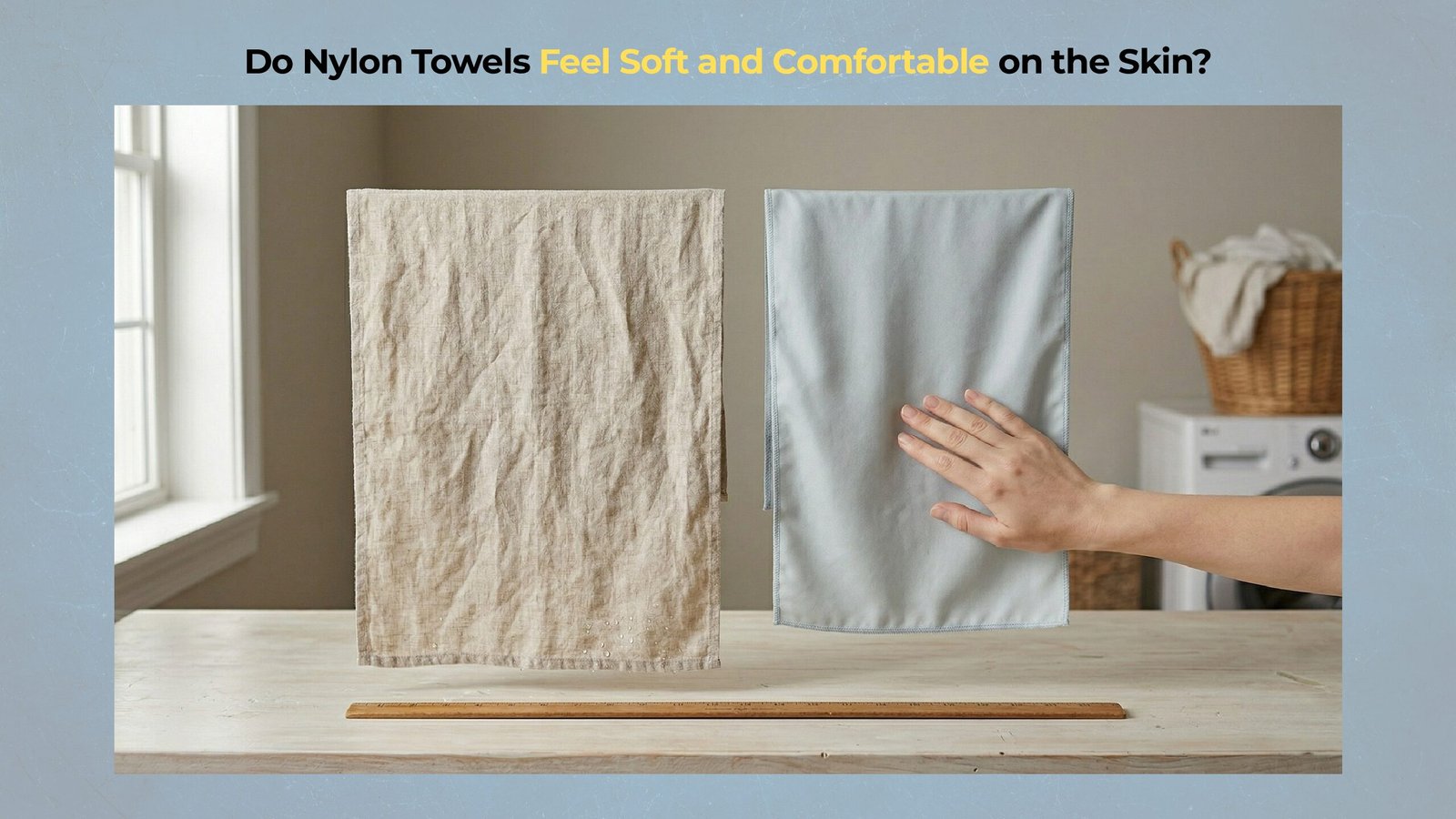
Do Nylon Towels Feel Soft and Comfortable on the Skin?
A technical audit of synthetic tactile ergonomics and polyamide fiber science.
Yes, nylon towel skin comfort typically provides a high-performance alternative for sensitive skin because synthetic blends move moisture effectively while providing a smooth surface that limits friction.
This guide audits the fiber physics and thermal properties of polyamide blends to verify nylon towel skin comfort and provide technical steps for maintaining a velvety finish.
Simple Translation: In practical terms, polyamide plays a major role in softness within synthetic blends; while polyester provides structural strength, auditing nylon vs polyester towels confirms that nylon facilitates the smooth glide that reduces irritation.
In the hierarchy of tactile ergonomics, sensory satisfaction results from how a fiber interfaces with the human epidermis during the drying process.
Why Does Nylon Towel Skin Comfort Matter for Daily Sensory Satisfaction?
Nylon towel skin comfort primarily determines the quality of post-activity recovery by establishing a smooth interface that reduces the mechanical friction associated with exposed fiber ends in natural textiles. This tactile profile is critical for individuals with heightened dermal sensitivity or those recovering from intense athletic exertion.
Identifying the “Low-Friction” Advantage of Nylon Towel Skin Comfort
Nylon towel skin comfort provides a “Low-Friction” advantage because continuous polyamide filaments can feel significantly smoother than natural fibers, which often feel slightly rougher due to exposed staple fiber ends. Under ASTM D1894 (Static and Kinetic Coefficients of Friction) standards, synthetic filaments often demonstrate a lower resistance during surface transit.
How Does Thermal Regulation Influence Nylon Towel Skin Comfort?
A characteristic “cool-to-the-touch” sensation may accompany nylon towel skin comfort because the high surface regularity of the filaments facilitates efficient heat dissipation and moisture transport. This behavior is often compared favorably against polyester drying speed benchmarks, as nylon provides a similarly rapid energy flux while maintaining a softer hand-feel.
What Physical Properties Define the Results of Nylon Towel Skin Comfort?
How Does Filament Geometry Drive Nylon Towel Skin Comfort?
Nylon towel skin comfort originates from a filament structure where low-denier fibers generally improve softness and provide high tactile flexibility. Per ISO 1144, polyamide filaments are engineered to be significantly finer than traditional fibers.
Definition – Denier: The mass in grams of 9,000 meters of a fiber, where lower numbers correlate with higher softness.
Why Does Elastic Recovery Support Nylon Towel Skin Comfort?
Nylon towel skin comfort depends on the high elastic recovery of the polymer, which helps maintain fabric flexibility and prevents the development of a stiff texture after repeated washing. Unlike cotton, which can lose its “spring” as cellulose becomes brittle, or the gradual loss of linen air drying longevity in some environments, nylon filaments possess a structural memory that facilitates loft recovery.
Laundry Steps to Activate and Protect Comfort
Following correct microfiber washing instructions is essential to activate peak nylon towel skin comfort and remove manufacturing residues without damaging the synthetic filaments.
How Does the Initial Rinse Unlock Nylon Towel Skin Comfort?
Nylon towel skin comfort remains restricted until an initial cool-water rinse removes finishing agents that may reduce softness initially.
Does Long-Term Heat Wear Lead to Persistent Roughness in Nylon Towel Skin Comfort?
Gradual thermal degradation can lead to stiff or rough areas if drying temperatures consistently exceed recommended limits. Maintaining proper drying protocols is as vital for synthetics as cotton mildew prevention is for natural textiles, ensuring the material stays fresh and functional.
Nylon Towel Skin Comfort Blend Performance Matrix
| Blend | Tactile Profile | Wicking | Performance |
|---|---|---|---|
| High Polyester | Smooth | Moderate | Basic Gym |
| 80/20 Blend | Velvety | High | Standard High-End |
| 70/30 Blend | Silky | Highest | Luxury / Sensitive |
Failure Modes & Sensory Challenges
Do Low-Quality Blends Compromise Nylon Towel Skin Comfort?
Nylon towel skin comfort typically fails in lower-tier microfiber textiles that utilize low polyamide content or non-split fibers.
Does Residue Buildup Affect Nylon Towel Skin Comfort?
This tactile profile can become “greasy” or “slimy” when fabric softeners and excess detergent deposit waxy films. Beyond the loss of softness, effective microfiber odor control becomes impossible once waxy chemical residues seal the wicking channels.
Distinguishing Rubbing vs. Patting for Nylon Towel Skin Comfort
Maximizing nylon towel skin comfort requires a shift to a “pat-and-press” motion to protect the Stratum Corneum.
How Can You Restore Revitalize Comfort?
Restoring compromised nylon towel skin comfort involves executing chemical resets to dissolve mineral residues and mechanical agitation to separate matted filaments.
Can Mechanical Agitation Resolve Stiffening in Nylon Towel Skin Comfort?
Nylon towel skin comfort can sometimes be recovered if stiffened fibers are tumbled on “Air Fluff” with wool dryer balls to mechanically separate filaments. Agitation flexes the fiber structure, helping to restore the original smooth glide.
Nylon Towel Skin Comfort Audit Checklist
Frequently Asked Questions (FAQ)
Are nylon towels genuinely soft?
Yes. Because polyamide filaments are extruded as continuous strands, they lack the jagged microscopic ends found in cotton. This results in significantly lower surface friction and a smoother glide against sensitive skin.
Why do synthetic towels sometimes feel “scratchy”?
Scratchiness usually results from high-heat drying, which causes synthetic filaments to shrink and collapse. It can also be caused by low-quality blends that use non-split fibers, which lack the velvety “wedges” needed for softness.
Can I use fabric softener with nylon towels?
No. Fabric softeners deposit a waxy film that seals the microscopic capillary channels of the nylon. This not only ruins absorbency but eventually makes the towel feel greasy rather than soft.
Technical Disclaimer
The information provided in this technical guide is for educational purposes regarding textile engineering and material science. Performance results are conditional upon specific blend ratios, local water hardness, and adherence to maintenance protocols.
Final Summary
Operationalizing a nylon towel skin comfort strategy requires a commitment to technical maintenance that honors the fiber science and mechanical glide of polyamide fibers.
Ultimately, a superior bathroom experience is defined by the precise nylon towel skin comfort engineering that aligns high-velocity wicking with optimized epidermal safety.