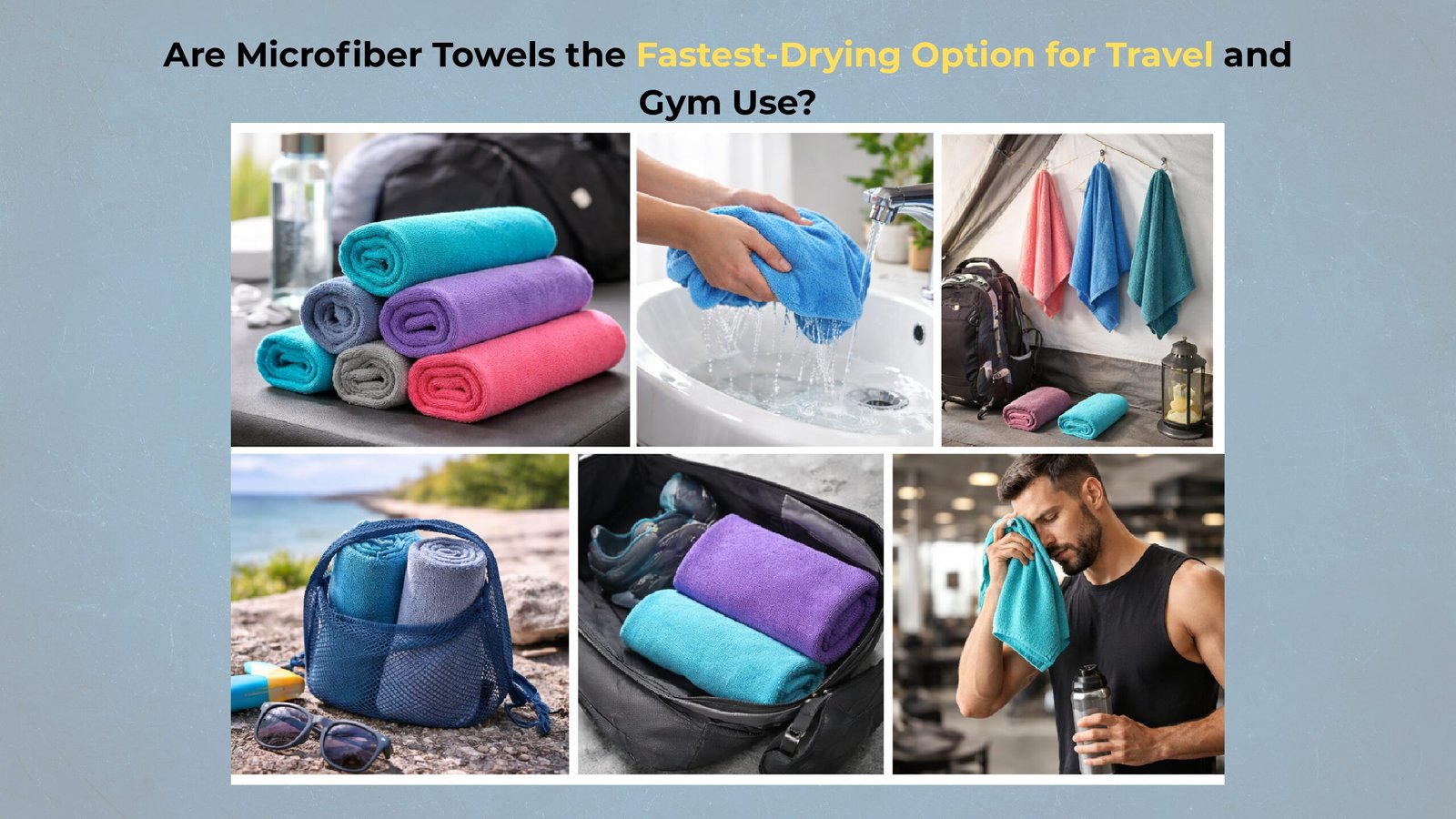
Are Microfiber Towels the Fastest-Drying Option for Travel and Gym Use?
Unraveling the Science and Art of Towels, Daily.
Microfiber Towels are the fastest-drying option for travel and gym use because their synthetic, hydrophobic fiber structure prioritizes speed (adsorption) and resilience over capacity and comfort. Microfiber Towels represent the peak of drying efficiency for active users due to a surface-area-to-mass ratio that facilitates instant evaporation. This efficiency originates from the fundamental physics of moisture management, specifically how synthetic polymers interact with water molecules, making microfiber the dominant choice for those needing fast turnaround between workouts or flights.
Why are Microfiber Towels Unbeatable for Drying Speed and Hygiene?
Microfiber Towels are unbeatable for drying speed and hygiene because their non-porous structure and rapid evaporation rate interrupt the microbial breeding cycle. Addressing “benefits of microfiber for gym hygiene” requires understanding Bacteriostasis: The prevention of the further growth of bacteria. While natural wicking is efficient, specialized Antibacterial Treatments for Microfiber Towels can further enhance defense against persistent contamination. Understanding these hygiene benefits leads to the underlying physics of adsorption.
How Does the Hydrophobic Adsorption Mechanism Work in Microfiber Towels?
The hydrophobic Adsorption mechanism in Microfiber Towels achieves speed by trapping water on the fiber surface rather than allowing it to soak into the core. This is mechanically facilitated by the fact that split fibers increase surface area by up to 40x, allowing for a mass density of moisture to reside in the wicking channels where air exposure is maximized. This high-efficiency design is the primary factor driving superior Microfiber Towels Drying Speed compared to natural alternatives.
How Do Microfiber Towels Minimize Weight and Bulk for Better Portability?
Microfiber Towels minimize weight and bulk because their Split Fibers allow for extreme mechanical compression without damaging the textile structure. In terms of technical metrics, Microfiber Towels possess a Denier of less than 1.0. This engineering is why Microfiber Towels are Compact and Lightweight, allowing for a 1/8th volume reduction advantage compared to natural cotton, facilitating extreme portability for active travel.
Does the Drying Speed of Microfiber Towels Improve Anti-Odor Performance?
The drying speed of Microfiber Towels improves anti-odor performance by dehydrating the environment before the 4-hour microbial breeding cycle can complete. Odor is a byproduct of moisture-dependent bacterial colonization; by ejecting water rapidly, microfiber achieves a mechanical bacteriostasis that cotton cannot match. However, users should be aware of potential Microfiber Towels Odor Retention issues that arise when body oils become trapped on synthetic surfaces without proper deep cleaning.
How Do You Compare Different Microfiber Towel Types and Knits?
You compare different Microfiber Towel types and knits by focusing on the material blend and the thermal tolerance of the specific weave. A primary differentiator is the concentration of Polyamide: The specific synthetic polymer that provides moisture-wicking properties in blends. These mechanical differences are best visualized through a direct functionality matrix.
How Do You Distinguish Quality by Fiber Blend and Knit Count in Microfiber Towels?
Distinguishing quality by fiber blend and knit count in Microfiber Towels requires identifying the specific 70/30 Polyester/Polyamide split necessary for maximum adsorption. Blends with higher polyester content (80/20) often feel softer initially but lack the capillary draw required for high-speed drying.
What is the Functional Difference Between Microfiber Towels and Cotton?
The functional difference between Microfiber Towels and cotton is defined by the trade-off between synthetic wicking speed and natural plush comfort.
| Performance Metric | Microfiber Towels (Synthetic) | Cotton Towels (Natural) | Best Use Case |
|---|---|---|---|
| Drying Speed | Very Fast (30-60 min) | Slow (4-8 hours) | Utility, Travel |
| Tensile Strength | Very High (Resists tearing) | Medium/High | Durability, Commercial |
| Odor Resistance | High (Dries before bacteria grows) | Low (Sustains dampness) | Hygiene, Gym |
| Tactile Feel | Grippy/Suede-like | Plush/Soft | Comfort/Plushness |
| Thermal Tolerance | Low (Melts at >140°F) | High | Laundry/Sanitization |
When Do Microfiber Towels Become the Most Practical Option?
Microfiber Towels become the most practical option when the environment, activity, or logistical constraints prioritize speed and packability above all else. This makes Microfiber Towels for Travel and Gym Use the superior logistical choice for minimalist itineraries. While practical, the material’s synthetic bonds require strict maintenance to prevent thermal failure.
Why Must You Avoid Using Microfiber Towels in High-Heat Sanitization?
You must avoid using Microfiber Towels in high-heat sanitization because temperatures exceeding 140°F (60°C) cause the synthetic bonds to melt and fuse. This fusion results in the total loss of adsorptive capacity, as the micro-capillary channels are permanently sealed.
How Can You Preserve the Speed and Durability of Microfiber Towels?
You can preserve the speed and durability of Microfiber Towels by rigidly adhering to thermal limits and avoiding chemical agents like fabric softeners.
What Are the Most Common Maintenance Violations for Microfiber Towels?
The most common maintenance violations for Microfiber Towels include the use of fabric softeners and bleach, both of which destroy the wicking channels. Adhering to professional Microfiber Towels Washing and Drying Care protocols is the only way to ensure the synthetic bonds remain intact.
| Violation | Impact on Microfiber Towels | Mechanism of Damage |
|---|---|---|
| High Heat Drying | Melts/fuses fibers | Loss of Adsorptive Capacity |
| Fabric Softener | Blocks wicking channels | Causes water to bead/repel |
| Chlorine Bleach | Weakens synthetic core | Reduces Tensile Strength |
How Do You Execute a 4-Step Audit to Verify Microfiber Towels Quality?
You execute a 4-step audit to verify Microfiber Towels quality by performing physical friction and wicking tests on the textile surface.
Frequently Asked Questions
Under standard ambient conditions, a quality microfiber towel dries in 30 to 60 minutes. This is approximately 8 times faster than a heavy cotton terry towel, which typically requires 4 to 8 hours to fully dehydrate.
Yes, but only on an “air dry” or the lowest heat setting. You must ensure the temperature never reaches 140°F (60°C). High heat causes the synthetic polymer bonds to melt and fuse, permanently sealing the wicking channels.
The sticky or grippy sensation is actually a sign of high-quality split fibers. This friction is a result of the thousands of microscopic “wedge” channels interacting with the surface of your skin to pull moisture away via capillary action.
While mechanically safe, their high adsorption rate can sometimes feel abrasive if you rub vigorously. For sensitive skin, we recommend a “pat-dry” technique rather than a wiping motion to prevent friction-based irritation.
Look for a 70/30 Polyester/Polyamide blend. The polyester provides the structure and durability, while the polyamide provides the moisture-wicking and adsorption capabilities essential for rapid drying and hygiene.
Conclusion: Are Microfiber Towels Suited for Your Everyday Use?
Microfiber Towels are suited for your everyday use if your routine demands the highest levels of speed, durability, and packability over tactile luxury. Efficiency is the ultimate luxury for the active traveler; prioritize function over feel for maximum utility. If you remain undecided, utilize our Towel Material Selector Tool to find the material that best matches your specific requirements for drying speed and odor resistance.
Disclaimer: The technical data and maintenance protocols provided in this guide are based on standard synthetic textile engineering benchmarks. Individual results may vary by manufacturer, specific material weave, and environmental conditions. TowelDaily is not responsible for damage resulting from improper handling, overheating, or deviation from a specific product’s unique care instructions.