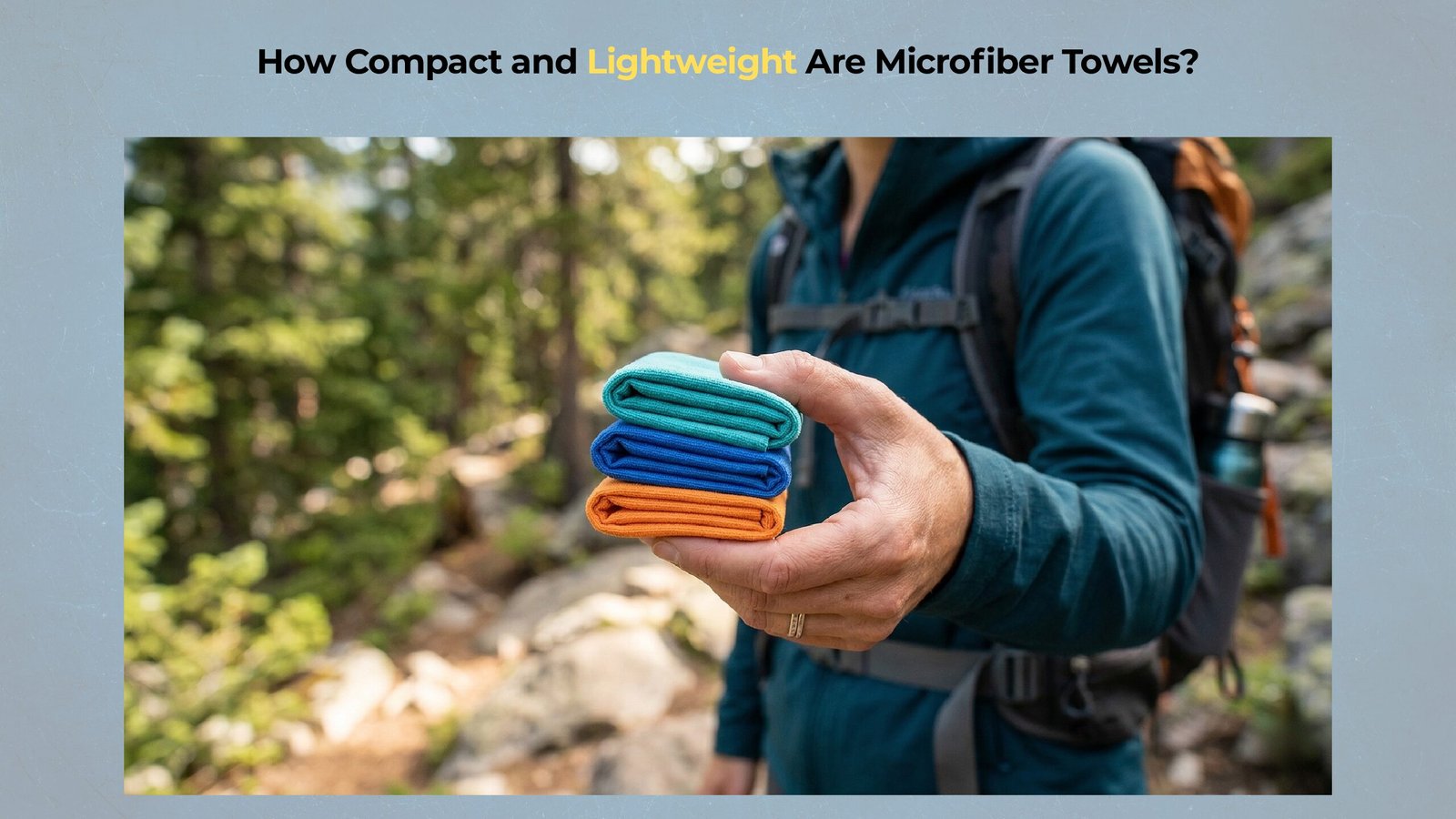
How Compact and Lightweight Are Microfiber Towels?
Technical Logistics & Materials Engineering Guide
High-density packing and weight-sensitive travel rely on microfiber towel compactness and weight because synthetic filaments utilize an ultra-low denier to achieve full-body coverage within a pocket-sized spatial footprint. Textile logistics research published in industrial journals confirm that optimized gear volume materially improves travel efficiency and compliance with strict carry-on limits.
Eliminating air gaps via weave geometry.
Lowering dry mass per square meter.
Immediate active weight recovery.
How Do Microfiber Towels Save Luggage Space and Reduce Weight?
Solving the burden of bulky towels typically requires a shift to microfiber towel compactness and weight, which facilitates full-body coverage while often occupying up to ~70% less total volume than standard cotton terry. This volumetric efficiency stems from the textile's high Mass Density—the objective relationship between the weight of the fiber and the total volume it occupies when folded.
💡 Simplified Explanation:
"In practical terms, a full-size microfiber towel occupies roughly the same luggage real estate as a standard cotton T-shirt."
What Is the Surface-Area-to-Mass Ratio of Microfiber Towels?
High efficiency in microfiber towel compactness and weight originates from an optimized surface-area-to-mass ratio where a standard bath towel occupies roughly the same spatial footprint as a small cotton washcloth. A suede microfiber towel often folds into ~15–20 cubic inches, whereas a standard cotton towel of identical dimensions typically exceeds 120 cubic inches.
[Split-fiber filaments] → [eliminate architectural bulk] → [optimize the surface-area-to-mass ratio]
- Airline Compliance: Frees up critical space in carry-on bags.
- Backpacking Efficiency: Reduces total pack volume for technical ascents.
- Gym Portability: Fits easily into shoe-sized locker compartments.
Once readers understand how microfiber reduces folded bulk and wet-weight penalties, they will naturally want to see how much water microfiber towels hold relative to their weight, because retained moisture determines the real carry burden during travel.
How Does the Dry-to-Wet Weight Transition Affect Travel Logistics?
Predictable travel logistics depend on a stable dry-to-wet weight transition, where the low moisture regain of synthetics prevents the extreme wet-weight penalty characteristic of natural fibers. Fiber engineering data documented by textile science journals confirm that the weight penalty of saturated natural fibers often exceeds 8x their dry weight, a threshold synthetics rarely reach.
Moisture Regain: The amount of water a bone-dry fiber absorbs from the air, expressed as a percentage of its dry weight. Dry microfiber typically starts 50% lighter than cotton; because its moisture regain is < 0.4%, it typically retains approximately 80% less total mass increase when damp.
[Low moisture regain] → [limits internal water storage] → [preserves lightweight travel portability]
Because this article focuses on space-saving travel efficiency, the most natural next step is how fast microfiber towels really dry, since drying speed directly affects how quickly that lightweight, compact towel becomes pack-ready again.
What Engineering Factors Make Microfiber Towels Compact and Lightweight?
The specific weave architecture dictates microfiber towel compactness and weight by manipulating filament density to eliminate the non-functional bulk found in traditional looped textiles. warp-thread density and the reduction of interstitial voids allow for high performance in limited spatial envelopes.
💡 Simplified Explanation:
"Think of a plush cotton towel as a thick sponge and a suede microfiber towel as a sheet of high-density blotting paper."
Which Weave Structures Offer the Best Compactness for Travel?
Choosing between suede and plush structures materially alters microfiber towel compactness and weight, with flat-woven suede typically providing the absolute minimum spatial footprint for ultralight trekking.
- Suede Weaves: Prioritize logistical efficiency; these flat-woven textiles utilize a non-looped filament orientation to eliminate interstitial air gaps.
- Terry Microfiber: Sacrifices ~50% of its compactness to provide a tactile experience closer to traditional linens, resulting in a higher "loft" penalty.
Because suede and flat weaves are recommended for maximum volumetric efficiency, readers comparing functional trade-offs would benefit from whether microfiber towel texture is comfortable for personal use, since the most compact weaves often feel different on the skin.
[Flat-weave suede architecture] → [minimizes interstitial air gaps] → [maximizes volumetric efficiency]
How Does GSM Affect Microfiber Towel Weight Efficiency?
Grams per Square Meter (GSM) directly correlates with the final microfiber towel compactness and weight, acting as the primary metric for total fiber mass in a folded state. Reference ASTM D3776 mass-per-unit-area verification to ensure the stated GSM is accurate. Selecting a 200–250 GSM threshold often provides up to ~40% more space-savings than 400+ GSM luxury alternatives.
How Does Wringing Maintain Microfiber Towel Portability?
Maintaining microfiber towel compactness and weight during transit requires a mechanical wringing reset that typically displaces ~90% of retained liquid to prevent "heavy-towel" logistical burdens. Interstitial Air Pockets are the spaces within the weave that must be cleared of water to restore the towel's lightweight profile.
What Is the Active Weight of Wrung-Out Microfiber Towels?
Management of microfiber towel compactness and weight during travel focuses on active carry-weight, where a simple manual wring returns the synthetic textile to a near-dry state often ~70% lighter than saturated cotton. Textile science research confirms that mechanical extraction in non-lumen fibers achieves significantly higher efficiency, allowing for immediate reset of the wicking engine.
[Low moisture regain] → [limits internal water storage] → [preserves lightweight travel portability]
When to Wring:
- Immediately post-use: To prevent moisture from migrating into dry luggage compartments.
- Before packing in a gym bag: To minimize the weight penalty during active transit.
- Prior to high-altitude transit: Where weight compliance is strictly enforced.
Since the article explains that wringing restores portability by removing trapped moisture, a strong follow-up is whether microfiber towels absorb well enough for full-body drying, which helps readers judge whether compactness comes with enough practical drying performance.
Microfiber vs. Cotton: Which Towel Is More Compact for Travel?
Selecting the ideal inventory requires spatial calibration of microfiber towel compactness and weight against cubic volume benchmarks to identify the Fit-for-Purpose fit for specific luggage constraints.
| Fiber Type (Bath Size) | Est. Folded Volume | Weight (Dry) | Portability Rank |
|---|---|---|---|
| Suede Microfiber | ~15–20 cu. in. | 5–8 oz | 1 (Elite) |
| Plush Microfiber | ~30–45 cu. in. | 8–12 oz | 2 |
| Natural Linen | ~25–40 cu. in. | 6–10 oz | 3 |
| Turkish Cotton | ~50–70 cu. in. | 12–16 oz | 4 |
How Do You Choose the Right Microfiber Towel Size for Travel?
Correct sizing ensures microfiber towel compactness and weight align with localized spatial realities, ranging from ultralight trekking to international leisure.
| Trip Type | Recommended Size | Portability Result |
|---|---|---|
| Ultralight Trekking | 12" x 24" (Face) | Pocket-sized; wring-and-repeat use |
| International Travel | 24" x 48" (Medium) | Full-body cover; fits in a shoe-sized gap |
| Beach / Leisure | 30" x 60" (Large) | Sand-free; 70% smaller than cotton |
What Are the Best Folding Techniques for Microfiber Towel Compactness?
Eliminating interstitial air pockets via the Ranger Roll method maximizes microfiber towel compactness and weight during the packing process. Dimensional Stability describes the ability of the textile to maintain its shape and roll-ability after repeated laundering.
💡 Simplified Explanation:
"Rolling your towel instead of folding it is the difference between a loose stack of papers and a tightly packed scroll."
How Do You Execute a Ranger Roll for Maximum Space Savings?
Executing a Ranger Roll secures peak microfiber towel compactness and weight by rolling the textile into a tight, stabilized cylinder that removes all internal air gaps.
The 3-Step "Strip-and-Tension" Roll Technique:
- Cuff Setup: Lay the towel flat and fold a 2-3 inch "cuff" at the bottom edge.
- Tension Roll: Fold the towel in thirds lengthwise and roll from the top toward the cuff under high tension.
- Secure Lock: Pull the cuff over the rolled cylinder to lock the fibers into a stabilized < 2-inch diameter.
Do Compression Sacks Improve Microfiber Towel Portability?
Utilizing mesh compression sacks maintains microfiber towel compactness and weight efficiency by applying external mechanical pressure to the textile while allowing residual moisture to escape.
[External mechanical pressure] → [displaces air voids] → [secures peak microfiber towel compactness]
The Mesh Advantage:
- Pore Aeration: Prevents the development of bacterial mildew by facilitating gas exchange.
- Volume Lock: Forces the fabric into its absolute minimum footprint through mechanical containment.
How Can You Restore the Flat-Pack Compactness of Microfiber Towels?
Achieving flexibility recovery in aged inventory involves executing a chemical reset to dissolve the mineral buildup and detergent salts that cause fiber stiffening. Textile durability studies on mineral calcification confirm that alkaline deposits materially increase fiber rigidity, reducing the textile's ability to compress for packing. Reference ISO 6330 laundering procedures; a white vinegar rinse effectively dissolves calcification that impairs folding.
When the guide explains that mineral buildup and poor care can reduce rollability and flat-pack efficiency, the most useful maintenance-focused next read is how to wash and dry microfiber towels correctly, because proper care preserves both compactness and long-term travel readiness.
How Do You Verify the Logistical Integrity of Your Travel Towels?
Systematic technical audits of weave type and dry mass verify the logistical integrity of microfiber towel compactness and weight to ensure the inventory meets minimalist travel requirements.
Checklist: Microfiber Towel Compactness and Weight Audit
- ☐Weave Audit: Is the material confirmed as "Suede" or "Flat" for maximum space-saving?
- ☐Mass Audit: Is the GSM verified between 200–300 for optimal weight efficiency?
- ☐Technique Check: Is the "Ranger Roll" or a mesh compression sack utilized to eliminate air gaps?
- ☐Weight Check: Is the dry weight of a full bath unit under 10 oz (280g)?
- ☐Flexibility Test: Does the textile remain soft and rollable without "crunchy" mineral resistance?
Frequently Asked Questions
A standard bath-sized suede microfiber towel typically occupies ~70% less total volume than cotton, folding into roughly 15-20 cubic inches.
Yes, dry microfiber is 50% lighter, and its low moisture regain prevents extreme wet-weight gains common in cotton.
Final Summary: Does Microfiber Towel Compactness and Weight Align With Your Travel Goals?
Operationalizing a microfiber towel compactness and weight strategy requires a shift from comfort-centric expectations to a logistical model that prioritizes suitcase volume and carry-weight.
- Spatial Maximization: Reclaim up to 70% of lost luggage space.
- Mass Efficiency: Maintain sub-10 oz dry weights for ultralight compliance.
- Logistical Reset: Utilize mechanical wringing to bypass the wet-weight penalty.
Ultimately, the right microfiber towel provides more space, less weight, and fewer packing compromises—transforming travel efficiency into a tangible advantage.
Disclaimer: Technical data provided is based on standardized textile engineering models (ASTM/ISO). Metrics may vary based on manufacturer proprietary weaves and compression force applied during packing.