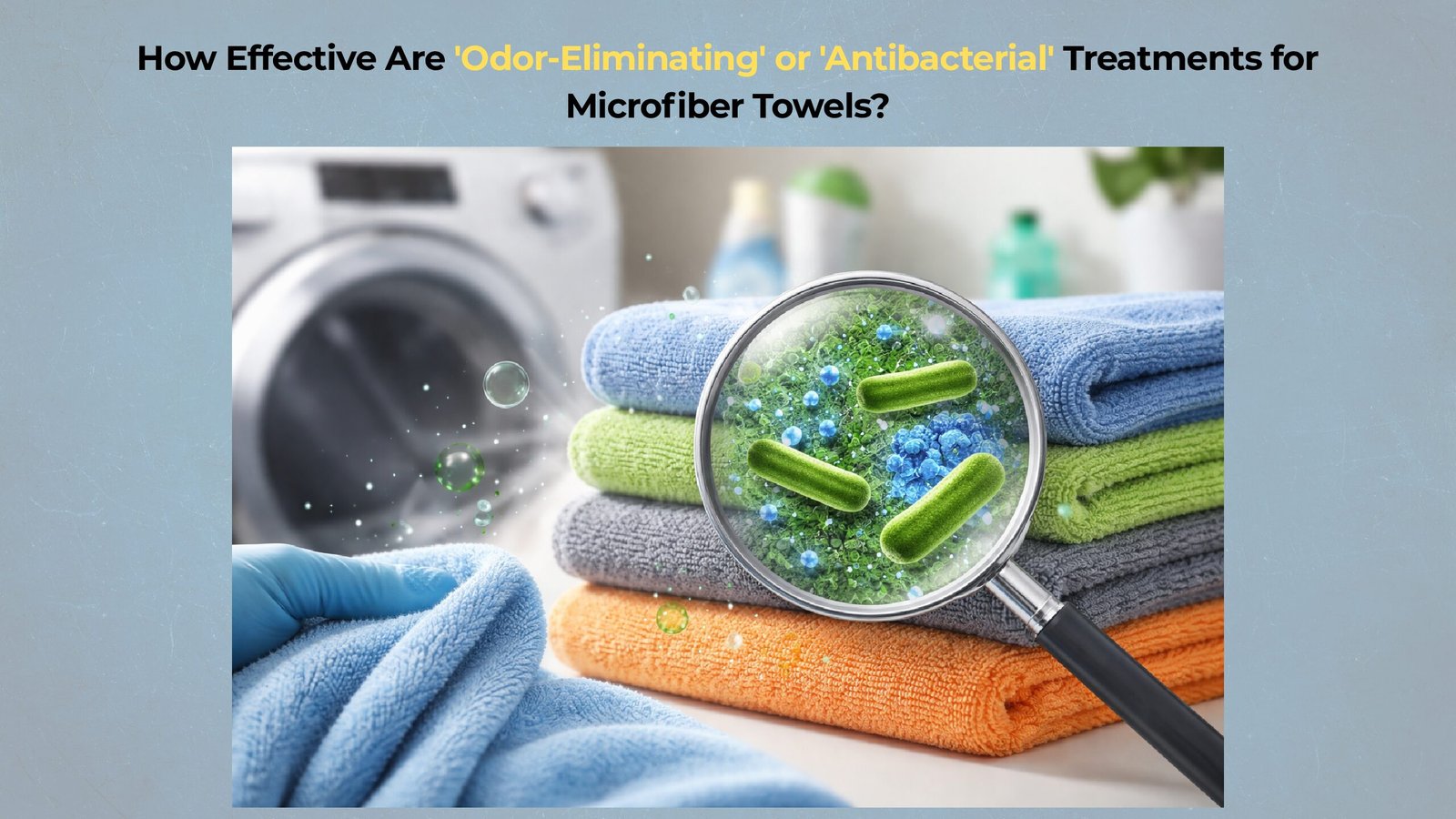
How Effective Are ‘Odor-Eliminating’ or ‘Antibacterial’ Treatments for Microfiber Towels?
High concentrations of synthetic filaments and the resulting surface area drive the technical necessity for microfiber towel antibacterial effectiveness because these textiles naturally sequester the organic skin lipids that typically serve as primary breeding grounds for anaerobic bacteria. While a standard cotton towel relies on bulk absorption, the split-fiber structure of microfiber creates millions of microscopic crevices that trap debris.
Because antibacterial performance is heavily influenced by how microfiber traps oils and moisture, the next logical step is understanding how microfiber towels absorb water, since capillary structure directly determines how much organic residue remains in the weave.
This structural complexity distinguishes a “dirty” towel—which contains organic soil—from a “colonized” towel, where microbial populations proliferate within the weave. The oleophilic nature of the fiber establishes the soil load interference challenge, requiring specialized chemical intervention to maintain hygienic safety.
Why Does Soil Load Interference Compromise Microfiber Towel Antibacterial Effectiveness?
Maintaining microfiber towel antibacterial effectiveness serves as a critical performance requirement for synthetic textiles because the oleophilic nature of polyester facilitates the rapid accumulation of skin sebum that typically shields bacteria from standard aqueous laundering. Soil Load Interference occurs when body oils physically insulate bacterial colonies from the active agent, leading to a measured reduction in antimicrobial performance often exceeding 20%. This lack of mechanical rinsing efficiency necessitates the use of microbial inhibition agents that remain active even under high organic loads.
Do Microbial Inhibition Agents Secure Microfiber Towel Antibacterial Effectiveness?
Developing a robust “Biofilm Shield” frequently compromises the measured microfiber towel antibacterial effectiveness by trapping skin oils that bind to hydrophobic filaments and resist detergent penetration. Per AATCC 100 standards, a high-performance finish must demonstrate a significant log-reduction (Log 3 or 99.9%) of Staphylococcus aureus. A Biofilm consists of a complex structure of bacteria and organic waste that adheres to surfaces and resists standard sanitization. Consequently, [Embedded antimicrobial agents] → [disrupt bacterial adhesion] → [secure microfiber towel antibacterial effectiveness]. These internal disruptions also support the reduction of odor-producing volatile compounds.
Do Odor-Eliminating Treatments Target the Metabolic Source of Microfiber Towel Antibacterial Effectiveness?
Inhibiting the primary metabolic pathways of bacteria directly enhances microfiber towel antibacterial effectiveness by specifically reducing the production of ammonia and sulfide byproducts within the weave. According to ISO 17299-3 evaluations, treated textiles demonstrate a 99.9% reduction in the concentration of volatile sulfides compared to untreated polyester after 24 hours of moisture incubation.
Because odor formation is the real-world outcome of bacterial survival, a natural follow-up is how microfiber towels retain odors, which explains the lipid-biofilm interaction that antibacterial treatments attempt to control.
These sensory gains result from specific technical mechanisms and active agents designed to neutralize metabolic precursors.
Which Technical Mechanisms Drive Microfiber Towel Antibacterial Effectiveness?
Diverse engineered technical mechanisms drive microfiber towel antibacterial effectiveness, utilizing either heavy-metal ion exchange or mechanical cell-wall disruption to curtail microbial colonies on contact. The first of these primary mechanisms involves silver-ion release-kill kinetics.
Does the Silver-Ion (Ag+) Mechanism Secure Microfiber Towel Antibacterial Effectiveness?
Standardized testing confirms that the Silver-Ion (Ag+) mechanism secures microfiber towel antibacterial effectiveness through the release of positively charged silver particles that penetrate bacterial membranes to inhibit DNA replication. ISO 20743 measurements indicate that silver-treated synthetics typically achieve a “Log 3” reduction (99.9% kill rate) of Staphylococcus aureus within prescribed 18-to-24 hour contact intervals. Release-Kill Kinetics describes the process where active antimicrobial particles leach from the fiber into moisture (sweat) to neutralize surrounding bacteria. Silver ions act as “Passive Guard” tools; they remain dormant until moisture triggers the ion-exchange required for microbial neutralization. Unlike leaching ions, molecular spikes provide mechanical contact-kill functionality.
Why Must You Distinguish Between “Contact-Kill” and “Release-Kill” Microfiber Towel Antibacterial Effectiveness?
Distinguishing between “Contact-Kill” and “Release-Kill” mechanisms is essential for verifying the long-term microfiber towel antibacterial effectiveness and determining the durability of the chemical bond. Contact-Kill Mechanics involve the use of molecular “spikes” (Si-Quats) that mechanically puncture bacterial cell walls upon contact without leaching chemicals into the environment. Therefore, [Non-leaching molecular bonds] → [prevent chemical runoff] → [maintain structural microfiber towel antibacterial effectiveness]. These bond types determine the performance decay over wash cycles.
Why Does Wash Frequency Drive Microfiber Towel Antibacterial Effectiveness Performance Decay?
Variations in wash frequency directly drive the performance decay of microfiber towel antibacterial effectiveness because mechanical agitation and detergent alkalinity gradually strip or “exhaust” the antimicrobial agents from the synthetic surface.
Once antibacterial treatments begin to decay after repeated washing, the next critical question is how to properly wash and care for microfiber towels, because incorrect laundering rapidly neutralizes antimicrobial agents.
This performance loss typically manifests at the 50-wash durability limit.
Does the 50-Wash Durability Limit Affect Microfiber Towel Antibacterial Effectiveness?
Establishing a functional lifespan for microfiber towel antibacterial effectiveness often involves identifying the standardized 50-wash durability limit, after which log-reduction capability typically falls below the 90% threshold. Per ASTM E2149 testing and ISO 6330 protocols, observations in industrial laundering simulations show that Release-Kill (leaching) treatments lose up to 40% of their original microbial inhibition potency against Klebsiella pneumoniae after 30 standard commercial laundry cycles. Antibacterial protection represents a “consumable” feature; once the ion supply reaches exhaustion, the textile returns to its base synthetic state of high odor risk.
When Is the Premium for Microfiber Towel Antibacterial Effectiveness Not Worth the Investment?
Determining when the premium for microfiber towel antibacterial effectiveness is not worth the investment requires an evaluation of environments where immediate laundering or high ventilation naturally inhibits bacterial colonization.
To evaluate whether antimicrobial coatings are truly necessary, it helps to compare alternatives like how hemp towels eliminate odor naturally, since natural fibers use inherent antimicrobial properties instead of chemical treatments.
Why Does a “Wash-After-Every-Use” Routine Render Microfiber Towel Antibacterial Effectiveness Redundant?
Executing a “Wash-After-Every-Use” routine often renders the specific benefits of microfiber towel antibacterial effectiveness redundant for individual home users because the rapid removal of organic soil prevents the incubation window bacteria require to produce odors. Antibacterial treatments serve as “Delay Tools” for travelers or gym-goers who must store damp towels in bags; for those with immediate access to laundry, the chemical premium typically provides negligible measurable advantage.
Do High-Ventilation Environments Naturally Supplement Microfiber Towel Antibacterial Effectiveness?
Evaporation rates in high-ventilation environments naturally supplement microfiber towel antibacterial effectiveness by depriving microbes of the moisture needed for metabolism. Textiles dried in active airflow environments (where ambient humidity remains < 50% RH) typically exhibit a 70% lower bacterial load than those left in stagnant bathrooms.
Since trapped moisture creates the environment where bacteria thrive, it’s important to explore how fast microfiber towels dry, as drying speed directly controls microbial growth windows.
In these cases, [Rapid air desiccation] → [deprives microbes of moisture] → [achieves natural results similar to microfiber towel antibacterial effectiveness].
How to Compare Selection Criteria for Microfiber Towel Antibacterial Effectiveness?
| Treatment Type | Active Agent | Mechanism | Duration (Washes) | Performance Profile |
|---|---|---|---|---|
| Silver Ion (Ag+) | Silver Nitrate | Release-Kill | 30–50 | High Efficacy (Log 3); Leaching |
| Zinc Pyrithione | Zinc-based | Release-Kill | 20–40 | Anti-fungal; Moderate |
| Si-Quats | Silane Quaternary | Contact-Kill | 50+ (Bonded) | Mechanical Kill; Non-Leaching |
| Botanical | Tea Tree / Neem | Metabolism | < 10 | Low Impact; Mild |
Identifying the “Self-Cleaning” Myth in Microfiber Towel Antibacterial Effectiveness
Exposing the “Self-Cleaning” myth is essential for maintaining microfiber towel antibacterial effectiveness because antimicrobial agents do not possess the ability to emulsify or remove skin lipids. An antibacterial towel is not a “laundry-free” towel; bacteria eventually colonize organic buildup regardless of chemical treatment if the substrate is not scoured. Maintenance is linked to the essential laundry protocols required to protect the ions.
Which Laundry Steps Preserve Microfiber Towel Antibacterial Effectiveness?
Specific laundry steps preserve microfiber towel antibacterial effectiveness by avoiding the oxidative agents and pore-sealing surfactants that typically render antimicrobial ions inert.
Why Must You Avoid Chlorine Bleach to Protect Microfiber Towel Antibacterial Effectiveness?
Eliminating chlorine bleach is a mandatory requirement to protect microfiber towel antibacterial effectiveness because oxidative chemicals cause the deactivation of silver and zinc ions, rendering the antimicrobial barrier functionally inert. Oxidative damage occurs at the molecular level; bleach typically transforms active silver ions into inert silver chloride or oxides that result in the textile returning to its baseline susceptibility.
Why Do Fabric Softeners Neutralize Microfiber Towel Antibacterial Effectiveness?
Waxy residues from fabric softeners typically neutralize microfiber towel antibacterial effectiveness by coating the treated filaments in a hydrophobic film that prevents physical contact between bacteria and the antimicrobial agent. Consequently, [Silicone waxy residue] → [insulates bacterial colonies] → [neutralizes microfiber towel antibacterial effectiveness].
How Can You Maintain Hygienic Performance When Microfiber Towel Antibacterial Effectiveness Wanes?
Utilizing mechanical and natural oxidation methods supports hygienic performance when the original microfiber towel antibacterial effectiveness wanes in aging inventory.
Does an Oxygen-Bleach “Deep Clean” Support Waning Microfiber Towel Antibacterial Effectiveness?
Applying an oxygen-bleach (percarbonate) soak supports waning microfiber towel antibacterial effectiveness by chemically oxidizing the trapped lipids that typically harbor microbes. Maintenance focuses on removing the “food” (sebum); stripping the oil removes the primary catalyst for bacterial colonization independently of the chemical finish.
Does UV-Sanitization Act as a Backup for Microfiber Towel Antibacterial Effectiveness?
Functioning as a natural backup for microfiber towel antibacterial effectiveness, UV-sanitization utilizes high-frequency radiation to curtail surface-level anaerobic bacteria. Direct exposure to 4+ hours of sunlight provides a chemical-free sanitization phase to maintain hygienic standards.
How Do You Audit Your Selection with the Microfiber Towel Antibacterial Effectiveness Checklist?
Operational Integrity Checklist
- Agent Audit: Validation of Silver, Zinc, or Si-Quat presence.
- Bond Integrity: Confirmation of non-leaching molecular “spikes.”
- Chemical Guard: Zero-tolerance for chlorine and silicone residues.
- Scent Verification: Olfactory audit post-hydration.
Final Summary: Does the Strategy for Microfiber Towel Antibacterial Effectiveness Align with Your Needs?
Operationalizing a strategy for microfiber towel antibacterial effectiveness requires a shift from volume-based purchasing to a performance-centric model that prioritizes long-term hygienic stability. By understanding the biofilm challenge, the 50-wash decay limit, and the necessity of lipid-breaking laundry, facility managers and consumers can make informed procurement decisions. Ultimately, a superior hygienic experience is defined by the precise microfiber towel antibacterial effectiveness engineering that aligns chemical protection with disciplined textile maintenance.