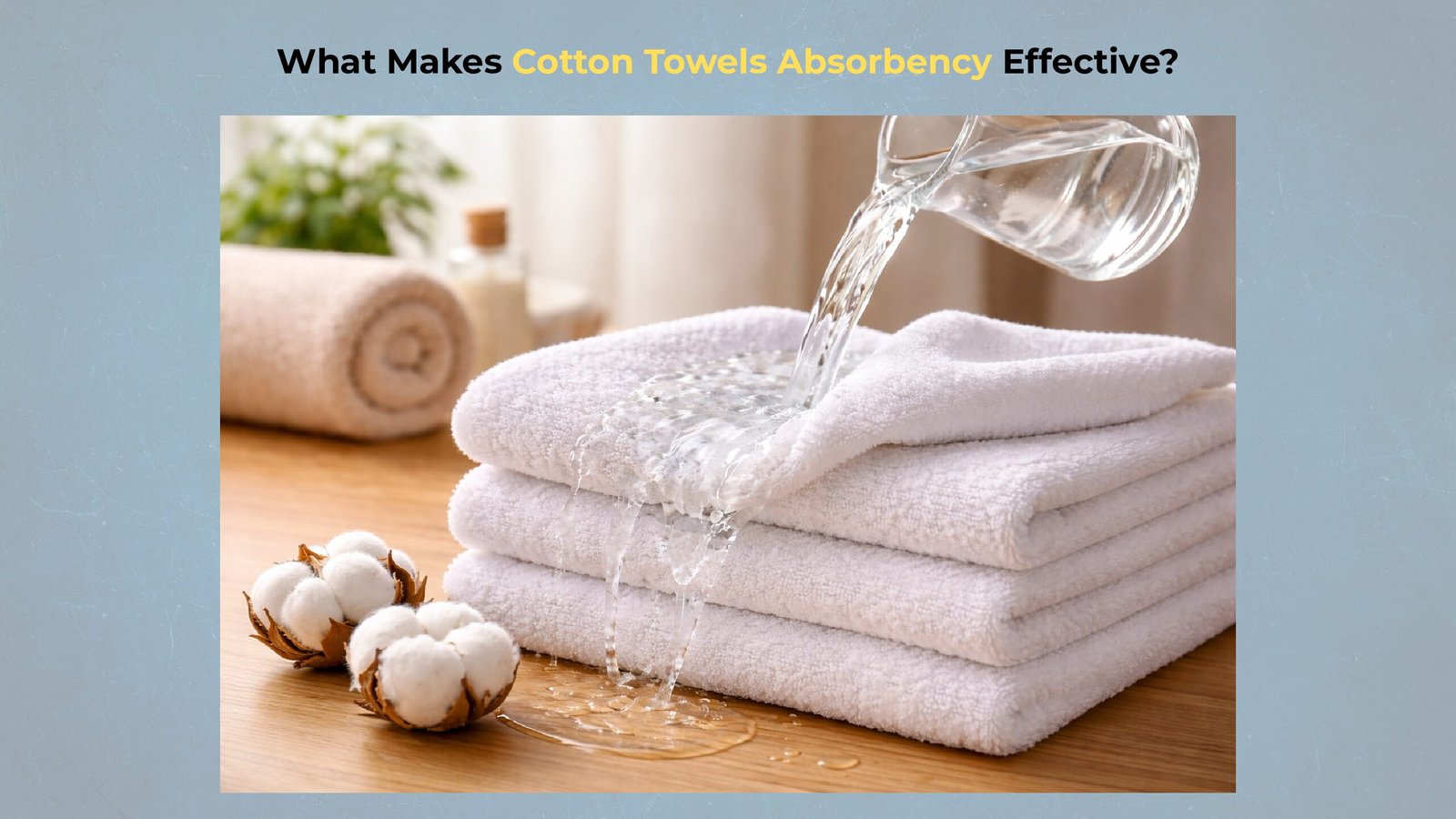
What Makes Cotton Towels Absorbency Effective?
Technical Analysis & Textile Science Guide
Cotton Towels Absorbency is effective because its natural cellulose fiber structure is chemically hydrophilic (water-loving), making it the gold standard for high water retention capacity.
Cotton Towels Absorbency is defined as the unique capacity of the natural cellulose fiber to draw water deep into its structure, distinguishing it from synthetic surface wicking. Cotton’s ability to retain large volumes of water is due to its porous molecular structure, not just its GSM or thickness.
To understand how cotton compares with other textile fibers in terms of moisture retention and drying speed, explore the full material overview in The 12 Towel Materials Guide, which explains how fiber chemistry influences absorbency performance.
Why Is the Cellulose Fiber Essential to Cotton Towels Absorbency?
The Cellulose fiber is essential to Cotton Towels Absorbency because its unique molecular structure provides the chemical bonding sites necessary for bulk liquid uptake.
Identifying the Chemical Mechanism Behind Cotton Towels Absorbency
Identifying the chemical mechanism behind Cotton Towels Absorbency reveals that the fiber’s hydroxyl groups bond directly with water molecules. Cellulose contains numerous hydroxyl groups (OH), which bond directly with water molecules, making the fiber inherently water-seeking.
Because cotton absorbency begins with cellulose chemistry and internal fiber porosity, the guide How Cotton Fibers Absorb and Retain Water explains the capillary mechanisms that pull water into the fiber lumen.
Analyzing Porosity and Fiber Structure in Cotton Towels Absorbency
Analyzing porosity and fiber structure in Cotton Towels Absorbency shows that the fiber’s unique cross-section creates internal micro-capillaries that draw water inward via Capillary Action. The hollow, bean-shaped cross-section of the cotton fiber creates internal micro-capillaries that draw water inward, initiating a mechanical wicking process.
Distinguishing True Absorption from Surface Wicking in Cotton Towels Absorbency
Distinguishing true Absorption from surface wicking in Cotton Towels Absorbency is crucial because capacity is defined by the water held inside the fiber, not just on its surface. Contrast the mechanism: Cotton Towels Absorbency (water inside fiber) vs. Microfiber (water on surface of fiber).
How Do Construction and GSM Maximize Cotton Towels Absorbency?
Construction and GSM maximize Cotton Towels Absorbency by increasing the available surface area (loops) and the sheer mass of absorbent fiber.
Correlating Loop Pile Design with Increased Cotton Towels Absorbency
Correlating loop pile design with increased Cotton Towels Absorbency shows that the terry loop structure significantly increases the total functional surface area. The loop (terry) weave significantly increases the physical surface area available to the water, maximizing initial contact and uptake.
If you want a deeper technical breakdown of how density, staple length, and weave geometry influence moisture retention, see What Factors Influence Cotton Towel Absorbency and Drying Performance?.
Comparison Matrix: Construction vs. Absorbency Impact
This comparison matrix maps structural construction features to their specific performance role in Cotton Towels Absorbency.
| Construction Feature | Role in Cotton Towels Absorbency | Impact on Performance | Trade-Off |
|---|---|---|---|
| Long Staple Fiber | Maximizes internal porosity | Highest Water Capacity | Slow Drying Time |
| High GSM Density | Increases sheer fiber mass | Maximizes Total Water Volume | High Weight/Bulk |
| Zero-Twist Yarn | Maximizes external fiber exposure | Increases Absorbency Speed | Low Durability |
Evaluating High GSM as the Ultimate Capacity Booster for Cotton Towels Absorbency
Evaluating High GSM as the ultimate capacity booster for Cotton Towels Absorbency proves that increasing fiber density is the simplest way to boost water volume. High GSM (700+) provides the sheer amount of cellulose required to achieve the highest possible water retention.
Since higher density towels can hold more water but dry more slowly, understanding the balance between comfort and evaporation is easier with Plushness vs Drying Speed in Cotton Towels.
When Do External Factors Limit Cotton Towels Absorbency?
External factors limit Cotton Towels Absorbency when chemical residues or mineral deposits defeat the fiber’s natural hydrophilic properties.
Preventing Clogging of Cotton Towels Absorbency in Hard Water Areas
Preventing clogging of Cotton Towels Absorbency in hard water areas is necessary because mineral deposits reduce the functional capacity of the fiber. Users in regions with high mineral content must be aware that calcium and magnesium deposits reduce the fiber’s capacity to absorb water.
Matching Towel Care to Maintain Cotton Towels Absorbency
Matching towel care to maintain Cotton Towels Absorbency is crucial because initial manufacturing finishes must be stripped to unlock full function. Proper washing is necessary to remove residual sizing and chemical finishes that seal the fibers upon purchase.
Avoiding Chemical Agents That Destroy Cotton Towels Absorbency
Avoiding chemical agents that destroy Cotton Towels Absorbency is mandatory because fabric softeners introduce a hydrophobic wax coating to the fiber. Fabric softeners and harsh detergents leave behind waxy, hydrophobic residue that eliminates the cotton fiber’s natural water-loving ability.
Cotton towel performance depends on environmental conditions. Relative humidity (RH) dictates the thermodynamic limit of how much moisture air can hold. High-GSM towels often fail in poorly ventilated bathrooms where a high RH prevents the necessary evaporation gradient.
Why Does Relative Humidity Impact Performance?
Cotton towel performance degrades in humid environments because the vapor pressure differential between the wet towel and the air is reduced. Evaporation is driven by RH rather than temperature alone. As RH approaches 100%, the air’s ability to accept moisture decreases, leading to long-term dampness and fiber degradation.
When slow drying leads to damp odors or mildew risk, the prevention strategies in How Cotton Towels Prevent Mildew and Musty Odors explain how airflow and humidity affect towel hygiene.
How Can You Test and Restore Optimal Cotton Towels Absorbency?
You can test and restore optimal Cotton Towels Absorbency by using objective audits and chemical stripping methods.
Restoring Clogged Cotton Towels Absorbency with Vinegar Stripping
Restoring clogged Cotton Towels Absorbency is achieved with Vinegar Stripping which dissolves the mineral and detergent buildup causing beading. Use a precise chemical method (vinegar followed by baking soda) for dissolving mineral and detergent buildup that causes beading.
If residue buildup is preventing proper water absorption, the restoration techniques explained in How to Maintain Cotton Towel Softness and Performance can help reopen clogged fiber pores.
Data Table: Symptoms of Impaired Cotton Towels Absorbency
This data table identifies the visual and tactile symptoms of impaired Cotton Towels Absorbency and provides the restoration solution.
| Symptom | Cause of Impaired Cotton Towels Absorbency | Restoration Method |
|---|---|---|
| Water Beading | Fabric Softener Residue | Vinegar Soak |
| Stiffness/Crunchiness | Mineral Deposits (Hard Water) | Baking Soda Wash |
| Slow Drying Time | High GSM Density | Mechanical Agitation (Dryer Balls) |
If your towels are still beading water or feeling waxy after washing, you can diagnose the exact care issue using the Towel Care Diagnosis Engine, which identifies detergent buildup, softener residue, or washing mistakes.
Best Practices for Mechanical Agitation to Boost Cotton Towels Absorbency
Best practices for Mechanical Agitation boost Cotton Towels Absorbency by ensuring maximum surface area exposure. Utilizing low-heat tumbling and dryer balls helps to open the pile structure and maximize the available surface area.
How Do You Validate Optimal Cotton Towels Absorbency Before Buying?
You validate optimal Cotton Towels Absorbency before buying by executing a 4-step physical audit of the construction and fiber quality.
Executing a 4-Step Cotton Towels Absorbency Audit
This 4-step Cotton Towels Absorbency audit is an “Absorption Test” box you can use to verify quality.
Conclusion: How Can You Synthesize the Science of Cotton Towels Absorbency?
Synthesizing the science of Cotton Towels Absorbency confirms that capacity is the result of chemistry and structural engineering working together.
Recap: Summarizing the Dual Mechanism of Cotton Towels Absorbency
Summarizing the dual mechanism confirms that effective Cotton Towels Absorbency relies on both fiber chemistry (hydroxyl bonds) and structure (loops/density).
Final Verdict: Prioritizing Chemistry and Structure for Best Cotton Towels Absorbency
The final verdict is that prioritizing chemistry and structure will yield the best long-term Cotton Towels Absorbency. Always prioritize long-staple fiber and optimal GSM for the best long-term Cotton Towels Absorbency.
The best absorption is an engineered outcome, not an accident.
Frequently Asked Questions
Why do cotton towels stop absorbing water after several months?
Absorbency loss is typically caused by the accumulation of fabric softener waxes, detergent residues, or mineral deposits from hard water which create a hydrophobic barrier over the cotton fibers.
How does white vinegar restore towel absorbency?
The acetic acid in vinegar dissolves mineral deposits and strips away waxy softener residues, reopening the pores of the cellulose fiber for capillary action.
Is a higher GSM always better for absorbency?
In terms of total volume, yes. However, very high GSM towels (800+) may dry much slower, increasing the risk of mildew if the bathroom is not well-ventilated.
Scientific & Practical Disclaimer
The information provided on Cotton Towels Absorbency is intended for educational and informational purposes based on textile chemistry standards. While the restoration methods described (vinegar/baking soda) are generally safe for natural cotton, individual results may vary based on fiber quality, water hardness, and specific detergent formulations. Toweldaily.com is not liable for damage resulting from improper chemical handling or environmental factors like relative humidity. Always consult specific manufacturer care labels before proceeding with advanced stripping methods.