Textile Engineering Series
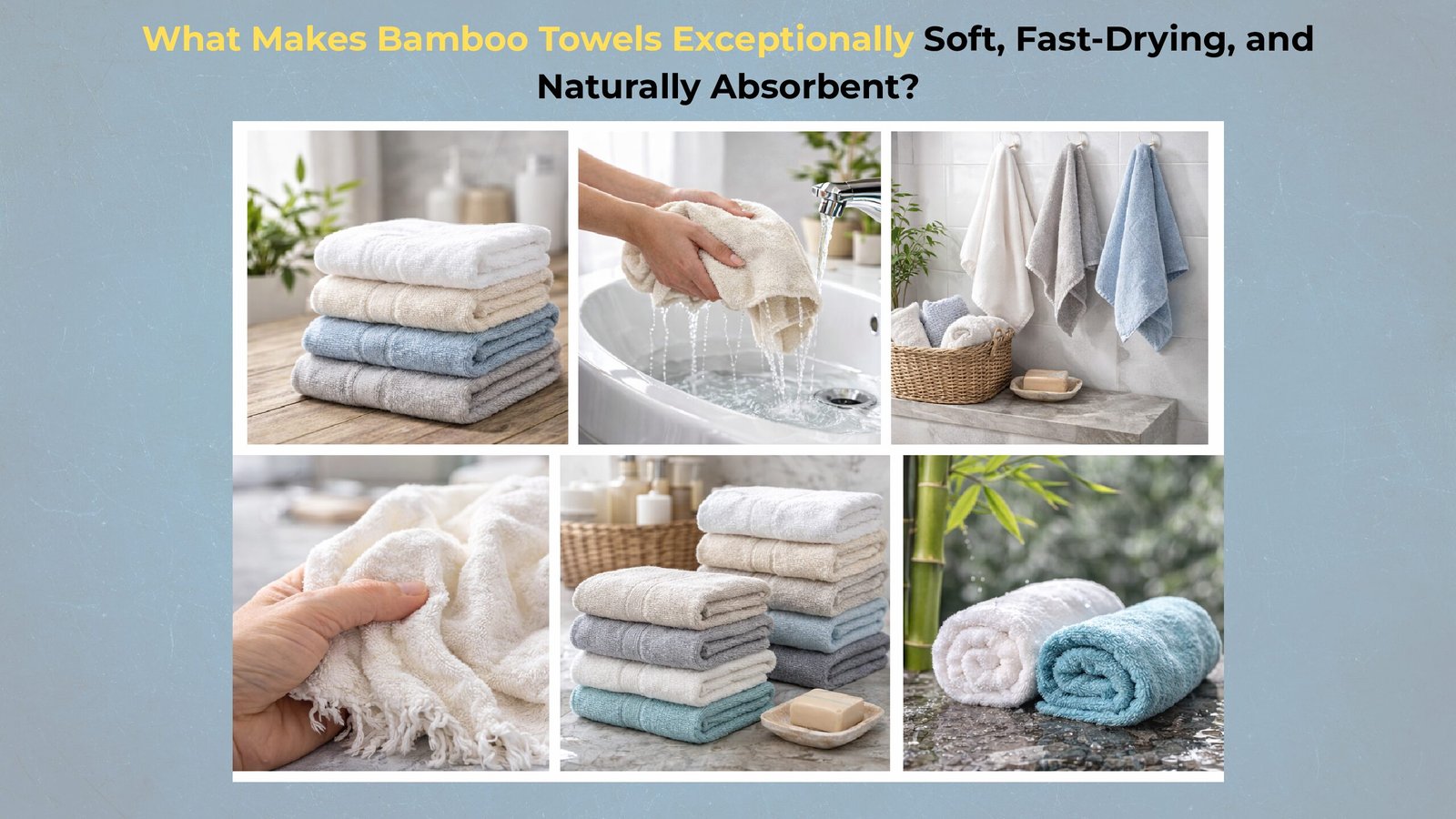
What Makes Bamboo Towels Exceptionally Soft, Fast-Drying, and Naturally Absorbent?
Bamboo Towels achieve exceptional softness, rapid fluid kinetics, and natural absorbency through a regenerated cellulose structure that minimizes surface friction while maximizing capillary pressure via a multi-hole fiber morphology. These regenerated cellulose textiles are defined by inherent antimicrobial agents known as **Bamboo Kun**, a friction coefficient 28.5% lower than cotton, and a thermal conductivity of 0.045 $W/m$. Evaluating textile material factors ensures that consumers prioritize longevity and eco-efficiency in their daily hygiene ritual.
Why are Bamboo Towels Superior for Skin Health and Hygiene?
Bamboo Towels are superior for skin health and hygiene because their unique fiber structure offers inherent microbial resistance and minimizes skin abrasion. The technical foundations of Bamboo Towels: Softness & Absorbency Science highlight how these fibers maintain a molecular profile that prioritizes dermatological integrity through reduced surface roughness. This natural resistance to pathogens is a distinct characteristic shared by other bio-based textiles like Hemp Towels, which are also prized for their antimicrobial durability.
Skin Interface
1. Friction Coefficient: The ratio of the force of friction between two bodies; determines the “drag” against the skin.
2. Surface Roughness ($Ra$): The arithmetic average of profile height deviations; lower values indicate a smoother feel.
How Does Bamboo Kun Prevent Odor and Mildew in Bamboo Towels?
Preventing odor and mildew is a core advantage of Bamboo Towels because the material retains Bamboo Kun, a natural bio-agent that inhibits bacterial growth. This organic substance, primarily found within the plant’s lignin, disrupts the cell walls of common microbes, preventing the metabolic processes that lead to “sour” towel smells.
Raw bamboo fiber exhibits a 99.8% bacterial inhibition rate, which remains remarkably stable at 70% even after 50 industrial wash cycles.
Inherent Bamboo Towels → contains Bio-Agents → inhibits odor-causing bacterial growth.
How Do Bamboo Towels Reduce Skin Friction and Irritation?
Maximizing comfort for skin is achieved with Bamboo Towels because their smooth, cylindrical fiber morphology reduces mechanical resistance against the epidermis. This uniformity prevents the microscopic “snagging” common with Cotton Towels, protecting the skin’s natural lipid barrier from micro-tears during the drying process. For those seeking the pinnacle of traditional luxury, Egyptian Cotton Towels offer a different path to softness through extra-long staple fibers.
Bamboo viscose maintains a friction coefficient of 0.25, representing a 28.5% reduction compared to standard cotton’s 0.35.
Beyond general softness, the chemical composition of the fiber provides a molecular defense against microbial proliferation.
How Do You Assess the Quality and Sustainability of Bamboo Towels?
You assess the quality and sustainability of Bamboo Towels by verifying the manufacturing process used to convert the plant into a usable fiber. Technical evaluation must distinguish between standard viscose and advanced closed-loop systems, much like the broader distinctions found in comprehensive towel material hubs. High-end benchmarks like Turkish Cotton Towels provide a comparison for performance-to-weight ratios in luxury bath environments.
Production Integrity
1. Closed-Loop System: A manufacturing protocol where nearly 100% of chemicals and solvents are recycled within the facility.
2. Carbon Sequestration: The plant’s ability to capture CO2; bamboo absorbs 35% more CO2 than an equivalent stand of trees.
What is the Difference Between Viscose and Lyocell Processing for Bamboo Towels?
Distinguishing between Viscose and Lyocell Processing is the most critical factor for the sustainability of Bamboo Towels. While viscose is essentially a form of Viscose Rayon Towels: Softness & Durability Breakdown, Lyocell processing represents the premium tier of environmental engineering, often marketed as Tencel for its specialized Lyocell (Tencel) Moisture Absorption Comparison results.
The Lyocell process recovers 99.5% of the NMMO solvent, and the resulting fiber possesses a tenacity of 32-36 $cN/tex$. This level of strength ensures better long-term performance as noted in research on Bamboo Towels Durability & Longevity, far exceeding standard viscose durability metrics.
How Do Bamboo Towels Compare to Cotton in Environmental Life-Cycle Metrics?
Evaluating the ecological footprint of Bamboo Towels reveals they require significantly fewer resources than traditional cotton farming. Bamboo’s rapid growth rate and lack of pesticide requirements allow for a vastly higher yield per hectare, making it a strategic choice for water-scarce regions.
Bamboo cultivation requires 93% less water than cotton, utilizing only 300–500 liters per kilogram of fiber compared to the staggering 22,500 liters required for certain cotton grades.
Comparison Matrix: Performance Against Other Natural Fibers
While bamboo leads in wicking speed, users often compare these results to traditional options such as Linen Towels to gauge total utility across different household climates.
| Performance Metric | Bamboo Towels | Premium Cotton | Linen |
|---|---|---|---|
| Friction Coefficient | 0.25 (Silky) | 0.32 (Plush) | 0.35 (Crisp) |
| Specific Pore Area | 82.04 $m^2/g$ | ~18.5 $m^2/g$ | Low |
| Drying Time (Mins) | 90 Mins | 120 Mins | 80 Mins |
| Moisture Regain | 11% – 13% | 8% – 9% | 12% |
How Can You Preserve the Softness of Bamboo Towels?
You can preserve the softness and integrity of Bamboo Towels by strictly controlling the heat and chemical agents used during the laundry process. Critical data on Bamboo Towels Shrinkage & Heat Sensitivity indicates that regenerated cellulose is highly sensitive to thermal degradation, making specific care protocols non-negotiable for fiber longevity.
Care Dynamics
1. Thermal Conductivity: The ability to transfer heat; at 0.045 $W/m$, bamboo is excellent at regulating temperature.
2. Cellulose Degradation: The breaking down of glucose polymer chains caused by excessive heat or high pH bleach.
Common Care Violations for Bamboo Towels
| Violation | Impact | Mechanism of Damage |
|---|---|---|
| High Heat (>60°C) | Brittle Fibers | Thermal Cellulose Chain Breakdown |
| Fabric Softener | Reduced Absorbency | Waxy Film Coating (up to 35% loss) |
| Chlorine Bleach | Weakness/Yellowing | Oxidation of Natural Molecular Bonds |
How Do You Validate the Authenticity of Bamboo Towels?
You validate quality and authenticity in Bamboo Towels by executing a 4-step audit focused on verifying the smooth texture, certification, and low density. These validation steps prevent the purchase of low-quality blends, often seen in Polyester Towels or Nylon Towels, which lack the unique bio-benefits of pure regenerated cellulose.
How Does GSM Impact the Performance of Bamboo Towels?
Determining the GSM of Bamboo Towels is essential because the material’s inherent softness allows for lower-weight towels to feel as plush as heavier cotton alternatives. This enables high performance without the excessive bulk that inhibits drying speed, a phenomenon detailed in our Bamboo Towels Drying Speed Analysis.
A 500 GSM bamboo towel provides the tactile equivalent of a 700 GSM cotton towel while drying 20% faster due to superior evaporative kinetics. This fast-drying capability often draws technical comparisons with Microfiber Towels for Travel & Gym Drying Performance commonly used in gym or travel contexts.
The 4-Step Bamboo Towels Fiber Integrity Test
- 1The Label Check: Look for “Lyocell” for maximum sustainability and tensile strength.
- 2The Feel Test: Confirm a “cool-to-the-touch” sensation, indicating high thermal conductivity (~0.045 $W/m$).
- 3The Certification Scan: Verify Oeko-Tex Standard 100 or GOTS logos to ensure zero residual toxins.
- 4The Squeeze Check: Verify “High Loft Efficiency”—the towel should feel light and airy despite its visual thickness. Choosing the right material for specific needs ensures the best user experience.
Frequently Asked Questions
Why do bamboo towels feel cooler than cotton towels?
This phenomenon is due to bamboo’s high thermal conductivity (~0.045 $W/m$), which allows the fiber to dissipate heat more efficiently than cotton. When you touch a bamboo towel, it draws heat away from your hand faster, creating a tactile “cool” sensation.
Do bamboo towels lose their antimicrobial properties over time?
While the Bamboo Kun bio-agent is molecularly bonded to the cellulose, industrial washing can slowly deplete its concentration. Scientific testing shows that bamboo towels retain approximately 70% of their original bacterial inhibition rate even after 50 industrial wash cycles.
Is it true that bamboo towels take longer to dry than cotton?
Actually, it is the opposite. While bamboo fibers can hold more water by mass, their high specific pore area ($82.04 m^2/g$) facilitates faster evaporative kinetics. At equivalent GSM ratings, a bamboo towel typically dries 20% to 30% faster than a cotton counterpart.
Can I use white vinegar to maintain the softness of my bamboo towels?
Yes, adding 1/2 cup of white distilled vinegar to the rinse cycle helps dissolve residual minerals and detergent buildup without damaging the cellulose. Unlike commercial fabric softeners, vinegar does not leave a waxy film that compromises absorbency.
Conclusion: Why are Bamboo Towels the Strategic Choice for Modern Bathrooms?
Bamboo Towels are the best balance of comfort and function, offering the unique combination of natural softness and superior fast-drying hygiene. By leveraging the molecular advantages of regenerated cellulose, they solve the fundamental textile dilemma of balancing luxury feel with microbial resistance.
The Final Verdict
“With a 25% higher seasonal repeat purchase rate, bamboo proves that the intersection of ecological intelligence and molecular design is the future of luxury textiles.”