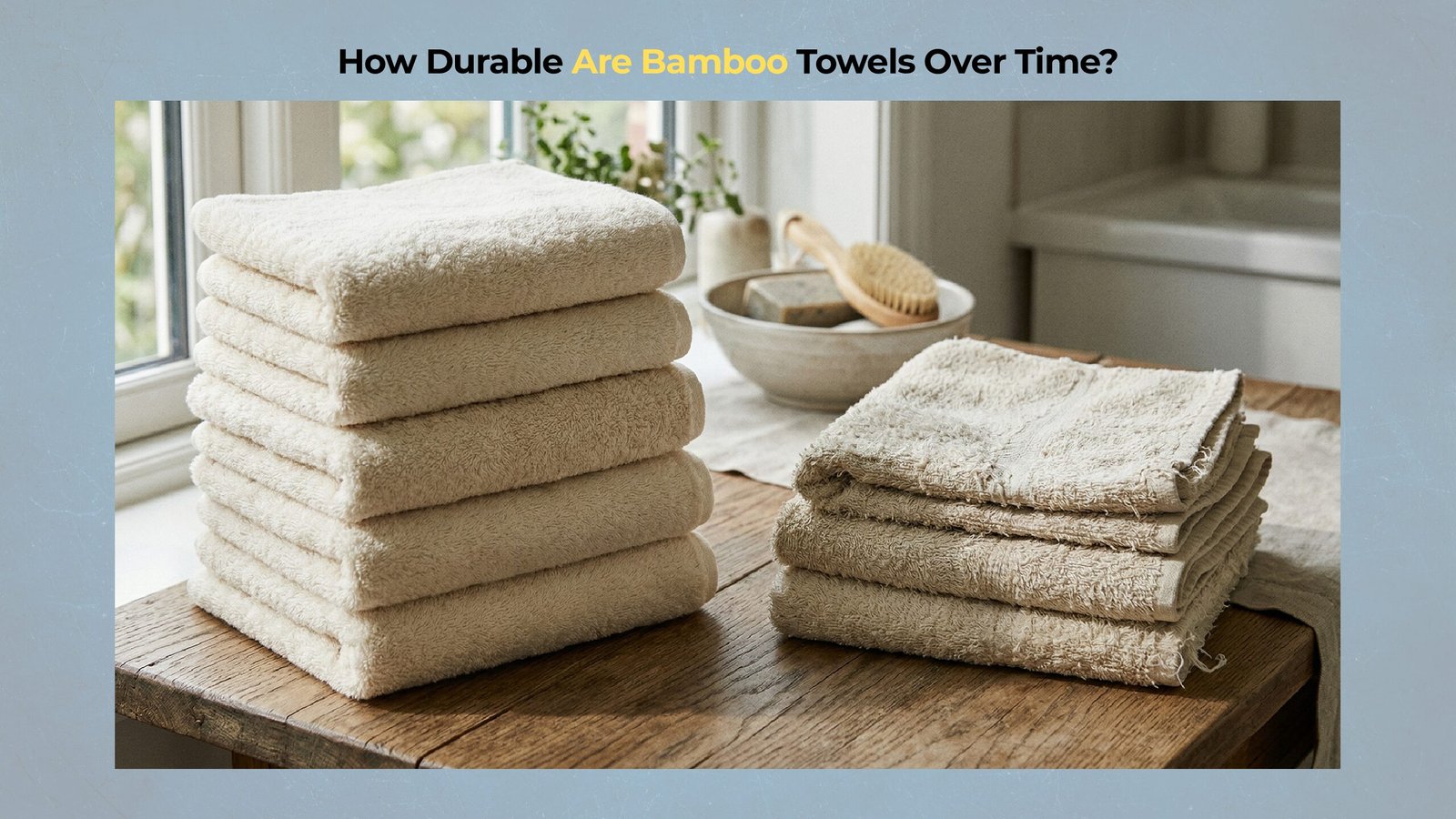
How Durable Are Bamboo Towels Over Time?
An authoritative technical guide to regenerated cellulose longevity and fiber mechanics.
Bamboo towel durability typically sustains a functional service life of several years when users implement low-impact laundering protocols that protect the delicate molecular structure of the regenerated cellulose fibers. While bamboo is often marketed for its unparalleled silkiness and moisture-wicking properties, it operates as a “high-performance, high-maintenance” asset compared to the ruggedness of standard cotton. Standard upland cotton relies on a coarse, high-friction fiber structure that resists aggressive mechanical agitation, whereas bamboo viscose is composed of smooth, extruded filaments that are highly susceptible to mechanical fatigue and chemical degradation.
Ultimately, the longevity of this textile determines the long-term household investment, as the cost-per-use (CPU) is directly tied to the user’s ability to manage fiber shedding and tensile strength over hundreds of wash cycles.
Why Does Bamboo Towel Durability Matter for Long-Term Household Investment?
Bamboo towel durability primarily determines the economic return on investment (ROI) by dictating the period before mechanical wear or fiber thinning necessitates inventory replacement. Unlike premium long-staple cotton (such as Pima or Egyptian), which may actually gain structural character over the first dozen washes, bamboo hits its peak performance immediately and then requires active preservation to prevent a rapid decline in pile density. For a broader buying framework, study the towel durability factor before judging bamboo towel longevity.
Technical Insight:
The replacement cycle for bamboo towels is often 25%-40% faster than cotton if maintenance is neglected, making the initial purchase price only one component of the total cost of ownership.
Identifying the “Service-Life” Expectations for Bamboo Towel Durability
Reaching the upper limits of bamboo towel durability typically depends on usage intensity and maintenance discipline, as these regenerated fibers often require more precise care than cotton to maintain their structural mass. A towel utilized daily in a master suite, exposed to high-frequency moisture and frequent laundering, will reach its wear threshold significantly faster than a decorative guest towel. If you want to compare lifespan expectations across materials, use the towel lifespan calculator before buying bamboo towels.
Evaluating the Environmental ROI of High-Performing Bamboo Towel Durability
Bamboo towel durability supports environmental sustainability goals by reducing the frequency of textile waste through the preservation of high-tenacity regenerated filaments. When a towel’s life is extended through proper care, the environmental footprint associated with its production—including chemical processing and water usage—is amortized over a longer period. Maximized fiber lifespan reduces cumulative textile waste, which in turn optimizes the environmental ROI of bamboo towel durability.
What Molecular Physics Define Bamboo Towel Durability?
Molecular physics define bamboo towel durability through the interaction of cellulose polymer chains and the temporary disruption of hydrogen bonds when the fibers are saturated with moisture. To understand why these towels feel different over time, one must examine the “Wet-Strength Paradox” inherent in all viscose-based textiles. If you want to understand how fiber composition changes wear resistance, read the towel material factor before choosing bamboo blends.
Analyzing the “Wet-Strength” Vulnerability in Bamboo Towel Durability
Bamboo towel durability faces its primary threat during saturation because water molecules disrupt the internal hydrogen bonds of regenerated cellulose, causing a significant reduction in tensile strength. This is measured by the Wet Modulus, which is defined as the measure of a fiber’s resistance to deformation and breakage while in a saturated state. Unlike cotton, which gets stronger when wet, regenerated cellulose (bamboo) loses up to 50% of its dry tensile strength during saturation, making it highly vulnerable to mechanical snags and tears during the wash cycle.
How Does “Fiber Smoothness” Support Bamboo Towel Durability?
Bamboo towel durability benefits from a smooth filament morphology that reduces surface-to-surface abrasion and inhibits the microscopic pilling found in coarser natural fibers. The absence of surface scales allows the loops to glide past each other rather than interlocking. While this smoothness preserves the visual youth of the towel by preventing “fuzzing,” it does not compensate for the lower core strength of the fiber under heavy mechanical load.
Which Specific Laundry Steps Preserve Bamboo Towel Durability?
Preserving bamboo towel durability requires a technical shift from high-heat convenience to a monitored maintenance protocol that protects the cellulose chains from thermal and mechanical fatigue. Because washing habits heavily affect regenerated cellulose, check the towel care instructions factor alongside this durability guide.
Executing the “Cool-Wash” Protocol for Bamboo Towel Durability
Bamboo towel durability remains stable when users maintain wash temperatures at or below 104°F (40°C) to prevent the accelerated breakdown of the regenerated filaments. High heat triggers a process known as Cellulose Chain Scission, where the molecular length of the polymer shortens, resulting in brittle, thin fabric. Low-temperature laundering preserves cellulose chain length, which in turn maintains the tensile strength of bamboo towel durability.
Why Does “Mesh-Bag Protection” Enhance Bamboo Towel Durability?
Bamboo towel durability increases significantly when utilizing mesh bags to isolate the wet textiles from the mechanical snag-and-tear risks posed by zippers, hooks, or rougher fabrics. Because bamboo’s wet modulus is low, a single snag from a zipper can lead to an unravelling event that cotton would otherwise resist. Mandating separate loads or mesh bag containment for all bamboo inventory is the most effective way to shield the fragile wet loops from mechanical trauma.
How to Select High-Performance Blends for Maximum Bamboo Towel Durability?
Selecting for bamboo towel durability at the point of purchase involves identifying hybrid constructions that utilize a cotton or linen “structural frame” to support the softer regenerated fibers. To compare regenerated fibers against cotton, linen, or synthetics, review the full towel material guide.
| Fiber Blend | Durability Rank | Primary Benefit | Functional Weakness |
|---|---|---|---|
| 100% Bamboo Viscose | Moderate | Maximum Tactile Softness | High Wet-State Fragility |
| 70/30 Bamboo-Cotton | High | Enhanced Structural Stability | Slightly reduced silkiness |
| 60/40 Bamboo-Linen | Highest | Maximum Tensile Strength | Stiffer initial “out-of-box” feel |
Does the “Double-Stitch” Requirement Secure Bamboo Towel Durability?
Bamboo towel durability depends on reinforced perimeter engineering, where double-needle lockstitching prevents the unraveling associated with the “slick” surface of viscose filaments. Users are directed to inspect hems for high-density stitching; bamboo’s lack of surface friction makes it more prone to “sliding” out of poorly executed seams, which can cause the towel to fray along the borders within just a few months.
When is Bamboo Towel Durability Insufficient for Your Environment?
Bamboo towel durability can fail in environments that prioritize mechanical throughput over fiber preservation, specifically in commercial or high-heat industrial settings.
Why is High-Frequency Commercial Use a Limit for Bamboo Towel Durability?
Bamboo towel durability typically collapses under the aggressive mechanical agitation and high-speed extraction cycles characteristic of industrial laundry facilities. Industrial extractors apply high G-forces that can “shred” or stretch saturated viscose fibers beyond their elastic recovery limit. Bamboo is optimized for domestic, gentle-care environments where turnover speed is secondary to tactile quality.
Do Low-Quality Viscose Processes Compromise Bamboo Towel Durability?
Bamboo towel durability fails prematurely in bargain-tier textiles that utilize short-staple fibers or inferior chemical regeneration methods that lead to rapid structural thinning. “Cheap” bamboo often skips the long-filament extrusion process, resulting in a towel that begins pilling after the first three wash cycles as the short fibers migrate to the surface.
When Does Bamboo Towel Durability Fail Under Standard Use?
Bamboo towel durability degrades when users introduce chemical oxidizers or excessive thermal energy that bypasses the material’s natural safety thresholds.
How Does “Fiber Thinning” Indicate a Failure in Bamboo Towel Durability?
Visible fiber thinning signals a compromise in bamboo towel durability often caused by the utilization of chlorine bleach or harsh, high-alkaline detergents. When bamboo loops start thinning or matting, run a quick check with the towel failure diagnostics tool. Chlorine induces molecular chain scission in cellulose, turning a dense towel into a transparent, “crunchy” fabric over time.
Does “Heat-Brittleness” Permanently Alter Bamboo Towel Durability?
Bamboo towel durability suffers permanent damage from “Heat-Brittleness” when repeated high-heat drying cycles remove the core moisture required to maintain filament flexibility. Unlike synthetics that melt, bamboo fibers undergo Hornification, where internal pores collapse, leading to permanent stiffness and increased pilling. This moisture loss is irreversible and dictates a “Low” or “Air Fluff” drying requirement.
How Can You Fix Pilling or Restore Bamboo Towel Durability?
Restoring bamboo towel durability in matted or pilled inventory involves executing mechanical resets to remove entangled fibers and chemical rinses to dissolve mineral rigidity. If repeated washing is changing softness or absorbency, the towel care diagnosis engine helps identify the maintenance problem.
Can You Resolve Surface Pilling to Improve Bamboo Towel Durability?
Bamboo towel durability and surface smoothness regain their original profile if a delicate fabric shaver or “cellulase” detergent safely removes the entangled surface fragments. Cellulase is defined as a specialized enzyme that biologically “clips” off the fuzzy micro-fibers that cause pilling. Enzymatic cellulase cycles remove damaged surface fibers, which restores the smoothness of bamboo towel durability.
Does a Vinegar Rinse Restore the Flexibility of Bamboo Towel Durability?
Bamboo towel durability recovers its original pliability when a periodic white vinegar rinse dissolves the calcium “crust” that typically makes regenerated fibers feel brittle. Users should add 1/2 cup of white distilled vinegar to the final rinse cycle to neutralize detergent residues and re-align filaments, effectively softening the towel without the use of wax-based fabric softeners that coat the fibers and reduce absorbency.
How to Verify Your Strategy with a Bamboo Durability Checklist?
Systematic technical audits of your selection and maintenance verify that current protocols for bamboo towel durability align with objective performance benchmarks.
Checklist: Bamboo Towel Durability Maintenance Audit
Material Audit: Does the label confirm a blend with at least 30% Cotton for a structural frame?
Thermal Check: Is the wash temperature strictly maintained at or below 104°F (40°C)?
Mechanical Check: Is the washing machine strictly set to “Gentle” or “Delicate”?
Chemistry Audit: Is the maintenance routine 100% free of chlorine bleach?
Dryer Audit: Is the drying temperature strictly verified as “Low” or “Air Fluff”?
Frequently Asked Questions: Bamboo Towel Durability
How long do bamboo towels last compared to cotton?
With disciplined maintenance (cool-wash, low-heat drying), bamboo towels typically sustain a functional service life of several years. However, they hit their wear threshold roughly 25-40% faster than long-staple cotton if exposed to high heat, which causes fiber thinning and hornification.
Can I use fabric softener on bamboo towels?
No. Fabric softeners leave a waxy film that coats the smooth viscose filaments, permanently reducing absorbency and wicking performance. A periodic distilled white vinegar rinse is the superior technical method for restoring flexibility.
Why is my bamboo towel pilling after only a few washes?
Pilling is usually the result of mechanical friction against rougher fabrics or the use of bargain-tier viscose with short-staple fibers. Utilizing mesh laundry bags and cellulase-based detergents can both prevent and resolve these surface entanglements.
Does bamboo really get weaker when it’s wet?
Yes. This is known as the ‘Wet-Strength Paradox.’ Unlike cotton, which gets stronger when wet, regenerated cellulose (bamboo) loses up to 50% of its dry tensile strength during saturation, making it highly vulnerable to snags and tears during the wash cycle.
Technical Disclaimer
Performance data and durability benchmarks provided in this guide are based on standardized textile engineering observations of regenerated cellulose (viscose). Individual results regarding bamboo towel durability may vary significantly based on local water hardness, detergent pH, and mechanical throughput. No claim is made that these textiles are “everlasting” or “indestructible.” Functional longevity is strictly conditional upon adherence to the low-impact laundering protocols detailed herein. Toweldaily.com is not responsible for damage resulting from high-heat extraction or chemical oxidation that exceeds the inherent physical limits of the fiber.
Final Summary: Does the Profile of Bamboo Towel Durability Fit Your Lifestyle?
Operationalizing a bamboo towel durability strategy requires a commitment to technical maintenance that honors the unique molecular physics of the regenerated beechwood or bamboo fiber. To separate soft feel from real long-term performance, compare this topic with the towel quality factor guide.
The trade-off is clear: Extreme Softness vs. Disciplined Care. Ultimately, a superior linen experience is defined by the precise bamboo towel durability management that turns a high-performance fiber into a lasting, soft-touch household asset through technical care.
Toweldaily.com — Unraveling the Science and Art of Towels, Daily.