What Makes a Linen Towel Absorbent?
Technical Blueprint for Bast Fiber Moisture Transport
Significantly improved linen towel absorbency typically results in efficient moisture transport that, depending on weave and finishing, often outpaces the speed of standard towel materials. Textile science research confirms that activated flax fibers demonstrate a high moisture-regain capacity (12% at standard conditions), facilitating rapid surface desiccation. These physics dictate hygiene and skin health by ensuring moisture is sequestered away from the epidermal layer for rapid atmospheric evaporation.
Why Does Superior Linen Towel Absorbency Matter for Skin Health and Hygiene?
Superior linen towel absorbency directly influences dermal hygiene because the rate of moisture turnover determines the duration of the biological window required for anaerobic bacterial colonization. Think of a damp towel as a petri dish; the faster the towel moves water away from the skin and evaporates it into the air, the less chance bacteria have to grow. This hygiene benefit is connected to the specific way the linen towel absorbency mechanism works to suppress odors.
How Does Linen Towel Absorbency Prevent Persistent Musty Odors?
Rapid linen towel absorbency prevents the development of “permastink” by maintaining the textile’s moisture content below the thresholds required for the formation of odor-producing volatile organic compounds. [Rapid moisture transport] → [limits stagnant water zones] → [inhibits odor-causing bacteria in linen towel absorbency]. Because linen moves moisture along the fiber’s interior micro-capillaries, the surface area remains drier, which materially restricts the metabolic activity of surface pathogens.
Why Does the “Dry-Touch” Advantage Enhance Linen Towel Absorbency?
A characteristic “Dry-Touch” profile defines high-performance linen towel absorbency, where moisture moves so efficiently along micro-capillary pathways that the textile typically feels drier than cotton even while holding a measurable amount of moisture. Technical Definition: Dry-Touch Sensation is the tactile perception of dryness occurring when moisture is sequestered in micro-capillaries away from the epidermis. These sensory results link back to the underlying molecular physics and fiber geometry.
How Do Molecular Physics and Fiber Geometry Drive Linen Towel Absorbency?
Molecular physics and fiber geometry dictate the limits of linen towel absorbency by establishing a network of high-affinity cellulose filaments and microscopic transport channels. This section demonstrates that wicking velocity is a byproduct of internal capillary pathways.
Do Internal Capillary Pathways Power Linen Towel Absorbency?
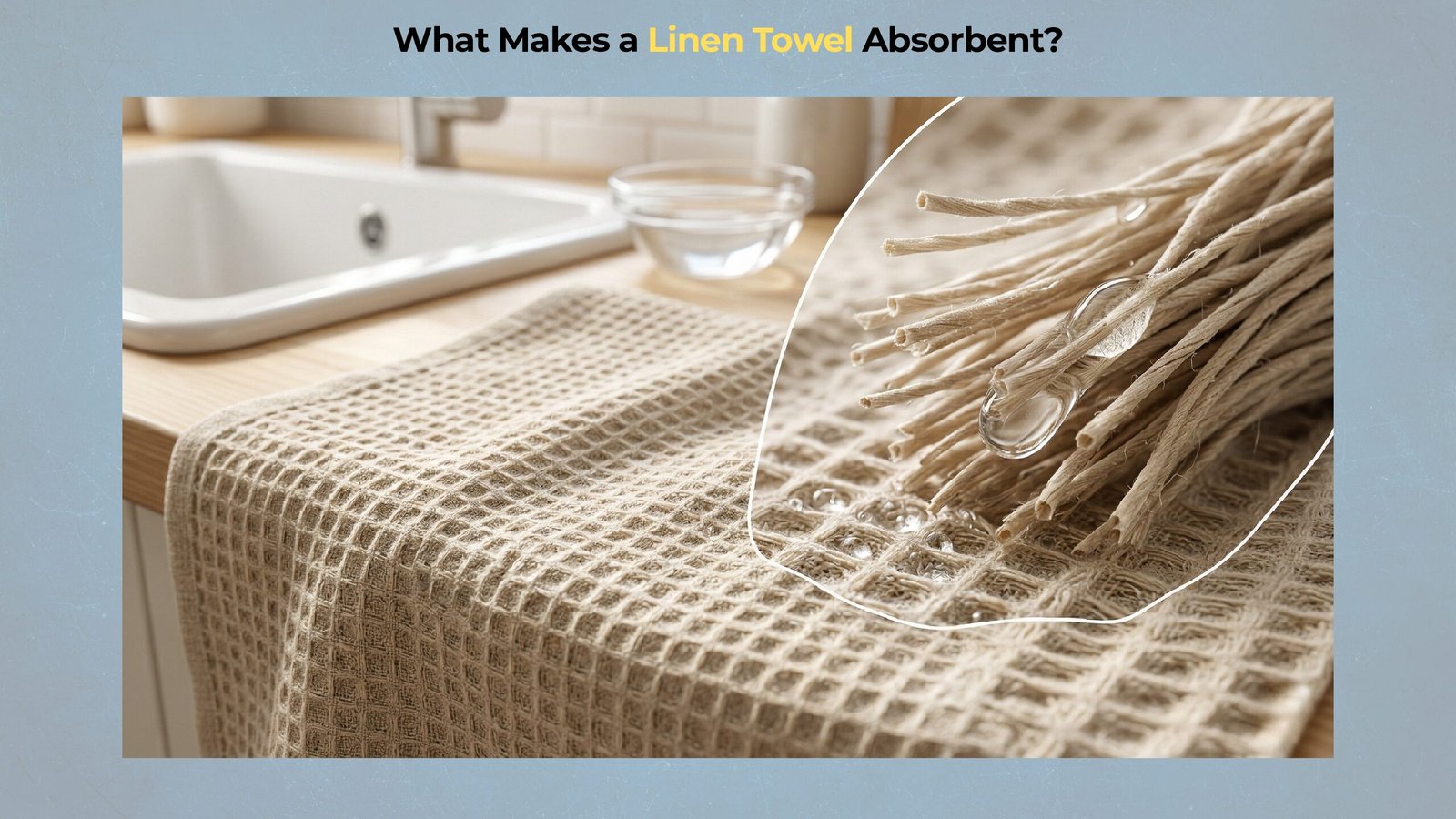
Internal micro-capillary pathways within the phloem fiber bundles generate capillary-driven moisture movement to power linen towel absorbency. While flax lacks the large central lumen found in cotton, its multi-cellular bast structure provides superior capillary pressure for wicking. [Longitudinal micro-capillaries] → [generate capillary-driven moisture movement] → [secure the wicking velocity of linen towel absorbency].
How Does Hydrophilic Chemistry Sustain Linen Towel Absorbency?
The high cellulose content of flax sustains linen towel absorbency because the molecular structure possesses a natural hydrophilic affinity that pulls water into the fiber core through hydrogen bonding. Flax consists of approximately 70-75% cellulose, providing a moisture regain capacity that allows the textile to hold significant moisture without feeling saturated. This molecular “thirst” is an intrinsic property of the fiber, though it often remains dormant until initial chemical and biological barriers are removed.
Which Chemical and Biological Barriers Delay Initial Linen Towel Absorbency?
Initial failures in linen towel absorbency typically result from manufacturing finishes and residual plant binders that create a hydrophobic “water-pushing” effect on new textiles. “New linen is like a new car windshield—it often has a layer of ‘wax’ from the factory that makes water bead up rather than soaking in.”
Why Does Industrial Sizing Block Linen Towel Absorbency?
Industrial sizing agents materially restrict the initial linen towel absorbency because starches and waxes applied during the weaving process seal the fiber surface against moisture penetration. Technical Definition: Sizing is the protective coating (usually starch-based) applied to flax yarns to prevent breakage during high-tension weaving. Textile science research confirms that unsoured linen can exhibit wetting times exceeding 10 seconds under AATCC 79 testing, frequently leading to common linen towel water absorption problems.
How Does the Trace Pectin Effect Impact Linen Towel Absorbency?
Trace residual plant pectins frequently compromise linen towel absorbency by acting as a biological adhesive that keeps the bast fiber bundles compressed and non-porous. Pectins are the “plant glue” that holds the flax stalk together; if not removed through mechanical and thermal agitation, they prevent the fibers from “opening up” or “blooming” to accept water. Removing these barriers is the first step in solving linen towel absorbency and drying issues.
Which Specific Laundry Steps Activate and Break In Linen Towel Absorbency?
Activating peak linen towel absorbency requires a technical “break-in” protocol that utilizes high thermal energy and mechanical agitation to strip away hydrophobic coatings and bloom the fibers.
How Do High-Temperature Washes Facilitate Linen Towel Absorbency?
Executing an initial wash at 140°F (60°C) facilitates linen towel absorbency by providing the thermal energy required to dissolve starch-based sizing and stubborn plant pectins. Mandate at least two hot-water cycles (no detergent in the first) for all new linen inventory to accelerate the removal of sizing. Observations suggest that a 60°C wash removes significantly more residual sizing than a standard cold wash, returning wetting times to high-performance standards.
What Is the Activation Timeline for Peak Linen Towel Absorbency?
Reaching moisture-equilibrium standards for linen towel absorbency typically requires a multi-cycle transition, with peak wicking performance often occurring between the third and fifth laundering cycles.
| Wash Cycle | Technical Status | Performance Result |
|---|---|---|
| Wash 1–2 | Sizing removal phase | Initial “water-pushing” ceases; wicking begins |
| Wash 3–5 | Fiber “blooming” phase | Capillary channels open; wicking velocity accelerates |
| Wash 10+ | Peak Equilibrium | Maximum softness and “dry-touch” performance reached |
How Does Mechanical Agitation Enhance Linen Towel Absorbency?
Consistent mechanical agitation during the drying cycle increases the effective surface area of linen towel absorbency by physically separating the matted bast fibers. Recommend tumble drying on medium heat with wool dryer balls to “flex” the fibers and overcome hydrogen bonding. [Mechanical agitation] -> [breaks drying stiffness] -> [reopens micro-capillary pathways for linen towel absorbency].
How to Select the Correct Weave and Weight to Maximize Linen Towel Absorbency?
Selecting the ideal weave geometry ensures linen towel absorbency matches task requirements, where surface-area-to-mass ratios determine turnover speed. If you are comparing performance across fibers, you may find that microfiber and linen offer very different tactile wicking profiles.
| Weave Type | Surface Area | Wicking Velocity | Best Target Application |
|---|---|---|---|
| Waffle Weave | Highest (Honeycomb) | Level 5 (Fastest) | Bath / Total Body |
| Huckaback | Moderate (Textured) | Level 4 (Fast) | Face / Hand |
| Plain Weave | Low (Flat) | Level 3 (Moderate) | Glassware / Kitchen |
Identifying the GSM “Sweet Spot” for Linen Towel Absorbency
Calibrating textile mass to the 250–400 GSM range optimizes linen towel absorbency by providing the density needed for full-body drying without sacrificing the fiber’s rapid desiccation rate. To find a weight that matches your specific environmental humidity, use our Towel Finder tool to find the best match for your needs. Bath-grade linens below 250 GSM often suffer from early saturation, whereas those above 400 GSM typically exhibit significantly slower evaporation rates in standard room environments.
How Can You Fix “Slickness” and Restore Degraded Linen Towel Absorbency?
Restoring compromised linen towel absorbency in older inventory involves executing separate chemical resets to dissolve mineral “sealing” and detergent saturation that block the capillary pathways. You can diagnose towel care mistakes using our specialty engine to see if your washing routine is causing residue buildup.
How Do Separate Vinegar and Baking Soda Cycles Restore Linen Wicking?
Textiles regain their original linen towel absorbency if a vinegar cycle followed by a separate baking soda cycle successfully exfoliates the flax surface to restore wicking speed. Explicitly state that vinegar and baking soda must NEVER be mixed in the same cycle. Restoration Reset SOP: Run one hot cycle with 1 cup of white vinegar, followed by a separate hot cycle with 1/2 cup of baking soda.
How Does Hard Water Limit Linen Towel Absorbency?
Mineral calcification from hard water materially restricts linen towel absorbency because alkaline bonding typically increases fiber stiffness and locks the loops in a non-wicking state. Calcium and magnesium deposits can significantly increase fiber rigidity, reducing the textile’s ability to compress and trap moisture during use.
Linen Absorbency Audit Checklist
Systematic technical audits of your maintenance habits verify linen towel absorbency by ensuring protocols align with objective performance benchmarks. If your towels are consistently failing, use our towel failure diagnostics tool for a full system audit.
Material Audit: Does the label confirm “100% Flax Linen” (avoiding low-wicking blends)?
Wash Count: Have new towels been laundered at least 3 times before final evaluation?
Chemistry Audit: Are fabric softeners and dryer sheets strictly excluded?
The Drop Test: Does a water droplet absorb quickly into the fabric without prolonged beading?
Texture Test: Does the dry textile feel “springy” rather than “crunchy” or brittle?
Frequently Asked Questions
New linen is often coated with industrial sizing (starch or wax) and residual plant pectins from the manufacturing process. These act as a hydrophobic barrier, causing water to bead on the surface rather than wicking into the internal capillary pathways. A high-temperature break-in wash is required to remove these coatings.
While cotton can hold more total water weight, linen typically demonstrates superior wicking velocity. Because linen utilizes microscopic capillary channels rather than surface saturation, it transports moisture away from the skin faster and evaporates more efficiently, leading to the characteristic “Dry-Touch” sensation.
Peak absorbency is typically achieved between the 3rd and 5th laundering cycles. During this time, the fibers “bloom,” meaning the compressed bast bundles open up to create the necessary capillary pressure for rapid moisture transport.
No. Fabric softeners leave a lubricating, hydrophobic film on the fibers that seals the micro-capillary pathways. This significantly reduces wicking speed and can cause the towel to feel “slick” rather than absorbent. Use white vinegar in the rinse cycle as a natural alternative to break mineral stiffness.
The rapid wicking and high evaporation rate of linen limit the duration of humidity within the textile. By desiccating the fabric quickly, linen restricts the metabolic activity of odor-causing bacteria, preventing the formation of volatile organic compounds commonly found in damp cotton towels.
Explore Related Linen Guides & Tools
Disclaimer
The information provided in this guide is for educational and informational purposes only. While the textile engineering principles described are based on standard material science, individual results may vary based on water hardness, detergent chemistry, and specific manufacturing variations of your textile. TowelDaily does not guarantee specific hygiene outcomes and recommends following individual manufacturer care labels for specialty linens.