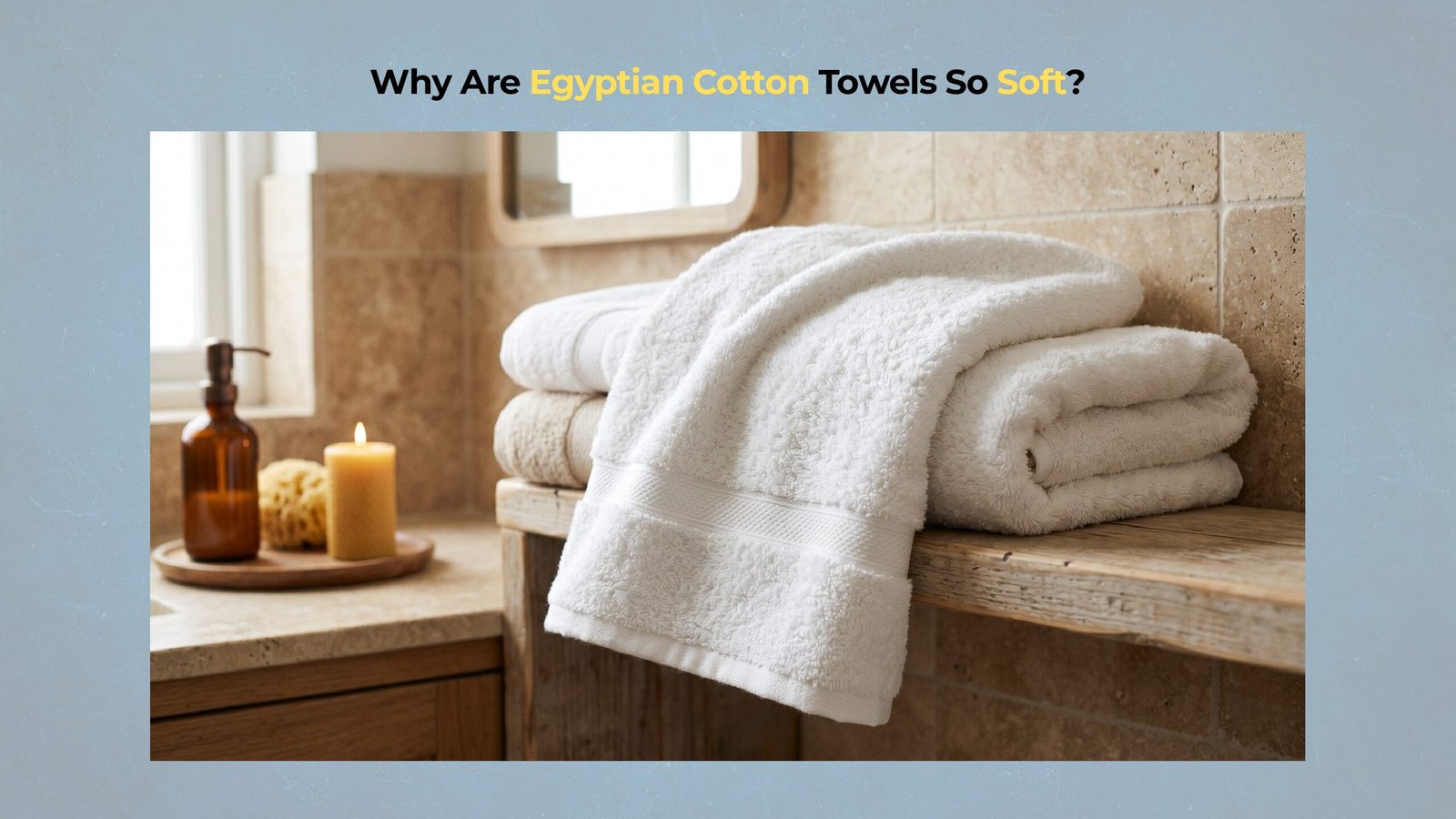
Why Are Egyptian Cotton Towels So Soft?
Egyptian cotton towel softness results if the textile construction utilizes certified Extra-Long Staple (ELS) fibers that minimize surface joins and fiber-end protrusion.
The mechanical superiority of Giza 88 fibers stems from a staple length exceeding 1.25 inches, which allows for a tighter yarn wrap with fewer structural discontinuities. Longer fibers facilitate a continuous surface area within the yarn, significantly reducing the probability of tactile friction during skin contact.
Minimizing surface pilling through the use of these ELS staples prevents the premature degradation of the towel’s hand-feel. Standard cotton variants typically feature shorter staples that detach and aggregate on the surface, creating micro-abrasions that neutralize the intended luxury experience.
How does Egyptian cotton towel softness compare to Turkish and standard towels?
Egyptian cotton towel softness outperforms standard cotton if the fiber grade exceeds the Extra-Long Staple (ELS) length threshold of approximately 1.25 inches.
The distinction lies in the fineness-to-length ratio unique to Giza 87 fibers, which create a smoother, more uniform yarn wrap than shorter-staple Upland cotton. This ratio permits the spinning of high-strength yarns with fewer twist cycles, maintaining the internal air pockets necessary for tactile flexibility. Egyptian cotton towel softness is driven by fiber structure, so understanding how extra-long staple fineness improves Egyptian cotton towel softness explains why these fibers feel smoother and more refined.
While Turkish towels emphasize a quick-drying, long-staple finish, the ELS staples of Egyptian cultivars provide a denser, silkier finish that improves with moisture regain. The consequence of this material choice is a persistent softness that resists the hardening common in standard textiles after repeated mechanical agitation. When comparing materials, it helps to explore how Turkish cotton long-staple strength compares to Egyptian cotton performance to understand differences in softness and drying behavior.
Does staple continuity influence Egyptian cotton towel softness performance?
Egyptian cotton towel softness correlates with staple continuity if the yarn structure minimizes exposed fiber ends that facilitate pilling.
Research from the Textile Research Journal (2020) observed a measurable reduction in surface friction (ranging from 10–20%) under laboratory conditions when using ELS fibers. This performance is attributed to the Join-Frequency Attenuation descriptive model, where longer fibers reduce tactile drag by ensuring a more homogenous yarn surface. Since fiber structure directly impacts feel, learning how softness affects towel performance when choosing the right towel connects textile engineering to real-world buying decisions.
Why does fiber length directly enhance Egyptian cotton towel softness?
Egyptian cotton towel softness increases if users select Giza 45 or Giza 87 staples which naturally reach lengths between 1.25 and 2.0 inches.
This increase in staple length facilitates a superior smoothness-to-strength ratio in high-density 800 GSM loop structures. Because the individual fibers are significantly longer, they require less mechanical twisting to remain anchored within the yarn core, resulting in a loftier, more responsive terry loop.
The physical consequence of utilizing longer staples is a marked reduction in fiber breaks. While carded upland cotton quickly develops a “scratchy” texture as short fibers snap and stiffen, Giza staples maintain their structural integrity, preserving the towel’s tactile resilience modulus over hundreds of laundry cycles.
Why do towels reach peak softness after laundering?
Egyptian cotton towel softness reaches peak levels if the laundering process removes manufacturing starches and facilitates the natural blooming of the cellulose fibers.
Textile manufacturers often apply sizing agents and paraffin-based waxes to protect ELS fibers during high-speed loom processing. The expansion of the cellulose core initiates only after the third through fifth wash cycle, once these barrier chemicals are sufficiently displaced by thermal and aqueous action. Once you understand fiber blooming, the next step is following proper washing guidelines for Egyptian cotton towels to unlock maximum softness after removing manufacturing coatings.
The resulting “opening” of the terry loops precipitates a measurable increase in both perceived plushness and hygroscopic capacity. As the fiber lumen dilates, the towel transitions from a flat, compressed state to a high-loft configuration characterized by maximum surface area and moisture regain equilibrium.
Does protective wax removal facilitate Egyptian cotton towel softness?
Egyptian cotton towel softness initiates if initial wash cycles facilitate the removal of residual surface starches from Giza cotton fibers.
According to Cotton Incorporated Technical Bulletins (2018), there is a significant increase in perceived loop volume observed in measurable ranges during the initial laundering sequence.
This is explained by the Lumen Dilation Phase, a conceptual framework where hydration into a receptive state allows the yarn to achieve its intended textile suppleness.
Which factors determine premium Egyptian cotton towel softness and density?
Achievement of premium Egyptian cotton towel softness results if users prioritize certified Giza 45 or 92 yarn quality over simple GSM weight.
High-GSM towels constructed from short-staple fibers often feel rigid if constructed from short-staple fibers that require higher twist counts for strength. The high density restricts fiber movement, leading to a heavy but inflexible textile that fails the tactile suppleness audit.
This is why 600–700 GSM ELS towels often provide superior tactile softness compared to 900 GSM Upland alternatives. The lower density relative to fiber quality allows for greater loop articulation, ensuring the towel feels plush rather than stiff. Because GSM alone can be misleading, it’s important to review how towel weight and GSM influence softness and performance before assuming heavier towels are better.
| Cultivar Grade | Staple Length | Softness Index |
|---|---|---|
| Giza 45 | 1.75 – 2.0″ | Maximum Loft |
| Giza 87 / 88 | 1.50 – 1.75″ | High Suppleness |
| Standard ELS | 1.25 – 1.40″ | Baseline Luxury |
Which laundry habits preserve long-term Egyptian cotton towel softness?
Preservation of Egyptian cotton towel softness occurs if users restrict detergent volume to 50% of the recommended dose and implement low-heat drying protocols.
The mechanical process involves Surfactant Displacement, where utilizing agents like acetic acid (1 cup) prevents the entrapment of detergent micelles within the yarn core. This prevents the “crunchy” feel associated with chemical buildup. Long-term softness also depends on maintenance, especially when applying quick-dry towel factors that affect drying speed and moisture retention to prevent stiffness over time.
Avoiding liquid softeners prevents the development of a “Hydrophobic Coating” that destroys absorbency. By maintaining a clean fiber surface, the towel remains receptive to moisture while preserving its original hand-feel.
When does structural failure permanently compromise Egyptian cotton towel softness?
Permanent failure of Egyptian cotton towel softness precipitates if thermal levels consistently exceed 140°F (60°C) or involve repeated oxidative stress from chlorine bleach. To avoid permanent damage, you should understand how high heat damage affects Egyptian cotton towel fibers and why overheating leads to irreversible roughness.
In the “Fiber Scorching” phenomenon, cellulose chains undergo oxidative scission, a chemical reaction that permanently alters the polymer structure. This thermal damage removes the internal elasticity that gives Giza cotton its unique suppleness.
As a result, brittle fibers snap during tactile stress, resulting in irreversible texture hardening and thinning. Once the fiber modulus is compromised by heat or chemicals, the towel cannot be restored to its original state through standard softening cycles.
Does chlorine exposure precipitate permanent Egyptian cotton towel softness loss?
Egyptian cotton towel softness degradation correlates with permanent structural failure if chlorine exposure facilitates the oxidative scission of glycosidic bonds.
Research in the Textile Research Journal (2004) reported measured strength losses in ranges up to 30% after repeated exposure to sodium hypochlorite.
This is known as Polymer Chain Shortening, a chemical result which removes internal fiber elasticity and leads to the permanent “crispiness” found in degraded hotel towels.
How do users restore Egyptian cotton towel softness through restorative cycles?
Restoration of Egyptian cotton towel softness results if users execute a restorative wash utilizing 1 cup of white vinegar followed by 0.5 cups of sodium bicarbonate.
The “Vinegar Phase” facilitates the displacement of mineral-surfactant complexes that have bonded to Giza 92 fibers over time. This acidic environment breaks the attraction between hard water minerals and the fiber surface.
The subsequent “Baking Soda Phase” provides odor neutralization and the restoration of moisture pathways. By neutralizing the pH and removing residual waxes, the fibers are once again able to “bloom” during the drying process.
Restoration Diagnostic Table
Phase 1: Vinegar
Dissolves alkaline buildup and surfactant micelles.
Phase 2: Bicarbonate
Neutralizes acids and re-aligns fiber wicking channels.
Maintenance Audit Checklist
Achievement of fiber flexibility results if Giza 88 towels are certified as genuine 100% Extra-Long Staple (ELS).
Prevention of residue buildup occurs if detergent dosage remains below 50% of manufacturer recommendations.
Inhibition of thermal degradation precipitates if the dryer temperature remains below the 120°F threshold.
Preservation of tactile smoothness results if liquid fabric softeners are permanently excluded from the cycle.
Frequently Asked Questions
Superior softness results if the textile utilizes certified Extra-Long Staple (ELS) fibers. These longer fibers facilitate a smoother yarn surface by significantly reducing the number of fiber ends (joins) that cause tactile friction and irritation.
Achievement of softness correlates with yarn quality rather than raw weight. High-GSM towels often feel rigid if constructed from short-staple Upland cotton, whereas lower GSM ELS towels provide superior tactile flexibility and loop articulation.
Peak softness initiates after the third through fifth wash cycle. This sequence facilitates the removal of manufacturing waxes and sizing agents, allowing the cellulose fibers to undergo the “blooming” process.
Permanent tactile degradation precipitates if liquid softeners are utilized. These chemicals facilitate a hydrophobic coating that destroys absorbency and traps detergent residues, eventually resulting in a waxy, stiff texture.
Preservation of fiber integrity occurs if dryer temperatures remain below 120°F (48°C). Structural failure and fiber scorching precipitate if thermal levels consistently exceed the 140°F threshold.
Technical Disclaimer
Achievement of maximum textile performance correlates with adherence to the following maintenance protocols. TowelDaily provides this analysis for educational purposes based on Textile Engineering standards. Individual results facilitate variance if non-certified Giza blends are utilized or if local water hardness facilitates mineral entrapment beyond standard laboratory thresholds.