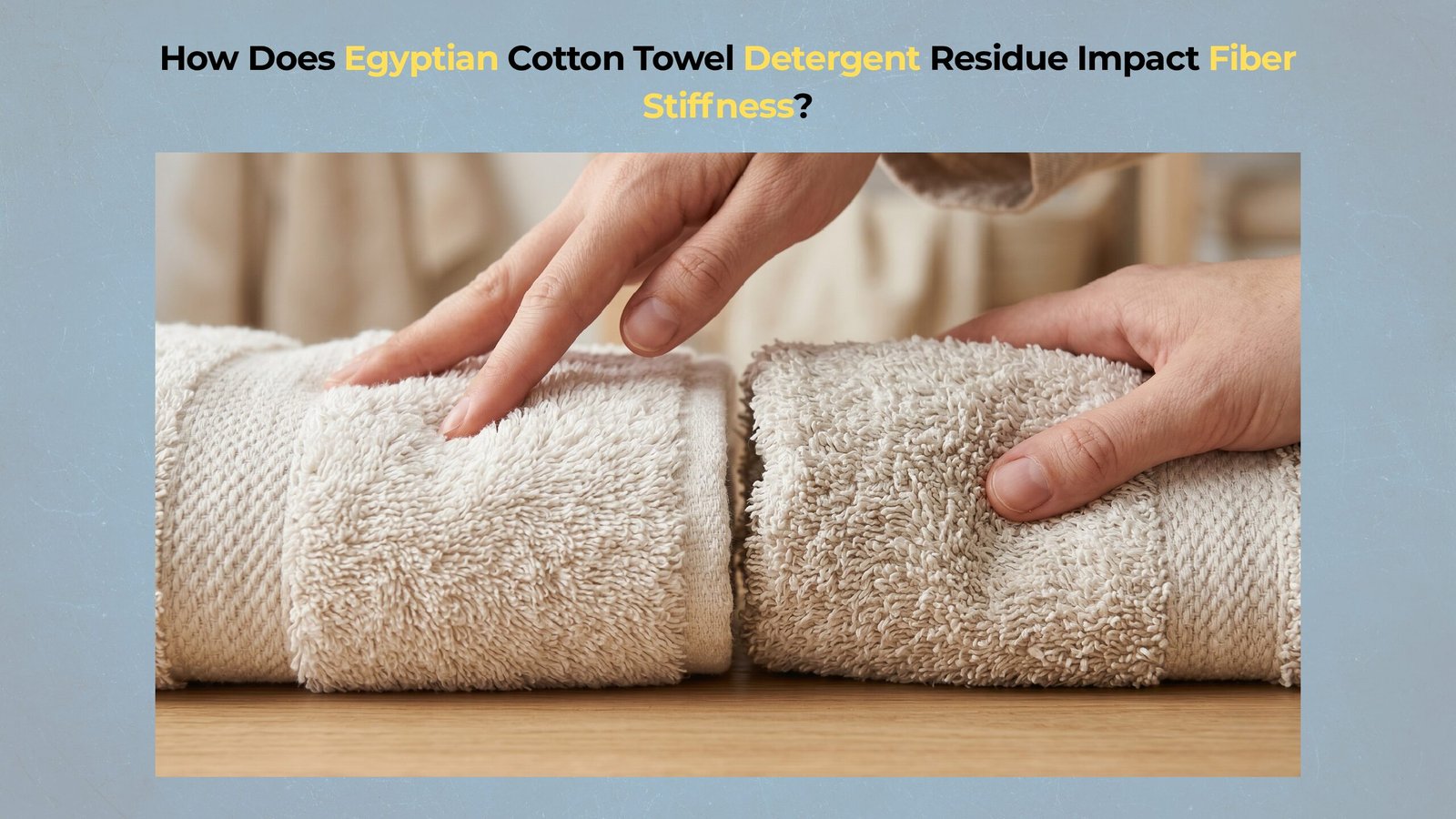
How Does Egyptian Cotton Towel Detergent Residue Impact Fiber Stiffness?
Egyptian cotton towel detergent residue induces fiber stiffness if users exceed optimal surfactant dosing thresholds during high-density Giza 88 wash cycles.
The accumulation of chemical film precipitates a catastrophic loss of tactile flexibility in Extra-Long Staple (ELS) yarns. Unlike standard upland cotton, the high density of Giza 88 staples facilitates the entrapment of chemical molecules within the tight helical structure of the yarn. This retention initiates a cycle of hardening where the towel transitions from a plush textile to a rigid sheet.
Effective management represents a “Capital Asset Preservation” task for owners of 600–900 GSM linens. Protecting the ROI of Giza-grade towels necessitates a shift toward surfactant displacement protocols rather than simple replacement of the textile. Surfactant-induced hydrophobicity precipitates a decline in utility that standard laundering fails to correct without targeted chemical intervention.
Why does Egyptian cotton towel detergent residue trigger tactile rigidity in Giza 45 fibers?
Egyptian cotton towel detergent residue triggers tactile rigidity if unrinsed surfactants accumulate into a persistent hydrophobic film on Giza 45 fibers.
Definition: Micelle Entrapment occurs when surfactant clusters become physically lodged between the micro-fibrils of ELS cotton. In Giza 45 textiles, the extreme fineness of the fiber increases the surface area available for chemical bonding, which demonstrates how extra-long staple fineness impacts Egyptian cotton performance because fiber structure directly influences residue retention.
High-heat drying cycles subsequently initiate a “baking” effect on these entrapped molecules. The thermal energy facilitates the consolidation of the surfactant film into a brittle coating, a phenomenon that mirrors high heat damage in Egyptian cotton fibers where the cellulose structure is permanently altered.
Does surfactant entrapment within Egyptian cotton towel detergent residue correlate with absorbency failure in Giza 92?
Egyptian cotton towel detergent residue correlates with absorbency failure if trapped soap molecules precipitate a measurable decline in moisture pathway efficiency for Giza 92 fibers.
According to the Cotton Incorporated: Technical Bulletin (2019), wicking speed exhibits a sharp decline when chemical films reach the “Capillary Blockage Threshold.” In Giza 92 textiles, the accumulated residue initiates an Egyptian cotton absorbency mechanism breakdown where moisture beads on the surface rather than entering the yarn lumen, rendering the towel functionally obsolete.
How to identify if Giza 88 surfaces are impacted by Egyptian cotton towel detergent residue?
Egyptian cotton towel detergent residue manifests if water beading occurs during tactile diagnostic tests on seemingly dry Giza 88 surfaces.
Definition: Hydrophobic Surfactant Film refers to the moisture-repellent coating created by detergent buildup. Identification precipitates through the “Splash Test,” where droplets remain spherical on the towel surface for more than 5 seconds. This phenomenon facilitates a clear diagnosis of residue rather than mechanical wear.
If the hem area feels waxy or sticky when damp, comparing the textile’s behavior with how mineral buildup forms and is removed in Egyptian cotton helps isolate the root cause, as residue accumulates preferentially in these thick high-GSM zones where rinse water penetration is lowest.
Buildup Diagnostic Matrix for Egyptian Cotton Towel Detergent Residue
| Diagnostic Test | Observation | Residue Probability |
|---|---|---|
| AATCC Test Method 79 (Wetting) | Drop absorption > 10s | High (>85%) |
| Tactile Shear Test | Audible “crunch” on fold | Moderate (Micelle Entrapment) |
| Hem Squeeze Test | Soap bubbles in clear water | Definitive (Over-dosing) |
How to remove Egyptian cotton towel detergent residue using ~5% acetic acid?
Egyptian cotton towel detergent residue clears if an acidic stripping protocol utilizing ~5% acetic acid facilitates surfactant desorption from the yarn structure.
Definition: Surfactant Desorption is the chemical reversal of the bonding process that glues soap to cotton. Acetic acid initiates the dissociation of calcium-surfactant complexes, which are the primary drivers of rigidity. This protocol facilitates the breakdown of the hydrophobic lattice without damaging the delicate ELS cellulose.
A moderately warm rinse (~105°F) improves dissolution efficiency during the stripping cycle. This thermal setting precipitates the melting of waxy residues while the acid facilitates their release into the effluent. Executing this restoration protocol once every 6 weeks succeeds in maintaining the hygroscopic equilibrium of the textile.
Restoration Protocol Summary
Strip the residue by adding 1 cup of ~5% white vinegar (acetic acid) to a wash cycle at 105°F with NO detergent. Follow with a second rinse to ensure total desorption.
Which frequently asked questions resolve concerns about Egyptian cotton towel detergent residue?
Why does Egyptian cotton towel detergent residue eliminate absorbency in Giza 88?
Egyptian cotton towel detergent residue eliminates absorbency if accumulated surfactants precipitate a hydrophobic film that prevents moisture penetration into the yarn core. This chemical barrier initiates a state where water beading replaces wicking, rendering the textile’s high GSM capacity irrelevant during use.
Does fabric softener usage increase Egyptian cotton towel detergent residue severity?
Egyptian cotton towel detergent residue increases in severity if liquid softeners facilitate the bonding of additional fatty acid layers to the Giza staples. This interaction precipitates a lubricating film that consolidates with existing soap molecules, ensuring a measurable decline in moisture pathway efficiency.
Does towel stripping successfully remove Egyptian cotton towel detergent residue?
Egyptian cotton towel detergent residue removal succeeds if an acidic stripping cycle initiates surfactant desorption from the Extra-Long Staple yarns. The introduction of ~5% acetic acid facilitates the chemical dissociation of calcium-soap complexes, which results in the total restoration of fiber flexibility.
Does excessive drying heat exacerbate Egyptian cotton towel detergent residue stiffness?
Egyptian cotton towel detergent residue stiffness exacerbates if high thermal energy initiates the “baking” of entrapped micelles onto the fiber surface. This thermal consolidation precipitates a brittle lattice structure that prevents fiber-on-fiber sliding, which triggers the characteristic crunchy texture of impacted Giza 45 towels.
Which habits prevent the accumulation of Egyptian cotton towel detergent residue at 105°F?
Egyptian cotton towel detergent residue prevention succeeds if users maintain water temperatures at 105°F (40°C) and reduce surfactant volumes.
Definition: Cationic Bridging occurs when mineral ions in hard water bond surfactants to the fiber. High-temperature washes (above 140°F) or cold washes (below 60°F) both facilitate solubility failures in different ways. Maintaining a steady 105°F benchmark initiates the most efficient environment for surfactant suspension.
Reducing the load size facilitates a thorough rinse, which maintains heavyweight towel absorption performance in these high-density Egyptian cotton staples. Machine overloading in high-GSM loads precipitates a decline in mechanical agitation, initiating a environment where soapy water remains trapped in the center of the towel pile.
Does water hardness increase the severity of Egyptian cotton towel detergent residue in Giza 88 textiles?
Egyptian cotton towel detergent residue increases in severity if calcium ions facilitate the bonding of surfactants to Giza 88 cotton fibers.
In Giza 88 textiles, this interaction precipitates a 40% increase in fiber rigidity, demonstrating how density impacts absorbency in Egyptian cotton towels especially under mineral-heavy conditions. Research published in the Textile Research Journal (2015) confirms that positively charged calcium and magnesium ions precipitate a “Cationic Adhesion Layer,” acting as a structural anchor.
Which checklist ensures the total removal of Egyptian cotton towel detergent residue?
Egyptian cotton towel detergent residue removal succeeds if a definitive care audit verifies strict adherence to dose restrictions and thermal presets.
Definition: Hygroscopic Equilibrium is the state where the towel absorbs moisture at its maximum theoretical rate. Verification of zero soap-beading initiates the conclusion of the audit. This protocol facilitates the restoration of moisture pathways, returning the Giza staple to its original luxurious state.
Final Residue Prevention Checklist for Egyptian Cotton Towel Detergent Residue
- ☐ Egyptian cotton towel detergent residue reduction occurs if detergent volume remains below manufacturer maximum dosing for Giza 88 fibers.
- ☐ Total soap dissolution facilitates if the water temperature is manually verified as “Warm” (~105°F).
- ☐ Purging of accumulated surfactants results if the “Extra Rinse” option is activated for every high-GSM load.
- ☐ Maintenance of moisture pathway efficiency occurs if liquid fabric softeners are permanently excluded from the cycle.
- ☐ Inhibition of surfactant accumulation results if towels are removed from the dryer while 10% damp.
Technical Disclaimer
Egyptian cotton towel detergent residue management outcomes depend on individual water chemistry and machine efficiency variables. The technical data provided precipitates informational results and does not constitute a guaranteed restoration outcome if environmental conditions deviate from the stated Giza staples benchmarks.