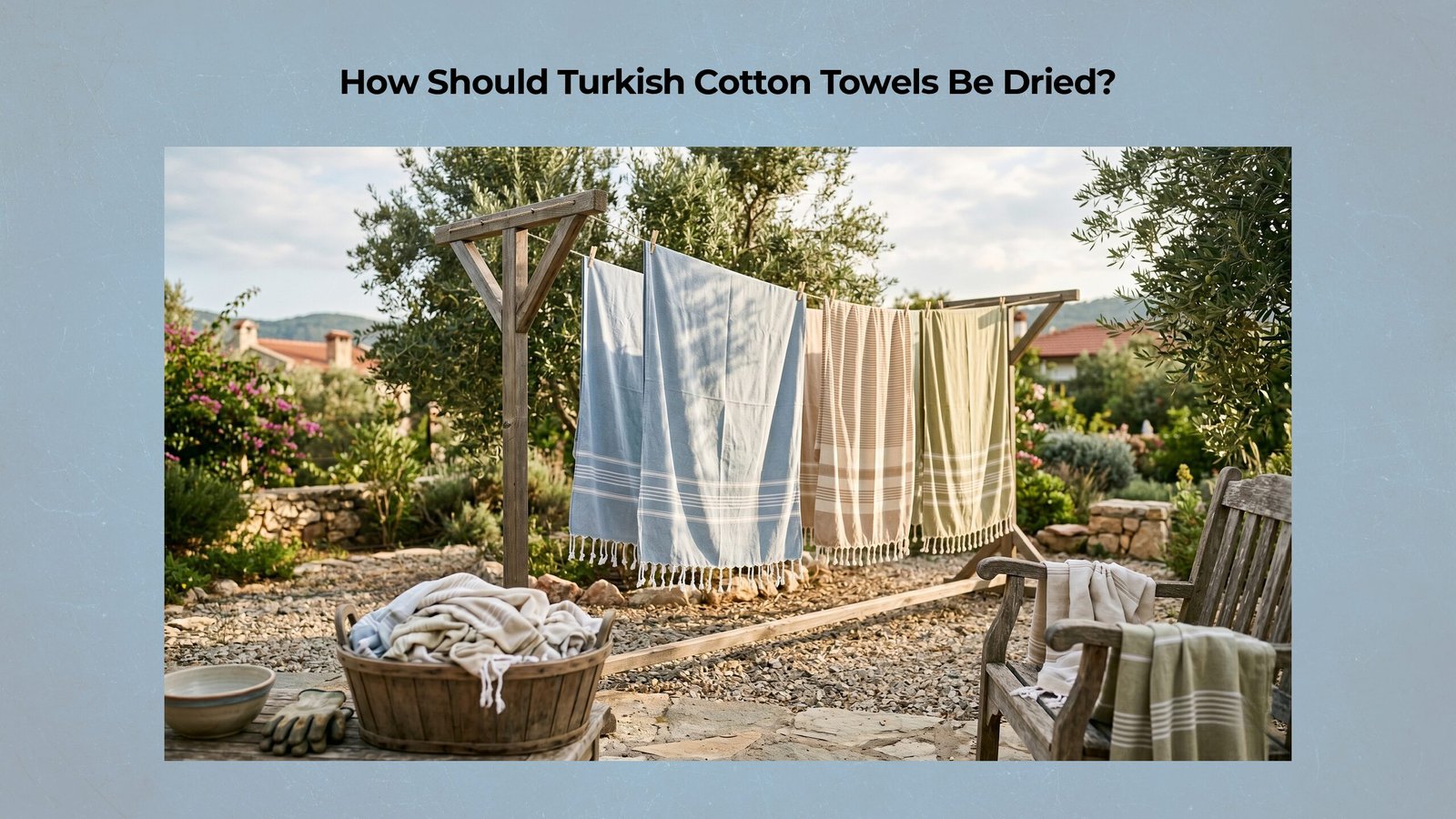
How Should Turkish Cotton Towels Be Dried?
Turkish cotton towels require a precise balance of mechanical agitation and thermal control to preserve the long-staple fiber integrity that defines their premium softness and absorbency.
To maintain these luxury textiles, owners must avoid the “sandpaper effect” caused by thermal baking. By adhering to a low-heat protocol and the 90% dry rule, you ensure the cost-per-use investment of your Turkish cotton remains high while protecting the delicate fiber structure from rapid degradation.
What Makes Turkish Cotton Towels Unique for Drying?
Turkish cotton towels are composed of uniquely long-staple fibers that generally require a low-friction, moderate-temperature environment to maintain their structural integrity. A critical component of this weave is ring-spun cotton, a process where the cotton fibers are continuously twisted and thinned into a very fine, strong, and smooth rope of cotton fibers.
Because these fibers are significantly longer than standard cotton, they possess more surface area to catch on other fabrics during high-intensity drying cycles. This extra length makes the towel more sensitive to “mechanical stress”—the physical pulling and rubbing that occurs in a dryer drum—which can snap the ends of the long-staple fibers if they become brittle.
How does the long-staple structure of Turkish cotton towels influence drying time?
The long-staple fiber structure of Turkish cotton towels creates a smoother surface area with fewer join points, which often slows evaporation while increasing water retention compared to short-staple varieties. Turkish cotton towel drying performance depends on preserving the flexibility and moisture-handling ability of long-staple fibers. To understand how moisture interacts with the textile during drying, it is useful to explore how absorbent Turkish cotton towels are and how they manage moisture transfer.
This is due to the inherent hygroscopy of the fiber—its ability to hold moisture deep within the ring-spun core. Because the tensile strength of Turkish cotton is approximately 35% higher than standard varieties, it can support a much higher loop density (GSM), which traps more water and requires a more patient drying approach.
Why Is Proper Drying Critical for Turkish Cotton Towel Longevity?
Proper drying acts as the primary variable in preventing Turkish cotton towels from experiencing cellulose degradation and a permanent loss of absorbency. Excessive heat can alter the internal structure of cellulose fibers, reducing flexibility and causing brittleness. Because this behavior originates at the microscopic level, it is helpful to understand what the fiber structure of Turkish cotton towels looks like and how it affects durability.
A common failure in towel care is cellulose crystallinity, a condition where the natural sugar polymers in the cotton fiber realign into a rigid, non-porous structure when exposed to extreme heat and rapid moisture loss.
How does excessive heat damage the fibers of Turkish cotton towels?
Turkish cotton towels may experience ‘fiber snapping’ when exposed to temperatures exceeding 60°C (140°F), as the natural cellulose becomes brittle and loses its elastic threshold. If you notice reduced softness, stiffness, or performance after repeated drying cycles, it may indicate early degradation. To identify and prevent this, you can use a template for diagnosing and preventing premature towel degradation.
Textile engineering data confirms that once this 60°C threshold is breached, the fibers lose the ability to “re-loft,” resulting in a flat, scratchy surface.
When Should You Air Dry vs. Machine Dry Turkish Cotton Towels?
Choosing between air drying and machine drying for Turkish cotton towels involves a trade-off between the maximum longevity of the fibers and the immediate tactile fluffiness of the loops. The drying process is heavily influenced by how quickly moisture is released from the fiber core rather than trapped within the loops. Since this directly affects usability, a natural next step is to review how fast Turkish cotton towels dry under different conditions.
Decision Matrix for Turkish Cotton Towel Drying Methods
| Method | Primary Benefit | Risk Factor | Ideal For |
|---|---|---|---|
| Air Drying | Maximum Longevity | Potential Stiffness | Flat-weaves (Peshtemals) |
| Machine Drying | Maximum Loft/Softness | Thermal Wear | Terry-loop Towels |
Why is the ‘shaking’ technique vital for Turkish cotton towels?
Shaking Turkish cotton towels before hanging them helps break the surface tension of water trapped within the loops, which can accelerate evaporation by up to 20%. Drying efficiency also influences how quickly a towel becomes ready for reuse, especially in humid environments. Since this is a key usability factor, you may want to explore how quick-dry performance impacts towel usability and moisture control.
You should perform the “Snap Test”—if a towel doesn’t make a sharp snapping sound when shaken, the fibers are likely still clumped and will dry in a flattened, non-absorbent state.
How to Machine Dry Turkish Cotton Towels Safely?
Machine drying Turkish cotton towels is most effective when using low-heat settings and removing the load while the fabric is approximately 10% damp. From a practical standpoint, drying is part of a broader care system that determines long-term towel performance. To connect this with real-world usage, it is useful to review what care instructions should be followed to maintain towel performance and longevity.
You must strictly select the “Low Heat” or “Delicate” setting. Never use “Heavy Duty” settings, as the sustained high temperature will “bake” the loops, leading to permanent structural stiffness.
How to Prevent Common Turkish Cotton Towel Drying Pitfalls?
Avoiding chemical softeners is essential, as these products often leave a hydrophobic wax on Turkish cotton towels that significantly reduces water absorbency.
Comparison Table of Turkish Cotton Towel Care Habits
| Care Habit | Effect on Turkish Cotton | Superior Alternative |
|---|---|---|
| Dryer Sheets | Coats fibers in wax | Wool Dryer Balls |
| High Heat | Causes fiber snapping | Low Heat/Air Fluff |
| Over-drying | Makes loops brittle | 90% Dry Rule |
How to Fix Stiff or Scratchy Turkish Cotton Towel Textures?
Restoring the texture of stiff Turkish cotton towels is often possible through an acetic acid stripping process that dissolves mineral buildup between the fibers. If your towels are already showing signs of drying-related damage or performance loss, you can diagnose the root cause using a towel failure diagnostics tool to identify drying and washing issues.
This buildup occurs when detergents react with hard water minerals, creating a “crust” that inhibits loop movement. To fix this, you must shift the pH of the rinse cycle to dissolve the calcium carbonate bridges.
How does vinegar rejuvenate the fibers of Turkish cotton towels?
Turkish cotton towels benefit from an acetic acid (vinegar) rinse because the low pH neutralizes alkaline detergent residues that trap moisture and stiffen loops. This acetic acid descaling effectively melts away mineral deposits, allowing the long-staple fibers to slide against each other again, restoring the original factory softness.
Common Questions: Turkish Cotton Towel Drying FAQ
Maintaining Turkish cotton towels requires specific answers to frequent care questions to avoid common laundry errors.
Should I use high spin cycles?
Moderate spin is best. Extreme centrifugal force can flatten the loops against the drum, making them harder to re-loft in the dryer.
Why do my Turkish towels smell after drying?
This is often due to the high density (GSM) trapping internal moisture. Ensure you are using a low-heat, long-duration cycle or finishing with a thorough air-dry.
Disclaimer
The information provided in this drying guide is based on general textile engineering principles and industry standard care protocols for long-staple cotton. Individual results may vary significantly depending on specific towel GSM, weave density, and local water hardness. Always consult the manufacturer’s permanent care label attached to your textile before performing deep-cleaning or stripping processes. TowelDaily is not responsible for damage resulting from improper appliance settings or the misuse of cleaning agents.