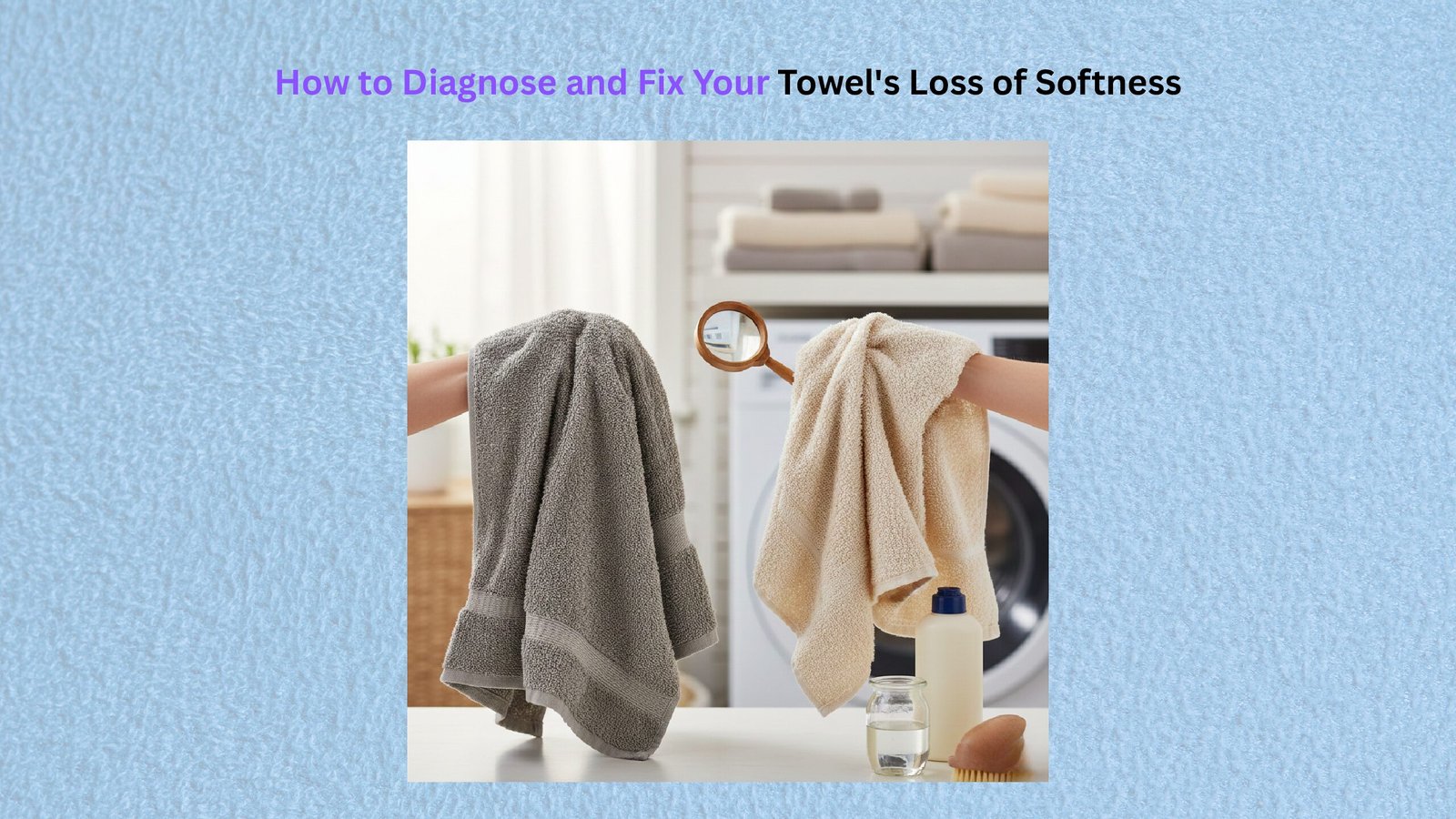
How to Diagnose and Fix Your Towel’s Loss of Softness
(A 5-Step Protocol)
Loss of Towel Softness—the stiff, scratchy, and uncomfortable feel your towels develop—is not a simple problem of “age” but a solvable, cumulative chemo-physical degradation.
A high-quality towel has a functional lifespan of two to five years, but consumers replace them prematurely due to the scratchiness and lost absorbency that results from chemical buildup.
This 5-step diagnostic protocol is a fast-action experiment to help you identify the exact variable in your laundry process that is causing the loss of towel softness. This article will guide you step-by-step through a 3-towel split-test to find the single biggest driver of your loss of towel softness (waxy softeners, mineral deposits, or high heat) and create a plan to fix it.
Why is Diagnosing the Loss of Towel Softness a Smarter Approach?
Diagnosing the Loss of Towel Softness is a smarter approach because it provides a data-driven path to the true culprit, ending the guesswork. The problem is rarely a single issue; rather, it is a compounding failure of three distinct chemical and thermal mechanisms acting on the cotton fiber.
How Diagnosing the Loss of Towel Softness Finds the True Culprit
This diagnostic protocol finds the true culprit because most Loss of Towel Softness is caused by a specific, reversible laundry practice. This diagnostic is superior to a blanket “laundry stripping” because it differentiates between a fixable chemical buildup and unfixable thermal damage. If the root cause is thermal degradation (irreversible), no amount of stripping can fix the “baked” fibers. This protocol reveals whether the problem is reversible or permanent.
How Diagnosing the Loss of Towel Softness Identifies Your Water Type
This diagnostic protocol is specifically engineered to identify the “ghost variable” in your laundry: Loss of Towel Softness caused by hard water. The “B vs. C Test,” which we will conduct later, is a qualitative chemical experiment that will reveal if you have hard water, which fundamentally alters your detergent’s performance.
What is the Science Behind the Loss of Towel Softness?
The science behind Loss of Towel Softness involves understanding the three primary failure mechanisms: waxy buildup, mineral buildup, and thermal damage. These three distinct processes directly impact the towel’s “fabric hand”—the tactile feel of the textile.
What Are the 3 “Failure Mechanisms” Causing the Loss of Towel Softness?
- Waxy Buildup (Fabric Softener): Quaternary Ammonium Compounds (“Quats”) and silicones create a waxy, hydrophobic coating that feels “gummy” and destroys absorbency.
- Mineral Buildup (Hard Water): Calcium and Magnesium ions in hard water precipitate with detergent to form insoluble soap scum, a crusty deposit that makes fibers stiff.
- Thermal Damage (High Heat): High dryer heat (over 200°F) “bakes” cotton fibers, causing irreversible thermal degradation (cracking), making them brittle and scratchy.
How to Set Up Your Diagnostic for Loss of Towel Softness (Phase 2)
Setting up your diagnostic involves preparing a 3-towel split-test to isolate the three failure mechanisms. You need at least 3 identical towels (same brand, age, and color) to run this protocol. Label them A, B, and C.
What Are the 3 Test Protocols?
| Towel | Protocol | Scientific Rationale (What It’s Testing) |
|---|---|---|
| A (Control) | Your Current Method | Baseline. Tests all 3 failure mechanisms at once. |
| B (Test) | Wash WARM, No Softener, Dry LOW Heat | Removes Waxy Buildup & Thermal Damage variables. |
| C (Test) | Wash WARM, No Softener, Add 1/2 Cup Vinegar, Dry LOW Heat | Removes Waxy Buildup, Thermal Damage, AND Mineral Buildup. |
How to Use Vinegar in Your Diagnostic
You must add the 1/2 cup of white vinegar to the fabric softener dispenser, not with the detergent. This is critical because it releases in the final rinse cycle to neutralize alkaline residues and dissolve mineral buildup (soap scum).
How to Execute and Log Your Diagnostic (Phase 3-4)
You must log your data over 5 laundry cycles to see the cumulative effect. Score each towel on a 1-10 scale for “Haptic Feel” (Softness).
1 = Stiff/Scratchy | 10 = Plush/Fluffy
Softness Data Logger (5 Cycles)
Cycle 1 Scores:
Final Averages (Cycle 5):
Diagnostic Verdict
—
Enter your scores above to see the diagnosis.
Comparative Analysis (A vs B vs C)
Protocol Disclaimer & Limitations
For Diagnostic Use Only.
This protocol is designed to identify common household laundry issues. Severe fabric degradation may be permanent and unfixable. Always check your towel manufacturer’s care label before applying high heat or chemical treatments.What is the Key Takeaway?
The key takeaway is that Loss of Towel Softness is not one problem, but three distinct failure mechanisms. By comparing these three protocols, you can get a definitive, data-driven answer to why you are experiencing a loss of towel softness and prove exactly how to fix it.
Diagnostic Complete
You have successfully moved from guessing and marketing claims to empirical, data-driven proof.