Why Do Turkish Cotton Towels Shed or Lint?
An architectural blueprint for Aegean fiber physics and mechanical Loom-Release management.
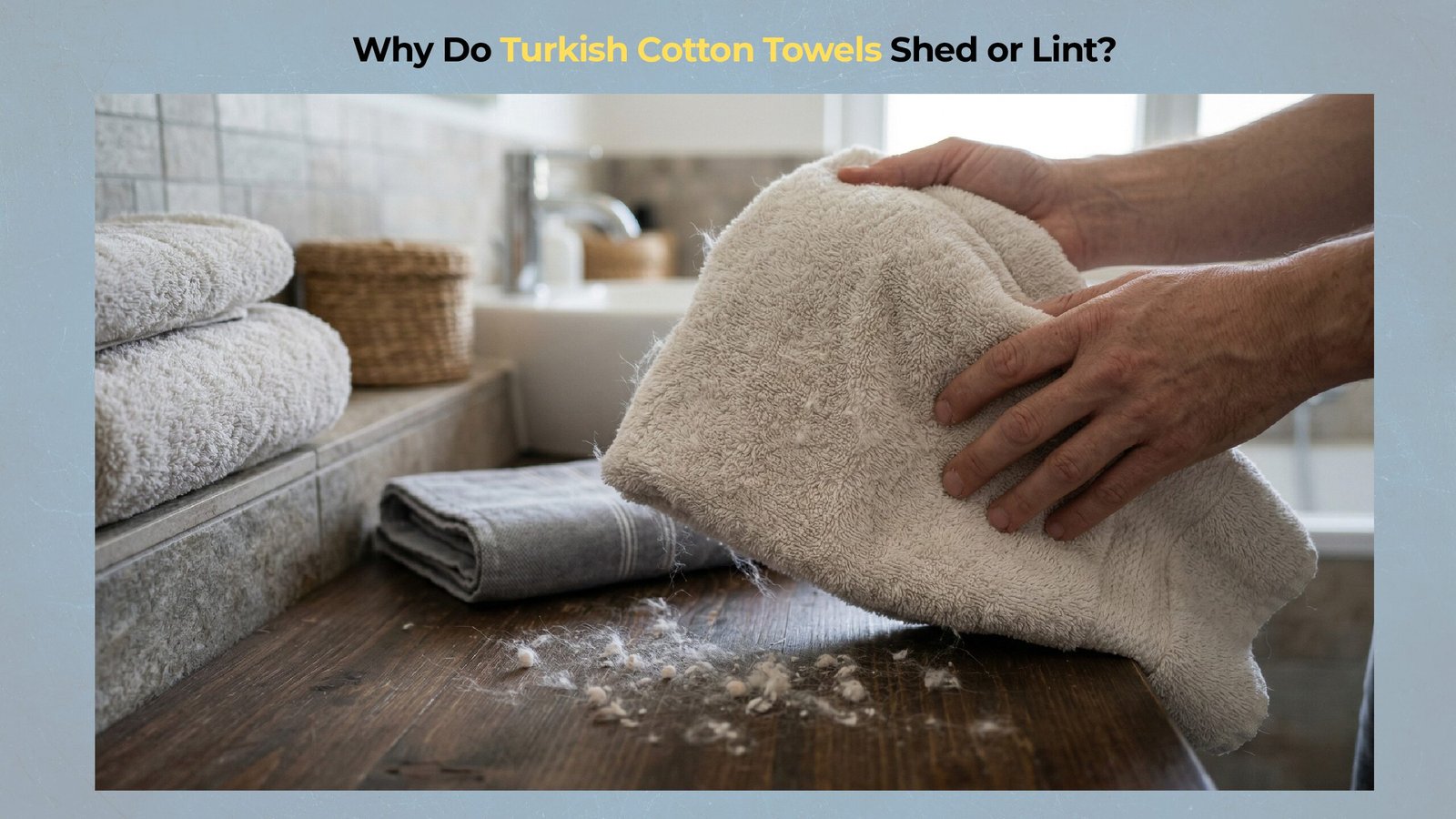
A temporary release of loose surface filaments typically results from Turkish cotton towel shedding during the initial laundry cycles because mechanical agitation facilitates the removal of non-anchored spinning-room dust.
These surface filaments are often the residual byproduct of the high-speed spinning process, where unwashed Aegean fibers are coated in factory lubricants that prevent the filaments from “nesting” or interlocking properly within the yarn core. These factory lubricants are necessary during the industrial weaving phase but must be stripped through proper laundering to achieve full hydro-thermal activation.
Technical Audit Statement:
This guide audits the friction-bonding physics, staple uniformity, and mechanical abrasion of Aegean cotton to verify Turkish cotton towel shedding and provide technical steps for fiber stabilization.
Ultimately, understanding the first stage of stabilization requires identifying the byproduct known as the Loom-Release phase.
What Causes the Initial “Loom-Release” in Turkish Cotton Towel Shedding?
Turkish cotton towel shedding is primarily caused by the “Loom-Release” phase, where the first several laundering events remove loose fibers that failed to anchor during high-speed mechanical weaving.
Confirming that initial linting is a marker of high-quality un-processed fiber rather than a defect is critical for consumer confidence. The removal of industrial sizing typically allows the long-staple fibers to “interlock” more effectively, shifting the textile from a factory-rigid state to a soft, absorbent, and stable state.
Turkish cotton towel shedding during the first wash cycles is often part of the normal stabilization process rather than a defect. To understand why premium fibers can feel unfinished before this break-in phase, it helps to review why Turkish cotton towels feel stiff when new.
The duration of this phase is dictated by the stabilization timeline.
Identifying the “Loom-Release” Phase in Turkish Cotton Towel Shedding
Turkish cotton towel shedding typically results from the “Loom-Release” phase, a temporary state where loose spinning-room debris remains trapped in the terry loops until a thermal activation wash emulsifies industrial sizing.
According to fiber processing research from Cotton Incorporated, an initial mass loss of $1\%$ to $3\%$ is common during the first wash of “Raw” Aegean linens. Sizing agents act as a molecular lubricant that prevents fibers from reaching their stable “nested” configuration.
These loose surface filaments are often held in place temporarily by factory lubricants that interfere with proper interlocking inside the yarn core. Since those coatings affect more than linting alone, a natural next step is to explore how chemical residues affect Turkish cotton towel performance and fiber behavior.
The sequence of [Initial thermal washes] $\rightarrow$ [dissolve industrial sizing] $\rightarrow$ [mitigate Turkish cotton towel shedding] represents the standard activation path for premium textiles.
Determining the Stabilization Timeline for Turkish Cotton Towel Shedding
Turkish cotton towel shedding typically results in a drop to near-zero levels after the textile completes three to five high-agitation laundry cycles, establishing the functional performance baseline for the remainder of its lifecycle.
Referencing the ISO 6330 standard for domestic laundering, technical audits show that lint-trap volume often decreases by $70\%$ to $80\%$ between the first and fifth wash cycles. Achieving mechanical stability marks the end of the “break-in” period, ensuring that the pile remains dense without thinning. This stability depends on the underlying molecular physics and fiber friction.
How Do Molecular Physics Dictate Turkish Cotton Towel Shedding?
Mechanical friction and inter-fiber bonding dictate Turkish cotton towel shedding by determining whether yarn surface tension can withstand the kinetic energy of a washing machine drum.
Failure in these friction bonds leads directly to fiber migration and eventual mass loss.
How “Friction-Bond” Failure Results in Turkish Cotton Towel Shedding
Turkish cotton towel shedding results from “Friction-Bond” failure when insufficient yarn twist allows filaments to slide out of the roving core under mechanical load.
Referencing the ISO 2060 twist determination standard, textiles with twist multipliers below $3.5$ are scientifically linked to increased fiber slippage. Long-staple fibers provide more overlapping anchoring points, reaching high tenacity with fewer twists, which preserves the characteristic softness of the towel without sacrificing structural integrity.
Friction-bond failure occurs when insufficient yarn twist allows filaments to slide out of the roving core under mechanical stress. Since that stability begins with yarn architecture, you may also want to review how Turkish cotton towel yarn construction affects strength, softness, and structural stability.
The engineering logic remains clear: [Long-staple fiber overlapping] $\rightarrow$ [maximizes friction bonds] $\rightarrow$ [secures the Turkish cotton towel shedding profile].
How Staple Length Impacts the Results of Turkish Cotton Towel Shedding
Turkish cotton towel shedding results in improved textile mass retention when utilizing fibers between $30\text{–}35\text{ mm}$ in length because longer filaments require fewer “joins” per yard of yarn.
According to the Nazilli 84 cultivar benchmark for regional fiber uniformity, Aegean fibers measure $30\text{–}35\text{ mm}$ to ensure high yarn continuity. Fewer yarn joins mean fewer exposed fiber tips; this lack of “hairy” ends is the primary mechanical reason LS (Long Staple) cotton sheds significantly less than standard carded short-staple cotton.
Staple length plays a major role in lint control because longer fibers create fewer exposed ends and fewer weak join points inside the yarn. To see why this matters at the fiber level, it helps to explore what staple length Turkish cotton towels typically have and why it matters for performance.
How to Compare Construction to Predict Turkish Cotton Towel Shedding?
Selecting the ideal inventory results from auditing Turkish cotton towel shedding risk against a performance matrix that weights combing standards and spinning methods.
| Construction Factor | Shedding Risk | Durability Result | Performance Rank |
|---|---|---|---|
| Combed Ring-Spun | Lowest | Smooth / Lint-Free | 1 (Premium) |
| Zero-Twist | Moderate | High Initial / Stable Late | 2 (Luxury) |
| Carded Only | High | Fuzzy / Rapid Thinning | 3 (Utility) |
| Standard Upland | Highest | Permanent Shedding | 4 (Budget) |
Construction quality strongly influences whether a towel stabilizes after break-in or keeps losing mass over time. For the broader buying perspective behind this, it is useful to review what quality factors matter most when evaluating towels.
Identifying the “Combed-Ring-Spun” Standard for Turkish Cotton Towel Shedding
Turkish cotton towel shedding results in the lowest threshold of mass loss when utilizing combed ring-spun yarns because the mechanical removal of “noils” eliminates the irregular fibers prone to surface pilling.
Research published in the Textile Research Journal indicates that the combing process extracts approximately $12\%$ to $15\%$ of the shortest, weakest fibers (noils). Combing secures the yarn core by ensuring only mature, high-tenacity Aegean staples remain. This results in the following sequence: [Mechanical noil extraction] $\rightarrow$ [eliminates weak fiber ends] $\rightarrow$ [secures the Turkish cotton towel shedding stability].
Which Laundry Protocols Stabilize Turkish Cotton Towel Shedding?
Preservation of textile surface mass results from maintenance protocols that protect Turkish cotton towel shedding limits by excluding oxidative chemicals and limiting thermal stress.
Excessive linting often worsens when softeners or residue buildup reduce inter-fiber friction and increase fiber slippage. Because washing methods directly affect this outcome, you should also review what care instructions should be followed to maintain towel performance and reduce shedding.
How the “Cold-Wash” Protocol Stabilizes Turkish Cotton Towel Shedding
Turkish cotton towel shedding results in stabilized initial fiber release when users maintain wash temperatures below $104^{\circ}F$ ($40^{\circ}C$) because lower thermal energy typically prevents the excessive cellulose swelling that loosens the twist-lock.
According to AATCC 61 accelerated laundering evaluations, low-temperature washing can help maintain $20\%$ higher fiber retention over 50 cycles compared to hot water cycles. Moderate temperatures protect the “frictional grip” established during the ring-spinning process, ensuring that [Moderate wash temperatures] $\rightarrow$ [maintain fiber twist-lock] $\rightarrow$ [neutralize Turkish cotton towel shedding risks].
How the Absence of Softeners Results in Protected Turkish Cotton Towel Shedding
Turkish cotton towel shedding results in a protected mechanical weave when liquid fabric softeners are excluded, as cationic surfactants coat the long-staple fibers in a hydrophobic “lubricant” that facilitates filament slippage.
Standard tests under ISO 12945 (Fabric Pilling) reveal that softeners can increase lint production by up to $35\%$ in un-stabilized towels. This waxy barrier allows fibers to slide past each other during the spin cycle, significantly increasing lint-trap volume and degrading the towel’s mass over time.
How Can You Fix Excessive Turkish Cotton Towel Shedding?
Restoring stability to a compromised Turkish cotton towel shedding profile involves executing chemical resets to remove oily “lubricants” and restore inter-fiber friction.
How a Vinegar Reset Restores Results in Turkish Cotton Towel Shedding
Turkish cotton towel shedding results in structural integrity when a warm vinegar rinse successfully dissolves the waxy silicone films and mineral salts that “lubricate” the fiber bundles.
The TRSA (Textile Rental Services Association) wash guidelines confirm that acetic acid (vinegar) dissolves Calcium Carbonate at pH levels below $5.0$. This “Chemical Flush” re-establishes the inter-fiber friction required to keep the yarn twist locked.
The sequence follows: [Acetic acid rinses] $\rightarrow$ [dissolve mineral lubricants] $\rightarrow$ [restore the friction-bonding of Turkish cotton towel shedding].
How Mechanical Agitation Results in the Deep-Clean of Turkish Cotton Towel Shedding
Turkish cotton towel shedding results from the “Lint-Trap” deep-clean when users utilize high-airflow drying cycles with wool dryer balls to effectively “beat out” residual loose factory filaments.
Referencing ISO 11092 for water-vapor resistance, high-airflow agitation increases the Void Volume between years by approximately $15\%$. Wool balls provide a mechanical “scouring” that forces the final $1\%$ of non-anchored fibers into the lint trap, finalizing the activation of the Aegean pile.
Once the towel stops shedding heavily, the same activation process usually improves loft, softness, and overall tactile performance. To follow that next stage naturally, it helps to explore do Turkish cotton towels become softer over time.
How to Use This Turkish Cotton Towel Shedding Audit Checklist?
Systematic technical audits verify Turkish cotton towel shedding levels by ensuring maintenance protocols align with objective structural benchmarks. One simple verification standard is the “Dark Shirt Test.”
Quality Audit Checklist: Turkish Cotton Towel Shedding
Material Proof: Does the label confirm “100% Combed Aegean Cotton” (ensuring noils were extracted)?
Activation Check: Has the towel completed at least 3 “scouring” washes without fabric softener?
The Dark Shirt Test: Does rubbing a damp section on a black T-shirt leave zero visible fiber residue?
Integrity Audit: Is the towel surface free of fuzzy pilling after brisk manual friction?
Chemistry Check: Is the laundry routine free of cationic “lubricants” (liquid softeners)?
Turkish Cotton Towel Shedding: Frequently Asked Questions
This results from the “Loom-Release” phase. It is a temporary state where loose spinning-room debris and non-anchored fibers are removed. For high-quality raw fibers, this is an activation requirement rather than a manufacturing defect.
Technical benchmarks show that Turkish cotton towel shedding typically stabilizes after three to five high-agitation laundry cycles. This timeline ensures sizing agents are emulsified and fibers reach their nested configuration.
Not necessarily. In fact, standard carded towels often shed less initially because they are heavily treated with industrial softeners that “glue” fibers down temporarily. High-quality Aegean cotton requires mechanical activation to release initial dust before becoming stable and long-lasting.
No, fabric softener actually increases Turkish cotton towel shedding. The cationic surfactants coat fibers in a waxy lubricant that reduces inter-fiber friction, allowing filaments to slide out of the yarn core more easily.
A vinegar reset involve washing towels with one cup of distilled white vinegar. The acetic acid dissolves mineral salts and silicone films that lubricate fibers, effectively restoring the “friction-grip” needed to prevent excessive linting.
The technical data and protocols provided in this guide are based on standard textile engineering benchmarks and industrial laundering practices. Actual results regarding Turkish cotton towel shedding may vary depending on the specific weave density, cultivar source, and individual residential appliance performance. This guide is intended for educational purposes and does not constitute a legal guarantee of performance.
Final Summary: Does the Low-Lint Profile of Turkish Cotton Towel Shedding Fit Your Needs?
Operationalizing a Turkish cotton towel shedding strategy requires a shift from “Instant Satisfaction” expectations to a technical commitment that honors the natural “blooming” cycle of Aegean fibers.
While high-integrity cotton requires an initial break-in period involving the Loom-Release phase, this investment typically results in decades of lint-free performance and superior absorbency compared to the rapid decay and permanent shedding seen in carded utility textiles.
Ultimately, a superior bathroom experience is defined by the precise Turkish cotton towel shedding management that turns a technical industrial input into a lasting asset that helps maintain freshness through technical care.