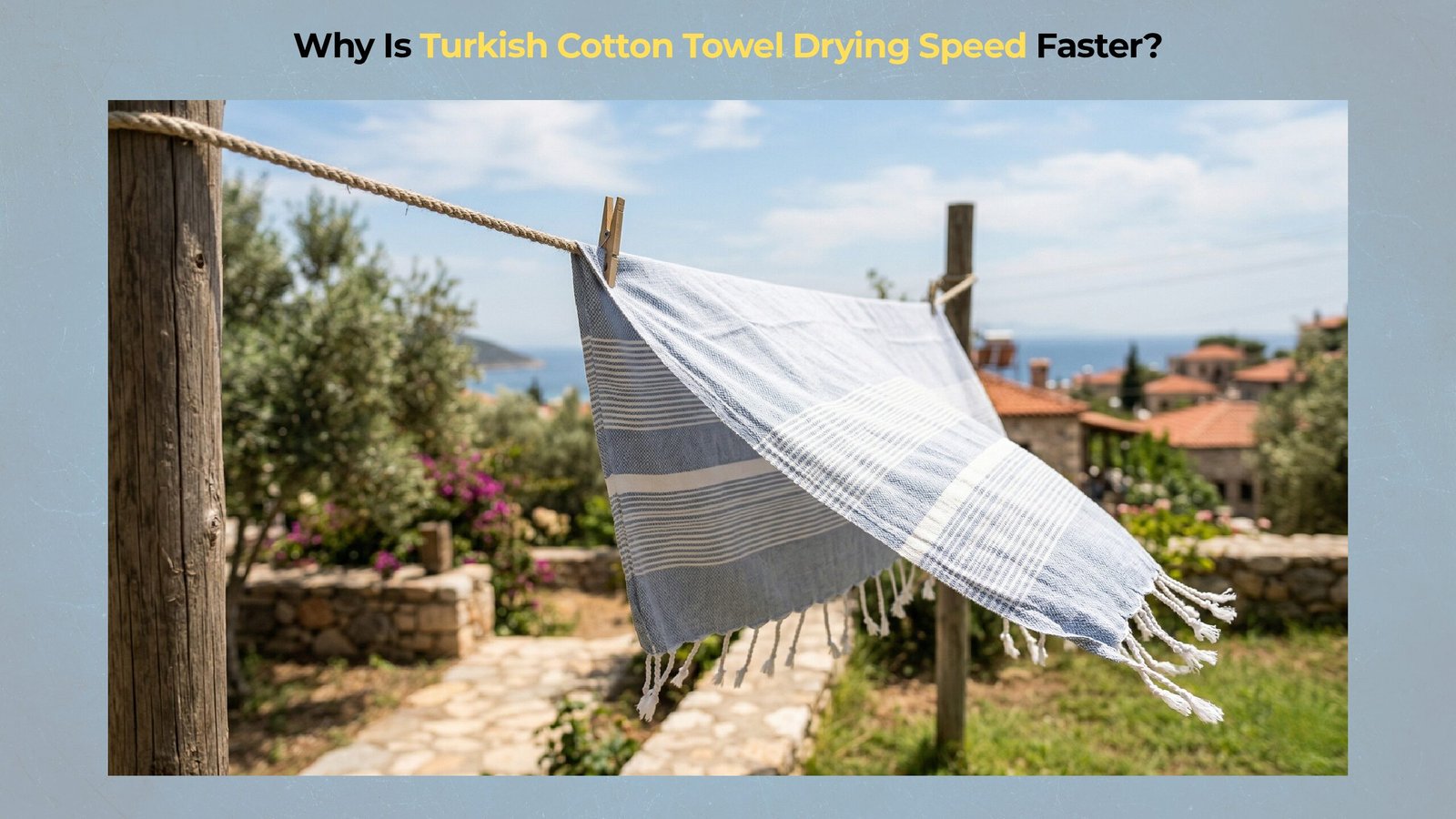
A specialized mechanical balance between moisture intake and atmospheric release typically influences Turkish cotton towel drying speed, utilizing long-staple Aegean fibers to facilitate a rapid return to moisture equilibrium. This moisture equilibrium prevents the deep-core saturation often found in denser Egyptian or utility-grade textiles.
Performance benchmarks often differentiate this material from standard utility linens. These utility linens frequently employ short-staple fibers that create high surface tension and trapped water pockets, leading to prolonged dampness and bacterial proliferation.
This guide audits the fiber physics, capillary evaporation, and atmospheric moisture transit of Aegean linens to verify Turkish cotton towel drying speed and provide technical steps for performance preservation.
Why Is Turkish Cotton Towel Drying Speed Faster Than Standard Linens?
Turkish cotton towel drying speed typically outpaces standard utility linens because the unique density and long-staple structure of Aegean cotton often prevents the core saturation associated with shorter fibers. These shorter fibers lack the uniform alignment necessary for rapid desiccation, often trapping moisture in the center of the yarn.
A specialized balance between moisture intake and atmospheric release defines Turkish cotton towel drying speed, preventing deep-core saturation common in denser textiles. To better understand how moisture enters the fiber before evaporation begins, it is helpful to explore how absorbent Turkish cotton towels are in real-world use.
Material wicking efficiency results from the alignment of parallel filaments. Parallel filaments facilitate a direct path for moisture to travel from the core to the textile surface, directly influencing the accelerated moisture-release benchmarks required for high-humidity environments.
How Do You Identify the Mechanics of this High-Efficiency Turkish Cotton Towel Drying Speed?
High-efficiency desiccation and optimized Turkish cotton towel drying speed result from a material framework that balances initial capillary pull with horizontal moisture transport to help avoid deep fiber saturation. This fiber saturation is the primary cause of prolonged drying times and “sour” odors in bathroom textiles.
Evidence of this performance can be found in the AATCC 199 (Drying Time of Textiles) test method. Test Method 199 confirms that under standardized conditions of $70^{\circ}F$ and 50% relative humidity, Aegean cotton achieves a superior moisture turnover rate compared to Extra-Long Staple (ELS) Egyptian varieties.
What Are the Benchmarks for Turkish Cotton Towel Drying Speed?
Standardized desiccation tests indicate that Turkish cotton towel drying speed can allow a textile to dry within several hours depending on environmental conditions, offering a high-efficiency alternative to denser ELS varieties. This drying window is critical for residential bathrooms where airflow exchange is limited.
Atmospheric turnover depends on the air permeability of the weave. Air permeability ensures that vapor pressure differentials remain high, preventing the “boundary layer” of humid air from stalling the evaporation process at the fiber surface.
How Does Molecular Physics Drive Turkish Cotton Towel Drying Speed?
Cellular-level air transit and capillary-driven evaporation typically drive Turkish cotton towel drying speed, leveraging the natural plumbing of the Aegean cotton strand. The Aegean cotton strand (Gossypium hirsutum) possesses a specific surface area (SSA) that optimizes the “Wick-to-Air” ratio.
Parallel filament alignment reduces moisture trapping inside the yarn core, enabling faster evaporation. Because this structure originates at the yarn level, you may want to explore how Turkish cotton towel yarn construction affects moisture transport and durability.
Surface energy facilitates the spread of moisture across the yarn’s outer layer. Moisture spread increases the total area exposed to ambient air, which significantly accelerates the transition of liquid water into gaseous vapor.
How Does Staple Length Facilitate Turkish Cotton Towel Drying Speed?
Turkish cotton towel drying speed and the associated evaporation rate are facilitated by a staple length of $30\text{–}35\text{ mm}$, which creates smoother, continuous yarns with fewer “trap points” for stagnant water molecules to accumulate. These stagnant water molecules are the primary bottleneck in low-quality textile desiccation.
This faster drying behavior results from long-staple Aegean fibers that maintain uniform alignment and airflow pathways. Since fiber length directly influences this mechanism, a logical next step is to review what staple length Turkish cotton towels typically have and why it matters.
Yarn uniformity can facilitate higher air flow through the weave. Air flow efficiency remains the dominant variable in achieving the semantic triple goal: [Long-staple fiber alignment] -> [minimizes interstitial stagnant zones] -> [facilitates Turkish cotton towel drying speed].
How Does Lumen Geometry Impact Turkish Cotton Towel Drying Speed?
The hollow central core of the fiber typically influences Turkish cotton towel drying speed by functioning as a transit channel that pulls internal moisture to the textile surface for evaporation. Lumen is defined as the hollow central canal of the cotton fiber. The central canal acts as a specialized hydraulic pump during the drying process.
Mature Aegean fibers can exhibit wider lumen diameters than immature varieties. Wider lumen diameters improve core drying efficiency by preventing the collapse of the fiber wall, maintaining the structural porosity required for vapor transit.
How Do Weaves and Weights Influence Turkish Cotton Towel Drying Speed?
Grams per Square Meter (GSM) and weave geometry typically influence Turkish cotton towel drying speed by establishing the total water-retention mass and the degree of core-level airflow. This core-level airflow determines how effectively the textile can shed moisture before mildew-inducing bacteria can colonize the damp loops.
Drying speed is heavily influenced by the total water mass retained within the textile, which is directly tied to GSM levels. To better evaluate this relationship, it is helpful to review how towel weight influences drying time, absorbency, and performance.
Capacity is typically governed by GSM tiers, which dictate the textile’s thickness. GSM tiers must be selected based on localized environmental humidity to ensure the towel returns to equilibrium between uses.
How Do GSM Tiers Scale Turkish Cotton Towel Drying Speed?
Turkish cotton towel drying speed typically scales inversely with GSM tiers, where increasing the fabric mass generally extends the duration required to reach moisture equilibrium.
| GSM Range | Weight Category | Est. Air-Dry Time | Performance Result |
|---|---|---|---|
| 300–450 | Lightweight | 2–4 Hours | Fastest / Travel-Ready |
| 500–650 | Mid-Weight | 4–6 Hours | Standard Home Balance |
| 700–900 | Heavyweight | 8–12 Hours | High Capacity / Slowest Dry |
How Does Weave Geometry Impact Turkish Cotton Towel Drying Speed?
The Turkish cotton towel drying speed and drying velocity fluctuate between Terry and Peshtemal structures, where flat-weave geometry often dries faster than high-density looped Terry alternatives under similar conditions.
Weave geometry determines airflow efficiency, where flat-weave structures dry faster than dense terry loops. Since structure varies across product categories, you may want to explore how different towel types influence drying speed and usability.
Low-mass porosity allows for rapid convective cooling and evaporation. This leads to the achievement of our goal: [Flat-weave Peshtemal geometry] -> [can maximize convective airflow] -> [facilitate Turkish cotton towel drying speed].
Why is Turkish Cotton Towel Drying Speed Influenced by Hygiene Priorities?
Preventing musty odors and biofilm formation is often influenced by Turkish cotton towel drying speed, which determines the duration of the biological window required for microbial colonization. Microbial colonization occurs rapidly when a textile remains above 15% moisture content for more than 4 hours.
Preventing odors requires identifying the damp-window reduction necessary for your climate. Damp-window reduction refers to the time it takes for a textile to pass from saturation to moisture equilibrium.
How Does “Damp-Window” Reduction Affect Turkish Cotton Towel Drying Speed?
Turkish cotton towel drying speed can reduce the metabolic activity of pathogens by reaching moisture equilibrium in under several hours, which can bypass the incubation period required for anaerobic bacteria. Moisture Equilibrium is defined as the state where the fiber moisture content matches ambient humidity.
Ambient humidity is the primary driver of bacterial metabolism in the bathroom. Microbial growth is suppressed when the desiccation cycle is shorter than the microbial doubling time, ensuring the textile remains hygienically safe.
What is the Odor-Prevention ROI of Turkish Cotton Towel Drying Speed?
Turkish cotton towel drying speed influences the odor-prevention return on investment by helping to prevent the stagnant dampness that allows sulfurous byproducts to bond to the fiber core. Sulfurous byproducts, often created by Moraxella osloensis, are responsible for the “stinky towel” syndrome.
Rapid desiccation starves bacteria of an aqueous environment required for nutrient transport. The aqueous environment must be removed quickly to protect the long-term aromatic integrity of the linen set.
Which Specific Laundry Steps Preserve Turkish Cotton Towel Drying Speed?
Preservation of the wicking pathways required for a high evaporation rate results from maintenance protocols that protect Turkish cotton towel drying speed by excluding hydrophobic residues and facilitating fiber expansion. Hydrophobic residues, such as waxy softeners, create a barrier that prevents water from entering the fiber lumen.
Maintaining fast drying speed requires proper laundering protocols that preserve fiber structure and airflow. Since maintenance directly affects performance, it is essential to understand what care instructions should be followed to maintain towel drying performance.
Wicking pathways remain restricted without the sizing-removal protocol applied to new textiles. The sizing-removal protocol is the essential “first step” in activating the Aegean fiber’s natural performance.
How Does the Sizing-Removal Protocol Unlock Turkish Cotton Towel Drying Speed?
Turkish cotton towel drying speed remains restricted until an initial wash at $140^{\circ}F$ ($60^{\circ}C$) removes the industrial waxes and starches that establish a hydrophobic wicking barrier. A hydrophobic wicking barrier prevents the “Bloom” required for maximum surface area exposure.
Capillary-driven moisture movement transports water from the core to the textile surface for evaporation. Since this same mechanism also determines initial water behavior, it is useful to understand why new Turkish cotton towels repel water before activation.
Higher laundry temperatures improve sizing emulsification efficiency by melting the industrial lipids used during the weaving process. Emulsification efficiency leads to: [Higher laundry temperatures] -> [improve sizing emulsification] -> [activate Turkish cotton towel drying speed].
How Does the Absence of Softeners Maintain Turkish Cotton Towel Drying Speed?
Turkish cotton towel drying speed can be significantly reduced if treated with liquid fabric softeners, as cationic surfactants coat the long-staple fibers in a hydrophobic silicone film. Hydrophobic silicone film effectively “plugs” the fiber’s natural plumbing system, turning a high-performance towel into a water-repellent sheet.
Drying performance can decline when hydrophobic residues block the fiber surface and reduce moisture release. To better understand this failure mechanism, you can explore how chemical residues affect Turkish cotton towel performance and safety.
Softeners target fiber-on-fiber friction to provide a sensory feeling of “softness” at the cost of wicking velocity. Fiber-on-fiber friction is necessary for structural loft; without it, the loops collapse and performance becomes sluggish.
How Can You Fix Sluggish Performance to Restore Turkish Cotton Towel Drying Speed?
Restoring compromised Turkish cotton towel drying speed involves executing chemical resets to emulsify oleophilic lipids and dissolve mineral calcification. Mineral calcification occurs in hard water environments, where calcium and magnesium ions bond to the cotton loops.
Chemical resets recover original wicking velocity by stripping the fibers back to their organic state. Original wicking velocity ensures that the towel remains functional for its entire lifespan.
How Does Stripping Detergent Buildup Restore the Turkish Cotton Towel Drying Speed Baseline?
Turkish cotton towel drying speed regains its original velocity when a warm vinegar rinse helps dissolve the hydrophobic silicone films masking the fibers. The silicone films are emulsified by the acetic acid, allowing the loops to “open up” again.
Dissolving waxy residues restores the drying baseline, which is the native performance of the Aegean fiber. This supports our protocol: [Acetic acid rinses] -> [dissolve waxy residues] -> [restore the Turkish cotton towel drying speed baseline].
How Does Resolving Mineral-Based Stiffness Improve Turkish Cotton Towel Drying Speed?
Restoration of fiber flexibility to improve Turkish cotton towel drying speed results from a separate baking soda cycle, which should not be used in the same cycle as vinegar due to neutralization, to soften the alkaline mineral deposits responsible for fiber “crunch.” Alkaline mineral deposits act as a structural anchor that prevents the fiber from breathing.
Separate laundry cycles are a factual directive to avoid the chemistry-reset neutralization that occurs when acids and bases are mixed. Executing these as distinct events ensures maximum mineral dissolution.
Frequently Asked Questions
Egyptian cotton is prized for its high absorbency due to extra-long-staple fibers, but this often leads to core saturation where water is trapped deep within the yarn. Turkish cotton’s long-staple fibers balance absorbency with a “wick-to-air” efficiency that prevents deep saturation, allowing for faster atmospheric release.
Under standard conditions (approx. 70°F and 50% relative humidity), a mid-weight Turkish towel (500-650 GSM) typically reaches moisture equilibrium within 4 to 6 hours. Lightweight Peshtemals can dry in as little as 2 hours.
Yes. Flat-weave (Peshtemal) towels maximize convective airflow and have less mass to hold moisture, making them significantly faster at drying than looped Terry weaves of the same GSM.
This is usually due to the buildup of hydrophobic surfactants from fabric softeners or mineral deposits from hard water. These residues clog the fiber’s wicking channels. Executing a vinegar reset followed by a baking soda wash typically restores original performance.
Yes—ensuring adequate airflow (CFM) and reducing local relative humidity are key. Spreading the towel out fully rather than folding it over a bar minimizes the stagnant boundary layer of air, facilitating faster evaporation.
How Do You Audit Your Linen Set with the Turkish Cotton Towel Drying Speed Checklist?
Systematic technical audits verify Turkish cotton towel drying speed by ensuring current inventory and care protocols align with objective performance benchmarks. Objective performance benchmarks are the only reliable way to measure if your towels are operating at peak efficiency.
Checklist: Turkish Cotton Towel Drying Speed Audit Checklist
Material Audit: Does the label confirm “100% Aegean Long-Staple Cotton”?
The Drop Test: Does a water droplet absorb instantly (< 2.0s) per AATCC 79 standards?
Desiccation Test: Does the towel typically become fully dry to the touch within several hours of use?
Visual Audit: Do the fibers show a visible “Bloom” (raised, open loops) post-wash?
Chemistry Audit: Is the laundry routine 100% free of liquid fabric softeners?
Technical Disclaimer
The performance data and drying rates presented in this guide are derived from standardized laboratory conditions (AATCC 199). Real-world Turkish cotton towel drying speed may vary significantly based on ambient relative humidity (RH), mechanical airflow exchange (CFM), localized temperature, and specific textile care histories. This information is intended for technical educational purposes and does not guarantee specific drying times in all domestic environments.