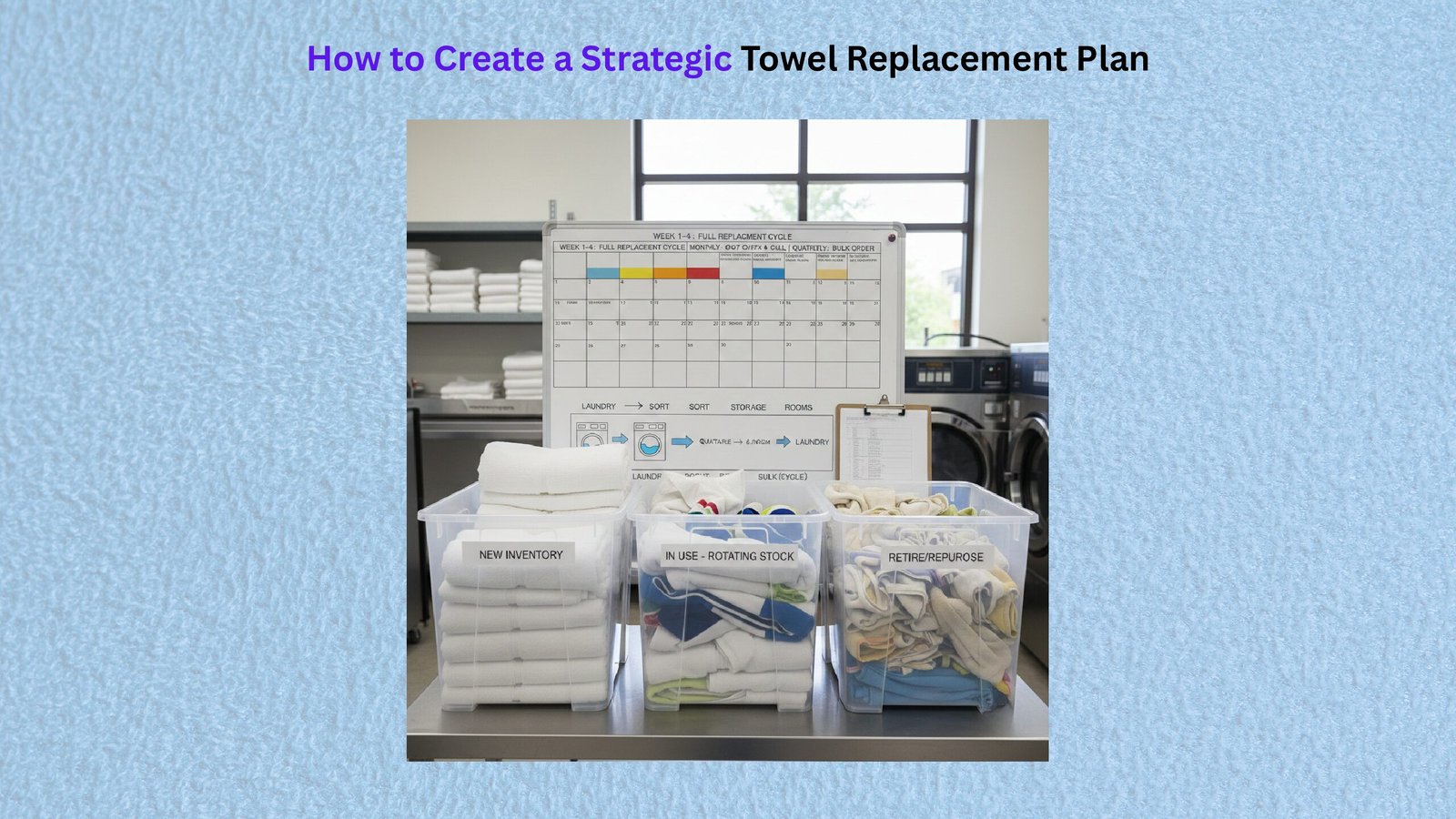
How to Create a Strategic Towel Replacement Plan
(A 5-Step Project Guide)
A Strategic Towel Replacement Plan is a 5-step project guide that transforms the chaotic, expensive chore of replacing towels—which are critical hygiene assets—into a structured, predictable, and high-value home upgrade using data-driven decisions.
Replacing towels often feels chaotic because households lack a system. Towels degrade, lose absorbency, and become unhygienic vectors for microbial contamination, yet most consumers lack a clear plan to replace them.
This guide transforms that chore into a structured project based on the P5 Project Planner model. A Strategic Towel Replacement Plan helps you define goals, manage resources, and ensure a high-quality, hygienic result.
This article will guide you step-by-step through this 5-phase protocol to deconstruct the task, make data-driven decisions (based on microbiology and material science), and execute your Strategic Towel Replacement Plan flawlessly.
Why is a Strategic Towel Replacement Plan a Critical Project?
A Strategic Towel Replacement Plan is a critical project because it directly solves two core household problems: the hidden hygiene risk (Microbiology) and the rapid material lifespan failure (Material Science) of your towels. This section establishes the project’s justification by quantifying the risks of inaction.
How a Strategic Towel Replacement Plan Solves the Hygiene Problem (Microbiology)
A Strategic Towel Replacement Plan solves the hygiene problem by treating towels as critical hygiene equipment, not just decor, based on clear microbiological data.
Microbiologist Charles Gerba (University of Arizona) confirms that towels are major breeding grounds for pathogens. His research found nearly 90% of bathroom towels were contaminated with coliform bacteria, while 89.0% of kitchen towels carried the same bacteria. Furthermore, Gerba identified E. coli on 14% of bathroom towels and 25.6% of kitchen towels, while a 2024 student study found E. coli rates as high as 36%.
The “musty” odor common in bathrooms is the metabolic byproduct of this bacterial and fungal colonization. Dermatologists warn this colonization transmits bacteria and fungi back to the host, causing acne, rashes, and infections like athlete’s foot, jock itch, and eczema flare-ups. The solution defines a strict 2-3 use wash cadence. This plan builds the resilient inventory required to service that cadence.
How a Strategic Towel Replacement Plan Solves the Lifespan Problem (Material Science)
A Strategic Towel Replacement Plan solves the lifespan problem by accepting that towels have a fixed material end-of-life (EOL) measured in wash cycles, which this plan budgets for.
The functional lifespan benchmark is approximately 120 wash cycles, though commercial-grade textiles may reach ~200. This translates to a 2-5 year EOL for most homes, aligning with the ANSI (American National Standards Institute) standard of 3 years. A critical tension exists here: The solution to the hygiene problem (more washing) is the accelerant to the lifespan problem (faster EOL). A Strategic Towel Replacement Plan accepts this, treating towels as high-performing consumable assets with a defined lifecycle.
What is the Science Behind a Strategic Towel Replacement Plan?
The science behind a Strategic Towel Replacement Plan involves using two key data points—GSM and Material—to make objective, data-driven procurement decisions.
How GSM (Weight) Defines Quality
| GSM Range | Profile (Feel/Weight) | Absorbency | Dry Time | Recommended Use Case |
|---|---|---|---|---|
| 300-400 | Lightweight, thin, coarser | Low | Very Fast | Gym, kitchen (quick-drying is key) |
| 400-600 | Medium-weight, balanced | Good | Moderate | The “perfect balance” for daily bath & guest towels |
| 600-900 | Heavy, “spa-like” plush | Exceptional | Very Slow | Luxury master bath (but high mildew risk) |
How Material Defines the “Absorbency vs. Dry Time” Trade-Off
Material defines the central trade-off you must solve in your Strategic Towel Replacement Plan: Absorbency (luxury) vs. Dry Time (hygiene). Maximum absorbency (Egyptian Cotton) means the slowest dry time, which accelerates the hygiene problem (microbial growth). While Egyptian Cotton is marketed as premium, it is functionally the worst choice for the project’s core hygiene mission. The data-driven plan selects Turkish Cotton or Hydro/Aerocotton, which align performance with the hygiene goal.
How to Create Your Blueprint for a Strategic Towel Replacement Plan (Phase 1-2)
Creating the blueprint for your Strategic Towel Replacement Plan (Phases 1-2) involves setting your project goals, quantities, and a detailed, itemized budget.
How to Set Your “Definition of Done”
You must first set your “Definition of Done” (or Project Charter) to give your Strategic Towel Replacement Plan a clear, measurable goal.
Project Charter: Definition of Done
How to Set Your “Goal Quantities” (The 3 Towel Rule)
To set your goal quantities for a Strategic Towel Replacement Plan, you must use the “3 Towel Rule” to ensure proper hygiene and rotation. Use the “3 Towel Rule” (one in use, one in the wash, one in reserve) per person to set your goals.
How to Set Your Itemized Budget (Interactive Calculator)
An itemized budget is essential to your Strategic Towel Replacement Plan for allocating resources and controlling costs. Use the calculator below to estimate your total project cost based on market averages.
Towel Replacement Budget Calculator
How to Execute Your Strategic Towel Replacement Plan (Phase 3-4)
Executing your Strategic Towel Replacement Plan (Phases 3-4) involves a smart procurement strategy, a “Pilot Purchase,” and a mandatory “First Wash Protocol.”
What is the “First Wash Protocol”?
The “First Wash Protocol” is a mandatory deployment step to chemically strip manufacturing coatings and unlock absorbency. New towels are treated with a silicone finish or waxy manufacturing coatings. These coatings are hydrophobic (water-repellent) to feel soft in the store.
First Wash Protocol Checklist
Planning Disclaimer & Limitations
For Educational & Planning Use Only.
This guide and the Budget Calculator are planning tools based on estimated market averages. Actual prices, product availability, and specific care instructions may vary by retailer and manufacturer. The “3 Towel Rule” and “First Wash Protocol” are best-practice recommendations for hygiene and material care, but results may vary based on individual usage and water conditions.What is the Key Takeaway?
The key takeaway is that this 5-phase guide transforms a chaotic chore into a predictable, data-driven project. By deconstructing the task and applying principles from microbiology, material science, and finance, the Strategic Towel Replacement Plan ensures your home is stocked with hygienic, high-performing assets.
Project Complete
You have successfully managed the project from justification to disposal, creating a closed-loop protocol for your next replacement cycle.