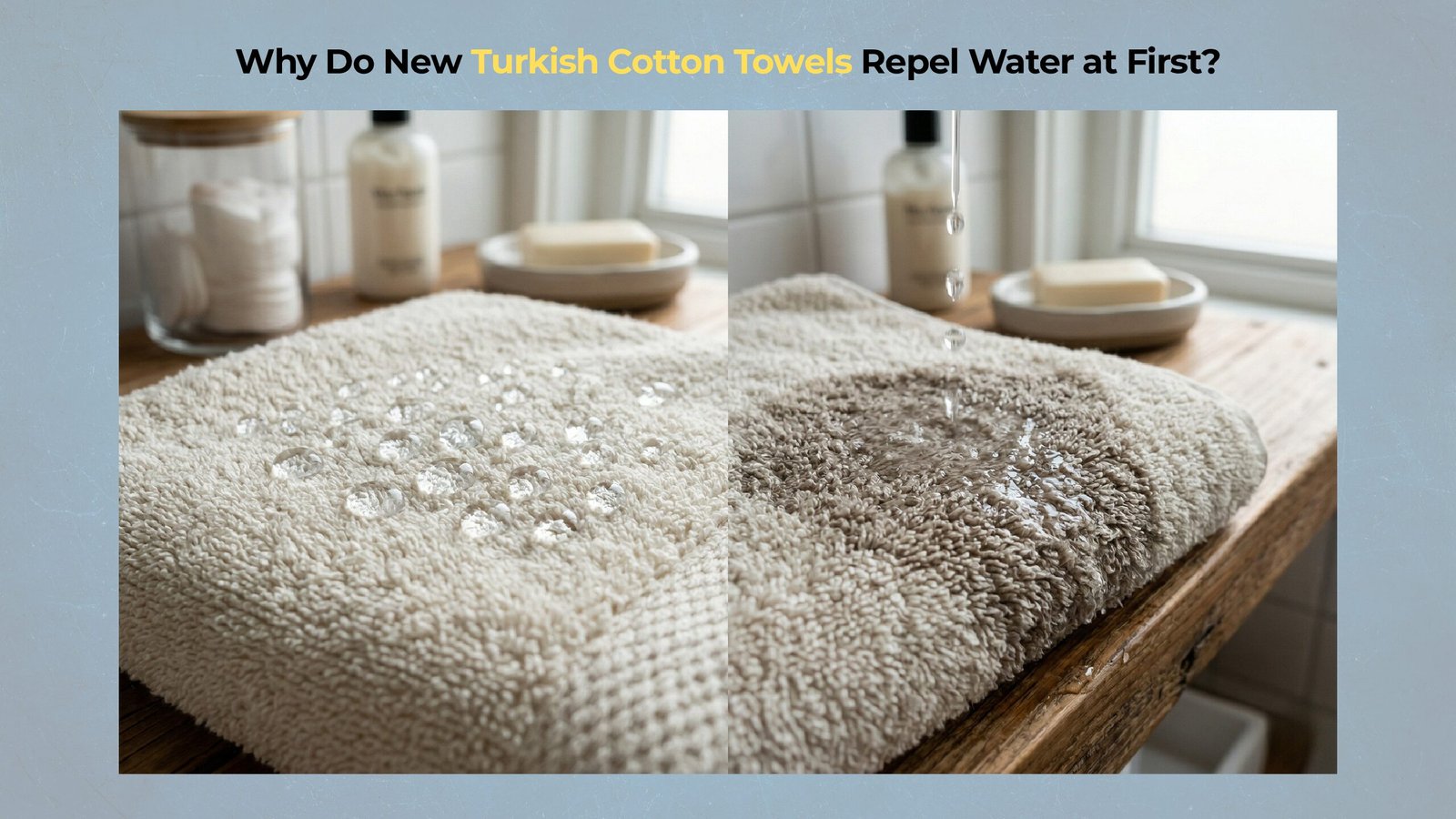
Why Do New Turkish Cotton Towels Repel Water at First?
A deliberate industrial state known as Turkish cotton towel initial water repellency typically results from the application of protective starches and waxes that manufacturers frequently suggest stripping before the Aegean fibers reach peak absorbency.
These protective starches and waxes establish a hydrophobic shield over the Gossypium hirsutum fibers, effectively preventing the cellulose structure from interacting with liquid moisture during the early stages of its lifecycle. This chemical barrier is a standard feature of high-quality loom-state production, ensuring the structural integrity of the long-staple yarns remains intact until the user initiates the first activation sequence.
State that high-performance wicking is a consequence of a thermal and chemical reset. This reset process restores the natural attribute of Moisture Regain, allowing the fiber thirst to overcome the manufactured surface tension and begin the capillary draw necessary for efficient drying.
Do New Linens Exhibit Turkish Cotton Towel Initial Water Repellency by Default?
A state of Turkish cotton towel initial water repellency typically represents the default condition for most new towels, providing a hydrophobic barrier that persists until the first warm-to-hot wash.
This hydrophobic barrier differentiates between a defective towel and an uncompromised factory finish by managing the attribute of Surface Tension to resist liquid penetration. Designers of luxury linens intentionally utilize this state to preserve the textile during its transition from the factory floor to the retail environment.
This default state is a consequence of the specific sizing chemicals and finishing agents used in production.
Identifying the Industrial Sizing System Used in Turkish Cotton Towel Initial Water Repellency
Turkish cotton towel initial water repellency typically originates from an “Industrial Sizing” system where starches and lubricants are applied to Aegean yarns to help prevent filament snapping during high-speed mechanical weaving. Since this process is closely tied to yarn structure, you may want to explore how Turkish cotton towel yarn construction affects strength and moisture transport.
This mechanical weaving process creates immense friction, which research in the Textile Research Journal suggests is mitigated through the application of paraffin-based waxes. To better understand how these initial coatings affect long-term performance, it is useful to explore how chemical residues impact Turkish cotton towel performance and safety. [High-speed industrial looms] -> [necessitate sizing wax application] -> [facilitate Turkish cotton towel initial water repellency].
Determining How Finishers Create a Hydrophobic Turkish Cotton Towel Initial Water Repellency Profile
Final-stage chemical treatments dictate the degree of Turkish cotton towel initial water repellency, as manufacturers may apply siliconized softeners to enhance retail shelf-appeal at the expense of initial wicking velocity. Since this also impacts comfort and surface feel, it is useful to understand how softness factors influence towel comfort and performance in daily use.
This wicking velocity is hindered because siliconized softeners create a high contact angle that resists water penetration. Retail “softness” is often an inverse indicator of immediate absorbency, as the chemical coating can temporarily seal the hydrophilic cellulose sites.
How Does Molecular Physics Drive Turkish Cotton Towel Initial Water Repellency?
Cellular-level surface tension and fiber shielding drive Turkish cotton towel initial water repellency, utilizing a molecular film that may prevent the “Deep-Drink” wicking characteristic of Aegean cotton. Surface tension physics explains why water beads on new towels instead of penetrating the fibers. Because this directly affects drying efficiency, it is helpful to evaluate how quick-dry performance impacts towel usability and moisture management.
This molecular film neutralizes Capillary Pressure by introducing non-polar surface energy into the textile matrix. Consequently, water molecules bead on the surface rather than penetrating the fiber interstices, a phenomenon that lasts until the first thermal interruption.
The sealant effect of the cotton lumen is a primary driver of this sustained repellency.
How the Hydrophobic Finish Profile Blocks the Cotton Lumen in Turkish Cotton Towel Initial Water Repellency
Turkish cotton towel initial water repellency involves a “Sealant Effect” where industrial waxes coat the fiber’s central canal (lumen), which can block the wicking pathways required for internal moisture storage.
This moisture storage is achieved through the hollow core of the lumen anatomy. [Waxy finish profiles] -> [coat the central lumen] -> [neutralize Turkish cotton towel initial water repellency wicking].
Determining How Surface Tension Variables Impact the Turkish Cotton Towel Initial Water Repellency Profile
The Turkish cotton towel initial water repellency profile fluctuates based on surface tension variables, where the smoother filaments of long-staple cotton can facilitate water beading when coated in factory resins.
This beading behavior is documented in The Journal of The Textile Institute, highlighting that fiber smoothness contributes to higher hydrophobic stability. Technical Benchmark: AATCC 79 absorbency standards indicate that sized towels can exhibit wetting times exceeding 10 seconds.
Why is the Turkish Cotton Towel Initial Water Repellency Profile Necessary for Shipping?
International shipping requirements necessitate Turkish cotton towel initial water repellency because the hydrophobic barrier helps protect the textile from absorbing ambient humidity during transoceanic transit.
This ambient humidity results in a Vapor Pressure Gradient that typically triggers premature moisture exchange if fibers are unshielded. By maintaining a hydrophobic state, manufacturers prevent the premature activation of the cotton’s thirst.
Logistics Technical Summary: The initial repellency profile serves as an essential antimicrobial safeguard. By inhibiting moisture uptake, it prevents “Container-Stink” and mold accumulation in stagnant, high-humidity sealed environments during the 30-45 day global transit cycle.
Shipping protection is a consequence of the humidity-resistance ROI of the textile finish.
Evaluating the Humidity-Resistance ROI of Turkish Cotton Towel Initial Water Repellency
Turkish cotton towel initial water repellency provides a return on investment (ROI) for global logistics by ensuring that linens arrive in a “Factory-Fresh” state, free from the microbial odors associated with stagnant moisture.
This stagnant moisture is a critical risk factor, as Cotton Incorporated data indicates container humidity levels can frequently exceed 70–80%. [Hydrophobic coatings] -> [inhibit ambient moisture uptake] -> [secure the hygiene of Turkish cotton towel initial water repellency during transit].
How to Compare Finish Types to Predict Turkish Cotton Towel Initial Water Repellency?
Selecting the appropriate inventory requires an audit of the finish type to predict the duration and intensity of Turkish cotton towel initial water repellency.
This repellency intensity is often proportional to the GSM (Grams per Square Meter), as denser textiles require a more comprehensive sizing application to protect the higher volume of fiber loops.
Activation effort is governed by the specific finish category of the textile.
Evaluating Performance Results for Turkish Cotton Towel Initial Water Repellency Using This Matrix
Turkish cotton towel initial water repellency performance typically follows a hierarchy based on factory-stage scouring, where “Raw” textiles often require the most intensive thermal reset.
This scouring degree is standardized under ISO 6330, which measures the residual oils left on the fiber surface after the initial wash cycle.
| Finish Category | Initial Absorbency | Primary Driver of Repellency | Activation Requirement |
|---|---|---|---|
| Raw / Sized | Very Low (Beading) | Heavy Starch & Paraffin Wax | High (2-3 Washes @ $60^{\circ}C$) |
| Garment-Washed | Moderate | Residual Finishing Softeners | Low (1 Standard Wash) |
| Stone-Washed | High | Mechanically Stripped Surface | Near-Zero (Rinse only) |
Which Specific Laundry Steps Eliminate Turkish Cotton Towel Initial Water Repellency?
Restoration of wicking potential results from executing a technical “Activation Protocol” that utilizes thermal energy to help dissolve the molecular bonds of Turkish cotton towel initial water repellency. Since proper laundering determines long-term usability, it is important to review what care instructions should be followed to activate towel absorbency.
This initial repellency begins to break down when the Kinetic Energy of the wash water exceeds the melting point of the industrial paraffin films. Without this thermal intervention, the towel may remain hydrophobic for dozens of cold-water cycles.
Activation is a consequence of the high-temperature reset.
Executing a High-Temperature Reset for Turkish Cotton Towel Initial Water Repellency
Turkish cotton towel initial water repellency typically dissipates during an initial wash at $140^{\circ}F$ ($60^{\circ}C$) with no detergent, as this temperature provides the kinetic energy required to emulsify paraffinic sizing. Thermal activation removes the hydrophobic barrier by emulsifying waxes during the first wash cycle.
This paraffinic sizing must be fully emulsified before detergents are added, as surfactants can sometimes react with raw sizing to create a persistent, sticky residue that inhibits loft. [High thermal laundering] -> [emulsifies industrial waxes] -> [neutralizes Turkish cotton towel initial water repellency].
Implementing an Acid-Neutralization Rinse for Turkish Cotton Towel Initial Water Repellency
Turkish cotton towel initial water repellency management concludes with an acetic acid (vinegar) rinse to help neutralize the high-pH fixatives often used in the industrial dyeing of Aegean linens.
This industrial dyeing process leaves behind alkaline traces that can keep fiber pores constricted. Acidic neutralization helps exfoliate the fiber surface, reopening the wicking pores and assisting in achieving high-performance “Drop-Sink” benchmarks.
When Does Water Repellency Return to the Turkish Cotton Towel Initial Water Repellency Profile?
Performance typically fails when maintenance errors re-introduce the same hydrophobic films that characterized the Turkish cotton towel initial water repellency profile. Water repellency can return when detergent buildup and minerals recoat the fiber surface. To better understand how this affects long-term fiber health, you can explore how cotton towel durability is affected by washing and repeated use.
These films result from Cationic Attraction, where positively charged molecules in laundry additives bind to the negatively charged cotton fibers. This bond creates a permanent synthetic seal that mimics the original factory sizing.
Wicking failure is a marker of mineral-detergent bonding.
Identifying Mineral-Detergent Bonding as a Failure of Turkish cotton towel initial water repellency
Turkish cotton towel initial water repellency returns when unrinsed detergent molecules bind with hard water minerals to form a waxy barrier over the fiber loops.
These fiber loops undergo a process of Calcification, hardening the pile and reducing the surface area available for moisture contact. Detail the “Bead Test”: If water beads on a towel that was previously absorbent, the issue is typically detergent loading, not factory sizing.
Recognizing Softener Buildup as a Driver of Turkish Cotton Towel Initial Water Repellency Failure
Turkish cotton towel initial water repellency can become a persistent failure state if liquid softeners are utilized, as cationic surfactants coat the long-staple fibers in a hydrophobic silicone layer. Fabric softeners can recreate a hydrophobic film similar to factory sizing, permanently reducing absorbency.
This silicone layer is chemically similar to the Polyamide structures used in waterproof rainwear, effectively waterproofing the towel loops. Fabric softeners act as “Synthetic Sizing” that can re-waterproof the towel, neutralizing the benefit of the initial break-in.
How Can You Fix “Slickness” to Restore the Turkish Cotton Towel Initial Water Repellency Profile?
Restoration of the original “thirsty” state involves executing a forensic stripping technique to help dissolve the chemical seals affecting the Turkish cotton towel initial water repellency profile.
This repellency profile management utilizes Sodium Bicarbonate, which acts as a mild abrasive and alkaline agent to break down greasy silicone and mineral deposits without damaging the delicate Aegean cellulose.
Stripping Chemical Barriers to Restore the Turkish Cotton Towel Initial Water Repellency Profile
Turkish cotton towel initial water repellency and wicking velocity are restored through separate cycles of sodium bicarbonate (baking soda) and acetic acid (vinegar) to help exfoliate the fibers.
Exfoliating these fibers requires a sequential approach; Factual Directive: Never mix baking soda and vinegar in the same cycle, as they neutralize each other, rendering the stripping process ineffective. [Forensic chemical stripping] -> [dissolves silicone layers] -> [restores Turkish cotton towel initial water repellency profile wicking].
Audit Your Purchase with the Turkish Cotton Towel Initial Water Repellency Checklist
Systematic technical audits help verify that Turkish cotton towel initial water repellency has been successfully removed and the fibers have reached a high-performance state.
This performance state is best validated through the AATCC 79 test method, which observes the time required for a textile to absorb a standardized droplet of water.
Checklist: Turkish Cotton Towel Initial Water Repellency Audit
Frequently Asked Questions
Q: Why does my new towel feel soft but repel water?
A: This is due to siliconized softeners applied at the factory level. While they enhance retail shelf-appeal, they temporarily seal the hydrophilic sites of the Aegean cotton, creating a high contact angle that resists moisture penetration.
Q: Is it necessary to use a detergent for the first wash?
A: No. Manufacturers frequently suggest a detergent-free wash at $140^{\circ}F$ ($60^{\circ}C$). This prevents surfactants from binding with raw sizing, which can otherwise create a persistent residue that inhibits the fiber’s natural loft.
Q: How many washes are needed to achieve maximum absorbency?
A: While Turkish cotton towel initial water repellency is neutralized in the first thermal reset, maximum wicking velocity and “Bloom” are typically reached after 3–5 standard laundering cycles as the cotton lumen fully reopens.
Final Summary: Does the High-Absorbency Potential Justify the Initial Break-in for Turkish Cotton Towel Initial Water Repellency?
Operationalizing a Turkish cotton towel initial water repellency strategy requires a commitment to thermal activation that transforms a “Preserved Asset” into a “High-Performance Tool.” After removing these barriers, you can review how absorbent Turkish cotton towels are after proper activation to fully appreciate the performance gain.
This technical tool represents the gold standard in bath linens, balancing the necessity of Shipping Protection with the ultimate goal of User Satisfaction. Ultimately, a superior bathroom experience is defined by the precise Turkish cotton towel initial water repellency management that turns a technical industrial input into a lasting, high-performance household asset through technical care.
Disclaimer: The technical information provided regarding Turkish cotton towel initial water repellency is for educational and illustrative purposes only. Thermal activation protocols involving water temperatures of $140^{\circ}F$ ($60^{\circ}C$) should be executed with caution to prevent household scalding. Always verify compatibility with your specific textile’s manufacturer care label and machine settings before performing forensic stripping or thermal resets. Toweldaily.com is not responsible for textile degradation resulting from improper chemical application or excessive heat exposure.