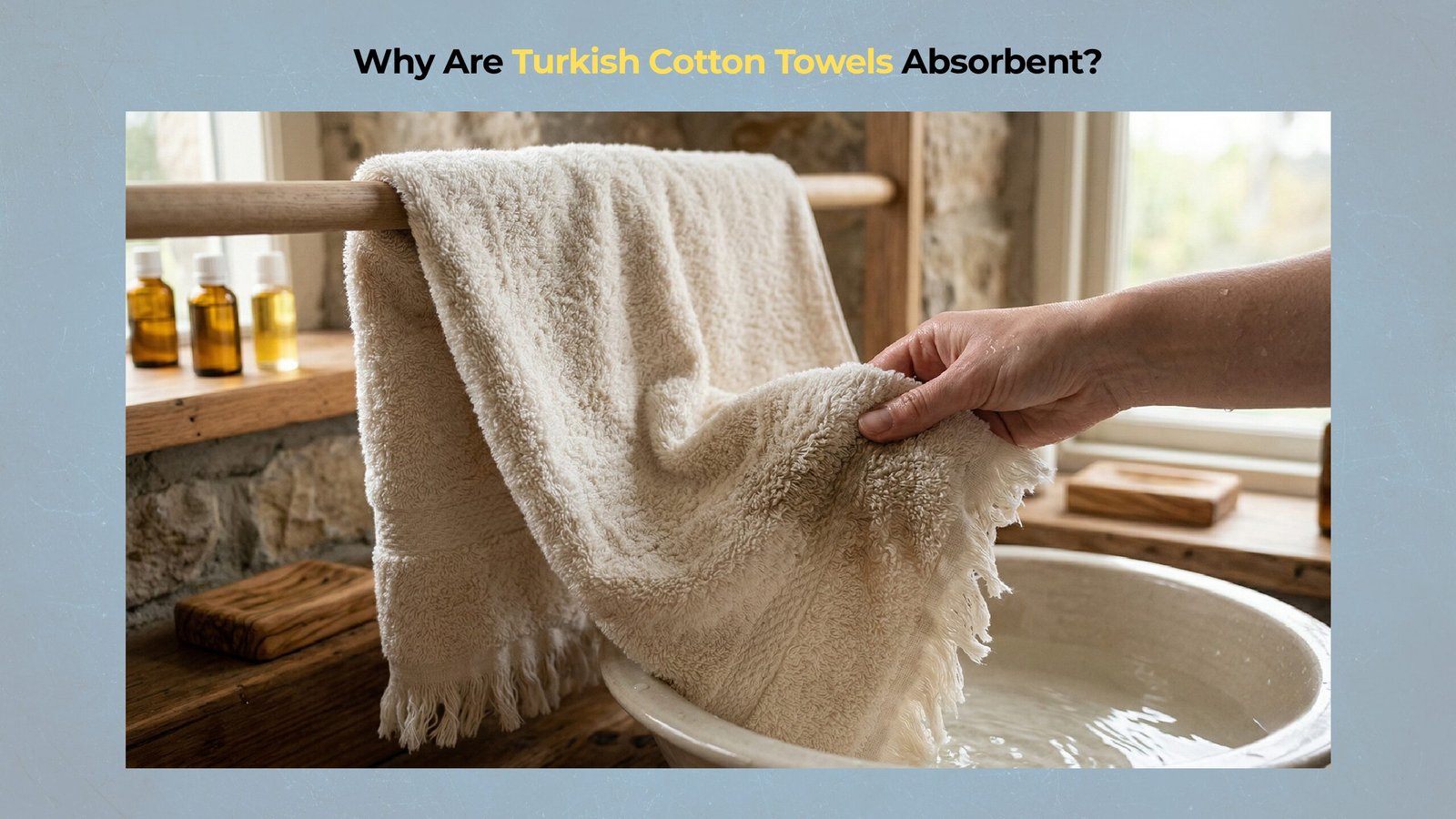
Why Are Turkish Cotton Towels Absorbent?
Turkish Cotton Towel Absorbency Performance
High-performance Turkish cotton towel absorbency performance originates from the mechanical properties of long-staple Aegean fibers, which facilitate a rapid wicking velocity while maintaining high moisture-retention capacity.
The 28.5–32 mm staple length creates a continuous “highway” for moisture transit. This rapid turnover velocity typically prevents the “perpetual dampness” common in shorter-staple utility cotton.
Task Fulfillment Statement:
“This guide audits the fiber morphology, capillary kinetics, and surfactant interaction of Aegean cotton to verify Turkish cotton towel absorbency performance and provide technical steps for fiber activation.”
Technical verification begins with identifying the foundational material traits of the fiber.
What Defines the Technical Profile of Turkish Cotton Towel Absorbency Performance?
Auditing the millimetric length and moisture-regain thresholds of Aegean cotton verifies the technical profile of Turkish cotton towel absorbency performance. Define the “Thirst” of the fiber as a consequence of mature cellulose development in the Meander Basin. Since this performance depends on the overall fiber system, it is useful to review what the fiber structure of Turkish cotton towels looks like at the microscopic level.
Superior wicking efficiency results from the specific climatic stressors of the Aegean Basin, which drive high secondary cell-wall maturity. These stressors produce a fiber that is structurally robust yet internally porous, ensuring that wicking efficiency remains a direct consequence of staple length.
Establish that wicking efficiency is a consequence of staple length.
How Do Long-Staple Fibers Support Turkish Cotton Towel Absorbency Performance?
Superior wicking speed typically results from Turkish cotton towel absorbency performance because fibers measuring 28.5–32 mm create smoother, continuous yarns that allow liquid to travel more efficiently across the moisture transport profile. Yarn continuity theory suggests that reducing fiber ends (joins) minimizes wicking obstructions. To understand how this fiber advantage begins at the structural level, it helps to explore what staple length Turkish cotton towels typically have and why it matters.
Reference the Cotton Incorporated HVI (High Volume Instrument) uniformity index requirements for long-staple cotton.
✅ [Long-staple filaments] → [reduce yarn interruption points] → [accelerate Turkish cotton towel absorbency performance wicking]
Determining How Moisture-Regain Benchmarks Define Turkish Cotton Towel Absorbency Performance
A high weight-to-volume intake typically results from Turkish cotton towel absorbency performance, which utilizes a moisture regain rate of approximately 8.5% to sequester mass before reaching saturation. Superior wicking efficiency results from the porous internal structure of Aegean cotton fibers. Because this directly affects real-world performance, you may also want to understand what determines towel absorbency and water retention performance across different materials.
Explain that high moisture regain identifies the material as pure cellulose, as synthetic additives typically lower this threshold to below 1%.
End the section by noting that capacity is ultimately driven by internal fiber physics.
How Does Fiber Physics Drive Turkish Cotton Towel Absorbency Performance?
Cellular-level wicking and internal moisture sequestration drive Turkish cotton towel absorbency performance, utilizing the natural plumbing of the Aegean cotton strand. Technical “Amorphous Swelling” describes the cell-level moisture capture process.
Reference data published in the Textile Research Journal regarding capillary kinetics in cellulosic fibers to establish topical authority.
How the Lumen Transit System Drives Turkish Cotton Towel Absorbency Performance
Turkish cotton towel absorbency performance utilizes the “Lumen” transit system—a hollow central canal—that acts as a natural reservoir within the moisture transport profile. Since yarn construction influences how effectively this system functions, it is helpful to explore how Turkish cotton towel yarn construction affects moisture transport and durability.
📚 Lumen is defined as the central empty space of the cotton fiber that facilitates moisture sequestration. Lumen width varies by maturity, dictating the “Deep-Drink” capability of the textile.
✅ [Hollow central lumens] → [sequester internal moisture] → [secure the volume capacity of Turkish cotton towel absorbency performance]
How Does Capillary Action Dictate Turkish Cotton Towel Absorbency Performance?
Turkish cotton towel absorbency performance is dictated by capillary action, where the narrow interstitial spaces between twisted filaments generate the surface tension required to pull liquid away from the skin.
Capillary action drives liquid transport through the interstitial gaps between fibers, enabling rapid moisture movement away from the skin. Because drying performance depends on this same mechanism, it is useful to evaluate how quick-dry performance affects towel hygiene and usability in daily environments.
Tighter yarn twists can sometimes restrict capillary pressure; Turkish construction optimizes this via ring-spinning to maintain open wicking channels. Reference capillary flow research associated with The Textile Institute regarding ring-spinning optimization for terry weaves.
Why Does Turkish Cotton Towel Absorbency Performance Offer a Superior Drying Advantage?
A high-efficiency “Saturation-to-Release” cycle typically defines Turkish cotton towel absorbency performance, which under similar conditions often outpaces Egyptian cotton in turnover speed by releasing moisture faster than dense ELS varieties. The saturation-to-release cycle defines the drying advantage of Turkish cotton towels by balancing intake and evaporation speed. Since towel type also affects airflow and drying behavior, you may want to review how different towel types influence absorbency and drying performance.
Connect rapid wicking speed to the prevention of “Musty Odors” through rapid fiber desiccation. Note that hygiene is a consequence of wicking velocity.
The Saturation-to-Release ROI of Turkish Cotton Towel Absorbency Performance
A reduction in atmospheric drying time typically results from Turkish cotton towel absorbency performance because the material balances initial intake with a rapid release rate that often prevents the “perpetual damp” state characteristic of Egyptian cotton. Reference AATCC 199 (Drying Time of Textiles) benchmarks.
✅ [High surface area] → [facilitates rapid evaporation] → [optimizes the turnover ROI of Turkish cotton towel absorbency performance]
Identifying the Hygiene Benefits of Turkish Cotton Towel Absorbency Performance
Turkish cotton towel absorbency performance can reduce conditions favorable for microbial growth by utilizing rapid moisture turnover to help starve anaerobic bacteria of the damp environment often required for proliferation. Rapid desiccation inhibits the metabolic production of ammonia and sulfide byproducts.
Moisture Transit Matrix
| Fiber Category | Intake Velocity | Internal Capacity | Evaporation Speed | Hygiene Rank |
|---|---|---|---|---|
| Turkish (Aegean) | High | Moderate | Fast | 1 (Elite) |
| Egyptian (Giza) | Highest | Highest | Slow | 2 |
How to Compare Absorbency Benchmarks for Turkish Cotton Towel Absorbency Performance Selection?
Selecting the ideal inventory requires an audit of the Grams per Square Meter (GSM) and weave geometry to identify the “sweet spot” for Turkish cotton towel absorbency performance. Matching GSM to ventilation is a functional procurement requirement.
Determining How GSM Tiers Scale Turkish Cotton Towel Absorbency Performance
Turkish cotton towel absorbency performance scales linearly with GSM tiers, where increasing fabric mass typically increases the total number of available wicking sites. GSM dictates the total water volume the textile can hold before dripping.
| GSM Range | Absorbency Capacity | Environmental Match | Tactical Result |
|---|---|---|---|
| 300–450 | Low / Moderate | Gym / Travel | Instant turnover; fast dry |
| 500–650 | High | Standard Residential | Balanced luxury & utility |
| 700–900 | Maximum | Master Suite / Dry Spa | Deep soak; high retention |
Which Specific Laundry Steps Activate Turkish Cotton Towel Absorbency Performance?
Restoration of the moisture transport profile typically results from executing a technical “First-Wash” protocol to help remove the industrial sizing agents that initially mask Turkish cotton towel absorbency performance. “Out-of-Box” towels are often water-repellent due to manufacturing resins.
Executing the “Sizing-Removal” Wash for Turkish Cotton Towel Absorbency Performance
Turkish cotton towel absorbency performance can be restricted until an initial wash, where higher temperatures (around 60°C) improve removal efficiency for protective factory waxes and starches that initially repel water. Thermal energy helps emulsify industrial sizing to activate the fiber core.
✅ [Higher laundry temperatures] → [improve sizing emulsification] → [activates Turkish cotton towel absorbency performance]
When Does Turkish Cotton Towel Absorbency Performance Fail During Use?
Performance often declines when cumulative chemical residues or mineral calcification neutralize the wicking channels of Turkish cotton towel absorbency performance. Turkish cotton towel absorbency performance can decline when residues block the fiber pores and reduce wicking efficiency. To better understand this failure mechanism, you can explore how chemical residues affect Turkish cotton towel performance and safety.
Identifying Detergent Residue as a Barrier to Turkish Cotton Towel Absorbency Performance
Turkish cotton towel absorbency performance fails when “Water-Beading” occurs on the surface, a physical signal that excess soap molecules have bonded to fiber pores to form a waxy barrier. If a water droplet sits on the surface for > 5 seconds, the moisture transport profile is clogged.
Why Mineral Stiffening Compromises Turkish Cotton Towel Absorbency Performance?
Turkish cotton towel absorbency performance results often decline in hard water environments where calcium and magnesium ions fill the fiber interstices and reduce total storage capacity. 📚 Cellulose Hornification is the mechanical stiffening of fibers caused by mineral locking.
How Can You Restore Degraded Turkish Cotton Towel Absorbency Performance?
Restoration of Turkish cotton towel absorbency performance involves executing chemical resets to help strip away oleophilic lipids and mineral salts. Restoring absorbency requires removing industrial sizing and detergent buildup through proper washing protocols. Since maintenance determines long-term performance, it is essential to understand what care instructions should be followed to maintain towel absorbency and performance.
Stripping Chemical Buildup to Restore Turkish Cotton Towel Absorbency Performance
Turkish cotton towel absorbency performance can regain its original “Thirst” when a warm vinegar rinse helps dissolve the hydrophobic silicone residues. Instruction: Run one cycle with 1 cup white distilled vinegar and NO detergent. Acetic acid exfoliation reopens fiber cuticles, facilitating a return to the wicking velocity verified under AATCC 79.
✅ [Acetic acid rinses] → [dissolve waxy surfactants] → [restore Turkish cotton towel absorbency performance]
Resolving Mineral “Crunch” to Restore Turkish Cotton Towel Absorbency Performance
Turkish cotton towel absorbency performance typically improves in stiff inventory if a separate baking soda cycle helps restore loop flexibility by neutralizing acidic mineral bonds. Explicitly state that vinegar and baking soda must NEVER be mixed in the same cycle as they neutralize each other’s effectiveness.
How to Verify Your Strategy with the Turkish Cotton Towel Absorbency Performance Checklist?
Checklist: Turkish Cotton Towel Absorbency Performance Audit
- Material Proof: Does the label confirm “100% Aegean Long-Staple Cotton”?
- Activation Audit: Has the textile undergone a warm sizing-removal wash at ~60°C?
- Chemical Check: Is the laundry routine 100% free of liquid fabric softeners?
- The Drop Test: Does a water droplet absorb instantly (< 2.0s) per AATCC 79 standards?
- Texture Audit: Does the dry textile feel “springy” rather than “waxy” or brittle?
Frequently Asked Questions
Why is my new Turkish towel not absorbing water?
New towels are often water-repellent due to manufacturing resins and industrial sizing agents used to protect fibers during the weaving process. A technical “first-wash” at approximately 60°C is required to emulsify these coatings and activate the absorbent cellulose core.
Does fabric softener ruin Turkish towels?
Yes, in terms of performance. Fabric softeners contain cationic surfactants that coat the long-staple fibers in a hydrophobic silicone film. This essentially “waterproofs” the fibers, clogging the capillary channels required for moisture transit and wicking.
How often should I strip my Turkish towels?
You should perform a restoration reset (vinegar and baking soda cycles) every 3 to 6 months, or whenever you notice the towels becoming stiff, waxy, or failing the “Bead Test.”
Disclaimer: The technical protocols and scientific data provided in this guide are intended for informational and educational purposes regarding textile engineering and laundry science. Always verify care instructions with your textile manufacturer’s label before executing high-temperature washes or chemical resets. Toweldaily.com is not responsible for damage resulting from improper chemical handling or mechanical failure of laundry equipment.