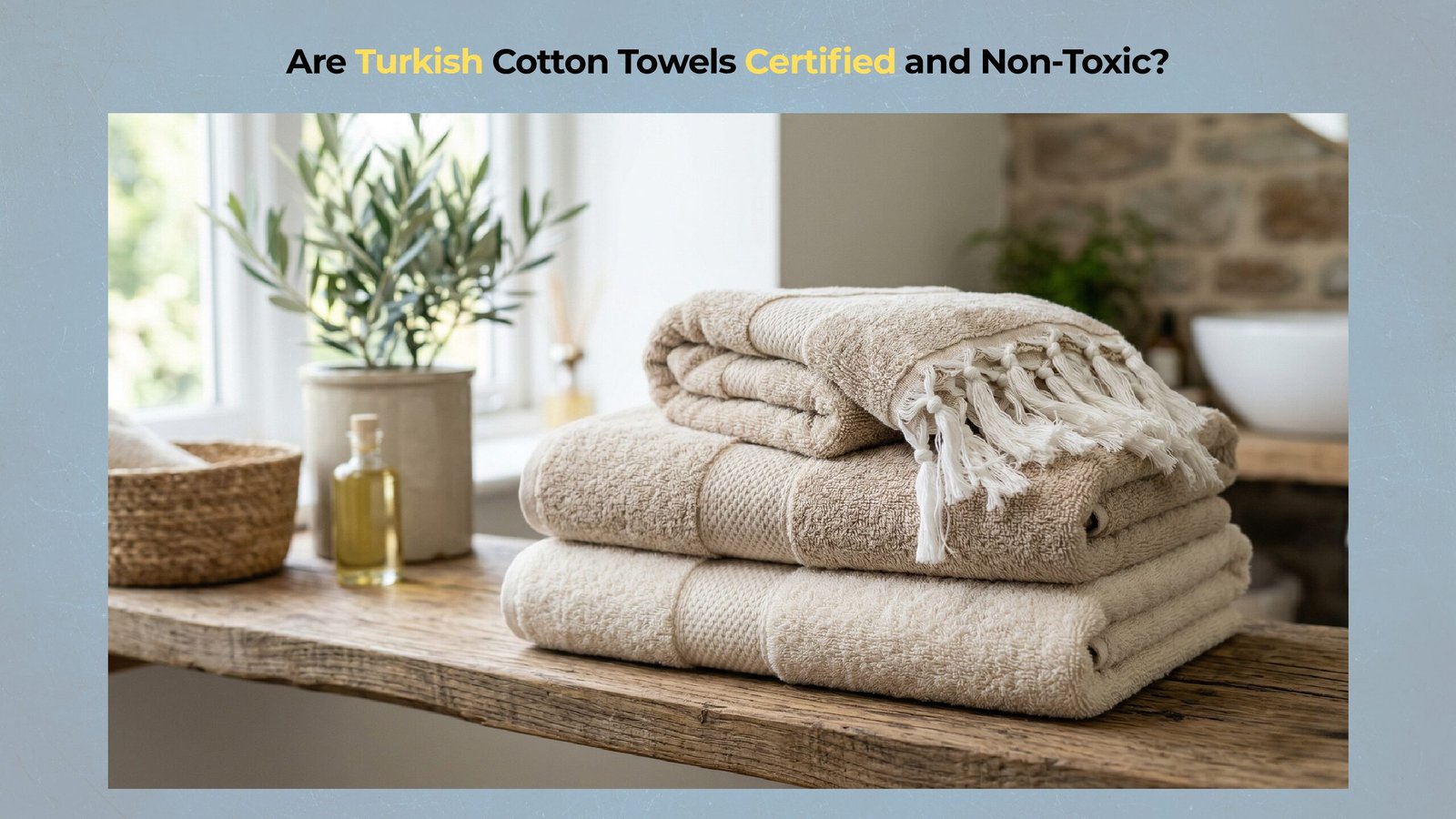
Are Turkish Cotton Towels Certified and Non-Toxic?
Yes, Turkish cotton towel certifications validate a non-toxic status for textiles labeled as organic Turkish cotton when adherence to Global Organic Textile Standard (GOTS) benchmarks ensures production without hazardous pesticides or synthetic chemicals.
Pesticides or synthetic chemicals are strictly prohibited during the cultivation of Aegean cotton destined for certified organic labels. This agricultural oversight prevents the bioaccumulation of toxic residues within the plant’s cellular structure before harvesting occurs.
These organic growing conditions produce eco-friendly and hypoallergenic properties ideal for sensitive skin by maintaining the integrity of the cotton’s natural wax layer. Without caustic chemical stripping during the growth phase, the fiber remains mechanically superior and biologically inert.
Task Fulfillment Statement
This guide audits the toxicological limits and regulatory frameworks of Aegean linens to verify Turkish cotton towel certifications and provide technical data on textile safety.
Safety in the high-end linen sector is governed by specific technical standards that move beyond marketing terminology into laboratory-verified thresholds.
What Technical Standards Define Turkish Cotton Towel Certifications?
Adhering to the “Social and Ecological” and “Human-Ecological” safety gates defines the technical standards for Turkish cotton towel certifications. To understand how these safety standards relate to real-world buying decisions, it helps to review what quality factors matter most when evaluating towels.
Safety gates serve as the subject for rigorous laboratory testing protocols. “Non-Toxic” constitutes a technical result of adhering to specific testing protocols like REACH or ISO, which measure molecular migration from the fabric to the human body.
Organic integrity is verified by GOTS organic benchmarks, which track the supply chain from the Turkish cotton fields to the final weaving facility.
How Do GOTS Organic Benchmarks Verify Turkish Cotton Towel Certifications?
Turkish cotton towel certifications reach the peak “Organic” tier when a minimum of 95% certified organic fiber content ensures the total exclusion of synthetic pesticides and GMOs from the supply chain.
GOTS 7.0 social and environmental criteria extend these protections to the manufacturing workforce. The standard requires that all chemical inputs, such as dyes and auxiliaries, be evaluated for their toxicological profile before they enter the production stream.
GOTS regulates dye-house wastewater treatment to establish a holistic environmental standard. This prevents the release of heavy metals and carcinogenic pigments into local Turkish ecosystems, preserving the purity of the surrounding water table.
[GOTS 7.0 Compliance] -> [prohibits hazardous processing inputs] -> [secures Turkish cotton towel certifications organic status].
What Are the Oeko-Tex Criteria for Turkish Cotton Towel Certifications?
Turkish cotton towel certifications prioritize human-ecological safety through the Oeko-Tex Standard 100, a protocol that screens the finished product for over 100 substances restricted by international health regulations. Since sustainability plays a major role in certification value, you may also want to understand how eco-friendly towel materials impact environmental and health safety.
Standard 100 Class I is the most stringent Oeko-Tex safety level safe for direct contact with infant skin (0-3 years). This class enforces the lowest possible ppm thresholds for substances like formaldehyde and extractable heavy metals.
[Oeko-Tex Standard 100 screening] -> [identifies restricted substance residues] -> [validates Turkish cotton towel certifications for dermal safety].
Why Do Turkish Cotton Towel Certifications Matter for Long-Term Health?
Protection against chronic epidermal inflammation and systemic toxin absorption results from Turkish cotton towel certifications, which restrict the mobility of harmful pigments and resins. Harmful pigments can leach from the towel during a hot shower, entering the body through open pores.
Azo dyes, if present in uncertified towels, can cleave into aromatic amines that are known carcinogens. By selecting certified Turkish linens, consumers eliminate this risk of mutagenic exposure during daily hygiene routines.
Health benefits are a direct function of mitigating contact dermatitis through the strict exclusion of industrial sensitizers.
How Do Turkish Cotton Towel Certifications Mitigate Contact Dermatitis Risk?
Turkish cotton towel certifications materially reduce the risk of contact dermatitis by strictly prohibiting the use of Azo dyes and allergenic finishing resins that trigger skin reactivity in sensitive users. To better understand how the fiber itself interacts with skin, you can explore what the fiber structure of Turkish cotton towels looks like at the microscopic level.
Dermatological data regarding textile-induced irritant contact dermatitis suggests that up to 10% of skin irritations can be traced back to laundry-based chemical residues. Certification ensures these triggers are absent from the fabric matrix.
Certified Aegean cotton excludes the formaldehyde resins found in cheaper textiles used for “easy-care” or wrinkle-free finishes. These resins are notorious for causing persistent skin redness and itching in humid bathroom environments.
[Absence of Azo pigments] -> [lowers epidermal reactivity] -> [optimizes Turkish cotton towel certifications for sensitive skin].
How Do Turkish Cotton Towel Certifications Reduce Endocrine Disruptor Risk?
Turkish cotton towel certifications provide a systemic safety barrier because verified textiles must exhibit phthalate and PFAS levels below the 0.1% by weight threshold established for endocrine safety. Since moisture interaction can influence chemical exposure, it is helpful to review what determines towel absorbency and how it affects skin contact performance.
Endocrine safety depends on restricting phthalates and PFAS that can migrate during towel use. Because washing and drying conditions affect this migration risk, it is useful to understand what care instructions should be followed to preserve towel safety and performance.
[Strict phthalate limits] -> [prevents hormone-disrupting molecular migration] -> [secures the systemic safety of Turkish cotton towel certifications].
Which Chemical Contaminants Are Strictly Limited by Turkish Cotton Towel Certifications?
Rigid laboratory thresholds for heavy metals and respiratory irritants define the chemical exclusion list within Turkish cotton towel certifications. Independent audits verify that no trace element exceeds human safety limits.
Toxicological Limit Matrix for Turkish Cotton Towel Certifications
| Substance | Class I Limit (Infant Safe) | Primary Health Impact | Regulatory Context |
|---|---|---|---|
| Formaldehyde | < 16 ppm | Respiratory / Carcinogenic | Standard 100 by OEKO-TEX |
| Azo Dyes | Zero (Prohibited) | Allergenic / Mutagenic | REACH Regulation |
| Heavy Metals | Trace (Lead < 0.2 ppm) | Neurotoxicity / Systemic | GOTS 7.0 / ISO 17050 |
| Phthalates | < 0.1% by weight | Endocrine Disruption | CPSIA Compliance |
What Are the Heavy Metal and Formaldehyde Limits for Turkish Cotton Towel Certifications?
Turkish cotton towel certifications ensure that lead, mercury, and free formaldehyde remain below detectable thresholds, providing a “Zero-Risk” profile for daily hygienic use.
Certification requires soil-to-loom traceability to prevent heavy metal entry from unverified fertilizers or contaminated irrigation water in the Aegean region. This traceability ensures that every gram of cotton is mapped to a compliant agricultural plot.
Selection depends on differentiating between OEKO-TEX and GOTS based on specific consumer priorities.
How Do You Differentiate Between Oeko-Tex and GOTS for Turkish Cotton Towel Certifications?
Selection between textile tiers results from comparing the human-ecological focus of Oeko-Tex against the full-lifecycle organic requirements of Turkish cotton towel certifications.
Certification Comparison Matrix for Turkish Cotton Towel Certifications
| Feature | Oeko-Tex Standard 100 | GOTS (Organic) |
|---|---|---|
| Primary Focus | Chemical Residue Safety | Fiber Origin & Ethical Labor |
| Organic Requirement | No (Applies to any fiber) | Yes (Minimum 70–95%) |
| Social Standards | Limited | Comprehensive (Fair Trade) |
| Dye Safety | High (Restricted list) | Extreme (Strict ecological list) |
How Do You Compare Safety Focus Using this Turkish Cotton Towel Certifications Matrix?
Turkish cotton towel certifications allow users to prioritize their values, whether the primary goal is finished product purity or full supply chain ethics. Because brand transparency often determines whether certifications are legitimate, it is useful to evaluate how towel brands influence trust, certification validity, and quality control.
The highest standard results from a “Dual-Certification” where both logos appear on the label. This represents the pinnacle of Turkish textile engineering, combining organic integrity with rigorous final-product screening.
Even certified textiles require specific laundry preservation steps to maintain their non-toxic status in the home.
Which Laundry Steps Preserve the Integrity of Turkish Cotton Towel Certifications?
Maintenance protocols that prevent the re-contamination of pure fibers with synthetic fragrances and silicone waxes preserve the original Turkish cotton towel certifications. Because washing and drying conditions affect this migration risk, it is useful to understand what care instructions should be followed to preserve towel safety and performance.
Wicking preservation is a consequence of additive avoidance, allowing the Aegean cotton to breathe and dry effectively between uses.
How Do You Execute the Initial Wash to Preserve Turkish Cotton Towel Certifications?
Turkish cotton towel certifications baseline levels are established by an initial wash using a pH-neutral, plant-based detergent to remove residual industrial “scents” without introducing synthetic allergens.
Heavy synthetic fragrances utilize phthalates as fixatives, which compromises the non-toxic status of the towel. Using fragrance-free options ensures the molecular purity of the organic cotton remains uncompromised by household chemicals.
[Fragrance-free detergents] -> [prevent phthalate contamination] -> [maintain Turkish cotton towel certifications integrity].
Why Must You Implement the “No-Softener” Rule for Turkish Cotton Towel Certifications?
Turkish cotton towel certifications for wicking efficiency and non-toxic safety are strictly compromised by liquid fabric softeners, which coat fibers in a hydrophobic silicone layer.
Liquid softeners are prohibited because Quaternary Ammonium Compounds (“Quats”) trigger dermal irritation and respiratory sensitivity. These compounds “glue” the cotton loops together, reducing the surface area available for water absorption.
How Do You Identify Fraudulent Claims and Greenwashing in Turkish Cotton Towel Certifications?
Terminal failure of the safety profile results from “Logo Fraud,” where marketing terms like “Natural” or “Eco-Friendly” mimic verified Turkish cotton towel certifications without legal accountability. These terms have no legal definition and often mask the use of conventional, pesticide-heavy cotton.
Verification of the textile requires an official database check. Without a specific license number, a “Natural” claim is scientifically meaningless.
What Are the Red Flags for Fake Turkish Cotton Towel Certifications?
Turkish cotton towel certifications are frequently imitated by generic labels like “Cotton-Rich” or “Sustainable,” which typically lack the third-party lab results required for verified safety.
A claim of “Turkish Cotton” without an OEKO-TEX or GOTS license number on the label constitutes an unverified claim. Authentic manufacturers always display their unique ID to facilitate consumer transparency.
How Do You Use the Turkish Cotton Towel Certifications Database Check?
Turkish cotton towel certifications validity is independently confirmed by entering the unique license number into the Oeko-Tex Label Check or GOTS Public Database.
To execute a “License Audit”: Locate the # on the tag → Visit the registry → Confirm active status. This three-step process is the only definitive way to ensure the textile meets the claimed safety benchmarks.
[Official registry auditing] -> [validates license legitimacy] -> [verifies authentic Turkish cotton towel certifications].
How Can You Restore the Baseline Purity of Your Turkish Cotton Towel Certifications?
Restoration of the non-toxic baseline for Turkish cotton towel certifications results from executing chemical resets that dissolve mineral calcification and factory residues. Since improper washing can degrade fiber performance, you may also want to review how cotton towel durability is affected by washing and repeated use.
Does a Natural Reset Restore the Turkish Cotton Towel Certifications Baseline?
Turkish cotton towel certifications purity regains its original neutral state if a warm cycle with 1 cup of white distilled vinegar effectively dissolves industrial residues.
This “Acid Reset” exfoliates the fiber surface to reveal the 100% cotton core. The acetic acid acts as a mild solvent for alkaline detergent buildup, restoring the fiber’s natural pH and absorbency.
[Acetic acid rinse] -> [neutralizes industrial pH] -> [restores Turkish cotton towel certifications baseline].
Audit Your Set with the Turkish Cotton Towel Certifications Checklist
Verification of current inventory is a consequence of auditing Turkish cotton towel certifications against industrial performance and safety benchmarks.
Checklist: Turkish Cotton Towel Certifications Quality Audit
Frequently Asked Questions About Turkish Cotton Towel Certifications
Do Turkish cotton towel certifications guarantee zero chemical presence?
No, Turkish cotton towel certifications validate that harmful substances remain below detectable and safe biological thresholds, rather than an absolute zero state. These standards allow for trace amounts of substances that the human body can safely process without endocrine or dermal disruption.
Is Oeko-Tex Standard 100 or GOTS superior for infant safety?
Oeko-Tex Standard 100 Class I is the specific benchmark for human-ecological safety in infants, whereas GOTS prioritizes organic fiber origin and full supply chain ethics. For immediate dermal safety on a newborn’s skin, Oeko-Tex Class I provides the most granular screening for residue mobility.
Can “greenwashing” mimic authentic Turkish cotton towel certifications?
Yes, marketing terms like “Eco-Friendly,” “Botanical,” or “Natural” are frequently utilized to mimic the safety profile of authentic Turkish cotton towel certifications without third-party lab verification. Only a visible, unique license number and official database listing confirm the non-toxic status of the textile.
How often should I perform a “Chemical Reset” on certified towels?
Executing a vinegar-based reset every 3 to 4 months typically maintains the original baseline of Turkish cotton towel certifications by removing mineral calcification from hard water. This periodic maintenance ensures the fibers remain porous and free of detergent residues that can trigger dermal sensitivity.
Disclaimer & Technical Notice
The information provided in this guide regarding Turkish cotton towel certifications is for educational and informational purposes only. It does not constitute medical advice or professional toxicological consultation. While the certifications mentioned (GOTS, OEKO-TEX) represent rigorous industrial safety gates, human biological reactions to textiles can vary based on individual health conditions and sensitivities. Always consult with a dermatologist or healthcare professional if you experience persistent skin irritation. Toweldaily.com is not responsible for variable biological outcomes resulting from the use of specific textile products.
Final Summary: Do Turkish Cotton Towel Certifications Meet Your Safety Standards?
Operationalizing a Turkish cotton towel certifications strategy typically results in a sustainable and generally more skin-compatible bathroom environment by prioritizing technical purity. While verified certifications result in a higher unit cost, they guarantee a significantly lower toxicological risk by eliminating carcinogenic and endocrine-disrupting inputs.
Ultimately, a superior bathroom experience is defined by the precise Turkish cotton towel certifications management that turns a high-performance fiber into a lasting, non-toxic household asset through technical care.