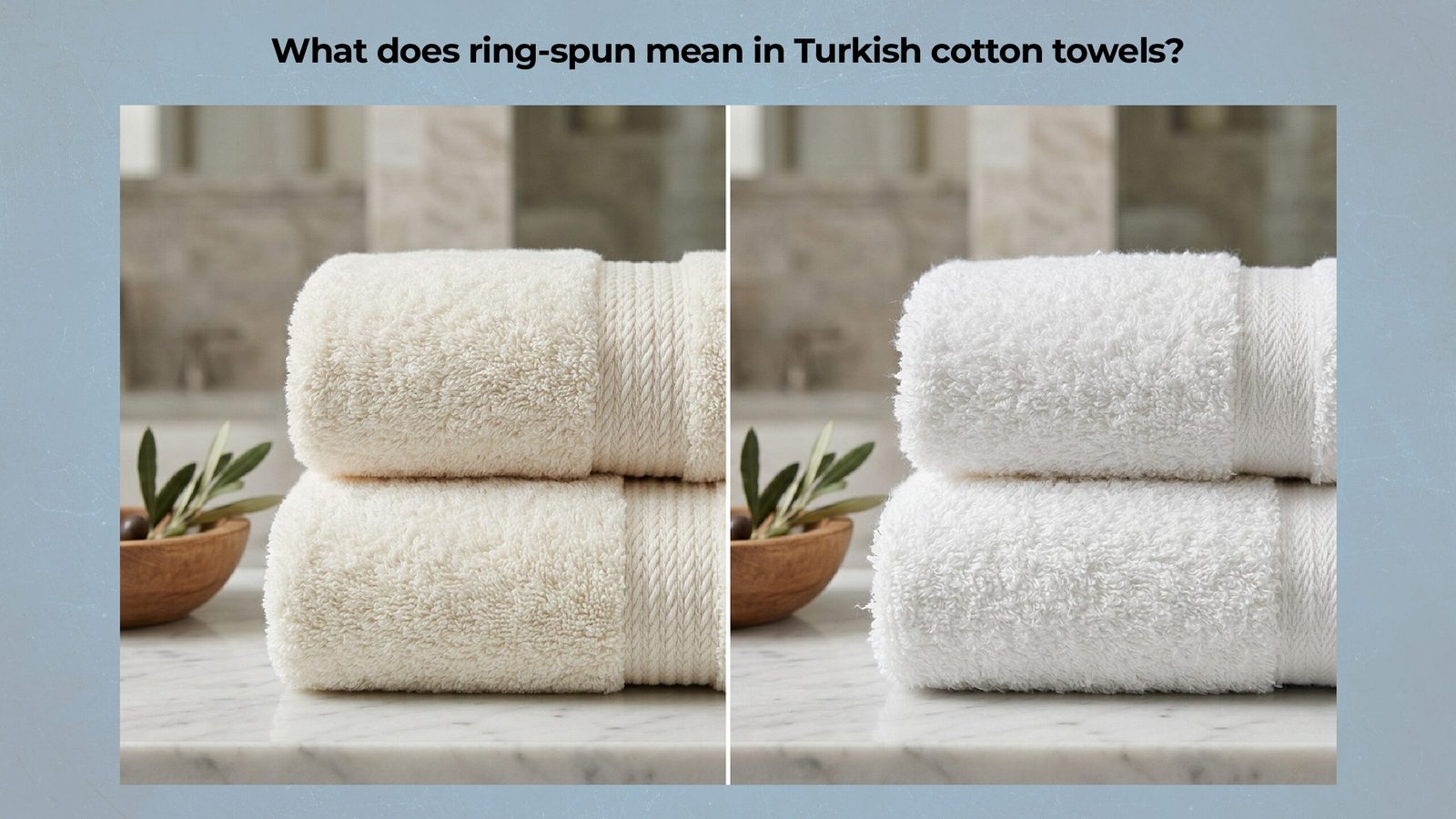
What does ring-spun mean in Turkish cotton towels?
A Technical Guide to Aegean Spinning Physics and Yarn Morphology
A high-performance equilibrium between tactile softness and tensile durability results from ring-spun Turkish cotton towel construction, which typically utilizes a mechanical frame to continuously thin and twist long-staple Aegean fibers. These fibers facilitate a drafting sequence that eliminates the loose alignment of open-end spinning. This absence of loose alignment secures the textile against mass loss and structural thinning, ensuring structural resilience factors are maintained over the product’s operational lifespan.
To better understand how this structural advantage fits into real-world towel selection, it is useful to explore how different towel types are designed for specific performance and usage scenarios.
Why is Ring-spun Turkish Cotton Towel Construction Stronger?
Inter-fiber friction and parallel alignment drive the structural resilience of ring-spun Turkish cotton towel construction. This structural resilience results from the spiral wrap of parallel fibers that creates a friction lock under tension. This friction lock prevents the loop-shredding and balding common in utility-grade cotton, as performance is governed by the continuous-twist mechanism.
Since this resilience is closely tied to yarn density and structural build, it is helpful to understand how towel weight influences durability, absorption, and overall performance.
How Does the “Continuous-Twist” Mechanism Drive Ring-spun Turkish Cotton Towel Construction?
Ring-spun Turkish cotton towel construction results from a mechanical frame that continuously thins the cotton roving while applying a uniform twist efficiency system to the yarn core. This twist efficiency system creates a consistent helix angle across the entire fiber length, adhering to the ISO 2060 standard for yarn linear density and twist determination. Continuous twisting removes the weak points common in “open-end” yarns where fibers are simply deposited and twisted without consistent tension.
Ring-spinning eliminates weak fiber alignment zones common in open-end yarns, resulting in a more stable yarn structure. To better understand how this compares to broader cotton constructions, you can explore how cotton towel absorbency and comfort vary based on fiber structure.
[Ring-spinning frames] → [apply uniform axial tension] → [optimize ring-spun Turkish cotton towel construction].
Analyzing the “Parallel-Friction Bond” in Ring-spun Turkish Cotton Towel Construction
Robust tensile strength in ring-spun Turkish cotton towel construction results from a parallel-friction bond where the increased surface area contact between long-staple fibers prevents yarn slippage. TPI (Twist Per Inch) in ring-spun yarns is typically 10–15% higher than in open-end yarns to ensure maximal friction locking. This mechanism secures the yarn against loop-shredding and ensures the structural integrity of the terry surface.
The continuous-twist mechanism in ring-spun Turkish cotton towel construction ensures uniform tension across the yarn. Because brand-level manufacturing standards often determine how well this process is executed, it is useful to evaluate how towel brands influence quality control and material consistency.
[Increased surface contact area] → [maximizes inter-fiber friction] → [secures ring-spun Turkish cotton towel construction strength].
How Do You Compare Twist Levels for Ring-spun Turkish Cotton Towel Construction?
Evaluating the degree of yarn twist determines the utility of ring-spun Turkish cotton towel construction by identifying the trade-off between softness and durability. This trade-off dictates the final performance profile of the textile, determining whether the product is optimized for plush luxury or industrial longevity.
| Twist Level | Tensile Strength (gpt) | Tactile Softness | Technical Result |
|---|---|---|---|
| Low Twist | Moderate (> 28) | Highest (Plush) | Maximum Bloom / Rapid Wicking |
| Medium Twist | High (> 32) | High (Balanced) | Standard Luxury Construction |
| High Twist | Highest (> 36) | Low (Crisp) | Industrial Durability / Exfoliating |
Why is Ring-spun Turkish Cotton Towel Construction Softer?
A reduction in surface irregularities and “hairy” ends typically dictates the tactile luxury of ring-spun Turkish cotton towel construction. This luxury originates from tightly binding long-staple fibers to reduce protruding tips. The absence of protruding tips facilitates a silk-like skin feel for sensitive epidermis, preventing the micro-abrasions common in utility-grade textiles.
Explaining “Join-Point” Reduction in Ring-spun Turkish Cotton Towel Construction
Improved skin compatibility results from ring-spun Turkish cotton towel construction because the long fibers typically require fewer “joins,” which limits the abrasive protruding tips on the yarn surface. A Join-Point is the overlapping zone where fibers are spliced together to form a continuous yarn; ring-spinning with long-staple Aegean cotton minimizes these splices significantly.
The reduction of join-points minimizes abrasive fiber ends, resulting in a smoother and more skin-friendly surface. Since this directly affects user comfort, you may also want to understand how softness factors influence towel comfort and skin feel in daily use.
[Long-staple fiber usage] → [minimizes join-point density] → [optimizes ring-spun Turkish cotton towel construction softness].
What Causes the “Bloom” Effect in Ring-spun Turkish Cotton Towel Construction?
Significant volumetric expansion typically results from ring-spun Turkish cotton towel construction after the initial wash as the mechanical tensions of the spinning frame release and the loops stand upright. This “Bloom” effect acts as a structural re-inflation of the fibers, increasing wicking surface area without adding mass.
The “Bloom” effect increases loop expansion and improves surface area for moisture interaction after washing. Because towel size and surface coverage influence drying efficiency, it is useful to review how towel size impacts usability, drying performance, and comfort across different applications.
Ring-Spun vs. Open-End: Which is Better for Ring-spun Turkish Cotton Towel Construction?
Selection of the ideal inventory requires a comparative audit of ring-spun Turkish cotton towel construction against the loose, random alignment of open-end utility textiles. The tight, parallel structure of ring-spun yarn offers 100% higher mechanical integrity in industrial wash cycles.
| Spinning Method | Fiber Alignment | Tactile Feel | Durability Rank |
|---|---|---|---|
| Ring-Spun | Parallel / Tight | Very Soft / Silky | 1 (Highest) |
| Combed Only | Parallel (No twist) | Soft but weak | 2 |
| Open-End | Random / Loose | Rough / Scratchy | 3 (Lowest) |
Identifying the “Durability ROI” of Ring-spun Turkish Cotton Towel Construction
A high return on investment (ROI) results from ring-spun Turkish cotton towel construction, as the mechanical lifespan typically exceeds that of open-end towels by 100% in high-turnover settings.
Ring-spun Turkish cotton towel construction provides higher durability compared to loosely aligned yarns. For a deeper understanding of how fiber structure affects long-term wear, you can explore how cotton towel durability is affected by washing and repeated use.
Formula: Unit Price / (Estimated Wash Cycles) = Cost-Per-Use (CPU).
Paying a premium for ring-spun yarn results in a lower CPU over a three-year period because the structural integrity of the loops prevents premature thinning.
Which Laundry Steps Preserve Ring-spun Turkish Cotton Towel Construction?
Maintenance protocols that protect the fiber alignment structure preserve the integrity of ring-spun Turkish cotton towel construction. This integrity is maintained by avoiding high-heat wash cycles that trigger fiber contraction. Preventing contraction secures the original TPI (Twist Per Inch) for consistent wicking and prevents loop collapse.
Maintenance protocols preserve the twist integrity and fiber alignment of ring-spun Turkish cotton towel construction. Since environmental impact is also influenced by washing practices, it is useful to evaluate how eco-friendly towel care and materials affect sustainability over the product lifecycle.
How to Prevent Filament Fraying in Ring-spun Turkish Cotton Towel Construction?
Preservation of surface sheen in ring-spun Turkish cotton towel construction results from avoiding high-heat wash cycles that can cause the tightly-wound fibers to contract and untwist. Strictly recommend wash temperatures below $104^{\circ}F$ ($40^{\circ}C$) to maintain the mechanical lock of the twist.
[Controlled wash temperatures] → [maintain twist tension] → [prevent pilling in ring-spun Turkish cotton towel construction].
Does Low-Heat Drying Preserve Ring-spun Turkish Cotton Towel Construction?
Protection of ring-spun Turkish cotton towel construction results from maintaining mechanical drying temperatures on “Low” to inhibit the thermal snapping of fine fibers. Mandate the use of wool dryer balls to provide mechanical “fluffing” that assists the bloom without exceeding safe thermal thresholds.
When Does Ring-spun Turkish Cotton Towel Construction Fail?
Terminal failure of ring-spun Turkish cotton towel construction occurs when oxidative chain scission or cumulative mineral calcification neutralizes the textile’s mechanical flexibility. Cumulative damage from chemical agents eventually leads to twist failure, evidenced by high lint production.
Identifying “Twist Failure” in Ring-spun Turkish Cotton Towel Construction
Excessive surface linting typically signals a failure of the ring-spun Turkish cotton towel construction, often indicating that aggressive bleaching has weakened the twist efficiency system. When the “friction lock” breaks, short fibers escape the yarn core, resulting in a visible thinning of the terry loops.
Why is Mineral Stiffening a Threat to Ring-spun Turkish Cotton Towel Construction?
Increased snapping risk results from ring-spun Turkish cotton towel construction being compromised by mineral calcification, where calcium ions fill the air gaps between parallel fibers. This leads to Cellulose Hornification: the irreversible loss of fiber flexibility caused by mineral bonding and excessive thermal stress.
How Can You Restore Ring-spun Turkish Cotton Towel Construction Softness?
Restoration of ring-spun Turkish cotton towel construction results from executing chemical resets to remove mineral residues and restore the parallel fiber alignment. These resets target waxy buildup and calcium deposits specifically.
Restoring Luster to Ring-spun Turkish Cotton Towel Construction Using the “Vinegar Reset”
Recovery of fiber flexibility and ring-spun Turkish cotton towel construction results from a warm vinegar rinse that dissolves the alkaline mineral films responsible for fiber brittleness. Run one warm cycle with 1 cup of white distilled vinegar; the acetic acid exfoliates the fiber surface to restore its natural wicking velocity.
[Acetic acid] → [dissolves mineral deposits] → [restores ring-spun Turkish cotton towel construction luster].
Audit Your Set with the Ring-spun Turkish Cotton Towel Construction Checklist
Verification of current inventory is a consequence of auditing ring-spun Turkish cotton towel construction against industrial performance benchmarks.
Checklist: Ring-spun Turkish Cotton Towel Construction Quality Audit
Frequently Asked Questions
The primary benefit is superior tensile strength and tactile smoothness. By thinning and twisting fibers continuously, the yarn becomes tighter and more durable than utility-grade alternatives.
If towels feel scratchy or stiff, a vinegar reset should be performed every 4–6 weeks to dissolve mineral deposits and restore the fiber bloom.