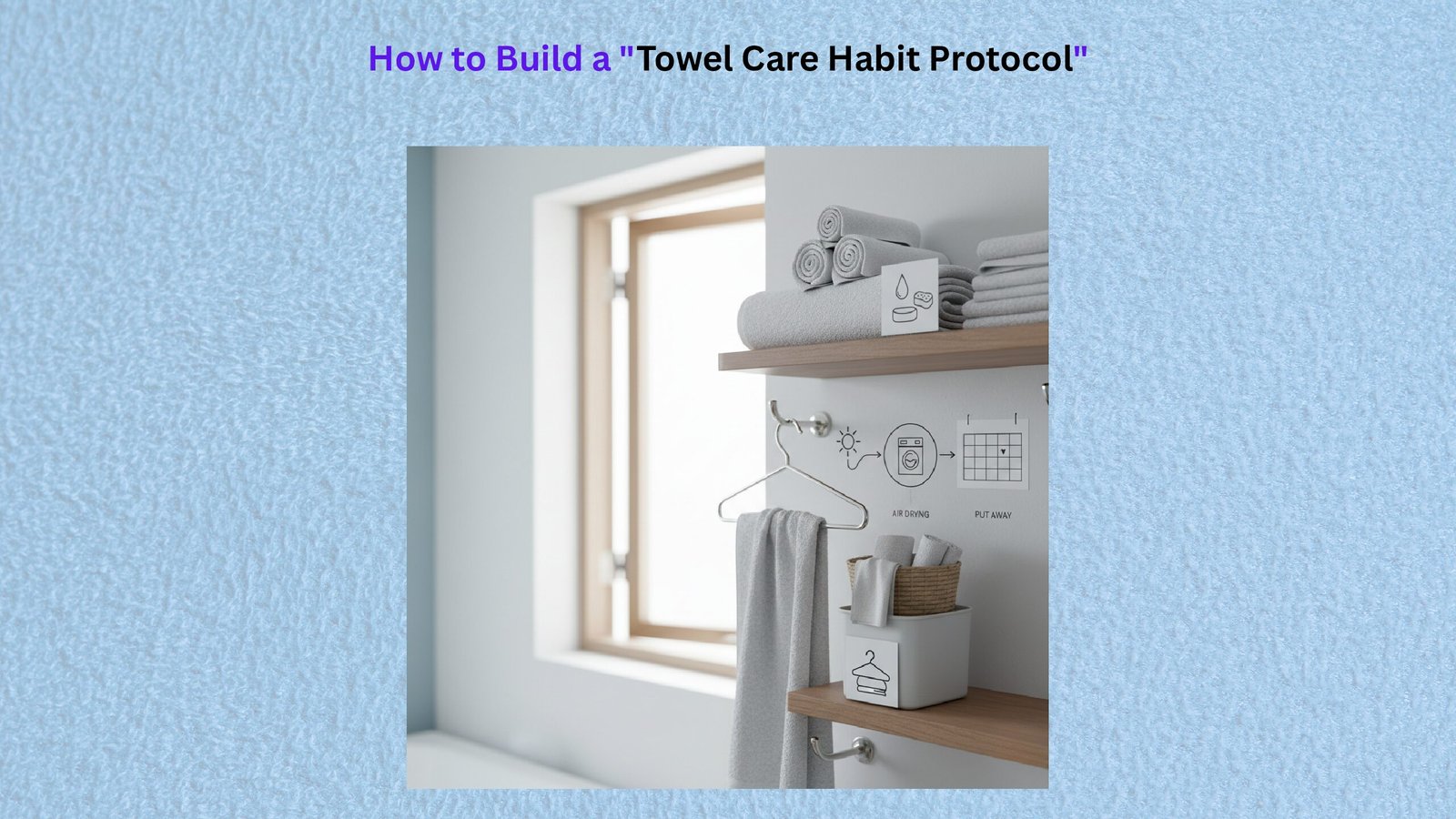
How to Build a “Towel Care Habit Protocol”
(And Keep Towels Soft Forever)
A Towel Care Habit Protocol is a behavioral system designed to overcome “laundry laziness” by installing a “Minimum Viable Habit” (MVH) that keeps towels soft, fresh, and hygienic forever.
Most consumers desire spa-quality softness but rely on willpower to execute the necessary laundry steps. Willpower inevitably drains, leading to “laundry laziness” where shortcuts compromise fabric integrity.
A robust protocol ignores motivation and uses “Habit Stacking” to make the correct technical execution the path of least resistance. This article will guide you step-by-step to build your own Towel Care Habit Protocol, anchor it to an existing routine, and execute the “Perfect Towel Load” consistently.
Why You Need a “Towel Care Habit Protocol” to Overcome Laundry Laziness
You need a Towel Care Habit Protocol because relying on willpower is an unreliable strategy; you need a system to overcome the friction of correct laundry care. “Laundry laziness” acts as the primary antagonist in home hygiene, manifesting when the brain seeks energy conservation over process adherence.
An established protocol bypasses this mental friction by automating the decision-making process. Building a “Minimum Viable Habit” (MVH) ensures that even on low-energy days, the essential standards for fabric maintenance remain non-negotiable.
How Does the “Minimum Viable Habit” Work in Your Towel Care Habit Protocol?
The “Minimum Viable Habit” (MVH) works in your Towel Care Habit Protocol by defining success as just one dedicated load per week, making the routine “too small to fail.” This approach leverages the behavioral psychology principle of momentum.
The “Perfect Towel Load” is defined as exactly one dedicated wash cycle per week resulting in a “too small to fail” routine that builds momentum. By shrinking the commitment to a single, high-quality execution, you eliminate the psychological barrier of “doing laundry” and replace it with a manageable, specific task.
Why Is “Laziness” the Main Enemy of Your Towel Care Habit Protocol?
“Laziness” is the main enemy of your Towel Care Habit Protocol because relying on willpower leads to shortcuts, such as mixing towels with clothing. These shortcuts degrade textile performance rapidly.
Mixing Towels with Jeans happens when we rely on willpower instead of a pre-decided system, resulting in fabric abrasion, pilling, and ruined softness. A protocol removes the option to mix loads, protecting the loop structure of your terry cloth from the abrasive hardware found on denim and general apparel.
How to Anchor Your “Towel Care Habit Protocol” to an Existing Routine
To anchor your Towel Care Habit Protocol, you must use “Habit Stacking” to link the new behavior to an existing, automatic trigger. Behavioral science dictates that willpower is a finite resource that depletes throughout the week. To bypass this depletion, you must utilize the “After I…” formula, grafting the new towel care steps onto a habit that already exists in your neural pathways. This transforms the new task from a conscious decision into an automatic reflex.
How to Define the “Trigger” for Your Towel Care Habit Protocol
You define the “Trigger” for your Towel Care Habit Protocol by identifying a non-negotiable weekly event that acts as the “Start” button for your laundry. This trigger removes the ambiguity of “when” to wash towels. Stripping the Beds on Saturday acts as an automatic “Anchor” or prompt, triggering the immediate start of your “Perfect Towel Load.” Without a precise trigger, the task floats in your schedule, vulnerable to procrastination and eventual neglect.
Select Your Strong Anchor
Choose one of these existing habits to serve as the immutable starting gun for your protocol:- “After I strip the beds on Saturday morning, I will immediately start the towel load.”
- “After I take my last clean towel from the shelf, I will immediately transport the dirty hamper to the washer.”
- “After I get home from grocery shopping on Sunday, I will immediately sort the towels into the drum.”
How to Execute the “Perfect Load” Checklist in Your Towel Care Habit Protocol
Executing the “Perfect Load” checklist is the core technical step of your Towel Care Habit Protocol that ensures hygiene and softness every single time. This standard operating procedure (SOP) guarantees that every wash cycle contributes to the longevity of your textiles rather than their degradation. This checklist must be performed consistently to earn the “X” on your streak tracker, preventing the gradual slide into poor habits.
The 7-Step “Perfect Load” Checklist
How to Track Consistency in Your “Towel Care Habit Protocol”
Tracking consistency in your Towel Care Habit Protocol creates a visual feedback loop that reinforces the “Don’t Break the Chain” psychology. Popularized by Jerry Seinfeld, this method utilizes visual streaks to generate psychological cost for missing a session. Seeing a continuous row of completed actions motivates adherence better than abstract goals. Use the matrix below to visualize your adherence to the protocol.
“Don’t Break the Chain” Streak Tracker
Mark an ‘X’ only if you completed a “Perfect Load.”
How to Refine Your “Towel Care Habit Protocol” Using a System Debrief
Refining your Towel Care Habit Protocol requires a “System Debrief” to analyze the habit mechanics and remove friction points. This section focuses on Metacognition—analyzing the habit itself, not just the laundry execution. If a week is missed, the failure lies in the system design, not your personal character. A diagnostic approach allows you to engineer a more robust environment for the next cycle.
System Debrief Log
How to Apply “Kaizen” to Your Towel Care Habit Protocol
Applying “Kaizen” (continuous improvement) to your Towel Care Habit Protocol means making small “Environmental Design” tweaks to remove future friction. We solve behavioral problems by altering the physical environment rather than demanding more mental effort. Forgetting Vinegar is solved by adding it to a permanent grocery list app (Environmental Design), resulting in a bulletproof system for the next cycle.
Protocol Disclaimer & Limitations
For Diagnostic Use Only.
This protocol is designed to identify common household laundry issues. Severe fabric degradation may be permanent and unfixable. Always check your towel manufacturer’s care label before applying high heat or chemical treatments.What is the Key Takeaway?
The key takeaway is that Loss of Towel Softness is not one problem, but three distinct failure mechanisms. By comparing these three protocols, you can get a definitive, data-driven answer to why you are experiencing a loss of towel softness and prove exactly how to fix it.
Diagnostic Complete
You have successfully moved from guessing and marketing claims to empirical, data-driven proof.