How Are Turkish Cotton Towels Constructed at the Yarn Level?
An architectural audit of Aegean spinning physics, structural ply integrity, and volumetric bloom dynamics.
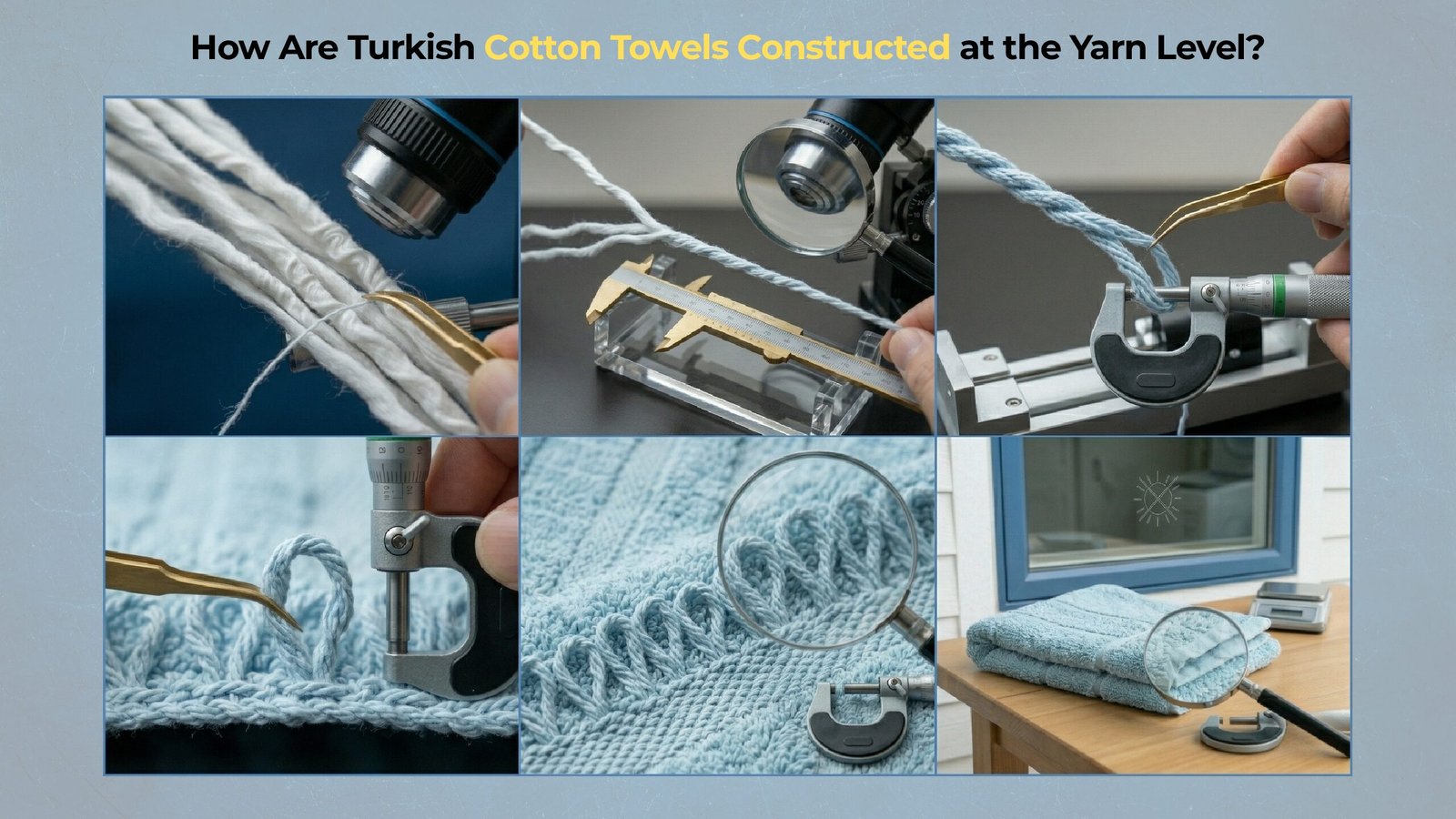
A high-performance equilibrium between tactile loft and tensile durability results from Turkish cotton towel yarn construction, which typically utilizes ring-spun long-staple fibers to optimize air-pocket volume. By aligning long-staple fibers in a parallel orientation, manufacturers can facilitate low-twist spinning that minimizes internal tension. This guide audits the spinning physics and structural integrity of Aegean fibers to verify Turkish cotton towel yarn construction and provide technical data on its absorbency and lifespan. Technical verification begins with the botanical origin of the fiber.
What Defines the Technical Profile of Authentic Turkish Cotton Towel Yarn Construction?
Auditing the relationship between long-staple Aegean fibers and the mechanical formation of the initial yarn sliver verifies the Turkish cotton towel yarn construction. Since fiber length directly impacts yarn performance, you may also want to explore how long-staple Turkish cotton fibers influence durability and drying efficiency. The utilization of fibers measuring 29.5–32 mm is necessary to maintain a stable yarn matrix during the high-speed spinning process. Consequently, this regional fiber density secures the yarn’s breaking resistance even when twist counts are kept intentionally low. Material quality is a consequence of botanical origin.
Identifying the Botanical Origin of Turkish Cotton Towel Yarn Construction
Superior yarn formation length results from Turkish cotton towel yarn construction because the specific cell-wall density of Aegean Gossypium hirsutum provides the foundation for high-tenacity spinning. Referencing the Nazilli 84 cultivar, we find a benchmark for regional fiber homogeneity. While the Mediterranean sun accelerates the plant’s metabolic cycles, the alluvial soil of the Meander Basin ensures the secondary cell wall matures with high crystalline cellulose content.
Does the “Combing” Standard Impact Turkish Cotton Towel Yarn Construction?
High tensile integrity results from this spinning method when manufacturers implement a combing process to remove short fibers and impurities from the fiber sliver. To understand how these structural improvements affect long-term usage, it is important to evaluate how durability factors influence towel lifespan and resistance to wear over repeated laundering cycles. Combing is the mechanical removal of “noils” (short fibers < 12.5 mm) to ensure high yarn uniformity and reduced shedding.
What Causes the “Bloom” Effect in Turkish Cotton Towels?
The physical expansion or “Bloom” of the loops results from Turkish cotton towel yarn construction, which leverages low-twist spinning to maximize the internal air-pocket volume of the yarn. Since this directly affects moisture handling, it is helpful to review what determines towel absorbency and moisture retention performance in different materials. Low TPI ratios prevent the over-compression of fiber bundles, allowing them to separate and expand after initial moisture saturation. This results in a distinctive increase in tactile softness and wicking speed during regular use. Wicking performance is a function of the low-twist ROI.
Identifying the “Low-Twist” ROI of Turkish Cotton Towel Yarn Construction
A significant increase in volumetric loft typically results from this yarn structure because long fibers may require fewer twists per inch (TPI) to maintain structural security. Because drying efficiency depends on this structure, you may also want to explore how quick-dry performance impacts towel usability and hygiene in real-world conditions. Per ISO 2060 standards, low-twist yarns typically utilize a twist multiplier (α) between 3.2 and 3.6. As the towel enters the drying phase, the lack of mechanical torque allows the Aegean fibers to “relax” and re-inflate, creating the plush profile sought in luxury hospitality.
How Does the Yarn Profile Determine Moisture-Transit Efficiency?
Rapid wicking velocity results from Turkish cotton towel yarn construction due to internal air channels that facilitate moisture movement. For a broader comparison of moisture transport behavior, you can review how cotton towel absorbency and comfort vary based on fiber structure. According to AATCC 199 drying-rate benchmarks, these porous yarn profiles act as high-speed conduits. This ensures that moisture moves to the textile surface for immediate atmospheric release, preventing the “damp towel” odor common in denser constructions.
Why are Turkish Cotton Towels Strong at the Yarn Level?
The physics of inter-fiber friction and ply-bonding drive the mechanical strength of Turkish cotton towel yarn construction. Since thickness and density influence these properties, it is useful to understand how towel thickness impacts durability, drying time, and structural stability. Overlapping 30–35 mm fibers create a natural friction lock that resists yarn slippage. This secure foundation prevents loop-shredding and mass loss during the high-velocity agitation of commercial laundering. Yarn security is governed by the inter-fiber bond.
Understanding the “Inter-Fiber Bond” in Turkish Cotton Towel Yarn Construction
Robust friction bonds results from Turkish cotton towel yarn construction because 30–35 mm fibers overlap more significantly than standard cotton to prevent yarn slippage. Inter-Fiber Friction is defined as the mechanical resistance that prevents individual fibers from sliding past one another under tension.
| Yarn Profile | Bond Strength | Performance Result | Durability Rank |
|---|---|---|---|
| Single-Ply / Low-Twist | High (LS fiber locked) | Peak Bloom / Softness | High |
| Two-Ply / High-Twist | Highest (Double-bonded) | Industrial Strength | Elite |
| Short-Staple / Carded | Low (Slippage prone) | High Linting / Thinning | Poor |
Is Turkish Cotton Towel Yarn Construction Superior to Egyptian and Pima?
Selection between premium yarns results from comparing Turkish cotton towel yarn construction against the high-density profiles of Egyptian Giza and American Pima. While Egyptian ELS fibers excel in “Extreme Saturation” and absolute strength, Turkish LS yarns provide a “Balanced Turnover” that allows for significantly faster drying times.
| Tier | Ply | Twist | Primary Benefit |
|---|---|---|---|
| Luxury Plush | Single-Ply | Low | Maximum Loft / Balanced Drying |
| Hotel Grade | Two-Ply | Moderate | High Tensile Strength / Longevity |
| Utility Grade | Single-Ply | High | High Exfoliation / Fast Drying |
Which Laundry Steps Preserve Turkish Cotton Towel Yarn Construction?
Operational Summary: Long-term yarn health results from maintenance protocols that protect Turkish cotton towel yarn construction from oxidative chain scission and thermal singeing. To maintain optimal performance, it is essential to follow proper care instructions for maintaining towel fiber integrity across repeated use.
How Do You Prevent Yarn Brittleness in Turkish Cotton Towels?
Permanent tensile loss results from treating this yarn structure with chlorine bleach, which induces the oxidative breakage of cellulose polymer chains. We strictly recommend hydrogen peroxide or oxygen-based whiteners to maintain the original yarn formation length.
Implementing “Thermal Guard” Protocols for Turkish Cotton Towel Yarn Construction
Protection of this construction method results from maintaining mechanical drying temperatures below 120°F (49°C) to inhibit the microscopic cracking of the yarn surface. High heat can cause the yarn surface to singe, destroying the natural luster of Aegean LS cotton and resulting in a scratchy tactile profile.
How Can You Restore Matted Yarn Construction?
Restoration of Turkish cotton towel yarn construction results from executing chemical resets to remove mineral residues and mechanical agitation to separate matted pile. Recovery of yarn flexibility and Turkish cotton towel yarn construction results from a warm vinegar rinse that dissolves the alkaline mineral films responsible for fiber brittleness. Running one warm cycle with 1 cup of white distilled vinegar allows the acetic acid to exfoliate the yarn surface and restore wicking velocity.
Technical FAQ
The long staple length (29.5–32 mm) provides a significantly higher surface area for inter-fiber friction. This allows the yarn to maintain its structural integrity under lower Twist-Per-Inch (TPI) counts, facilitating the porous structure necessary for the “Bloom” effect.
Inversely, high-twist construction typically reduces absorbency by compacting the fibers and eliminating internal air pockets. Turkish cotton towel yarn construction relies on low-twist multipliers (α 3.2–3.6) to ensure rapid moisture wicking and atmospheric release.
Two-ply construction is superior for industrial tensile strength and edge-integrity; however, single-ply Turkish yarn is often preferred for guest comfort as it facilitates a superior “Bloom” and faster drying cycles in commercial laundry environments.
Quality Audit Checklist
- Material Audit: Does the label confirm “100% Combed Aegean Cotton”?
- Spinning Check: Is the yarn “Ring-Spun” (indicated by surface smoothness and natural luster)?
- Bloom Test: Do the loops exhibit a visible increase in loft after the wash?
- Certification Check: Does the product carry GOTS 7.0 or OEKO-TEX Standard 100 verification?