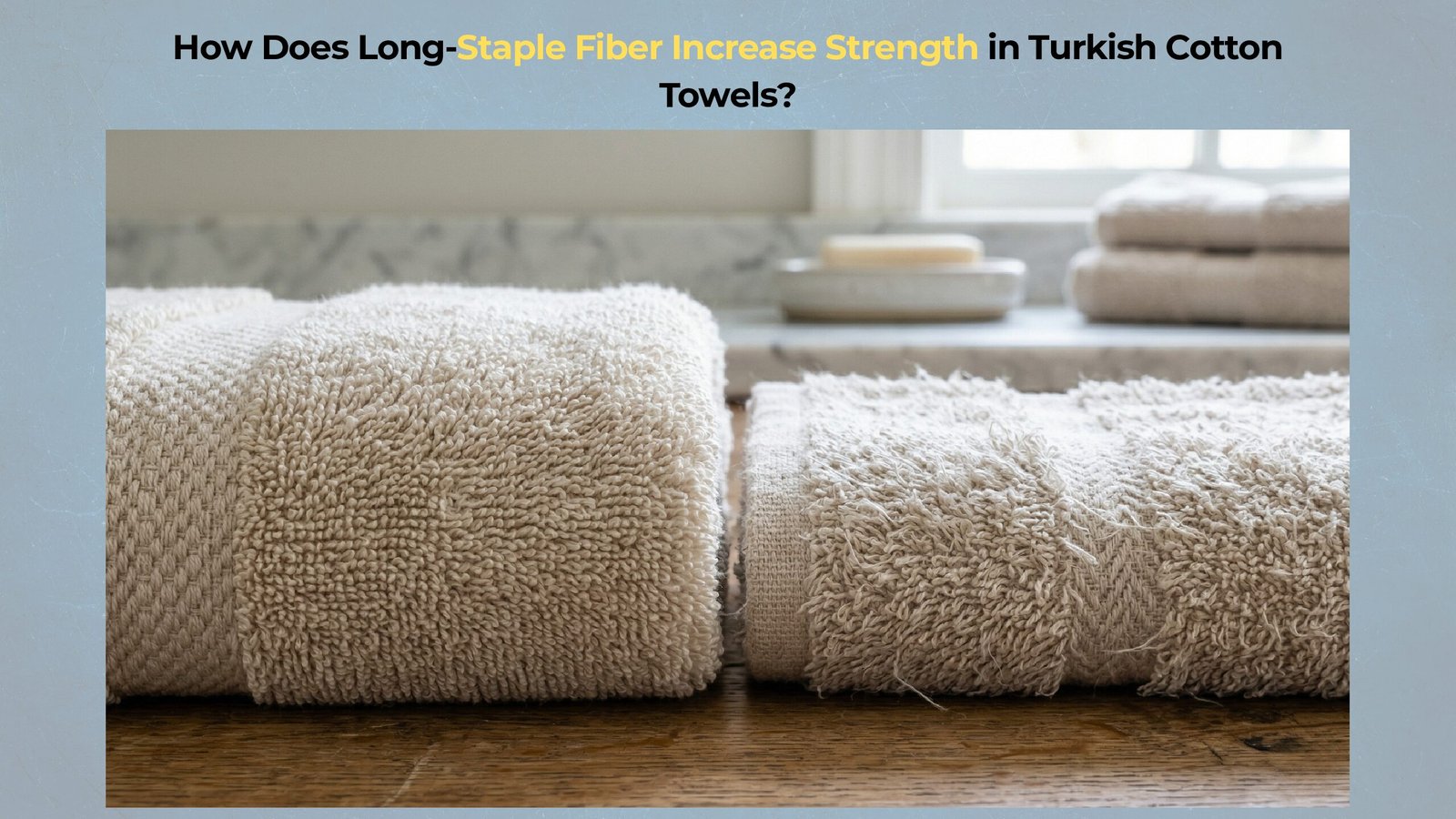
How Does Long-Staple Fiber Increase Strength in Turkish Cotton Towels?
Superior wicking efficiency and structural endurance result from the Turkish cotton towel long-staple strength, which typically benchmarks Aegean fibers between 29.5 mm and 31.0 mm to optimize moisture turnover and lifecycle ROI. The 29.5–31.0 mm UHM length maximizes inter-fiber friction by increasing the total overlapping surface area within the yarn core. This secures a 200+ cycle industrial durability verified under ISO 6330, establishing a baseline for luxury linen endurance. Superior textile quality is a direct result of the Turkish cotton towel staple length, which dictates the density of exposed fiber ends and yarn stability. Since overall quality depends on multiple structural variables, it is important to understand what determines towel quality and long-term performance beyond fiber length alone.
Technical Directive:
This guide audits the yarn physics and mechanical stress limits of Aegean cotton to verify the Turkish cotton towel long-staple strength and provide technical data on its industrial lifespan. Textile quality is a direct result of technical profiling.
What Defines the Technical Profile of Turkish Cotton Towel Long-Staple Strength?
Auditing the geographic source and the specific millimetric Upper Half Mean (UHM) of the fiber verifies the Turkish cotton towel long-staple strength. The Nazilli 84 cultivar requirement dictates fiber homogeneity by ensure a consistent micronaire and tensile profile across the harvest. Identifying regional authenticity as the driver of tensile resilience is critical for procurement accuracy in the luxury market.
Classification is a consequence of botanical origin.
Identifying the Botanical Origin of Turkish Cotton Towel Long-Staple Strength
Superior tensile resilience results from the Turkish cotton towel long-staple strength because the Aegean Gossypium hirsutum variety develops specific cell-wall thicknesses influenced by the region’s consistent solar cycle and soil nutrition. The Nazilli 84 cultivar serves as the benchmark for regional fiber homogeneity, benefiting from hand-harvesting protocols that prevent the mechanical fiber breakage common in machine-picked upland cotton. This preservation maintains the full 30 mm+ staple length required for high-stress applications.
Determining the Staple Classification for Turkish Cotton Towel Long-Staple Strength
Technical Long-Staple (LS) classification is a consequence of the Turkish cotton towel long-staple strength meeting the Upper Half Mean (UHM) threshold of 29.5 mm to 33.3 mm. This differentiates Aegean fibers from “Standard Upland” cotton, which typically falls below 25 mm, and “Extra-Long Staple” (ELS) varieties that exceed 34.9 mm. A critical metric in this classification is the Uniformity Index (UI)—defined as the ratio between the mean length and the upper half mean length—which must reach 82% to 85% to ensure consistent yarn tenacity. High pilling resistance results from the Turkish cotton towel staple length because longer fibers reduce exposed fiber tips and join-points. To better understand how durability is influenced by these structural factors, you can explore how durability factors impact towel lifespan and resistance to wear over repeated use.
Why Does Turkish Cotton Towel Long-Staple Strength Define the Lifespan of Luxury Linens?
The functional service life of linens results from the Turkish cotton towel long-staple strength, which dictates the rate of mass loss and yarn-crashing resistance. High tenacity directly correlates to the reduction of fiber mass loss during high-G extraction cycles in industrial laundering. This results in a 20% to 30% reduction in annual replacement expenditures for hospitality assets.
Economic value is a function of Cost-per-Wash ROI.
Identifying the “Cost-per-Wash” ROI of Turkish Cotton Towel Long-Staple Strength
A 20% to 30% reduction in annual replacement expenditures results from the Turkish cotton towel long-staple strength when compared to a 12-month utility-grade replacement cycle. Using ISO 6330 laundering protocols, Aegean fibers demonstrate verified industrial lifecycles of 200–250 wash cycles. This durability creates a cost-per-use denominator that is often 50% lower than standard Upland towels which typically fail via thinning or pilling within 50 cycles. A verifiable industrial lifecycle of over 200 wash cycles is a consequence of the Turkish cotton towel staple length, supported by strong inter-fiber cohesion. Since thickness and density influence both durability and drying speed, it is helpful to understand how towel thickness impacts performance, drying time, and structural stability.
Determining the Tensile Stress Limits for Turkish Cotton Towel Long-Staple Strength
Resistance to high-RPM centrifugal force results from the Turkish cotton towel long-staple strength, which allows the weave to withstand extraction forces up to 1,200 RPM without structural tearing or loop distortion. Breaking strength for premium Aegean fibers typically meets or exceeds 50 lbs-force as verified under ASTM D5034 grab testing standards. Tensile tenacity typically exceeds 30 g/tex, allowing individual loops to absorb extreme spin-cycle kinetic energy without fiber rupture.
How Do Molecular Physics Drive the Mechanical Advantage of Turkish Cotton Towel Long-Staple Strength?
Inter-fiber friction and optimized yarn twist multipliers drive the mechanical advantage of the Turkish cotton towel long-staple strength. Overlapping surface area creates a friction bond that prevents individual fibers from sliding past one another under tension. This molecular interlocking ensures yarn stability under tension, even with low twist counts that prioritize softness.
Yarn security is governed by the overlapping surface area.
Understanding the “Overlapping Surface Area” in Turkish Cotton Towel Long-Staple Strength
Robust inter-fiber bonding results from the Turkish cotton towel long-staple strength because the 30 mm+ fiber profile typically increases the surface area contact required for molecular inter-yarn adhesion. A Friction Bond is the mechanical interlocking of fibers achieved through surface contact and yarn torsion; the longer the staple, the higher the cumulative frictional resistance within the yarn core. Superior initial wicking results from the Turkish cotton towel staple length, which absorbs more water during the drying-off phase while still enabling fast evaporation. To compare this behavior with other cotton constructions, you can explore how cotton towel absorbency and comfort vary by fiber structure.
Determining the Role of “Twist Efficiency” in Turkish Cotton Towel Long-Staple Strength
A superior strength-to-softness ratio results from the Turkish cotton towel long-staple strength because longer fibers require a lower twist multiplier to achieve stable structural security. Using Koechlin’s Equation ($T_m = \alpha \cdot \sqrt{Ne}$), we can quantify the relationship between twist and tenacity. High-strength LS fibers typically utilize a twist multiplier ($\alpha$) between 3.2 and 3.8, whereas standard cotton requires $\alpha > 4.2$ to maintain integrity, which results in a harsher hand-feel.
How Does Turkish Cotton Towel Long-Staple Strength Compare to Egyptian and Pima Cotton?
Optimal durability-to-dryness ratios result from comparing the Turkish cotton towel long-staple strength against the absolute tenacity of Giza and Pima varieties. While Egyptian ELS provides maximum tensile density, Turkish LS fiber maintains a more porous structure that facilitates faster desiccation. This identifies the ideal balance for high-humidity environments where bacterial suppression is paramount. The “Goldilocks” equilibrium between high absorbency and rapid evaporative efficiency results from the Turkish cotton towel staple length. When evaluating how this balance fits into real-world buying decisions, it is helpful to review how towel material affects absorbency, durability, and drying performance across different textile types.
| Fiber Variety | Staple Length | Tensile Strength (gpt) | Wash Lifecycle | Performance Profile |
|---|---|---|---|---|
| Turkish (Aegean) | 29.5–32.0 mm | > 30 g/tex | 200–250+ | Balanced (Strength + Speed) |
| Egyptian (Giza) | > 34.9 mm | > 35 g/tex | 150–200 | Max Strength / Slow Dry |
| Pima (Supima) | > 34.9 mm | > 32 g/tex | 150–200 | Industrial / High Softness |
| Standard Upland | < 25.0 mm | < 25 g/tex | 50–80 | Utility / High Mass Loss |
Identifying the “Durability Sweet Spot” for Turkish Cotton Towel Long-Staple Strength
Under identical GSM and weave conditions, significantly faster drying typically results from the Turkish cotton towel long-staple strength compared to Egyptian ELS, providing a technical “Sweet Spot” for high-humidity environments. While ELS varieties possess higher absolute tenacity, the more porous LS framework of Turkish cotton triggers a faster desiccation rate—often approaching 50% faster in standard ambient conditions—reducing the window for microbial colonization. Rapid atmospheric moisture release is a consequence of the Turkish cotton towel staple length, which creates a porous structure that supports airflow. For a broader understanding of how moisture behavior varies across textiles, you may want to review what determines towel absorbency and water retention performance in different materials.
A 50% reduction in drying time compared to denser cotton types results from the Turkish cotton towel staple length and its smooth-yarn release mechanism. Since drying efficiency is critical for hygiene and usability, it is useful to evaluate how quick-dry performance affects towel usability and odor prevention in high-use environments.
Which Laundry Steps Preserve the Integrity of Turkish Cotton Towel Long-Staple Strength?
Maintenance protocols that prevent molecular chain scission and thermal embrittlement preserve the Turkish cotton towel long-staple strength. Chlorine bleach and excessive thermal exposure are catastrophic to glycosidic bonds, leading to rapid fiber fragmentation. Mass loss is a direct consequence of chain breakage. Long-term fiber health is a direct result of maintenance protocols that protect the Turkish cotton towel staple length from chemical and thermal damage. To ensure optimal performance over time, it is essential to follow proper care instructions for preserving towel fiber integrity across repeated laundering cycles.
Preventing “Cellulose Chain Scission” to Preserve Turkish Cotton Towel Long-Staple Strength
Severe reduction in functional tenacity results from treating the Turkish cotton towel long-staple strength with chlorine bleach, which induces the oxidative breakage of cellulose polymer chains. Data indicates that the Limiting Viscosity Number of the fiber typically drops by over 80% after only 10 bleach cycles, indicating catastrophic chain scission.
Implementing “Thermal Guard” Protocols for Turkish Cotton Towel Long-Staple Strength
Protection of Turkish cotton towel long-staple strength results from maintaining mechanical drying temperatures below $120^{\circ}F$ ($49^{\circ}C$) to inhibit the development of microscopic fiber cracking. “Heat-Brittleness” occurs when core moisture is stripped beyond equilibrium, causing fibers to snap under tension during standard use. Maintaining a trace moisture level ensures the cellulose matrix remains flexible and resilient.
Frequently Asked Questions: Turkish Cotton Towel Long-Staple Strength
Long-staple fibers, such as those found in Aegean cotton, provide a higher degree of inter-fiber friction bonding. Because the fibers are 29.5 mm or longer, they overlap more extensively within the yarn core, creating a mechanical lock that prevents thinning and breakage under the high tensile stress of centrifugal laundering.
To qualify as high-performance long-staple (LS) Turkish cotton, the fiber must meet an Upper Half Mean (UHM) threshold of 29.5 mm to 32.0 mm. This specific length is a product of the Aegean microclimate, which dictates secondary cell wall deposition to secure high tenacity values above 30 g/tex.
Bleach initiates oxidative cellulose chain scission, which physically breaks the polymer chains that give the fiber its strength. This leads to a catastrophic loss of functional tenacity, resulting in pilling and mass loss. To preserve the asset ROI, laundry protocols must strictly utilize pH-neutral detergents and exclude chlorine-based oxidants.
Turkish long-staple fibers possess a naturally more porous framework compared to the extreme density of Egyptian Extra-Long Staple (ELS) fibers. This porosity accelerates the desiccation rate during drying cycles, balancing industrial strength with high turnover efficiency in moisture-heavy environments.
A lower twist multiplier (typically between 3.2 and 3.8) is only possible with long-staple fibers. Because the fibers are longer, they require less torsion (twist) to stay secure. This allows the towel to maintain a lofty, soft hand-feel while the inherent Turkish cotton towel long-staple strength provides the necessary structural security.
How to Audit Your Set with the Turkish Cotton Towel Long-Staple Strength Checklist?
Auditing current inventory against High-Volume Instrument (HVI) performance benchmarks verifies the Turkish cotton towel long-staple strength. This involves both chemical assessment and physical tension testing.
Restore Fiber Flexibility Using the “Vinegar Reset” for Turkish Cotton Towel Long-Staple Strength
Recovery of Turkish cotton towel long-staple strength results from an acetic acid (vinegar) reset that triggers a chemical reaction to dissolve the alkaline mineral crusts responsible for fiber brittleness. Calcium Acetate Formation occurs when acetic acid reacts with calcium carbonate (limescale) to create a water-soluble salt that rinses away effortlessly.
Final Summary: Does High-Quality Cotton Towel Long-Staple Strength Meet Your Needs?
Sustainable, odor-free bathroom environments typically result from the Turkish cotton towel long-staple strength, which balances luxury softness with turnover efficiency. To ensure your textiles meet these technical benchmarks, utilize the following execution checklist:
Execution Checklist
Technical Disclaimer: Performance metrics and strength claims associated with Turkish cotton towel long-staple strength are strictly conditional upon professional laundering standards. While Aegean fibers provide superior tensile tenacity, structural integrity remains contingent on the total exclusion of oxidative bleaching agents and the maintenance of mechanical drying temperatures below threshold limits. Failure to adhere to these parameters induces premature cellulose chain scission, rendering all durability benchmarks void. Users should verify local water chemistry to prevent mineral-locked fiber fatigue.
Ultimately, a superior bathroom experience is defined by the precise Turkish cotton towel long-staple strength management that turns a high-performance fiber into a lasting, odor-free household asset through technical care.