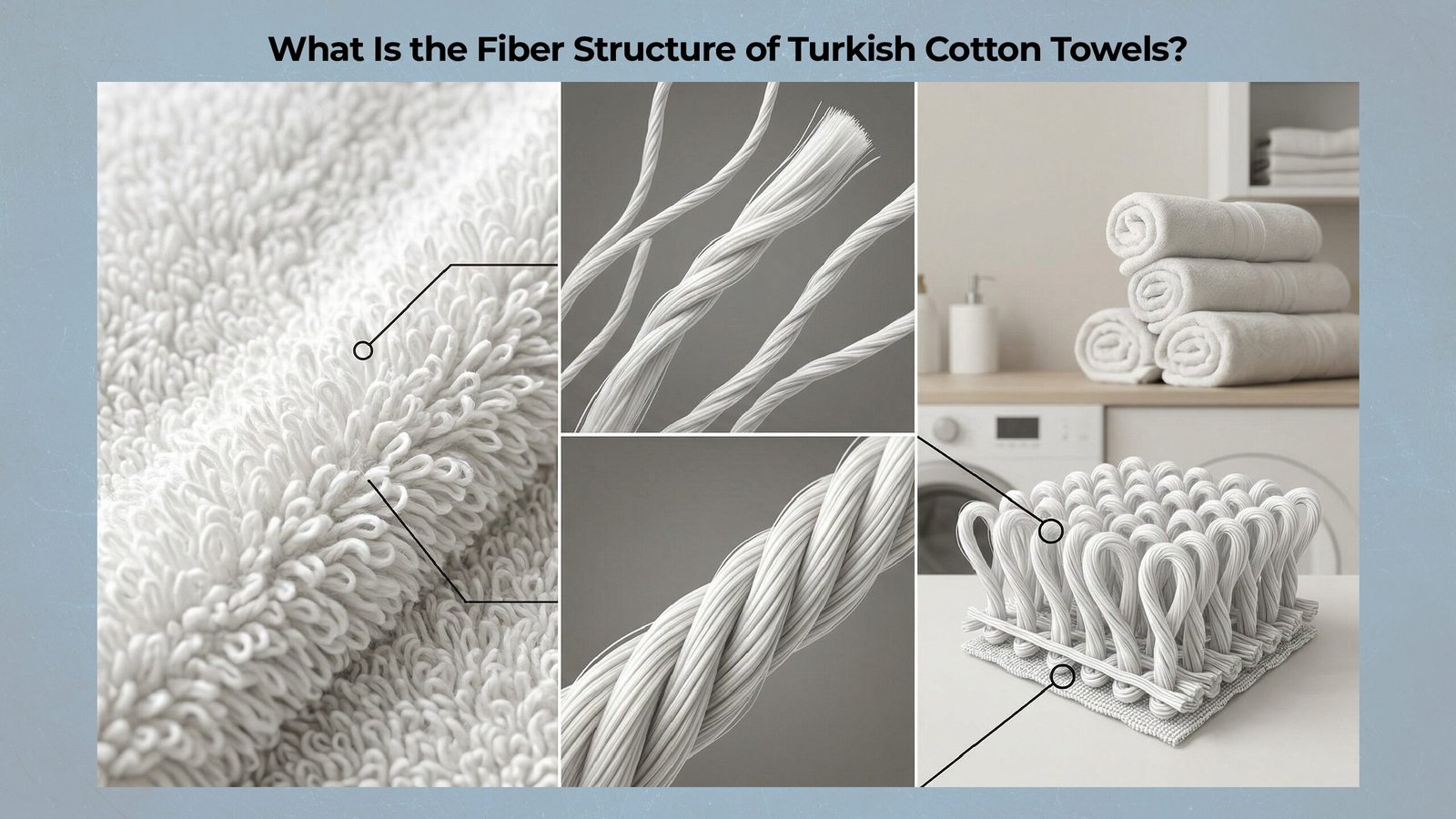
What Is the Fiber Structure of Turkish Cotton Towels?
Why Does the Turkish Cotton Towel Fiber Structure Determine Long-Term Performance?
The Turkish cotton towel fiber structure primarily determines the long-term utility of linens by dictating the rate of moisture turnover and the textile’s resistance to mechanical pilling. Consistent sunlight and stable climate conditions in basins like the Great Meander support optimal fiber development and secondary cell wall cellulose deposition. This deposition is critical for maintaining the high tensile strength required to survive industrial laundering cycles (ISO 6330) without losing structural integrity.Performance depends on the foundational soil mineralogy and climate conditions found uniquely in the Aegean region. Since longevity is a key performance metric, it is important to understand how durability factors influence towel lifespan and structural integrity over time.Analyzing Climate and Nutrition as Drivers of the Turkish Cotton Towel Fiber Structure
Climate and nutrition drive the development of the Turkish cotton towel fiber structure, where consistent solar radiation and adequate potassium levels support the fiber elongation necessary for long-staple classifications. Alluvial soils with stable pH ranges optimize nutrient bioavailability, helping to prevent the water stress that typically reduces fiber length and increases short-fiber content (SFC).Evaluating the “Bloom” Mechanics in the Turkish Cotton Towel Fiber Structure
Mechanical “Blooming” within the Turkish cotton towel fiber structure typically results from a high natural convolution density that supports flexibility and bulk as fibers re-inflate during laundering. Natural convolutions (twists) provide the mechanical friction needed for yarn interlocking, which facilitates “Blooming” once industrial weaving tensions are released. To ensure this expansion is preserved, it is essential to follow proper care instructions for maintaining towel fiber structure without damaging the internal cellulose framework. This allows fibers to physically expand to increase tactile loft without increasing the physical mass of the textile.Why is Turkish Cotton Towel Fiber Structure Considered Balanced for Absorbency and Drying?
The Turkish cotton towel fiber structure is considered balanced for absorbency and drying because the long-staple Aegean fibers establish a porous architecture that supports airflow relative to denser ELS cotton structures. This prevents the fabric from retaining moisture for extended periods, which is common in higher-density textiles that lack this specific morphological trait. To better understand how this impacts real-world performance, you can explore what determines towel absorbency and moisture retention performance in different materials.Analyzing the Saturation-to-Evaporation Ratio in the Turkish Cotton Towel Fiber Structure
Analyzing the saturation-to-evaporation ratio in the Turkish cotton towel fiber structure reveals that the material typically dries faster than ELS cotton due to a lower absolute saturation capacity. This balance prevents “perpetual dampness,” materially restricting the probability of anaerobic bacterial proliferation. In high-humidity environments, this turnover rate is essential for maintaining hygiene and preventing odor loops. This makes it important to evaluate how quick-dry performance affects towel usability and hygiene, especially in humid environments.Evaluating Capillary Action and Surface Area in the Turkish Cotton Towel Fiber Structure
The Turkish cotton towel fiber structure facilitates rapid capillary-driven absorption through the utilization of micro-pores in the cell wall that pull moisture into the fiber structure. Fibril angles vary across fiber layers and contribute to the flexibility and tensile behavior required for high-performance toweling that meets AATCC 79 standards for absorbency.What Defines the Botanical Anatomy of the Turkish Cotton Towel Fiber Structure?
Botanical anatomy defines the Turkish cotton towel fiber structure through a multi-layered biological architecture composed of a protective cuticle, a high-density secondary wall, and a central lumen. The cuticle, composed of waxes and pectins, serves as a barrier that is optimized during scouring to allow for efficient wetting and moisture uptake into the cellulose core.Quantitative Morphological Statistics for the Turkish Cotton Towel Fiber Structure
Quantitative statistics for the Turkish cotton towel fiber structure identify a mean fiber diameter of 15–20 µm, while the central lumen width varies widely depending on maturity and growth conditions. Specific gravity is typically near 1.5, and the “kidney bean” cross-sectional shape serves as a marker of mature cellulose development.Defining “Long-Staple” Benchmarks Within the Turkish Cotton Towel Fiber Structure
Defining “Long-Staple” within the Turkish cotton towel fiber structure typically requires a technical benchmark between 28.5 mm and 32 mm to ensure the spinning of high-count yarns with fewer exposed fiber ends. Regional cultivars like Nazilli 84 are associated with careful harvesting practices that prevent the fiber breakage common in standard machine-picked cotton.These physics culminate in specific comparisons to Egyptian and Pima varieties. The staple length dictates the yarn’s final smooth texture.How Does the Turkish Cotton Towel Fiber Structure Compare to Egyptian and Pima Cotton?
Selection between luxury cotton tiers depends on comparing the Turkish cotton towel fiber structure against the saturation-heavy profiles of Giza and Pima varieties to identify the optimal match for high-turnover environments. While Egyptian cotton is prized for its high volume of water storage, Turkish cotton is engineered for turnover speed.| Basin / Variety | Staple Length | Tensile Strength | Performance Profile | Drying Profile |
|---|---|---|---|---|
| Söke Basin (PGI) | ~30.7 mm | ~33.3 g/tex | Elite durability | Rapid Turnover |
| Meander Basin | ~30.1 mm | ~32.4 g/tex | Balanced utility | Standard Turkish |
| Egyptian (Giza 45) | > 35 mm | > 35 g/tex | Max capacity | Slowest |
| Upland (Standard) | < 25 mm | < 25 g/tex | Prone to pilling | Variable |
Evaluating the Physicochemical Composition of the Turkish Cotton Towel Fiber Structure
The physicochemical composition of the Turkish cotton towel fiber structure typically consists of 94–96% cellulose with ~60–70% crystallinity in the secondary wall. Organized crystalline regions provide tensile strength via hydrogen bonding, while the amorphous regions serve as the primary sites for moisture and dye uptake.Maintaining this molecular purity requires specific laundry preservation steps. Any breakdown in crystallinity leads to premature fiber failure.Which Laundry Steps Preserve the Integrity of the Turkish Cotton Towel Fiber Structure?
Preserving the integrity of the Turkish cotton towel fiber structure requires a technical shift from high-heat laundering to a monitored maintenance protocol that limits molecular chain scission and hornification. Managing the pH and thermal environment is critical to preventing the collapse of the internal porous framework that defines the towel’s performance.Managing Hornification Risks in the Turkish Cotton Towel Fiber Structure
The Turkish cotton towel fiber structure can suffer from “Hornification” if exposed to elevated drying temperatures (typically above ~60°C), which can accelerate pore collapse over repeated cycles. Hornification is the irreversible fusion of cellulose microfibrils that reduces the fiber’s ability to re-swell, leading to a permanent loss of absorbency and a stiff tactile feel. Since thickness and density influence heat retention, it is useful to understand how towel thickness impacts drying performance and fiber stability.Preventing Polymer Degradation in the Turkish Cotton Towel Fiber Structure
Turkish cotton towel fiber structure longevity can be compromised by high-alkaline conditions, which can contribute to cellulose chain degradation via beta-elimination under repeated exposure. Mandating pH-neutral detergents is necessary, as progressive depolymerization can lead to a reduction in loop height and wicking mass over time.Care fails if users ignore standard failure patterns. A neutral pH ensures the hydrogen bonds remain intact.When Does the Turkish Cotton Towel Fiber Structure Fail to Perform?
Turkish cotton towel fiber structure typically fails to perform when users apply improper laundering methods or introduce chemical coatings like softeners. Fabric softeners form a hydrophobic coating on the long-staple fibers, which significantly reduces absorbency by creating a waxy barrier that water cannot penetrate. To understand how maintenance affects long-term performance across materials, you can explore how cotton towel durability is affected by washing and repeated use.Identifying “Fiber Fatigue” in the Turkish Cotton Towel Fiber Structure
High-RPM spin cycles exceeding 800 RPM contribute to “Fiber Fatigue” in the Turkish cotton towel fiber structure by inducing lateral compression that flattens the terry loops. Moderate spin speeds are recommended to preserve the textile’s three-dimensional wicking loft and prevent loop detachment.Restore fibers via a chemical reset if these fatigue signs appear. Early intervention is the key to textile longevity.How Can You Restore a Matted Turkish Cotton Towel Fiber Structure?
Restoring a compromised Turkish cotton towel fiber structure involves executing a chemical reset to dissolve the mineral films and detergent residues that inhibit the natural wicking channels. This exfoliation process is vital for returning the textile to its original state of porous efficiency and tactile softness.Stripping Mineral Buildup to Restore the Turkish Cotton Towel Fiber Structure
The Turkish cotton towel fiber structure regains its original wicking velocity when separate laundry cycles of acetic acid (vinegar) and sodium bicarbonate (baking soda) successfully exfoliate the fiber surface. Explicitly, vinegar and baking soda must NEVER be mixed in the same cycle. Run one warm cycle with 1 cup white vinegar, followed by a separate rinse or wash cycle with 1/2 cup baking soda.How to Verify Your Strategy with a Fiber Structure Checklist?
Systematic technical audits of selection and care verify that current protocols for the Turkish cotton towel fiber structure align with high-performance benchmarks.Checklist: Turkish Cotton Towel Fiber Structure Audit Checklist
Origin Check: Does the label confirm “100% Aegean Cotton” or specific basin cultivars like Söke or Nazilli?
Integrity Audit: Is the surface free of excessive pilling or fuzzy fiber breakage after 5 washes?
Thermal Check: Are drying temperatures typically maintained at low-to-medium settings to manage hornification?
pH Verification: Is the detergent a low-alkalinity formula to protect against polymer degradation?
Wicking Test: Does a water droplet absorb quickly into the fabric without beading or runoff?
Frequently Asked Questions: Turkish Cotton Fiber Physics
The Turkish cotton towel fiber structure creates a porous framework using long-staple fibers that facilitate atmospheric evaporation. Egyptian towels use extra-long staple (ELS) fibers designed for maximum water storage, which leads to higher saturation and slower drying times.
Blooming is the volumetric expansion of the Turkish cotton towel fiber structure. Once the tensions of the weaving loom are released and the towel is washed, the natural convolutions (helical twists) in the fiber cause it to re-inflate and gain loft without adding weight.
No. Softeners coat the Aegean long-staple fibers in a hydrophobic film (glazing). This seals the wicking channels and prevents the Turkish cotton towel fiber structure from effectively absorbing water.
Temperatures above 60°C trigger “Hornification.” This causes the internal cellulose microfibrils to fuse together irreversibly, collapsing the pores and making the towel feel stiff and “scratchy.”
The Aegean region provides a unique terroir—consistent solar radiation and mineral-rich alluvial soil—that optimizes the cellulose crystallinity and staple length necessary to form a durable, high-performance Turkish cotton towel fiber structure.
Final Summary: Does the Turkish Cotton Towel Fiber Structure Meet Your Drying Needs?
Operationalizing a Turkish cotton towel fiber structure strategy requires a commitment to environmental awareness that balances luxury softness with the technical requirement for rapid turnover. While Egyptian ELS offers maximum absolute capacity, the porous framework of Turkish cotton provides the elite turnover required for odor prevention.Ultimately, a superior bathroom experience is defined by the precise Turkish cotton towel fiber structure management that turns a high-performance fiber into a lasting, odor-free household asset through technical care.
Technical Disclaimer: The performance data, morphological statistics, and chemical protocols outlined in this guide are based on standardized textile engineering benchmarks (ASTM D5034, ISO 6330). Individual results regarding drying speed, loft, and fiber longevity may vary depending on local water hardness, specific laundering hardware, and environmental humidity levels. This information is intended for educational purposes and is not a substitute for specific manufacturer care instructions.