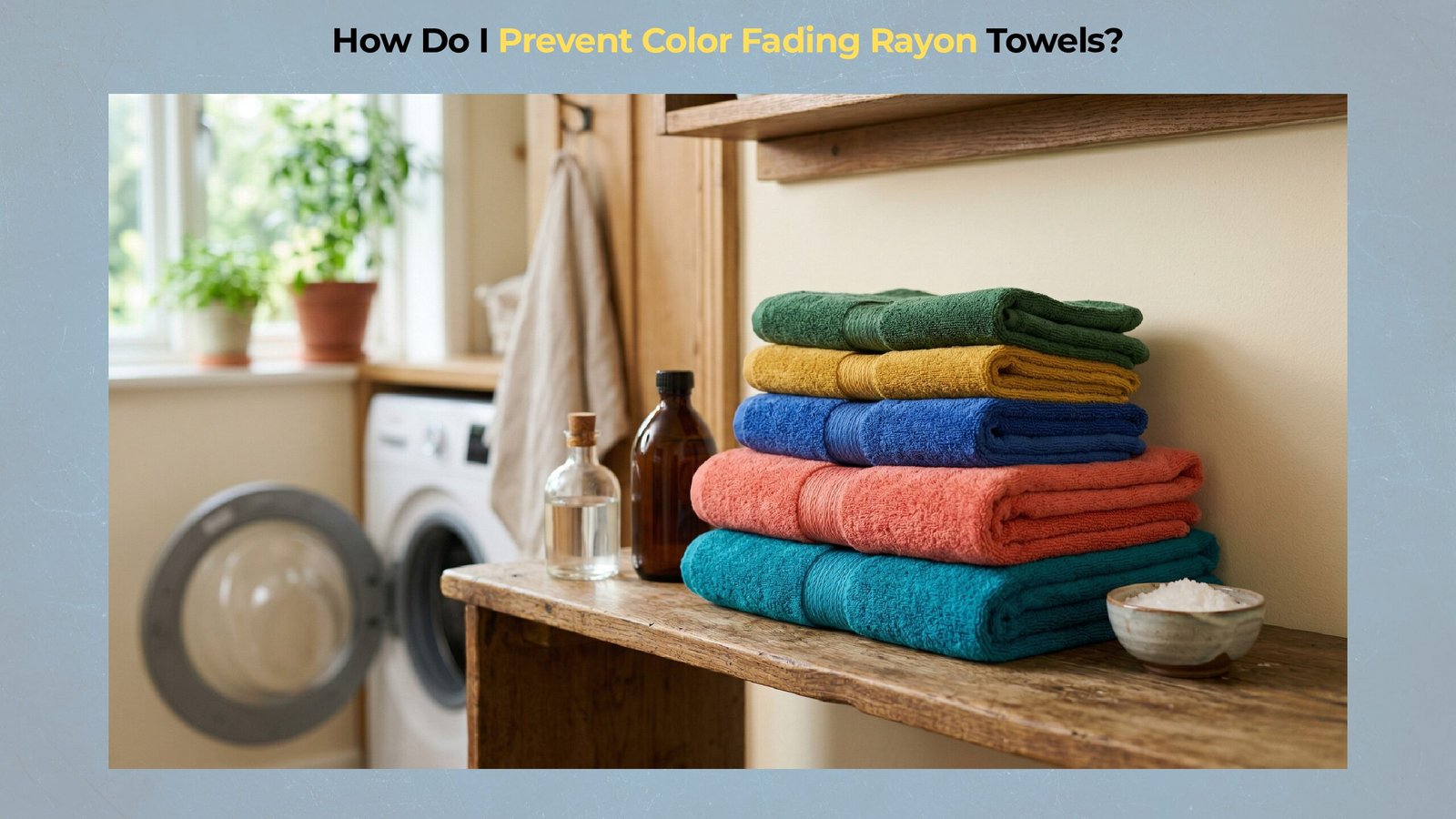
How Do I Prevent Color Fading Rayon Towels?
Textile Engineering & Aesthetic Preservation Protocol
Effective prevention of rayon towel color fading typically requires a technical shift from high-heat laundering to a monitored maintenance protocol that protects against both actual pigment loss and the perceived fading driven by surface fibrillation. This systematic approach ensures the unique molecular physics of regenerated fibers are honored during every wash cycle.
In the luxury textile market, color retention serves as the primary marker for the textile’s “visual age.” When dye chromophores degrade or fibers shear, the towel communicates structural fatigue, prematurely ending its functional lifecycle in high-end residential or hospitality environments.
Why Does Rayon Towel Color Fading Determine Aesthetic Lifespan?
Rayon towel color fading primarily determines the aesthetic lifespan of premium linens by dictating the rate at which surface degradation and pigment loss compromise the textile’s luxury appearance. When evaluating long-term appearance and performance, it is helpful to understand how color and design quality influence towel lifespan and visual appeal in high-end environments.
Maintaining this lifespan requires a deep dive into the molecular fiber behavior of regenerated cellulose. Understanding the interaction between surfactants and the polymer chain is essential for long-term vibrancy.
What Molecular Fiber Behavior Drives Rayon Towel Color Fading?
Molecular fiber behavior drives rayon towel color fading through the separate mechanisms of fiber fibrillation, which triggers perceived fading, and chemical desorption, which triggers actual pigment loss.
Analyzing Fiber Fibrillation as a Driver of Perceived Rayon Towel Color Fading
Fiber fibrillation typically drives perceived rayon towel color fading through mechanical abrasion that creates light-scattering surface fuzz. To better understand how this structural fatigue develops into visible damage, you should explore why rayon towels shed, snag, or tear easily under mechanical stress.
Evaluating Dye-Fiber Interaction and Actual Rayon Towel Color Fading
Actual rayon towel color fading often results from the chemical desorption of dye molecules, where high alkaline levels or excessive thermal energy weaken the bond between pigment and fiber. Since moisture behavior directly affects dye stability, it is useful to examine how absorbent rayon towels are and how washing impacts their performance over time.
High-pH detergents act as swelling agents. When the amorphous regions of the viscose or modal fiber swell excessively, the space between polymer chains widens, allowing dye molecules to diffuse out of the fiber and into the wash liquor.
Colorfastness performance ultimately depends on dye class, fixation efficiency, and post-dye washing processes in regenerated cellulose systems.
Molecular stability requires specific laundry prevention steps.
Which Specific Laundry Prevention Steps Mitigate Rayon Towel Color Fading?
Specific laundering protocols mitigate rayon towel color fading by limiting kinetic energy and maintaining chemical neutrality. Because drying speed influences how long fibers remain in a vulnerable swollen state, it is useful to evaluate how quick-dry performance affects towel maintenance and longevity in practical use.
Executing the “Cold-and-Gentle” Wash for Rayon Towel Color Fading
Rayon towel color fading remains controlled when users maintain wash temperatures at or below 30°C, because lower thermal energy reduces swelling and dye diffusion. To better understand how washing directly affects fiber structure, you can review how to wash rayon towels to prevent shrinkage and fiber damage during repeated cycles.
Following **ISO 105-C06** (Colorfastness to laundering) standards, cold water restricts the molecular mobility of pigments. By staying below the glass transition temperature of the wet fiber, you significantly reduce the probability of dye migration into the aqueous environment.
Selecting Low-Alkalinity Detergents to Mitigate Rayon Towel Color Fading
Rayon towel color fading is prevented by utilizing low-alkalinity detergents near neutral pH (≈7.0–8.0) that exclude the optical brighteners responsible for creating a bluish haze on dark or saturated textiles.
Warning: Avoid “Heavy Duty” detergents. These formulas are designed for cotton soil removal and utilize high pH to swell fibers. Furthermore, optical brighteners are fluorescent chemicals that deposit on the fiber surface; on vibrant towels, they create a cloudy, bluish haze that masks the true depth of the original hue.
Mitigation must extend to the drying phase to prevent UV oxidation.
How Do Desiccation Protocols Address UV Oxidation in Rayon Towel Color Fading?
Desiccation protocols address rayon towel color fading by isolating the textile from solar radiation and limiting the thermal stress that triggers fiber fatigue.
Implementing the “Shaded-Air” Rule for Rayon Towel Color Fading
Rayon towel color fading and pigment degradation are secured by the “Shaded-Air” rule, where colored linens are dried exclusively in complete shade because UV radiation breaks dye chromophores through oxidation.
UV-A and UV-B radiation initiate a photo-oxidative process. This energy level is sufficient to permanently cleave the covalent bonds of the dye molecules, resulting in irreversible desaturation. Once the chromophore is broken, the color cannot be restored chemically.
Preventing Heat-Brittleness to Control Rayon Towel Color Fading
Rayon towel color fading typically accelerates with excessive heat during drying because thermal stress increases fiber brittleness and fibrillation. Since durability and lifespan are directly impacted by these stresses, it is important to understand how durability factors influence towel performance over time.
Mandate: Remove towels while they remain approximately 5-10% damp. Mechanical tumbling of “bone-dry” regenerated fibers causes the dry loops to shear against one another. This shears the surface, resulting in the frosty, faded texture discussed earlier.
Prevention also relies on a strategic approach to product selection.
How to Select High-Fastness Dyes and Blends to Resist Rayon Towel Color Fading?
Selecting optimized dyeing methods typically ensures superior resistance to rayon towel color fading by identifying textiles where colorants are integrated during fiber formation rather than applied as a surface coating. When making a purchase decision, it is essential to evaluate how towel material affects durability, color retention, and overall performance across different fiber types.
Performance Matrix for Rayon Towel Color Fading Resistance
| Dye Method | Fade Resistance | Technical Detail | Recommended? |
|---|---|---|---|
| Dope-Dyed (Rare) | Highest | Colorants integrated during fiber formation | Highly Recommended |
| Yarn-Dyed | High | Individual yarns dyed before construction | Yes |
| Piece-Dyed | Moderate | Finished fabric dyed after construction | Standard |
Identifying Oeko-Tex Safety Ratings for Rayon Towel Color Fading
Rayon towel color fading management involves identifying Oeko-Tex Standard 100 certification, which primarily indicates chemical safety rather than dye stability or colorfastness. While this verifies the absence of harmful arylamines, it does not serve as a performance guarantee for pigment retention.
To establish a correct maintenance baseline after purchasing certified linens, it is essential to review what care instructions should be followed when maintaining towels, especially for moisture-sensitive regenerated fibers.
When Does Rayon Towel Color Fading Reach Aggressive Fail-States?
Rayon towel color fading transitions into an aggressive fail-state when users introduce oxidative chemicals or ignore the signs of cumulative mineral masking.
Diagnostic Failure Matrix for Rayon Towel Color Fading
| Mistake | Primary Result | Scientific Reason |
|---|---|---|
| Direct Sunlight | Blotchy Fading | UV-induced chromophore oxidation |
| Chlorine Bleach | Actual Pigment Loss | Oxidative destruction of dye chromophores |
| High-Agitation | Perceived Fading | Mechanical fiber fibrillation (Frosting) |
| Hard Water | Ashy / Dull Texture | Mineral “Crust” masking the pigment |
Recognizing the “Frosting” Effect of Mechanical Fibrillation in Rayon Towel Color Fading
Rayon towel color fading often manifests as a “Frosting” effect, where light scattering from fibrillated fibers creates perceived dullness rather than a reduction in the textile’s actual dye concentration.
Diagnostic Tip: If the towel appears faded only on high-friction areas (the peaks of the terry loops), the cause is structural fatigue (fibrillation). If it is faded uniformly across the surface and deep within the base weave, the cause is actual leaching or UV exposure.
Understanding the cause allows for hue restoration.
How Can You Fix Dullness to Restore Hue in Rayon Towel Color Fading?
Restoring the appearance of rayon towel color fading involves executing chemical resets to help remove mild mineral films and enzymatic cycles to clear light-scattering surface fuzz.
Does Mineral Stripping Improve the Appearance of Rayon Towel Color Fading?
Rayon towel color fading is often temporarily reversed if a warm vinegar rinse dissolves mild mineral films that typically gray the appearance of dyed fibers.
While **acetic acid** (white vinegar) is effective for mild mineral films and neutralizing alkaline deposits, it has limited utility against heavy scale. To reveal the true pigment beneath the “gray haze,” run one warm cycle with 1 cup of white distilled vinegar and NO detergent.
Resolving Perceived Fading with a Cellulase Enzymatic Reset
Perceived rayon towel color fading caused by fibrillation regains its original hue accuracy through an enzymatic cellulase reset that biologically “clips” away the matted surface fuzz.
How to Verify Your Strategy with a Rayon Towel Color Fading Checklist?
Systematic technical audits of your maintenance habits verify that current protocols for rayon towel color fading align with objective performance benchmarks.
Rayon Towel Color Fading Maintenance Audit Checklist
Is the detergent a low-alkalinity formula near neutral pH (≈7.0–8.0) and free of optical brighteners?
Is the wash temperature strictly confirmed at or below $86^{\circ}F$ ($30^{\circ}C$)?
Are towels preferably washed in mesh bags to reduce fibrillation and perceived fading?
Is the drying location strictly isolated from direct solar radiation?
Are towels removed while still slightly damp to reduce mechanical stress and fiber-shear?
Technical FAQ
Why do my black rayon towels turn red or brown over time?
This “red-shift” results from the selective photo-oxidation of dye blends. Black textiles are often achieved by mixing blue, yellow, and red chromophores. Blue and yellow pigments are typically more sensitive to UV radiation and chlorine; once they cleave, the more stable red pigments remain.
Is Modal more fade-resistant than standard Viscose rayon?
Generally, yes. Modal is a High Wet Modulus (HWM) rayon. Because its crystalline structure is more resilient when wet, it experiences less amorphous swelling during laundering than standard Viscose, trapping dye more effectively.
Does Oeko-Tex Standard 100 guarantee the towel won’t fade?
No. Oeko-Tex Standard 100 is a chemical safety certification. It is not a performance rating for colorfastness or laundering durability, which are measured by AATCC or ISO standards instead.