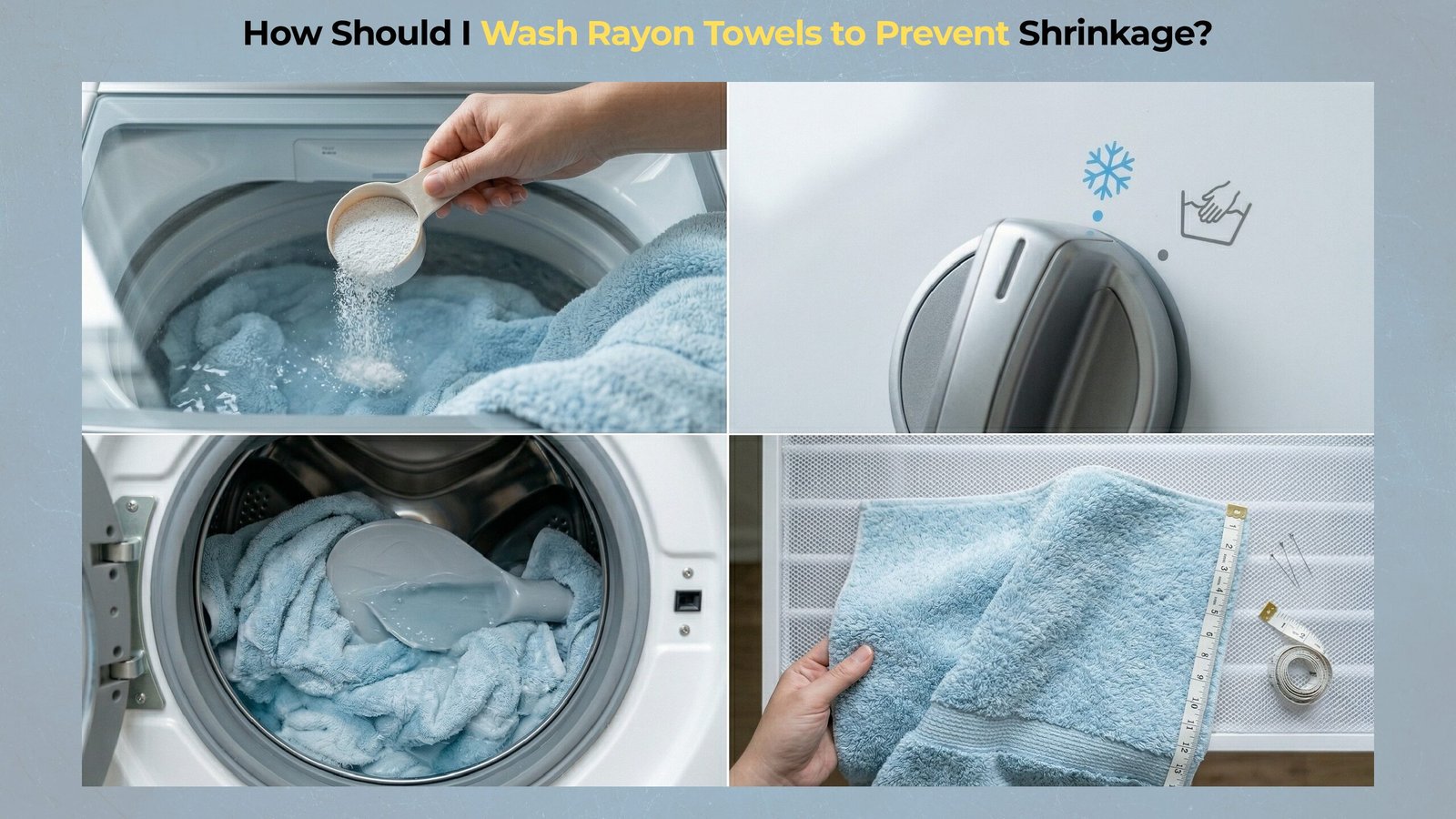
How Should I Wash Rayon Towels to Prevent Shrinkage?
Effective prevention of rayon towel shrinkage requires a technical shift from high-heat convenience to a monitored maintenance protocol that respects the moisture equilibrium of regenerated cellulose. This dimensional change represents the fiber returning to its natural state after being subjected to industrial tension during manufacturing. Maintaining these dimensions directly impacts textile utility.
Why Does Managing Rayon Towel Shrinkage Matter for Maintaining Textile Utility?
Rayon towel shrinkage primarily determines the long-term utility of premium linens by dictating whether the textile maintains its intended anatomical coverage and aesthetic drape. When the surface area decreases beyond the 10% threshold, the functional capacity of the towel to wrap and dry the body effectively diminishes. Managing utility requires identifying the specific fiber-lock risk.
Identifying the Link Between Rayon Towel Shrinkage and “Fiber-Lock”
Rayon towel shrinkage results in “Fiber-Lock” when excessive contraction forces regenerated fibers to compact so tightly that the air-trap required for absorbency disappears. To better understand how this structural change also leads to surface damage over time, you should explore why rayon towels shed, snag, or tear easily under mechanical stress.
[Excessive fiber contraction] → [triggers mechanical fiber-lock] → [compromises the wicking of rayon towel shrinkage].
Evaluating the “Active Change” Period for Rayon Towel Shrinkage
The “Active Change” period for rayon towel shrinkage typically spans the first three laundry cycles, during which the fibers undergo their most significant relaxation from industrial weaving tension. During this critical phase, following proper care is essential, so it’s helpful to review how to properly care for and maintain rayon towels to stabilize fiber behavior early.
Does Rayon Towel Shrinkage Occur More Significantly Than in Cotton or Microfiber?
Rayon towel shrinkage presents a higher dimensional risk than natural seed-fibers or synthetics because regenerated cellulose possesses a higher swelling coefficient and lower wet-tenacity. If you’re comparing how this affects real-world performance, consider evaluating how durable rayon towels are with regular use to understand long-term structural limits.
Analyzing the Swelling Factor in Rayon Towel Shrinkage vs. Cotton
Rayon towel shrinkage outpaces cotton shrinkage because regenerated fibers swell significantly when wet, creating a more dramatic “snap-back” during the drying phase. While ELS cotton maintains stability through natural structural lumens, rayon fibers absorb up to 13% of their weight in moisture, physically forcing the weave to expand and then drastically contract as the water departs.
Evaluating Synthetic Dimensional Stability Compared to Rayon Towel Shrinkage
Hydrophobic synthetics like microfiber exhibit near-zero dimensional loss, a stability that contrasts with the moisture-sensitive nature of rayon towel shrinkage. For a deeper comparison of maintenance differences, you can review what are the proper washing instructions for microfiber towels, which explains why synthetics tolerate more aggressive cycles.
What Molecular Behavior Drives the Risk of Rayon Towel Shrinkage During Laundering?
Molecular fiber behavior drives rayon towel shrinkage through the disruption and reformation of bonds within the amorphous regions of the cellulose polymer. When saturated, water molecules act as plasticizers, allowing the cellulose chains to slide past one another. Focus specifically on the swelling-to-contraction cycle.
Analyzing the Swelling-to-Contraction Cycle in Rayon Towel Shrinkage
Rayon towel shrinkage follows a mechanical “Swelling-to-Contraction” cycle where water-saturated fibers expand and then reset into a shorter, more compact state as moisture evaporates. The evaporation of water creates surface tension forces that pull the fiber chains into a denser configuration than they occupied before wetting.
Evaluating High-Heat Damage as a Catalyst for Rayon Towel Shrinkage
Repeated high-heat exposure acts as a catalyst for rayon towel shrinkage by increasing the kinetic energy of cellulose chains, causing them to contract more aggressively than during ambient air-drying. This energy facilitates the collapse of the fiber’s internal structure.
[Excessive dryer heat] → [increases cellulose kinetic energy] → [accelerates rayon towel shrinkage].
When Does the Most Significant Rayon Towel Shrinkage Occur?
The most significant rayon towel shrinkage occurs when high-GSM textiles are subjected to aggressive mechanical agitation and thermal over-exposure in the laundry drum. Heavier towels retain moisture longer, extending the “vulnerability window” where fibers are prone to movement.
| Cause | Severity | Preventability | Technical Result |
|---|---|---|---|
| High Heat (>60°C) | High | Largely Controllable | Excessive fiber contraction |
| High Agitation | Moderate | Largely Controllable | Mechanical “snap-back” of wet fibers |
| Over-Drying | Moderate | Largely Controllable | Fiber “locking” and loss of loft |
| Industrial Tension | Low | Non-Preventable | Natural relaxation of the weave |
Recognizing High-GSM Density as a Driver of Rayon Towel Shrinkage
High-GSM density acts as a driver of rayon towel shrinkage because heavier towels sequester more internal moisture, leading to greater fiber swelling and more dramatic contraction. ASTM D3776 mass-per-unit-area verification confirms that denser weaves provide more resistance to air-flow, trapping heat and accelerating dimensional loss. These risks necessitate specific washing prevention steps.
Which Specific Washing Steps Effectively Prevent Rayon Towel Shrinkage?
Specific laundering protocols prevent rayon towel shrinkage by limiting thermal energy and reducing mechanical stress during the material’s weakest wet state. These steps prioritize fiber integrity over convenience. Lead into the cool-wash protocol.
Executing the Cool-Wash Protocol to Mitigate Rayon Towel Shrinkage
Rayon towel shrinkage remains controlled when users maintain wash temperatures at or below 104°F (40°C) to reduce stress on the fiber structure. To further optimize washing performance without compromising moisture behavior, it’s useful to understand how absorbent rayon towels are and how washing affects their performance over time.
[Low-temperature laundering] → [reduces stress on the fiber structure] → [mitigates rayon towel shrinkage].
Implementing the “Gentle-Agitation” Rule for Rayon Towel Shrinkage
The “Gentle-Agitation” rule secures rayon towel shrinkage limits by utilizing “Delicate” settings that prevent the high-speed centrifugal force from stretching and then snapping back wet fibers. It is mandatory to maintain spin speeds below 800 RPM to avoid mechanical over-extension. Prevention also relies on selecting optimized blends.
How to Select Blends That Offer Superior Resistance to Rayon Towel Shrinkage?
Selecting optimized blends ensures superior resistance to rayon towel shrinkage by identifying fiber generations with inherently higher dimensional stability. Modern variants like Lyocell utilize closed-loop spinning that creates a more crystalline molecular structure.
| Fiber Type | Shrinkage Risk | Stability Rank | Best Maintenance Path |
|---|---|---|---|
| Standard Viscose | Highest | 3 (Volatile) | Air-dry or “Damp-Pull” only |
| Modal | Moderate | 2 | Low-heat tumble permissible |
| Lyocell (Tencel) | Lowest | 1 (Stable) | Standard gentle care protocols |
When Does Rayon Towel Shrinkage Exceed Standard Maintenance Expectations?
Rayon towel shrinkage can reach excessive levels if users bypass thermal safety limits or utilize industrial laundering equipment designed for high-tenacity cotton. Such environments create “catastrophic fail-states” for regenerated cellulose.
Recognizing the High-Heat Danger for Rayon Towel Shrinkage
Repeated high-heat exposure can significantly increase rayon towel shrinkage beyond normal levels, where dryer settings above 140°F (60°C) trigger catastrophic and permanent dimensional loss. This heat makes fibers brittle, rendering future “unshrinking” efforts ineffective.
Does the “Bone-Dry” State Trigger Rayon Towel Shrinkage?
Rayon towel shrinkage reaches its maximum intensity during “Bone-Dry” cycles, where removing 100% of moisture forces fibers into a rigid, shrunken lock-step. To prevent this, users must follow the “Damp-Pull” rule—removing towels while they are still 10-15% damp to preserve fiber flexibility.
How Can You Partially Reverse Excessive Rayon Towel Shrinkage?
Restoring shrunken inventory involves executing the “Steam-and-Stretch” protocol to temporarily relax the fiber structure for manual reshaping. While permanent heat damage cannot be undone, moisture-induced contraction remains somewhat reversible.
Resolving Fiber Contraction Using the “Steam-and-Stretch” Fix for Rayon Towel Shrinkage
Rayon towel shrinkage regains partial length through the “Steam-and-Stretch” fix, which utilizes moisture to disrupt the bonds that hold fibers in a shrunken state. Users should mist the towel with water or use a high-steam iron, then pull gently from the center toward the corners while the fabric is warm and saturated.
[High-pressure steam] → [relaxes fiber bonds] → [partially reverses rayon towel shrinkage].
How to Verify Your Strategy with a Rayon Towel Shrinkage Checklist?
Systematic technical audits of your selection and care verify that current protocols for rayon towel shrinkage align with objective performance benchmarks.
Checklist: Rayon Towel Shrinkage Maintenance Audit
Material Audit: Does the label confirm a more stable variant like Modal or Lyocell?
Thermal Check: Is the wash temperature strictly confirmed at or below 104°F (40°C)?
Mechanical Check: Is the washing machine strictly set to “Delicate” or “Hand Wash”?
Dryer Audit: Is the machine strictly set to “Air Fluff” or “Extra Low”?
Moisture Check: Are the towels removed from the dryer while still slightly damp?
Frequently Asked Questions: Rayon Towel Dimensional Stability
Regenerated cellulose fibers possess a higher swelling coefficient. When saturated, the fiber diameter expands radially, which forces the longitudinal yarns to contract. Upon drying, the fibers “lock” into this shorter state, leading to a more dramatic dimensional loss than the lumen-stabilized structure of natural cotton.
Complete restoration is rarely possible if the fibers have been subjected to high-heat “Fiber-Lock.” However, using the “Steam-and-Stretch” protocol can recover up to 5-8% of lost length by temporarily disrupting the hydrogen bonds and allowing for manual reshaping while the fabric is warm and damp.
Air-drying eliminates the aggressive thermal contraction caused by tumble dryers, but it does not prevent “Relaxation Shrinkage.” Relaxation shrinkage is the fiber returning to its natural, tension-free state after manufacturing. Air-drying is the safest method to keep this shrinkage within the 3-10% benchmark.
Fabric softeners coat fibers in a lubricating film, which can slightly reduce the friction that leads to mechanical “snap-back” during agitation. However, softeners also reduce the hydrophilic properties of the towel. For rayon, maintaining thermal discipline (cool washing) is a significantly more effective shrinkage prevention strategy than chemical additives.
Yes. Lyocell (often branded as Tencel) is the most dimensionally stable regenerated cellulose fiber due to its high crystallinity and high wet-modulus. Modal offers moderate stability, while standard Viscose remains the most volatile and prone to significant dimensional changes.