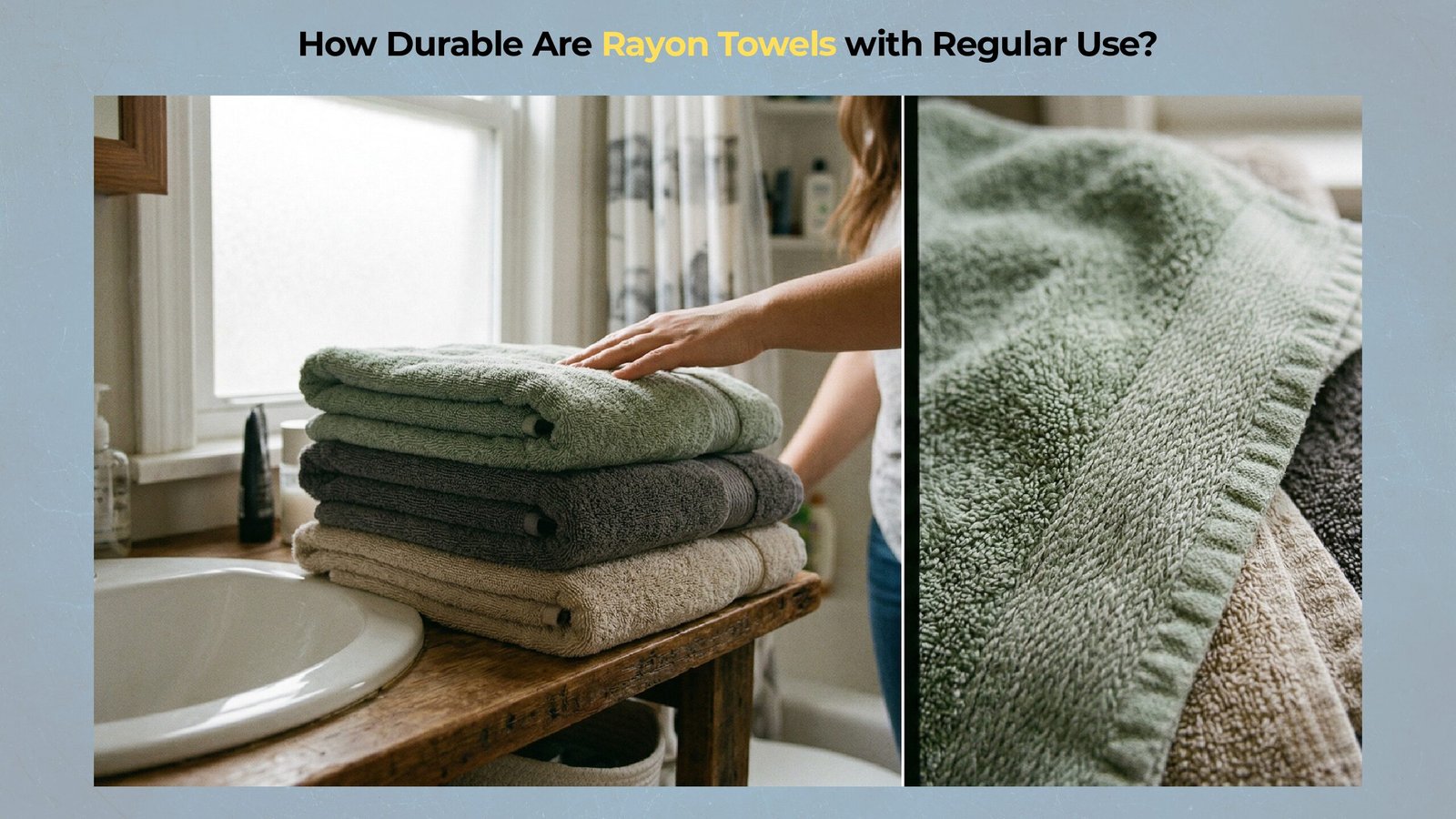
How Durable Are Rayon Towels with Regular Use?
An authoritative technical guide to regenerated cellulose longevity.
Rayon towel durability can last several years under proper care, though the structural lifespan of the regenerated cellulose fibers typically varies significantly based on usage intensity and maintenance discipline. This guide audits the wet-tenacity physics and mechanical preservation of regenerated cellulose to verify rayon towel durability and provide technical steps for maximizing the textile’s long-term performance value.
While standard cotton is often perceived as the default for longevity, rayon acts as a “high-performance, low-friction” asset. Because it is an engineered fiber, its resilience is not monolithic; rather, it is a byproduct of how well the user mitigates the inherent physics of fiber swelling and mechanical agitation. A higher degree of maintenance discipline is required to prevent the premature depletion of its luxurious pile.
Understanding fiber longevity is critical because it ultimately determines long-term bathroom planning and inventory management.
Why Does Rayon Towel Durability Matter for Long-Term Bathroom Planning?
Rayon towel durability primarily determines the economic and environmental return on investment (ROI) by establishing the frequency of inventory replacement required to maintain luxury standards. Establishing a predictable lifecycle involves comparing linen towel absorbency, durability, and drying performance to identify the performance benchmarks required for high-end residential assets.
Managing the structural integrity of regenerated cellulose ensures that high-end softness is not a temporary retail feature, but a persistent performance metric that stabilizes bathroom operating costs over a 24-to-36-month horizon.
Effectively managing these expectations requires identifying specific service-life expectations based on real-world usage.
Identifying the “Service-Life” Expectations for Rayon Towel Durability
Rayon towel durability can last several years under proper care, though the service life often varies significantly by usage intensity as these fibers typically deplete faster than cotton if subjected to standard high-heat laundering. For a towel in high-rotation daily use, the “peak-comfort” window—where the textile maintains its original absorption and hand-feel—is approximately 1.5 to 2 years.
Unlike long-staple cotton, which can withstand aggressive abrasion, cotton towel durability factors usually favor the seed-fiber for high-impact mechanical stress. Every wash cycle is a destructive event for regenerated filaments. Households must calibrate their expectations: a guest towel used once a month may maintain its integrity for a decade, while a gym towel used and washed daily will show signs of fiber fatigue within months.
Evaluating the Environmental ROI of High-Performing Rayon Towel Durability
Superior rayon towel durability supports environmental sustainability goals by reducing the frequency of textile waste through the preservation of high-purity regenerated filaments. By extending the lifecycle of a bamboo or beechwood-derived towel, users maximize the carbon-sequestration benefits of the source crops.
Maximized fiber lifespan → reduces cumulative textile waste → optimizes the environmental ROI of rayon towel durability
The environmental gains are not just in the material’s biodegradability, but in the energy saved by not manufacturing a replacement. However, these gains are strictly dependent on the molecular physics of the fiber itself.
What Molecular Physics Drive the Limits of Rayon Towel Durability?
Molecular physics drive rayon towel durability through the interaction of hydrophilic polymer chains and the susceptibility of the fiber surface to mechanical shearing. When rayon is manufactured, wood pulp is chemically dissolved and extruded into filaments. This process creates a fiber that is highly absorbent but structurally distinct from the lignified fibers found in nature.
Analyzing the “Wet-Tenacity Gap” in Rayon Towel Durability
Rayon towel durability faces its primary threat during saturation because the material can lose a significant portion of its strength when wet compared to dry conditions. This phenomenon, known as the “Wet-Tenacity Gap,” is the most critical technical vulnerability of regenerated cellulose.
Figure 1: Comparison of Tensile Strength. While cotton maintains stability when saturated, rayon experiences a significant drop in wet tenacity.
Technical Definition: Wet Tenacity is the measure of a fiber’s resistance to rupture while in a saturated state. In rayon, water molecules penetrate the amorphous regions of the polymer chain, acting as a plasticizer that weakens the intermolecular bonds. Understanding cotton absorbency factors and moisture retention helps illustrate why this vulnerability is unique to rayon, as cotton fibers often strengthen upon hydration.
This “Wet-Tenacity Gap” makes the towel susceptible to stretching and tearing during the high-RPM extraction phase of the wash cycle.
Evaluating “Filament Fibrillation” as a Driver of Rayon Towel Durability
Rayon towel durability declines when repeated mechanical friction triggers fibrillation, a process that creates surface pilling and reduces perceived smoothness over time. Unlike cotton, which sheds short fibers, rayon filaments tend to “splinter” at the surface level.
Figure 2: The transition from a smooth filament to a fibrillated state. Splintering creates the surface pilling that degrades the towel’s luster.
Fibrillation results in the gradual accumulation of surface fuzz. This micro-texture masks the original luster of the towel and creates a “velvet-like” feel that eventually turns rough as the pilled fibers trap mineral deposits. It is the primary signal of fiber fatigue. To maintain a consistent sensory experience, many households also consider polyester towel breathability and wrap comfort as an alternative for high-durability needs.
Which Specific Laundry Steps Maximize Rayon Towel Durability?
Specific laundering protocols maximize rayon towel durability by limiting thermal energy and implementing mechanical shielding to protect the weakened wet fibers. Managing the wash environment is the only way to counteract the Wet-Tenacity Gap.
Executing the “Cool-and-Gentle” Protocol for Rayon Towel Durability
Rayon towel durability remains stable when users maintain wash temperatures below 104 degrees Fahrenheit (40 degrees Celsius), as long-term heat and stress can degrade fiber integrity. High heat causes the fiber to swell excessively, further distancing the polymer chains and making them easier to snap under the weight of the water.
Low-temperature laundering → limits fiber swelling → maintains the tensile strength of rayon towel durability
Implementing “Hardware-Isolation” to Protect Rayon Towel Durability
Rayon towel durability increases significantly when users utilize large mesh bags to isolate the wet textiles, as snagging can damage loops and weaken the fabric structure. It is strictly forbidden to wash rayon alongside items containing Velcro, zippers, or sharp metal hardware. Because the fiber is at its weakest when wet, a single snag can unravel a terry loop and create a pathway for further structural decay.
How to Select High-Performance Variants for Maximum Rayon Towel Durability?
Selecting high-performance variants optimizes rayon towel durability by identifying fiber generations that possess inherently higher wet-modulus and pilling resistance. Not all “bamboo” or “rayon” towels are created equal; the manufacturing method dictates the baseline resilience.
Fiber Resilience Matrix for Rayon Towel Durability
| Fiber Type | Wet-Strength Rank | Pilling Resistance | Durability Rank |
|---|---|---|---|
| Lyocell (Tencel) | Highest | High | 1 (Most Durable) |
| Modal (Beechwood) | High | Moderate | 2 |
| Standard Viscose | Low | Low | 3 (Most Fragile) |
Matching GSM to Your Usage Intensity for Optimal Rayon Towel Durability
Calibrating textile density to the 500–650 GSM range secures rayon towel durability, as prolonged moisture exposure can contribute to odor and perceived wear. We strongly warn against weights exceeding 700 GSM for rayon blends. Unlike cotton, rayon holds onto water with high tenacity, which increases the risk of bacterial odors if not dried rapidly. Research into polyester towel odor retention and moisture risk highlights how synthetic blends handle saturation differently.
When Is Rayon Towel Durability Compromised in High-Stress Environments?
Rayon towel durability can fail in environments that prioritize high-volume turnover and aggressive sanitization over fiber preservation. Conceptually, high-stress laundering environments are optimized for speed, which directly conflicts with the molecular stability requirements of regenerated fibers. Comparing this to a polyester towel drying speed comparison illustrates why high-volume facilities often avoid cellulose-based towels.
Why Is High-Frequency Commercial Use a Limit for Rayon Towel Durability?
Rayon towel durability typically declines in commercial laundry or gym environments because high-speed extraction in commercial systems can increase mechanical stress on weakened wet fibers. Rayon is optimized for domestic, gentle-care environments; high-RPM extraction can increase wear on wet fibers compared to standard cotton.
Does Processing Quality Influence the Results of Rayon Towel Durability?
Rayon towel durability declines prematurely in budget-tier textiles that utilize short-staple fibers or inferior chemical regeneration methods during manufacturing. Even with regular maintenance, rayon towel durability with regular use is ultimately capped by the purity of the extrusion process and filament uniformity.
How Can You Fix Surface Wear to Extend Rayon Towel Durability?
Restoring rayon towel durability in matted or pilled inventory involves executing mechanical resets to remove entangled fibers and chemical rinses to dissolve mineral rigidity. This restoration protocol can significantly extend the usable life of an aging linen asset.
Can You Resolve Surface Pilling to Improve Rayon Towel Durability?
Rayon towel durability improves if specialized “cellulase” detergents remove surface fuzz, which improves surface feel but does not fully restore structural strength.
Figure 3: Cellulase enzymes biologically “clip” away the micro-fibrils that cause surface roughness and pilling.
Technical Definition: Cellulase is an enzyme that biologically “clips” away the fuzzy micro-fibers that cause pilling. This process restores the light-reflecting properties of the towel, making it look and feel newer.
Enzymatic cellulase cycles → remove surface fuzz → restore the smoothness of rayon towel durability
Does Stripping Mineral Buildup Prevent Brittle Rayon Towel Durability?
Rayon towel durability improves when a periodic white vinegar rinse dissolves the calcium “crust” that can make aged fibers feel brittle and prone to breakage. Adding 1/2 cup of white distilled vinegar to the rinse cycle neutralizes detergent residues and re-aligns filaments, preventing the structural rigidity that precedes fiber snapping during usage or storage.
Technical FAQ: Common Rayon Maintenance Queries
With proper care, a rayon towel in daily rotation typically maintains its structural integrity for 1.5 to 2 years. Understanding why linen towels absorb water differently can also help users appreciate the unique absorption curves of rayon.
Stiffness is usually the result of mineral buildup (calcium carbonate) or surfactant residue trapped between filaments. This “mineral crusting” can be resolved using the white vinegar stripping protocol to restore fiber flexibility.
No. Fabric softeners leave a hydrophobic silicone coating on the fibers, which reduces absorbency and can trap odors inside the regenerated cellulose structure, eventually leading to material failure.
High heat triggers excessive fiber swelling and bond degradation. A single high-heat cycle won’t destroy the towel, but it causes irreversible molecular fatigue that accelerates pilling and thinning.
Not necessarily. While budget fibers pill faster, even high-end Lyocell can pill if subjected to high-friction agitation. It is a natural byproduct of filament fibrillation under mechanical stress.
Maintenance Audit Checklist
Rayon Towel Durability Maintenance Audit Checklist
Material Audit: Does the label confirm a high-tenacity variant like Lyocell or Modal?
Mechanical Check: Is the washing machine strictly set to “Gentle” or “Delicate”?
Chemistry Audit: Is the maintenance routine 100% free of chlorine bleach?
Thermal Check: Is the wash temperature strictly confirmed at or below 104 degrees Fahrenheit (40 degrees Celsius)?
Dryer Audit: Is the machine strictly set to “Low” or “Air Fluff”?
Final Summary
Operationalizing a rayon towel durability strategy requires a commitment to technical maintenance that honors the unique fiber physics of regenerated fibers. Ultimately, a superior linen experience is defined by the precise rayon towel durability management that turns a high-performance fiber into a lasting, soft-touch household asset through technical care.
Ultimately, a superior linen experience is defined by the precise rayon towel durability management that turns a high-performance fiber into a lasting, soft-touch household asset through technical care.
Technical Disclaimer
The information provided in this guide is for technical and educational purposes only. Rayon towel durability outcomes are subject to individual laundering hardware variations, local water hardness levels, and specific textile manufacturing batches. While the protocols outlined are based on general textile engineering principles, Toweldaily does not guarantee specific service-life outcomes. Always consult the manufacturer’s care label before implementing specialized chemical rinses or enzymatic treatments.