Textile Engineering | Maintenance Protocol
How Should You Dry Linen Towels for Best Results?
An authoritative blueprint for bast fiber desiccation and mechanical softening.
Superior linen towel drying results typically originate from a balance of mechanical agitation and strict moisture management that prevents the rigid alignment of bast fiber bundles.
Unlike cotton, which relies on a convoluted ribbon structure for flexibility—a fundamental variance among towel materials—flax (Linum usitatissimum) is a bast fiber characterized by high crystallinity and a rigid, rod-like morphology. When water evaporates from these fibers in a static state, the resulting surface tension pull causes individual filaments to bond tightly. This phenomenon dictates the ultimate tactile performance of the textile, determining whether the user experiences a supple drape or a brittle, “crunchy” texture. Consequently, the relationship between evaporation kinetics and fiber durability is the primary variable in professional textile maintenance.
Why Do Linen Towel Drying Results Affect Long-Term Softness and Durability?
The long-term softness and structural durability of flax depend on linen towel drying results because the speed and depth of moisture removal dictate the degree of cellulose chain stress.
💡 Simplified Explanation
“Think of linen fibers like a stack of wet papers; if they dry perfectly still, they stick together and get stiff. If they dry while moving, they stay soft and flexible.”
When drying occurs too rapidly or reaches a “bone-dry” state, the flax fibers undergo physical contraction that can lead to micro-fractures in the cell wall. Over time, these cumulative stresses degrade the tensile strength of the towel, leading to thinning and premature failure, often necessitating towel failure diagnostics to evaluate structural integrity. To mitigate this, maintenance protocols must target a specific moisture equilibrium benchmark.
How Does Over-Drying Compromise Linen Towel Drying Results?
Establishing a moisture equilibrium standard secures linen towel drying results by preventing “cellulose hornification,” a state where fibers lose their ability to re-swell and absorb moisture.
Hornification: The gradual loss of fiber swelling capacity caused by the removal of core moisture during excessive thermal drying.
Excessive thermal exposure → triggers cellulose hornification → materially restricts linen towel drying results. Maintaining a slight residual moisture preserves flexibility; excessively dry linen often feels stiff and less compliant during use compared to towels reaching equilibrium naturally, effectively disrupting the primary linen absorbency mechanism.
Do UV Hygiene Benefits Improve Linen Towel Drying Results?
Utilizing natural sunlight exposure facilitates linen towel drying results for white textiles because UV-B radiation provides mild antimicrobial effects that reduce surface microbial load.
Sunlight provides inconsistent but measurable reduction in surface bacteria; solar exposure facilitates pigment oxidation in dyed linens, necessitating outdoor drying restrictions for colored inventory. Clarify that while sunlight reduces surface load, it is not a reliable alternative to thermal or chemical sanitization.
How Does Fiber Physics Influence Linen Towel Drying Results?
The underlying fiber physics dictate linen towel drying results through the mechanical interaction of water molecules and cellulose chains during the evaporation phase.
Does the “Hydrogen Bonding” Effect Cause Stiff Linen Towel Drying Results?
Stiff linen towel drying results in stagnant environments result from “Hydrogen Bonding,” where water molecules evaporating from between filaments force the bast fibers to align and bond into a rigid structure.
Reference the biological “snap” of dried phloem fibers. Temporary hydrogen bonding causes stiffness until fibers are re-flexed; mechanical agitation significantly improves softness by breaking these bonds as they form.
Why Does Fast Drying Not Ensure Soft Linen Towel Drying Results?
A performance trade-off exists between evaporation velocity and linen towel drying results, as rapid static air-drying typically produces stiffer fibers than slower, mechanically agitated methods.
Mechanically agitated drying typically produces noticeably softer textiles because constant fiber movement prevents the alignment required for rigid bond formation; this linen drying performance is governed by the disruption of static moisture bridges.
Identifying “Blooming” vs. “Flattening” in Linen Towel Drying Results?
The visual and tactile distinction between blooming and flattening characterizes linen towel drying results, where mechanical tumbling facilitates the expansion of the bast fiber bundles.
Fiber Blooming: The process where individual filaments within a flax yarn untwist and increase in volumetric loft.
Mechanical agitation → facilitates fiber blooming → optimizes the loft of linen towel drying results, a stark contrast to microfiber drying speeds which rely on synthetic capillary action.
Which Specific Laundry Steps Achieve Optimal Linen Towel Drying Results?
Executing a standardized chronological workflow ensures that linen towel drying results consistently deliver a soft, high-capillary surface without the use of chemical softeners.
How to Execute the “Damp-Finish” Protocol for Soft Linen Towel Drying Results?
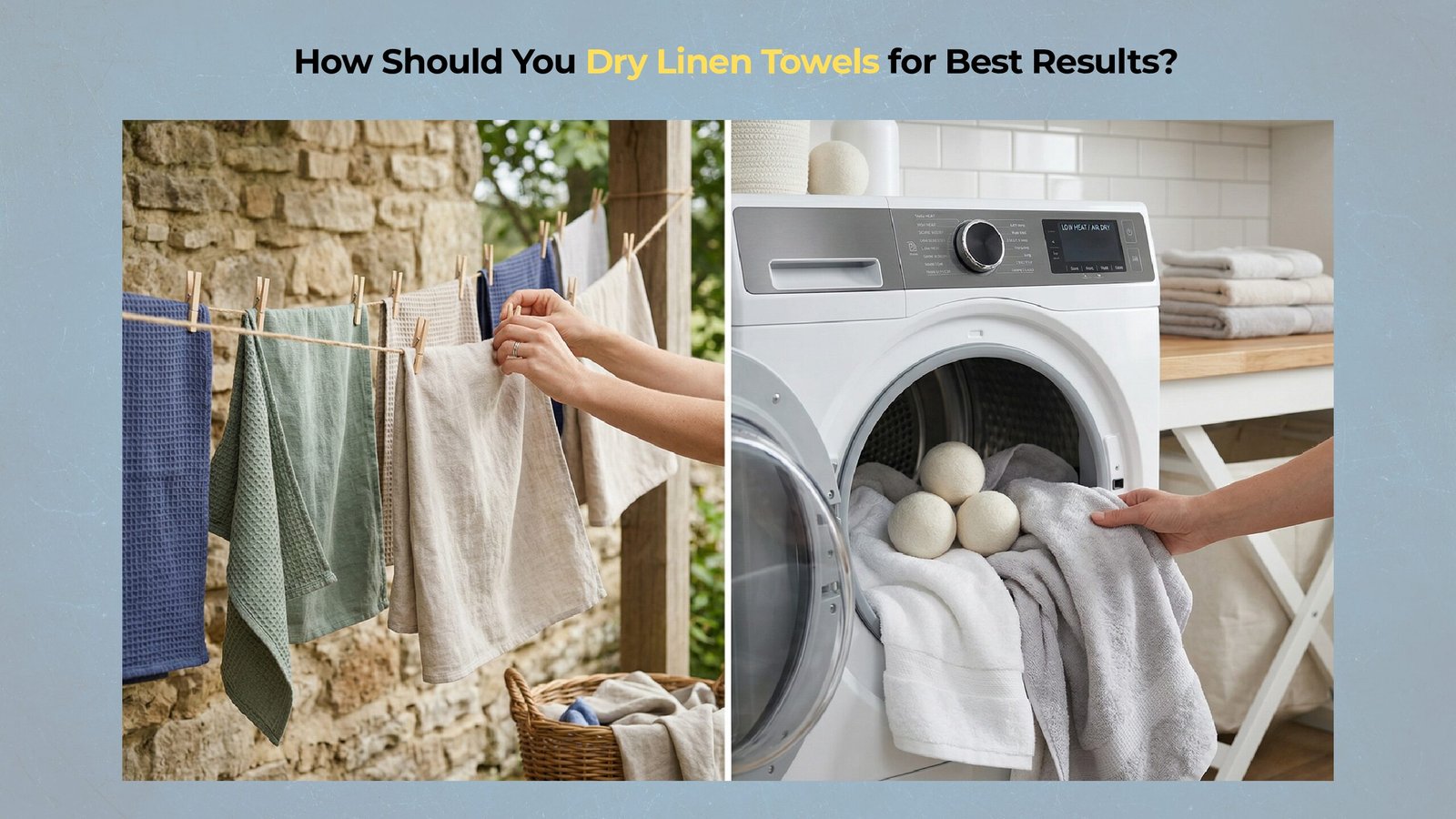
Implementing a hybrid “Damp-Finish” protocol secures the best linen towel drying results by utilizing air-drying for energy efficiency and a brief tumble-finish for mechanical softening.
Why Is the “Manual Snap” Critical for Air-Dried Linen Towel Drying Results?
Performing a vigorous “Manual Snap” improves linen towel drying results for users without mechanical dryers by physically separating the wet bast fibers before they align into a rigid matrix.
Instruction: Mandate 3–5 sharp snaps before hanging and 3 more upon removal from the line to restore the textile’s drape.
How to Match Your Environment to Optimal Linen Towel Drying Results?
Selecting the appropriate desiccation path for your local climate—a decision-making process supported by our towel finder tool—optimizes linen towel drying results by preventing the twin risks of over-drying and microbial stagnation.
| Environment | Recommended Method | Primary Risk Factor |
|---|---|---|
| Arid / Low Humidity | Line-Dry (Indoor) + Tumble Finish | High risk of fiber brittleness |
| Humid / Coastal | Full Tumble Dry (Low Heat) | High risk of mildew/stagnant odor |
| Moderate / Airy | Outdoor Line-Dry (Shade) | High performance; risk of UV fading |
Identifying Weave-Specific Needs for Linen Towel Drying Results
The structural geometry of the weave materially alters linen towel drying results, where waffle-textures require mechanical lofting that flat-weave linens do not necessitate.
Waffle-weave linens utilize a “honeycomb” architecture that collapses if not tumbled; the mechanical impact of dryer balls facilitates the re-inflation of these pockets for peak absorbency.
How Can You Fix “Crunchy” Textures to Restore Linen Towel Drying Results?
Restoring compromised linen towel drying results in aged or stiff inventory involves executing a chemical reset to dissolve the mineral “sealing” that blocks bast fiber movement and contributes to common linen water absorption issues.
Does Vinegar Striora Restore Stiff Linen Towel Drying Results?
Resolving mineral “locking” improves linen towel drying results because an acetic acid (vinegar) flush dissolves the calcium and magnesium deposits that mechanically stiffen flax loops.
Instruction: Add 1/2 cup of white distilled vinegar to the final rinse cycle to exfoliate the synthetic-free weave.
Do Wool Dryer Balls Revitalize Matted Linen Towel Drying Results?
Utilizing wool dryer balls revitalizes matted linen towel drying results by providing concentrated mechanical impact that lifts the pile and breaks up rigid fiber alignment.
Instruction: Run a 10-minute “Air Fluff” cycle with 3–4 wool dryer balls to restore tactile luxury to older linens.
Frequently Asked Technical Questions
This texture is the macroscopic result of hydrogen bonding. When flax fibers dry in a static position, water molecules pull the cellulose chains into a rigid, aligned matrix. Without mechanical agitation to disrupt these bonds during evaporation, the textile remains stiff.
No. Chemical softeners utilize fatty acids or silicone to coat fibers, which materially restricts the capillary action of the flax lumen. For linen, softness should be achieved mechanically (agitation) or chemically via mineral stripping (vinegar), rather than through hydrophobic coatings.
True hornification is largely irreversible at the molecular level. Once core moisture is removed and cellulose chains collapse into a non-swelling state, the fiber’s absorbency and elasticity are permanently diminished. Prevention via the “Damp-Finish” protocol is the only viable technical strategy.
The frequency depends on local water hardness. In high-mineral environments, a restoration cycle every 4-6 weeks prevents the cumulative mineral “locking” that compromises tactile performance.
⚠ Technical Disclaimer
The linen towel drying results detailed in this guide are based on standardized textile engineering protocols. However, real-world performance is conditional and may vary significantly based on local water hardness (PPM), ambient relative humidity, and the mechanical efficiency of specific residential or industrial appliances. While these methods optimize bast fiber supple-ness, users should adjust protocols based on the physical feedback of their specific textile inventory.
How to Verify Your Strategy with a Linen Drying Results Checklist?
Systematic technical audits, utilizing methodologies similar to our towel care diagnosis engine, verify that current linen towel drying results align with the molecular needs of the flax filaments.
Explore Related Linen Guides & Tools
Final Summary: Do Your Methods Support the Best Linen Towel Drying Results?
Operationalizing a linen towel drying results strategy requires a commitment to mechanical agitation and moisture preservation that honors the unique physics of the flax fiber.
- ✔ Mechanical agitation disrupts hydrogen bonds for softness.
- ✔ Moisture equilibrium (12%) prevents cellulose hornification.
- ✔ Climate-specific methods protect fiber and pigment integrity.
Ultimately, a superior linen experience is defined by the precise linen towel drying results that turn raw flax into a soft, high-performance textile through technical maintenance.