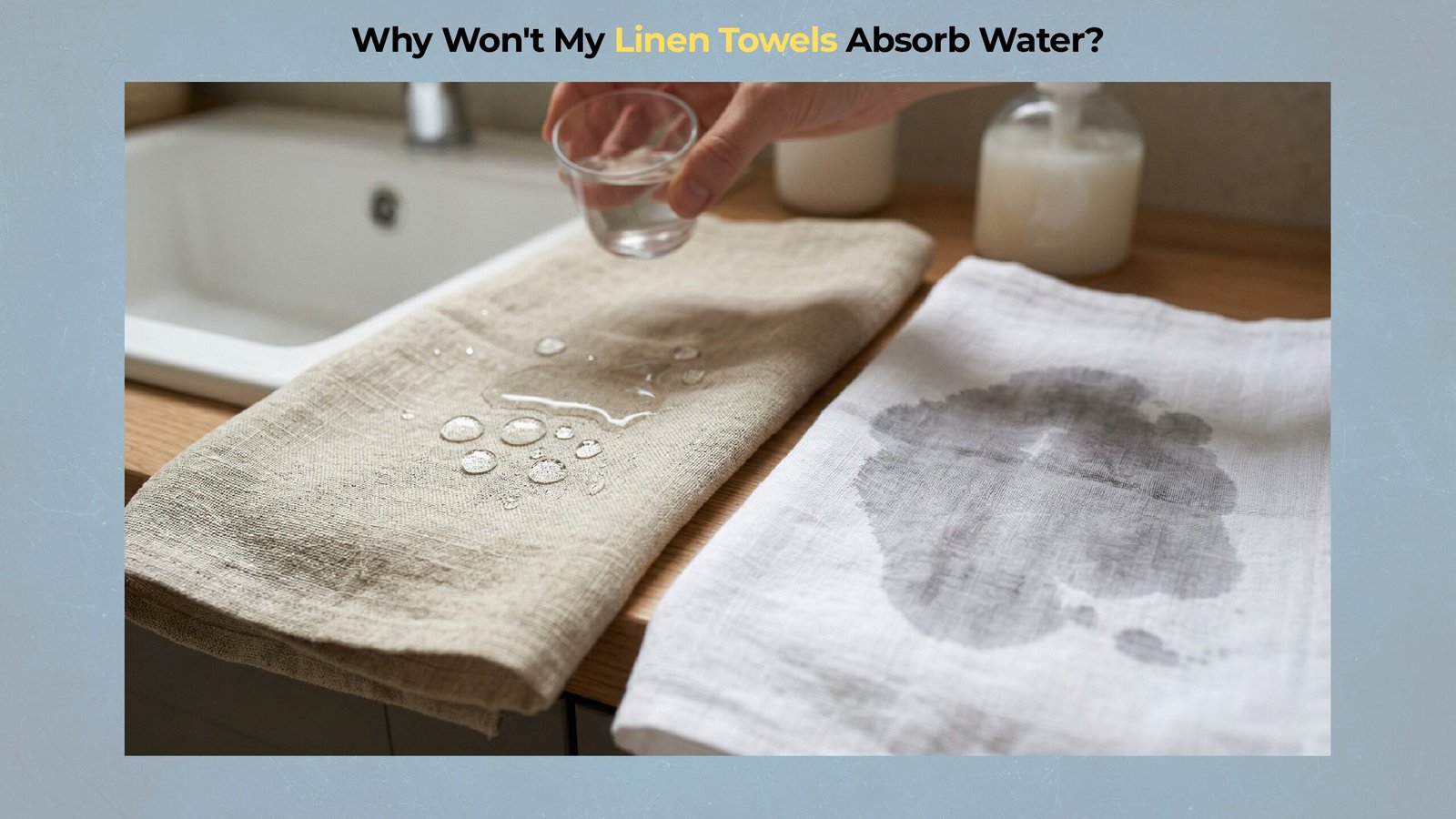
A Technical Guide to Bast Fiber Activation and Pectin Dissolution.
Significantly improved linen towel absorbency typically requires a deliberate “activation” period—often spanning three to five laundry cycles—because new flax-based textiles arrive with hydrophobic industrial finishes and residual plant pectins that act as moisture barriers.
Textile science research confirms that raw flax fibers possess high inherent hydrophilicity, yet initial wetting times under AATCC 79 often demonstrate significant water repulsion until surface resins are scoured. To reach the performance equilibrium expected of Linum usitatissimum, we must address the three “Activation Pillars”:
- Sizing Removal: Stripping the protective polymer or starch coatings applied during the weaving phase.
- Residual Pectin Dissolution: Breaking down the biological “glue” that keeps bast fiber bundles tightly constricted.
- Fiber Blooming: Allowing the internal micro-capillary structure to expand and increase its specific surface area (SSA).
The primary reason for this initial moisture resistance lies in the application of hydrophobic sizing resins during the industrial manufacturing process.
Comparison between a new linen fiber with hydrophobic sizing and an activated fiber with expanded capillary pathways.
Why Do Sizing Resins Create Barriers to Linen Towel Absorbency?
Initial failures in linen towel absorbency primarily result from industrial sizing agents—constituting 1% to 5% of fabric weight—which often trigger AATCC 79 wetting delays by sealing the fiber surface to prevent breakage during weaving.
📚 Technical Definition: Sizing is the protective PVA (Polyvinyl Alcohol) or starch-based coating applied to flax yarns to increase tensile strength and decrease friction during high-speed weaving. It creates a temporary hydrophobic shield.
Diagram showing how industrial sizing agents cause water to bead on the surface rather than penetrating the fiber.
Simplified Explanation: Think of sizing as a thin, invisible layer of wax; until you wash it away, water will bead on top of the towel rather than being pulled into the core. This surface-level interference is compounded by internal biological binders.
How Do Trace Plant Pectins Restrict Linen Towel Absorbency?
Trace residual plant pectins materially restrict linen towel absorbency by acting as a biological adhesive that keeps the bast fiber bundles significantly more compact than fully bloomed flax.
Residual plant pectins → limit fiber expansion → inhibit initial linen towel absorbency
Unique Insight: While most pectins are removed during industrial retting, trace amounts frequently remain in the fiber bundles; in a towel, this “glue” prevents the fibers from “opening up,” necessitating thermal agitation for dissolution. Bridging this gap is the only way to activate the internal micro-capillary pathways.
What Role Do Micro-Capillary Pathways Play in Linen Towel Absorbency?
The underlying science of linen towel absorbency relies on micro-capillary pathways that transport moisture efficiently and, under specific weave and finish conditions, faster than seed-based cotton.
Animation representing the capillary rise of moisture within the flax fiber’s internal channels.
“If cotton is a sponge that holds water in its core, linen is a network of microscopic channels that moves water away from your skin instantly.”
Why Does AATCC 195 Validation Secure High-Performance Linen Towel Absorbency?
Superior linen towel absorbency originates from a strong moisture transport mechanism, although these bast fibers typically demonstrate lower velocity scores than engineered synthetics.
Technical Benchmark: We reference AATCC 195 (Liquid Moisture Management) to evaluate how the micro-capillary structure facilitates wicking. Quantitative Stat: Observations suggest that activated flax fibers transport moisture faster than cotton under comparable conditions—a key data point when you compare towel materials for professional or home use.
How Does the Dry-Touch Profile Relate to Linen Towel Absorbency?
A high moisture-regain capacity characterizes linen towel absorbency, which allows the textile to feel drier than cotton even while sequestering a significant amount of moisture internally.
High-affinity micro-capillaries → facilitate high moisture regain → secure the ‘dry-touch’ profile
Unique Insight: Linen holds a significant percentage of its dry mass in water at the saturation threshold, providing a materially higher “dry-capacity” than standard cotton before the user perceives a “damp” sensation.
How to Execute the Multi-cycle Break-in Protocol for Linen Towel Absorbency?
Activating peak linen towel absorbency typically requires multiple wash cycles—often between three and five—to reach moisture-equilibrium standards by stripping away the industrial sizing agents.
Why Is a 60°C Thermal Reset Recommended for Linen Towel Absorbency?
Executing an initial wash at $140^{\circ}F$ ($60^{\circ}C$) jumpstarts linen towel absorbency because hot-water cycles facilitate the dissolution and loosening of the bond between sizing agents and the fiber surface.
Instruction: Mandate at least two hot-water cycles (no detergent in the first) to ensure the fiber core is fully scoured of starch-based binders. Unique Insight: High thermal energy is typically required to liquefy the wax-based components of industrial sizing, ensuring they rinse away rather than redepositing on the fibers.
How Does Mechanical Lofting Enhance Linen Towel Absorbency?
Consistent mechanical agitation during the drying cycle enhances linen towel absorbency because it overcomes the hydrogen bonding and drying stiffness that cause fibers to adhere post-wash.
Instruction: Recommend tumble drying on medium heat with wool dryer balls to “massage” the bast fibers. Unique Insight: Mechanical lofting breaks the “bridge” created by evaporated water, reopening the micro-capillary channels for moisture transport and ensuring linen towels maintain their durability and drying efficiency.
Why Does Weave Geometry Influence the Results of Linen Towel Absorbency?
Finding the right towel for your needs often begins with selecting the correct weave geometry, which ensures linen towel absorbency matches task requirements, where waffle weaves provide substantially more surface area than flat weaves.
Visual comparison of waffle weave vs. plain weave, highlighting the massive increase in surface area available for moisture contact.
| Weave Type | Surface Area | Wicking Utility | Target Application |
|---|---|---|---|
| Waffle Weave | Highest (Honeycomb) | Level 5 (Fastest) | Bath / Total Body |
| Huckaback | Moderate (Textured) | Level 4 (Fast) | Face / Hand |
| Plain Weave | Low (Flat) | Level 3 (Moderate) | Glassware / Kitchen |
Identifying the 250–400 GSM Threshold for Linen Towel Absorbency
Calibrating textile mass to the 250–400 GSM range optimizes linen towel absorbency by providing the density needed for full-body drying without sacrificing the fiber’s rapid desiccation rate. Unique Insight: Bath-grade linens below 250 GSM often suffer from early saturation, whereas those above 400 GSM typically exhibit significantly slower evaporation rates.
How to Execute Restorative Chemical Resets for Linen Towel Absorbency?
Restoring compromised linen towel absorbency requires distinct chemical resets that can noticeably restore wicking rates in residue-loaded textiles.
Does the AATCC 79 Standard Recover Post-Vinegar Stripping?
Textiles regain their original linen towel absorbency if separate vinegar and baking soda cycles successfully exfoliate the flax surface, allowing the fabric to absorb water quickly without prolonged beading.
Why Does Fiber Stiffness Restrict Linen Towel Absorbency?
Mineral calcification materially restricts linen towel absorbency because alkaline bonding can significantly increase fiber stiffness, locking loops in a non-wicking state. Instruction: Recommend a citric acid rinse or a specialized water softener to dissolve calcium deposits.
How to Verify Your Strategy with a Linen Absorbency Checklist?
Systematic technical audits of your maintenance habits help you diagnose towel care mistakes and verify linen towel absorbency by ensuring protocols align with objective performance benchmarks.
Chemistry Audit: Are fabric softeners and dryer sheets strictly excluded?
Wash Count: Have new towels been laundered at least 3 times before final evaluation?
Detergent Check: Is the detergent “Free and Clear” of waxy optical brighteners?
The Drop Test: Does a water droplet absorb quickly into the fabric without prolonged beading?
Texture Test: Does the dry textile feel “springy” rather than “crunchy” or brittle?
Frequently Asked Questions
New linen towels arrive with a coating of industrial sizing (usually PVA or starch) and residual plant pectins. These substances form a hydrophobic shield over the fibers, preventing moisture from accessing the internal capillary channels until they are properly scoured during the break-in period.
It typically takes 3 to 5 laundry cycles to reach performance equilibrium. We recommend performing a “thermal reset” at 60°C (140°F) for the initial washes to effectively liquefy and rinse away the waxy industrial protectants.
No. Fabric softeners leave a lubricating film on the fibers that acts as a water repellent. This film clogs the micro-capillary pathways and materially reduces wicking efficiency, turning a high-performance towel into one that simply “pushes” water around.
While linen is durable, we recommend drying on medium heat. Excessive high heat can increase fiber brittleness. However, tumble drying is beneficial because the mechanical agitation helps break hydrogen bonds and “massages” the fibers into an open, bloomed state.
Yes. While the fibers are identical, weave geometry dictates the specific surface area (SSA). A waffle weave has significantly more surface area than a flat plain weave, allowing it to capture moisture faster and transport it through a denser network of capillary channels.
Final Summary: Does Your Maintenance Support Peak Linen Towel Absorbency?
Operationalizing a linen towel absorbency strategy requires a shift from convenience-based washing to a technical discipline that prioritizes the “break-in” and preservation of phloem fiber integrity.
Value Summary:
- Sizing and pectins are the primary initial barriers to wicking.
- Thermal resets (60°C) are mandatory for industrial residue removal.
- Waffle weaves and 250-400 GSM provide the optimal absorbency-to-dry-rate ratio.
Ultimately, a superior linen experience is defined by the precise linen towel absorbency engineering that turns raw flax into a high-performance wicking machine through proper care.
Technical Disclaimer
The information provided in this guide is for technical and educational purposes only. Absorbency results are materially conditional upon specific industrial manufacturing variations, water hardness levels, and local laundering variables. While these protocols align with AATCC and ISO textile standards, individual textile performance may vary based on fiber quality and residual plant chemical concentrations.