How Should Microfiber Towels Be Washed and Dried?
Positioning: Textile Engineering, Maintenance SOPs, and Materials Science
Adhering to a standardized microfiber towel wash and dry cycle preserves the split-fiber geometry and high-capillary wicking required for professional-grade soil removal and tactile softness. Textile science research published in industrial materials journals confirms that improper laundering typically reduces synthetic wicking efficiency significantly (often up to ~40% under poor conditions) within the first five cycles.
The Logistical Pillars of Polymer Preservation
- Thermal Regulation: Management of heat energy to prevent reaching the Glass Transition Temperature (Tg).
- Chemical Purity: Compatibility with non-ionic surfactants while excluding Cationic Softeners.
- Material Segregation: Strict isolation from cellulose-based textiles (cotton) to prevent lint entrapment.
Why Do Synthetic Laundry Rules Determine the Life of Your Microfiber Towels?
Specialized laundry rules dictate the success of the microfiber towel wash and dry cycle because thermoplastic filaments possess unique heat sensitivities and oleophilic (oil-attracting) traits that do not exist in natural fibers. Unlike cotton, which relies on simple water absorption, synthetic blends of Polyethylene Terephthalate (PET) and Polyamide (Nylon) utilize mechanical split-wedges to scour surfaces. To contrast the physics of synthetic vs. organic care, professionals often explore all towel materials to define specific maintenance boundaries.
Oleophilic Attraction: This is the chemical affinity synthetic polymers have for organic oils and skin lipids. Because microfiber is naturally oil-attracting, standard laundering often fails to fully release sebum without specific surfactant interaction. Those who compare towel materials will observe that microfiber requires a total departure from traditional hot-water cotton protocols to maintain this attracting force.
💡 Simplified Explanation: “Think of cotton as a thirsty sponge that loves water, while microfiber is more like a magnet that loves oil—meaning it needs a different strategy to release trapped grime.”
What Is the Heat Softening Limit in the Microfiber Wash and Dry Process?
Failure to follow thermal boundaries in the microfiber towel wash and dry cycle typically initiates fiber softening and structural damage as temperatures approach or exceed 140°F (60°C). While the melting point of PET is much higher, structural softening and loop deformation frequently occur at moderate laundry temperatures, permanently sealing wicking channels. This damage directly reduces how much water microfiber towels can hold, preventing the interstitial storage of liquid molecules.
How Does the “Oil Buildup Trap” Affect Microfiber Towel Performance?
Microfiber towels act as an “Oil Buildup Trap” because the non-polar molecular structure of polyester can retain significantly more oils than cotton if not properly scoured. This oil-trapping capability explains why many researchers ask do microfiber towels retain odors more aggressively than natural fibers. Without proper surfactant scoured at controlled temperatures, these oils calcify, leading to permanent polymer glazing.
How to Select the Correct Detergent and Settings for Your Microfiber Towels?
Selecting the correct detergent and machine parameters ensures the microfiber towel wash and dry cycle results in deep cleaning without inducing the molecular degradation of the filaments. This requires moving beyond standard domestic practices toward a protocol anchored in ISO 6330 standards. Professional detailers and facility managers often find the right towel for your needs using a tool to ensure that specific dirt loads match the polymer density.
Microfiber Towel Wash and Dry Cycle Parameter Matrix
| Parameter | Ideal Technical Setting | Performance Result |
|---|---|---|
| Water Temp | Cold to Warm (< 105°F) | Protects filaments; releases lipids |
| Detergent | Liquid (Free & Clear) | Prevents pore-clogging residue |
| Agitation | Medium / Normal | Provides mechanical release of trapped dirt |
| Dryer Temp | Low / Air-Fluff | Prevents fiber softening; restores loft |
What Is the “Clear and Free” Standard for Microfiber Detergents?
Adhering to the “Clear and Free” standard supports the microfiber towel wash and dry cycle by ensuring that no perfumes, dyes, or optical brighteners remain trapped in the fiber interstices. Perfumes and dyes are essentially “filler” chemicals; in the tight weave of microfiber, these fillers act as physical blockages that reduce the surface area available for future wicking. The total exclusion of liquid softeners and dryer sheets is mandatory, as these cationic surfactants seal wicking channels with a waxy coating.
Why Is Material Sorting Critical for a Successful Microfiber Laundry Load?
Material segregation represents the primary defense against mechanical cross-contamination in the microfiber towel wash and dry cycle, preventing the permanent “linting” of synthetic surfaces.
💡 Simplified Explanation: “Washing microfiber with cotton is like washing a sheet of Velcro with a fuzzy wool sweater—the microfiber will grab every loose piece of lint and never let it go.”
How Does the “Lint Magnet” Effect Ruin Microfiber Towels?
Microfiber towels act as a “Lint Magnet” because the negative static charge of the filaments pulls loose fibers from cotton towels, which can noticeably reduce the textile’s cleaning capacity.
Unique Insight: Pre-loading the weave with lint fills the split-fiber wedges before the towel ever touches the intended cleaning surface, essentially “spending” the wicking capacity on laundry debris rather than soil removal.
What Is the 5-Step Workflow for a Perfect Microfiber Laundry Event?
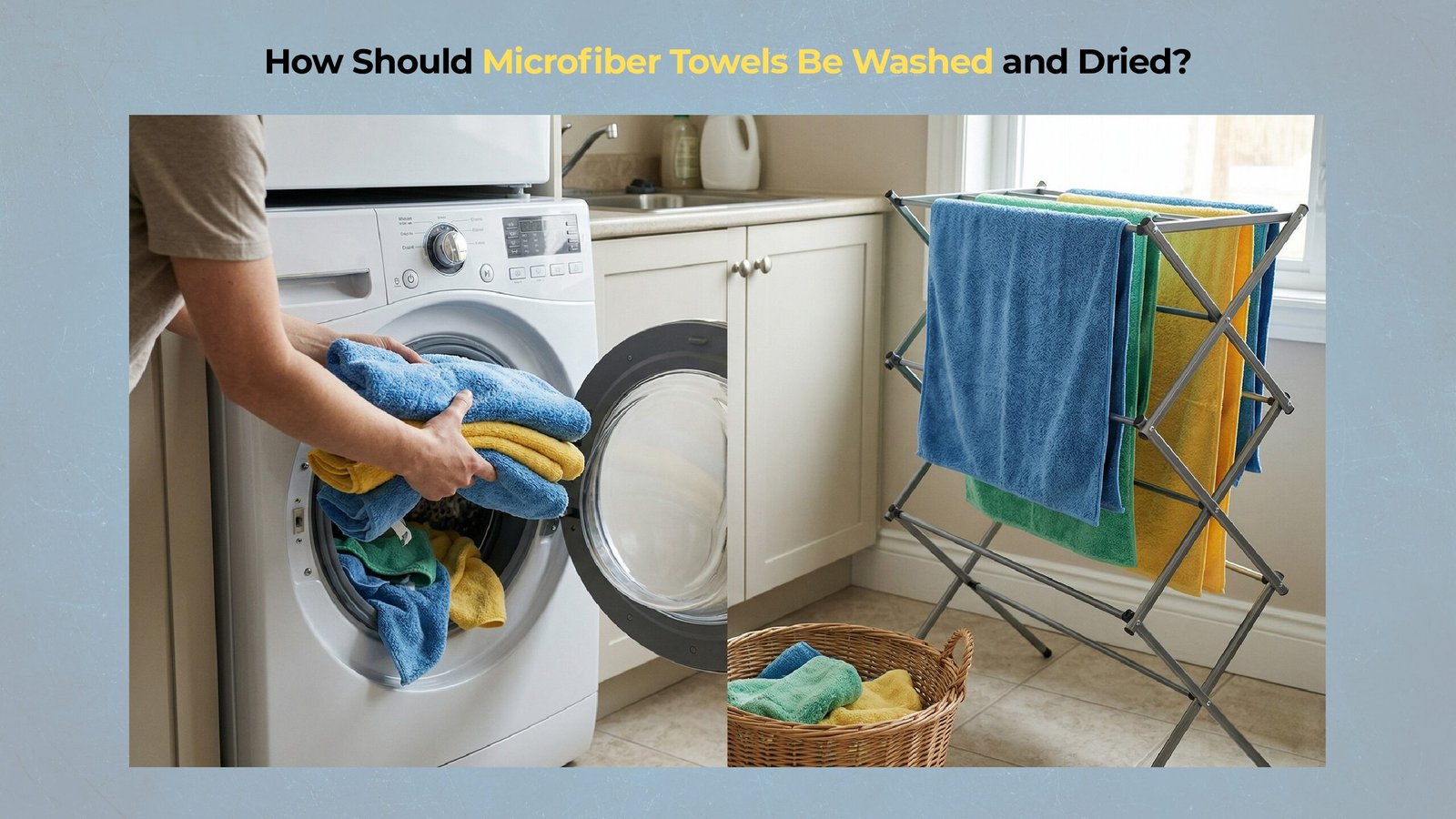
Executing a standardized 5-step workflow ensures the microfiber towel wash and dry cycle results in a repeatable restoration of the textile’s wicking speed and velvety hand-feel.
How to Execute the Cold-to-Warm Wash Phase for Microfiber?
The wash phase of the microfiber towel wash and dry cycle typically utilizes temperatures between 60°F and 105°F and liquid surfactants to ensure deep penetration of the dense weave gaps. Powder detergents utilize granular fillers that often remain undissolved in low temperatures, physically wedging into the split fibers and reducing tactile softness. For heavily soiled items, the inclusion of Lipase Enzymes can aid in the emulsification of lipids.
How to Implement the Low-to-No Heat Drying Phase for Microfiber?
Successful microfiber towel wash and dry cycle outcomes culminate in a short, low-heat drying phase that can dry significantly faster than cotton depending on thickness and airflow. Fiber engineering data suggest that the hydrophobic core of polyester typically facilitates total moisture release with significantly less thermal energy than saturated cotton. Scientific Nuance: Drying times are highly dependent on GSM (Grams per Square Meter) and ambient ventilation; over-drying is the primary cause of fiber glazing.
How Can You Restore Wicking and Softness to Older Microfiber Towels?
Restoring compromised performance in the microfiber towel wash and dry cycle involves executing separate chemical resets to dissolve accumulated waxy layers and mineral salts. Understanding whether microfiber towels absorb water well enough for full body drying after heavy use depends entirely on the status of these capillary wedges and the removal of waxy occlusions.
How Do Separate Vinegar and Baking Soda Cycles Strip Buildup?
Textiles that repel water typically recover their wicking velocity if a vinegar cycle followed by a separate baking soda cycle successfully exfoliates the synthetic surface. Factual Directive: Acetic Acid (vinegar) and Sodium Bicarbonate (baking soda) must NEVER be mixed in the same cycle as they neutralize each other, rendering the chemical stripping inert.
The Restoration Reset Protocol:
- Cycle 1: Wash with 1 cup of white vinegar (No Detergent). This dissolves mineral calcification.
- Cycle 2: Wash with 1/2 cup of baking soda. This emulsifies organic waxy residues.
FAQ: Critical Maintenance Queries for Microfiber Preservation
Can I wash microfiber with cotton towels if I use a “Free and Clear” detergent?
No. Even with correct chemistry, material segregation is vital. The negative static charge of synthetic filaments will mechanically capture cotton cellulose lint, permanently plugging the split-fiber wedges and degrading wicking efficiency.
Why did my towels start repelling water after only a few washes?
This is typically caused by surfactant buildup or glazing. If you used fabric softeners or detergents with dyes/perfumes, waxy residues have sealed the capillary channels. To accurately determine the damage, one can diagnose towel care mistakes using our diagnostic engine to see if the blockage is chemical or thermal.
Is it safe to use bleach for disinfecting microfiber in athletic environments?
Standard Sodium Hypochlorite (bleach) is generally discouraged as it can weaken the polymer bonds of the polyamide wedges over time. When considering if antibacterial microfiber towels are effective, research shows that mechanical soil removal in a controlled wash is often superior to harsh chemical additives for synthetic polymers.
How often should the “Restoration Reset” be performed?
A chemical reset should be performed when the AATCC 79 absorbency test fails (water beads on the surface). In heavy-use environments like professional detailing or athletic facilities, this typically occurs every 6 to 12 months depending on local mineral content and soil load.
Technical Disclaimer
Maintenance outcomes and wicking recovery levels provided in this guide are subject to variable machine parameters, local water mineral concentrations (hardness), and the current state of polymer glazing or chemical calcification within the textile. While these protocols are engineered for preservation, results may vary significantly across different industrial and residential environments. Always consult the ISO 3758 care symbols on manufacturer-specific labels for unique synthetic blends. TowelDaily assumes no liability for textile damage resulting from improper execution of chemical restoration cycles.
How to Verify Your Strategy with a Microfiber Cycle Checklist?
Systematic technical audits of your laundering steps verify that the current microfiber towel wash and dry cycle aligns with the molecular needs of the synthetic filaments.
Checklist: Microfiber Towel Wash and Dry Cycle Audit
Sorting Check: Is the microfiber washed exclusively with other microfiber (zero cotton contact)?
Chemistry Audit: Is the detergent verified as “Free and Clear” of all softeners, dyes, and perfumes?
Thermal Audit: Is the wash water temperature verified at or below 105°F?
Dryer Check: Is the machine setting confirmed as “Low Heat,” “Extra Low,” or “Air Dry”?
Absorbency Test: Does a water droplet (AATCC 79) absorb quickly without beading on the dry textile surface?